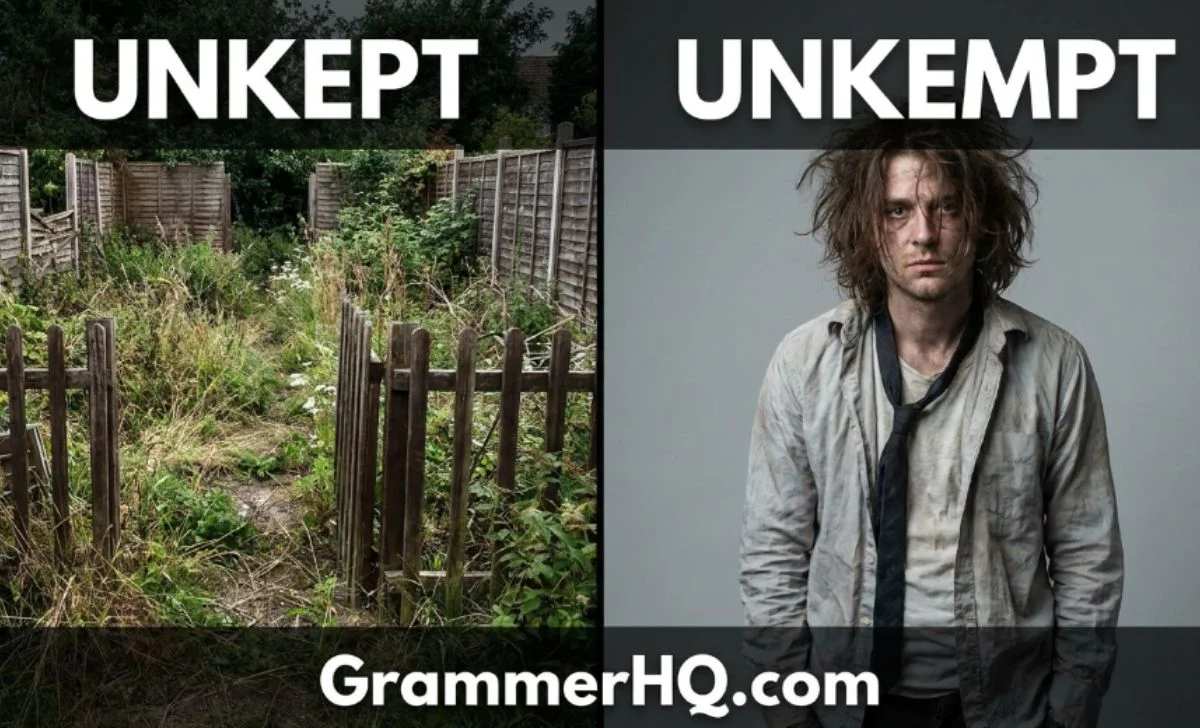
Have you ever wondered whether unkept or unkempt is the correct word? You’re not alone. Many English learners and even native speakers mistakenly write unkept when they actually mean unkempt.
The confusion happens because both words seem logical at first glance and share the root word keep. However, only one is the standard adjective used to describe someone or something that looks messy, untidy, or poorly maintained.
In this guide, you’ll learn the difference between unkept and unkempt, their meanings, pronunciation, usage, grammar rules, real-life examples, and simple tricks to remember the correct spelling with confidence.
Quick Answer
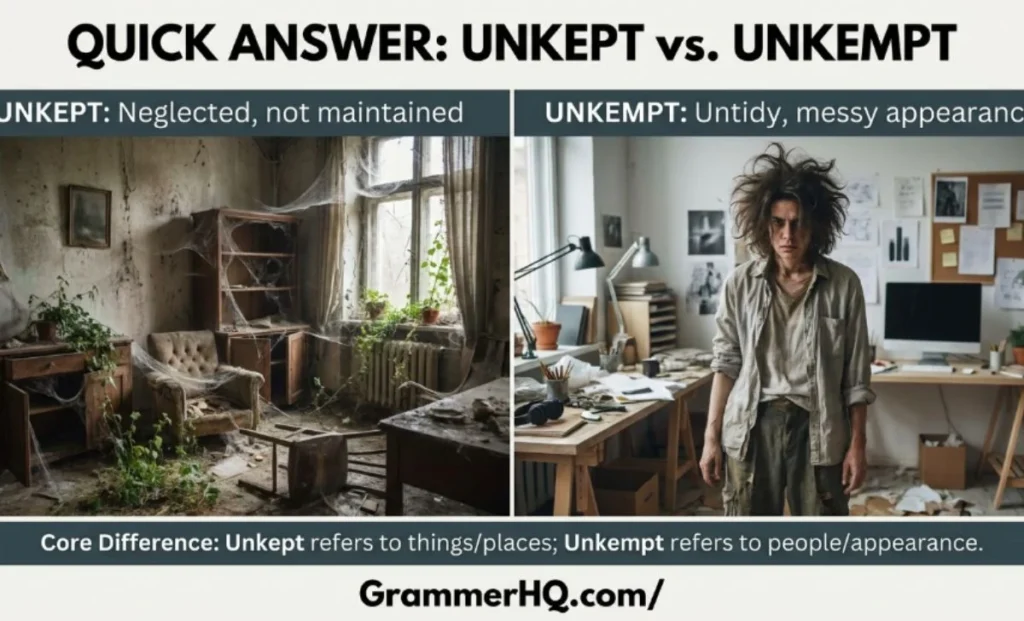
Unkempt is the correct and standard English word when describing someone or something that is messy, untidy, or not well cared for.
Unkept is generally not accepted as standard English in modern dictionaries and is usually considered a misspelling or an incorrect substitute for unkempt.
Example:
✅ The old house looked unkempt after years of neglect.
❌ The old house looked unkept after years of neglect.
Meaning of Each Word
Unkempt
Pronunciation (IPA): /ˌʌnˈkempt/
Part of Speech: Adjective
Meaning:
Unkempt describes a person, place, or thing that looks untidy, messy, dirty, or not properly maintained.
It can describe:
- Hair
- Clothing
- Gardens
- Rooms
- Buildings
- Personal appearance
Examples:
- His unkempt hair made him look as if he had just woken up.
- The abandoned garden had become unkempt over the years.
- She wore an unkempt jacket covered in dust.
Unkept
Pronunciation (IPA): /ʌnˈkept/ (rarely used)
Part of Speech: Sometimes interpreted as an adjective, but not recognized as standard English for describing appearance.
Meaning:
Many people assume unkept means “not kept” or “not maintained.”
Although that interpretation seems logical, modern English almost always uses unkempt instead when describing untidiness.
In rare situations, writers may use unkept literally to mean not kept (for example, “an unkept promise” is still uncommon, and “a promise not kept” or broken promise is preferred).
Examples of Better Alternatives:
Instead of:
❌ an unkept promise
Use:
- a broken promise
- a promise that wasn’t kept
- an unfulfilled promise
What’s the Difference Between Unkept and Unkempt?
| Feature | Unkempt | Unkept |
|---|---|---|
| Standard English | ✅ Yes | ❌ Usually No |
| Dictionary Recognition | ✅ Yes | Limited or nonstandard |
| Meaning | Messy, untidy, poorly maintained | Usually intended to mean “not kept” |
| Common Usage | Very common | Rare |
| Used for Appearance | ✅ Yes | ❌ No |
| Recommended in Formal Writing | ✅ Always | ❌ Avoid |
| American English | ✅ Standard | ❌ Nonstandard |
| British English | ✅ Standard | ❌ Nonstandard |
Key Difference
The biggest difference is simple:
- Unkempt is the correct adjective for describing something untidy.
- Unkept is generally considered an incorrect substitute and should be avoided in standard writing.
Which One Is Correct?
If you’re writing in school, at work, for an exam, or online, the correct choice is unkempt.
Use unkempt when describing:
- messy hair
- untidy clothing
- neglected buildings
- overgrown gardens
- cluttered rooms
- poor personal appearance
Examples:
- The child’s unkempt hair needed brushing.
- They moved into an unkempt apartment.
- His beard had become noticeably unkempt.
Avoid Using “Unkept”
Although some people believe unkept should be the opposite of kept, modern English doesn’t use it this way.
Instead, choose:
- unkempt (for appearance)
- not kept
- broken
- unfulfilled
- neglected (depending on context)
Why Do People Confuse These Words?
The confusion between unkept and unkempt has several causes.
They Look Similar
Both words begin with un- and seem related to the verb keep, making it easy to assume they are interchangeable.
Logical Guessing
Many learners naturally think:
keep → kept
So they create:
un + kept = unkept
While this seems reasonable, English doesn’t follow that pattern here. The established word is unkempt.
Rare Exposure
Many people hear unkempt in conversation but rarely see it written. When they try to spell it, they often replace -kempt with the more familiar -kept.
Spell Check Doesn’t Always Help
Some writing tools may not immediately explain the difference, leading writers to believe unkept is acceptable.
Influence of Everyday Speech
Because kept is a very common word, the brain tends to substitute it automatically when spelling unkempt, even though the meanings are different.
Origin and History
Understanding the history of unkempt explains why unkept feels logical but isn’t the standard word.
The Origin of Unkempt
The word unkempt dates back to Middle English. It comes from the old adjective kempt, which meant well-combed, neatly arranged, or well-groomed. The word kempt itself is the past participle of the old verb kemb, meaning to comb.
Adding the prefix un- created unkempt, meaning not combed or not well-groomed.
Over time, the meaning expanded beyond hair to describe anything that looks untidy, neglected, or poorly maintained.
Why “Kempt” Sounds Unusual
Today, most people rarely use the word kempt by itself. You’ll occasionally hear phrases like:
- She looked neat and kempt.
- He appeared well-kempt before the interview.
However, unkempt is far more common than kempt in modern English.
Where Did “Unkept” Come From?
Unlike unkempt, unkept did not become an accepted standard adjective for messy appearance.
People often create it because they recognize the verb:
- keep
- kept
Then assume:
- un + kept = unkept
Although this seems grammatically reasonable, dictionaries and style guides overwhelmingly recommend unkempt when describing untidiness.
American vs British English
One common question is whether unkempt is American English while unkept is British English—or vice versa.
The answer is no.
Both American English and British English use unkempt as the standard spelling.
| Feature | American English | British English |
|---|---|---|
| Unkempt | ✅ Standard | ✅ Standard |
| Unkept | ❌ Nonstandard | ❌ Nonstandard |
American English
Examples:
- His unkempt beard needed trimming.
- The yard looked unkempt after the storm.
British English
Examples:
- The garden had become unkempt.
- His unkempt appearance worried his family.
There is no regional spelling difference.
Unlike words such as:
- Color / Colour
- Organize / Organise
- Traveling / Travelling
Unkempt remains the preferred spelling in both varieties of English.
Pronunciation Guide
Unkempt
IPA (American English):
/ˌʌnˈkempt/
Syllables
un • kempt
Stress
The primary stress falls on the second syllable:
un KEMPT
Pronunciation Tip
Think of saying:
un + kempt
Avoid pronouncing it like:
❌ un-kept
Unkept
Although it can technically be pronounced:
/ʌnˈkept/
it is generally avoided because it is not the standard word for describing an untidy appearance.
Grammar Rule
The easiest grammar rule is:
Use “unkempt” as an adjective to describe someone or something that is untidy or poorly maintained.
Examples:
- unkempt hair
- unkempt beard
- unkempt lawn
- unkempt room
- unkempt appearance
Do not replace it with unkept.
Correct
- Her hair looked unkempt.
- The building appeared unkempt.
Incorrect
- Her hair looked unkept.
- The building appeared unkept.
Original Example Sentences
Everyday Conversation
- His unkempt hair made him look tired.
- The abandoned house looked unkempt.
- She apologized for her unkempt appearance.
- Their backyard became unkempt during winter.
- The dog had an unkempt coat.
Formal Writing
- The inspector noted the property’s unkempt condition.
- Visitors noticed the unkempt grounds immediately.
- The report described the park as unkempt.
- The neglected cemetery appeared unkempt.
- The office discouraged an unkempt appearance.
Business
- Employees should avoid arriving with unkempt clothing.
- A neat appearance creates a better impression than an unkempt one.
- The hotel manager addressed complaints about the unkempt gardens.
Academic
- The novel describes the character as unkempt to symbolize hardship.
- Students analyzed how the author’s description of an unkempt village created mood.
- Researchers noted the unkempt condition of the abandoned site.
Daily Life
- The child’s hair became unkempt after playing outside.
- Heavy rain left the garden looking unkempt.
- His beard grew increasingly unkempt during the trip.
- The cabin remained unkempt until the owners returned.
Common Mistakes
Mistake 1
❌ His hair looked unkept.
✅ His hair looked unkempt.
Why?
Unkempt is the accepted adjective for a messy appearance.
Mistake 2
❌ The lawn was unkept.
✅ The lawn was unkempt.
Why?
English uses unkempt to describe neglected or untidy places.
Mistake 3
❌ She arrived with an unkept hairstyle.
✅ She arrived with an unkempt hairstyle.
Why?
Hair is one of the most common nouns modified by unkempt.
Mistake 4
❌ His unkept beard looked messy.
✅ His unkempt beard looked messy.
Why?
Use unkempt when describing grooming or appearance.
Easy Memory Trick
A simple way to remember the correct word is:
Think of Hair
Whenever you picture someone with messy hair, think:
Unkempt Hair
This is one of the most common collocations in English.
Remember This Phrase
Messy = Unkempt
Not:
Messy = Unkept
Another Trick
The word kempt originally meant well-combed.
So:
- Kempt = neatly combed
- Unkempt = not neatly combed
This historical meaning makes unkempt much easier to remember.
Synonyms and Related Words
While unkempt has a specific meaning—untidy or poorly groomed—it has several synonyms depending on the context.
| Word | Meaning | Best Used For |
|---|---|---|
| Untidy | Not neat or organized | Hair, rooms, clothing |
| Messy | Disorderly or cluttered | Everyday situations |
| Disheveled | Hair or clothes in disorder | Personal appearance |
| Scruffy | Shabby or untidy | Casual appearance |
| Sloppy | Careless or untidy | Clothing or work |
| Neglected | Not properly cared for | Gardens, buildings, property |
| Disordered | Not arranged properly | Rooms or spaces |
| Ragged | Torn or worn-out appearance | Clothing |
| Well-groomed | Neat and clean | Opposite of unkempt |
| Kempt | Neatly combed or maintained | Rare opposite of unkempt |
Related Grammar Terms
- Misspelling
- Correct spelling
- Adjective
- Word confusion
- English vocabulary
- Common spelling mistakes
- American English
- British English
- Word usage
- Writing tips
FAQ,s
Is unkept a real word?
Unkept exists occasionally as a literal form meaning “not kept,” but it is not the standard word for describing a messy or untidy appearance. In modern English, unkempt is the accepted and recommended choice.
Which is correct: unkept or unkempt?
Unkempt is the correct spelling when describing someone or something that looks untidy, messy, or poorly maintained. Unkept is generally considered a misspelling in this context.
What does unkempt mean?
Unkempt means untidy, messy, poorly groomed, or not properly maintained. It can describe hair, clothing, gardens, rooms, buildings, or a person’s overall appearance.
Can I use unkept in formal writing?
It is best to avoid unkept in formal writing. Most dictionaries and style guides recommend unkempt when referring to an untidy appearance.
Is unkempt used in both American and British English?
Yes. Unkempt is the standard spelling in both American English and British English. There is no regional spelling difference.
Why do people spell it as unkept?
People often assume that because the past tense of keep is kept, the opposite should be unkept. However, the correct adjective comes from the older word kempt, not from kept.
What is the opposite of unkempt?
Common opposites include:
- neat
- tidy
- well-groomed
- orderly
- kempt (rare)
Can unkempt describe places?
Yes. Unkempt is commonly used for places such as gardens, yards, parks, buildings, and rooms that appear neglected or untidy.
Is unkempt only used for hair?
No. Although unkempt hair is one of the most common phrases, the adjective can describe many people, places, and objects that are not well maintained.
How can I remember the correct spelling?
Remember the phrase:
Unkempt hair is a common English expression.
If you’re describing something messy or poorly groomed, choose unkempt, not unkept.
Conclusion
If you’re deciding between unkept and unkempt, the correct choice is almost always unkempt. It is the standard English adjective used to describe someone or something that looks messy, untidy, or poorly maintained.
While unkept may seem logical because it resembles the past tense of keep, it is not the accepted word for appearance in modern English.
Whether you’re writing an email, an academic paper, a business report, or a social media post, unkempt is the spelling you should use with confidence. Remember this simple rule: Messy appearance = unkempt.
Read More Bloogs: