Have you ever typed cringey in a message only for your spell checker to suggest cringy—or the other way around? You’re not alone.
This spelling question has become increasingly common as the word cringe has evolved from a verb into one of the internet’s favorite adjectives. The good news is that both spellings exist, but they aren’t used equally in every context.
In this guide, you’ll learn the difference between cringey vs cringy, which spelling dictionaries recognize, when each form is appropriate, and how to choose the best option for everyday writing, academic work, and social media.
Quick Answer
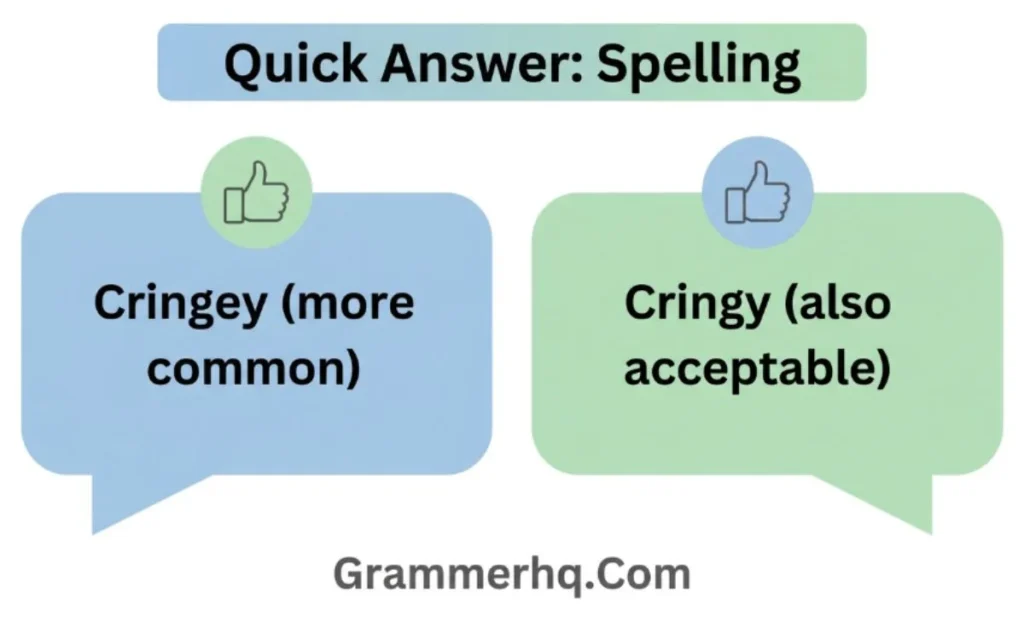
If you’re wondering whether cringey or cringy is correct, here’s the short answer:
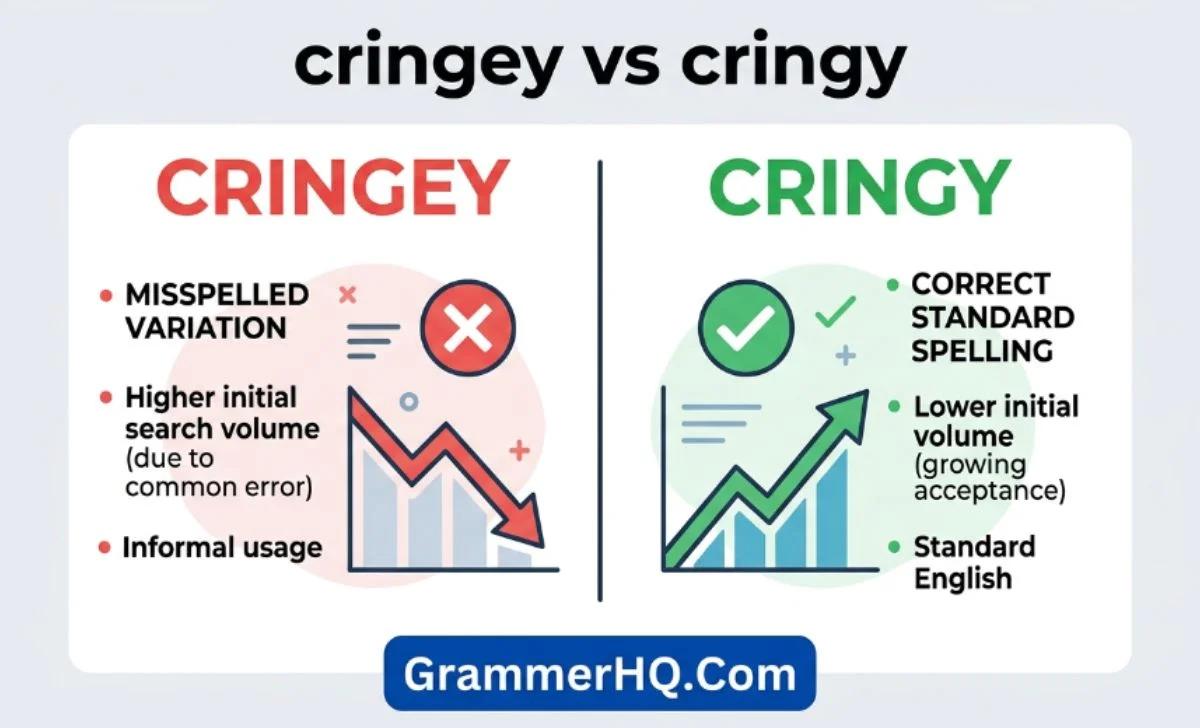
- Both “cringey” and “cringy” are accepted spellings.
- Cringey is the more widely used and preferred form in modern English.
- Cringy is also considered correct and appears in several dictionaries, but it’s less common.
- If you’re writing for a broad audience, professional publication, or website, cringey is usually the safer choice because readers are more familiar with it.
In terms of meaning, there is no difference between the two words. Both describe something that causes embarrassment, awkwardness, or second-hand embarrassment.
What Does “Cringey” Mean?
Definition
Cringey is an informal adjective used to describe something that feels awkward, embarrassing, or so uncomfortable that it makes you mentally “cringe.”
It often refers to:
- Embarrassing behavior
- Awkward conversations
- Poor jokes
- Uncomfortable social situations
- Overdramatic online content
- Videos or posts that make viewers feel second-hand embarrassment
For example:
- That speech was so cringey that nobody knew how to react.
- His attempt to sound cool came across as cringey.
The word has become especially popular in internet culture, where people frequently describe memes, videos, comments, or trends as “cringey.”
Where Did the Word Come From?
The adjective comes from the verb cringe, which means to shrink back in embarrassment, fear, or discomfort.
Over time, English speakers began adding adjective endings to create a word that described the feeling something causes rather than the reaction itself.
Simple evolution:
- Cringe (verb)
- Cringey / Cringy (adjective)
This type of word formation is common in English. Many informal adjectives develop naturally through everyday speech before becoming widely accepted by dictionaries.
Cringey vs Cringy: What’s the Difference?
The Short Answer
There is no difference in meaning between cringey and cringy.
Both describe something awkward, embarrassing, or uncomfortable.
The real difference is spelling preference and usage frequency, not definition.
| Feature | Cringey | Cringy |
|---|---|---|
| Meaning | Awkward or embarrassing | Awkward or embarrassing |
| Correct spelling | ✅ Yes | ✅ Yes |
| Dictionary recognition | ✅ Yes | ✅ Yes |
| More common | ✅ Yes | Less common |
| Best choice for most writing | ✅ Recommended | Acceptable |
In everyday writing, many native English speakers naturally choose cringey because it looks more familiar and matches the spelling pattern of similar informal adjectives.
Why Do People Get Confused?
The confusion happens because English doesn’t always follow a single rule when forming adjectives from nouns or verbs.
Compare these examples:
- Mess → Messy
- Dirt → Dirty
- Fun → Funny
When people tried to turn cringe into an adjective, two spellings emerged:
- Cringey
- Cringy
Both gradually entered common usage, especially online. As social media expanded, millions of users adopted whichever version looked more natural to them.
Today, you’ll find both spellings in blog posts, online discussions, entertainment articles, and casual conversations.
Which Spelling Is Correct?
Dictionary Recognition
Several respected dictionaries recognize both spellings, showing that neither is considered a spelling mistake.
Major language references such as Merriam-Webster, Cambridge Dictionary, Collins Dictionary, and Dictionary.com acknowledge the word as part of modern informal English, although they may list one spelling as the primary headword or note the other as a variant.
This reflects how living languages evolve: when enough people consistently use a word, dictionaries document that usage rather than invent it.
Which Spelling Is More Common?
Although both are correct, cringey appears more frequently in modern online writing, digital publications, and everyday communication.
You’ll often see cringey in:
- Blog articles
- Entertainment news
- Lifestyle websites
- Online reviews
- Social media discussions
- Casual conversations
Cringy still appears regularly, but it’s generally the less common variant.
If your goal is clarity and consistency, especially for SEO content or professional writing, cringey is usually the better option because it’s the spelling most readers expect.
Should You Use Cringey or Cringy?
Ask yourself one simple question:
Who is your audience?
- If you’re writing a blog, article, website, or business content, cringey is the stronger choice.
- If you’re texting friends or posting casually on social media, either spelling works because the meaning stays exactly the same.
- If you’re writing academic or professional documents, remember that both words remain informal, so a more formal alternative—such as embarrassing, awkward, or uncomfortable—may fit better depending on the context.
The most important rule isn’t choosing one spelling over the other—it’s staying consistent throughout your writing.
If you start with cringey, avoid switching to cringy later in the same article. This improves readability and gives your content a polished, professional feel.
American English vs British English
One of the first questions people ask is whether cringey belongs to American English while cringy belongs to British English. The answer is more nuanced.
Unlike spelling pairs such as color/colour or center/centre, there isn’t a strict regional rule for cringey vs cringy.
Both spellings appear in American and British English because the word itself is relatively modern and grew in popularity through the internet rather than traditional publishing.
American English
In the United States, you’ll see cringey more often in:
- Entertainment articles
- Pop culture blogs
- News websites
- Social media
- Product reviews
Because it is the more familiar spelling, many editors and content creators naturally prefer it.
Example:
- That commercial was so cringey that viewers skipped it immediately.
British English
British writers also use cringey frequently, although cringy occasionally appears in newspapers, blogs, and online discussions.
Rather than following a regional rule, writers usually stick with the spelling they personally prefer or the one recommended by their publication’s style guide.
Key Takeaway
There is no American vs British spelling difference here.
Instead, the distinction comes down to usage preference, and cringey has become the more common choice across both varieties of English.
Why Do Both Spellings Exist?
English Is Always Evolving
English constantly creates new words and new spellings. Many words that began as informal expressions eventually became accepted by dictionaries after years of widespread use.
The adjective cringey/cringy is a perfect example.
It developed from the verb cringe, which means to react with embarrassment, discomfort, or awkwardness.
As people wanted a quick way to describe something that causes that reaction, they naturally began saying things like:
- That’s cringey.
- That video is cringy.
Because there wasn’t an official spelling at first, both forms spread online.
The Influence of Internet Culture
Social media accelerated the popularity of the word.
Platforms where you’ll commonly encounter it include:
- YouTube
- TikTok
- X (formerly Twitter)
People often use cringey or cringy to describe:
- Embarrassing dance videos
- Forced jokes
- Awkward interviews
- Fake motivational posts
- Overacting in videos
- Uncomfortable public interactions
- Poor pickup lines
This widespread online use helped both spellings gain recognition in modern English.
Why Dictionaries Accept Both
Language authorities don’t create words—they record how people actually use them.
When millions of English speakers consistently used both spellings, respected dictionaries began listing them as accepted variants.
That doesn’t mean both spellings are equally popular. It simply means neither is considered incorrect.
Which Spelling Should You Use?
The best choice depends on where you’re writing.
For Blog Posts and Websites
Use cringey.
It is more recognizable, reads naturally, and matches what most readers expect to see.
Example:
The movie received mixed reviews because several scenes felt unnecessarily cringey.
For Professional Writing
Although cringey is acceptable in informal business communication, formal documents usually sound stronger with alternatives like:
- embarrassing
- awkward
- uncomfortable
- inappropriate
Instead of writing:
The presentation was cringey.
A formal report could say:
The presentation created an awkward impression.
For Academic Writing
Academic writing generally avoids slang and highly informal vocabulary.
Instead of cringey, choose more precise words such as:
- embarrassing
- socially awkward
- uncomfortable
- inappropriate
- emotionally uncomfortable
This creates a more professional tone.
For Social Media
Both spellings are completely acceptable.
Examples:
- That reel is so cringey 😂
- This trend is honestly cringy.
Since social media values personal style more than strict editorial rules, either version feels natural.
For Everyday Conversations
Both spellings communicate the same meaning.
Choose one and remain consistent.
Most native speakers instinctively write cringey, simply because they encounter it more often.
Cringey vs Cringy Comparison Table
| Feature | Cringey | Cringy |
|---|---|---|
| Meaning | Awkward or embarrassing | Awkward or embarrassing |
| Grammar | Informal adjective | Informal adjective |
| Correct spelling | ✅ Yes | ✅ Yes |
| Dictionary status | Accepted | Accepted |
| Usage frequency | More common | Less common |
| Suitable for blogs | ✅ Recommended | Acceptable |
| Suitable for social media | ✅ Yes | ✅ Yes |
| Suitable for academic writing | Better avoided | Better avoided |
| Preferred by many editors | ✅ Yes | Sometimes |
| Meaning difference | None | None |
Real-Life Examples
Seeing the words in context makes the difference much easier to understand.
Everyday Conversations
- His attempt to impress everyone was a little cringey.
- That joke felt cringy, but everyone laughed anyway.
At School
- The student’s fake excuse sounded cringey to the teacher.
- Reading old diary entries can feel surprisingly cringy.
In the Workplace
- The forced team-building exercise felt cringey to several employees.
- The overly dramatic sales pitch came across as cringy rather than persuasive.
On Social Media
- People called the influencer’s apology video cringey because it didn’t sound genuine.
- Some viewers thought the viral dance challenge looked cringy, while others found it entertaining.
In Entertainment
Movie reviews, TV recaps, gaming discussions, and music reviews often use cringey to describe scenes, dialogue, or performances that create second-hand embarrassment rather than genuine emotion.
Common Mistakes to Avoid
Even though cringey and cringy mean the same thing, writers often make mistakes when using them. Avoiding these common errors will make your writing more polished and professional.
Mixing Both Spellings
One of the biggest mistakes is switching between cringey and cringy in the same article.
❌ The video was cringey. Later, the ending became cringy.
✅ The video was cringey. Later, the ending became even more cringey.
Choose one spelling and use it consistently throughout your content.
Using It in Formal Writing
Both spellings are informal. While they’re perfectly natural in conversations, blogs, and social media, they may sound out of place in academic papers, legal documents, or formal business reports.
Instead, consider words such as:
- Embarrassing
- Awkward
- Inappropriate
- Uncomfortable
- Unprofessional
Confusing It With “Cringe”
Remember the difference:
- Cringe = Verb (an action)
- Cringey / Cringy = Adjective (describes something)
Examples:
- I cringe whenever I watch that scene. ✅
- That scene is cringey. ✅
Easy Trick to Remember:
If you’re unsure which spelling to use, remember this simple tip:
Think of “cringey” as the default choice for most writing.
Since it’s the spelling most readers recognize, it’s the safest option for:
- Blog posts
- Website content
- News articles
- Reviews
- Marketing copy
- Social media captions
A quick memory trick is:
“When in doubt, choose Cringey.”
You’ll rarely go wrong with this choice.
Related Words You Should Know:
Understanding related vocabulary helps you use cringey more naturally.
Cringe
The original verb meaning to react with embarrassment or discomfort.
Example:
I cringe every time I remember that speech.
Cringe-worthy
A compound adjective that means extremely embarrassing.
Example:
The dialogue was completely cringe-worthy.
Embarrassing
A more formal alternative that’s suitable in professional and academic writing.
Example:
The presentation contained several embarrassing mistakes.
Awkward
A versatile adjective describing uncomfortable social situations.
Example:
The silence after his joke was awkward.
Knowing these alternatives allows you to match your word choice to the tone of your writing.
FAQ,s
Is cringey a real word?
Yes. Cringey is a recognized informal adjective used to describe something embarrassing or awkward. It appears in major English dictionaries and is widely used by native speakers.
Is cringy also correct?
Yes. Cringy is also an accepted spelling. Although it’s less common than cringey, it carries exactly the same meaning.
Which spelling is more common?
Cringey is generally the preferred spelling in online articles, blogs, and everyday writing. It’s the version most readers expect to see.
Is there any difference in meaning?
No. Both spellings describe something that causes embarrassment, awkwardness, or second-hand embarrassment.
Should I use cringey in professional writing?
If you’re writing casually, it’s fine. For formal reports or academic work, consider alternatives such as embarrassing, awkward, or inappropriate.
Why do both spellings exist?
English evolves through everyday usage. As the verb cringe became popular online, people naturally formed two adjective spellings—cringey and cringy. Over time, both gained acceptance.
Does Grammarly accept both spellings?
Grammar and spell-check tools generally recognize both spellings, although some may suggest cringey because it’s more commonly used.
Is cringey or cringy better?
Cringey is usually the stronger primary keyword because it’s searched and recognized more often. However, naturally mentioning cringy as a spelling variant helps cover related search queries without keyword stuffing.
Final Verdict
When comparing cringey vs cringy, the answer is refreshingly simple: both spellings are correct, and neither changes the meaning of the word.
They both describe something awkward, embarrassing, or likely to cause second-hand embarrassment. The main difference lies in popularity rather than accuracy.
For most situations including blog posts, website content, reviews, and everyday communication cringey is the better choice because it’s the spelling most readers recognize and many editors prefer.
Cringy remains a valid alternative, especially in casual writing, but consistency is key. Pick one spelling, stick with it throughout your piece, and choose more formal alternatives when writing for academic or professional audiences.
By understanding the history, usage, and context behind both forms, you can write with greater confidence and clarity.
Read More Blogs:
- Right or Write: What’s the Difference and Which Is Correct?
- Succesful vs Successful: Which Spelling Is Correct?