Have you ever hesitated before writing shakey, wondering if it should actually be shaky? You’re not alone. This spelling confusion catches students, professionals, and even fluent English speakers because the pronunciation makes both words seem correct.
However, only one spelling is accepted in standard English and recognized by major dictionaries. Choosing the wrong form can make emails, essays, reports, and social media posts look less polished than intended.
Whether you’re improving your English, preparing for an exam, or simply want to write with confidence, knowing the correct spelling matters.
Here you’ll discover which form is correct, why the confusion happens, when Shakey may still appear as a proper name, and practical examples that will help you remember the right choice every time.
Quick Answer
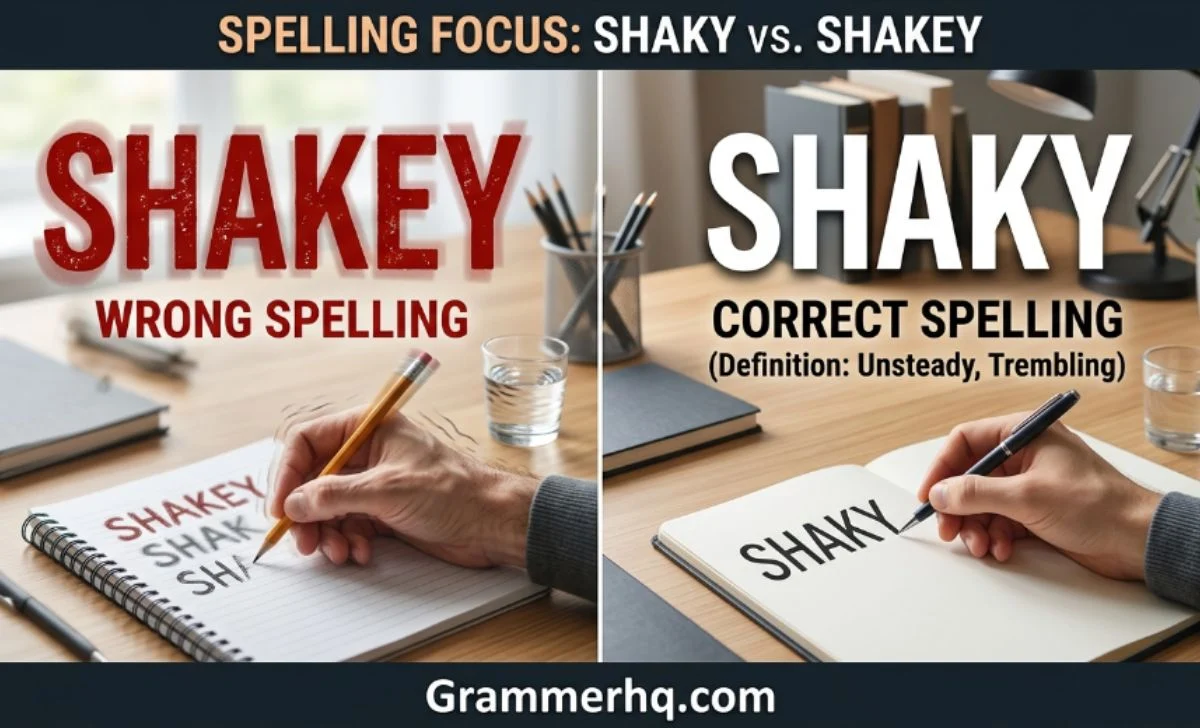
Shaky is the correct spelling in standard English. It means unsteady, trembling, weak, uncertain, or not completely stable.
Shakey is generally considered a misspelling and does not appear as the standard dictionary form, although it may occasionally be used as a proper name, nickname, or brand. For everyday writing, always choose shaky.
What Is the Difference Between Shakey and Shaky?
Short answer: Only shaky is considered the standard English spelling.
Although both words may look reasonable, English spelling doesn’t always follow pronunciation. The accepted adjective is shaky, not shakey.
| Word | Status | Meaning | Should You Use It? |
|---|---|---|---|
| Shaky | ✅ Standard English | Unsteady, weak, trembling, uncertain | Yes |
| Shakey | ❌ Usually a misspelling | Not accepted as the standard spelling | No (except proper names) |
If you’re writing for school, work, business, publishing, or professional communication, shaky is the only spelling you should use.
What Does Shaky Mean?
Shaky is an adjective that describes someone or something that is not stable, steady, or secure. Depending on the context, it can refer to physical movement, emotions, health, confidence, relationships, finances, or even technology.
Here are the most common meanings.
1. Physically Unsteady
A person or object that moves without stability.
Examples:
- My hands felt shaky after carrying the heavy boxes.
- The old bridge looked shaky, so we crossed carefully.
- The ladder became shaky because one leg was loose.
2. Nervous or Lacking Confidence
Sometimes shaky describes emotions rather than physical movement.
Examples:
- She sounded shaky before giving her presentation.
- His confidence became shaky after several failed interviews.
- I felt shaky during my driving test.
3. Weak or Uncertain
The word can also describe situations that are not secure or reliable.
Examples:
- The company’s financial position remains shaky.
- Their argument is based on shaky evidence.
- The economy experienced a shaky recovery.
This flexible meaning is why shaky appears in everyday conversation, journalism, business writing, academic discussions, and news reports.
How Do You Pronounce Shaky?
The standard pronunciation is:
IPA (UK): /ˈʃeɪ.ki/
IPA (US): /ˈʃeɪ.ki/
It has two syllables:
SHAKE + ee
Although the ending sounds like “key,” the correct spelling remains -ky, not -key.
Pronunciation Tip
Many spelling mistakes happen because English pronunciation and spelling don’t always match perfectly.
Writers often hear the final sound and assume it should be written as key, leading to the incorrect spelling shakey.
Why Do People Write Shakey Instead of Shaky?
The confusion isn’t random. Several factors make shakey seem believable, especially for English learners.
The pronunciation is misleading.
Because the word ends with the sound “kee,” many people instinctively add -ey instead of -y.
English spelling isn’t always predictable.
English contains many irregular spelling patterns, so writers often rely on sound rather than standard spelling.
Autocorrect doesn’t catch every mistake.
Some writing tools may overlook shakey, especially if it’s used as a surname, nickname, or business name somewhere online.
Search engines show both spellings.
When people search for shakey or shaky, they often see websites, usernames, brands, or older web pages using shakey, making it seem like both spellings are equally acceptable.
In standard English, however, dictionaries consistently recognize shaky as the correct form.
Is Shakey Ever Correct?
Short answer: Yes but only in limited situations. While shakey is not the standard English spelling of the adjective, it can appear as part of a proper noun, brand name, nickname, username, or business name. In those cases, the spelling is intentional and should not be “corrected.”
For example:
- Shakey’s Pizza (restaurant brand)
- A musician or athlete with the nickname Shakey
- A social media username such as @ShakeyGamer
These are names, not examples of standard English spelling.
When to Use Each Spelling:
| Situation | Correct Form |
|---|---|
| School essay | Shaky |
| Business email | Shaky |
| Academic writing | Shaky |
| News article | Shaky |
| Personal message | Shaky |
| Brand or nickname | Shakey (if that’s the official name) |
Tip: If you’re describing someone as nervous, unsteady, weak, or uncertain, always use shaky.
Shakey vs Shaky Comparison Table:
| Word | Meaning | Part of Speech | Standard English | Example | Common Mistake |
|---|---|---|---|---|---|
| Shaky | Unsteady, trembling, weak, uncertain | Adjective | ✅ Yes | She felt shaky after the long run. | None |
| Shakey | Usually a proper name or misspelling | Proper noun / Nonstandard spelling | ❌ No (as an adjective) | We had dinner at Shakey’s Pizza. | Using it instead of shaky |
Grammar Rule:
Quick Answer: When describing a person, object, feeling, argument, relationship, or situation that is unstable or uncertain, the correct adjective is shaky.
English adjectives often end in -y, and shaky follows this standard spelling pattern.
Correct:
- shaky hands
- shaky voice
- shaky relationship
- shaky evidence
- shaky economy
- shaky internet connection
- shaky performance
- shaky camera footage
Incorrect:
- shakey hands
- shakey relationship
- shakey argument
- shakey confidence
Although the pronunciation may suggest adding -ey, English spelling rules recognize only shaky in standard usage.
Word Origin (Etymology)
The adjective shaky comes from the verb shake, which has existed in English for centuries. As the language evolved, the suffix -y was added to create an adjective meaning “likely to shake” or “characterized by shaking.”
Examples of similar adjective formations include:
- smoke → smoky
- rock → rocky
- cloud → cloudy
- wind → windy
- frost → frosty
Likewise:
- shake → shaky
This is why shaky follows a familiar English word-formation pattern.
Real-Life Examples
Seeing the word in context makes it much easier to remember.
Everyday Conversation
My hands became shaky after drinking too much coffee.
She looked shaky after standing for several hours.
The chair feels shaky. Please don’t sit on it.
School and Academic Writing
His explanation was based on shaky evidence.
The student’s argument seemed shaky because it lacked reliable sources.
Business Communication
Investors became worried after the company reported shaky financial results.
Their future plans still look shaky.
Professional Emails
The internet connection was shaky during today’s meeting.
The project’s timeline appears shaky because several tasks are delayed.
News and Media
Analysts warned about the country’s shaky economy.
The team made a shaky start but improved later.
Technology
The video looks shaky because the camera wasn’t stabilized.
We had a shaky Wi-Fi connection throughout the presentation.
Relationships
They are trying to rebuild a shaky relationship.
Trust became shaky after the misunderstanding.
Health
I felt shaky after skipping lunch.
His legs were shaky after the marathon.
Incorrect vs Correct Examples
❌ I felt shakey after the exam.
✅ I felt shaky after the exam.
❌ Their evidence is shakey.
✅ Their evidence is shaky.
❌ She has shakey hands.
✅ She has shaky hands.
❌ The bridge looks shakey.
✅ The bridge looks shaky.
Common Mistakes People Make
1. Spelling by Sound
Many learners hear the ending “kee” and assume the word should end with -key.
✅ Correct: shaky
❌ Incorrect: shakey
2. Copying Informal Internet Spellings
Usernames, blogs, or social media posts sometimes use shakey creatively. That doesn’t make it standard English.
Always follow dictionary spelling in formal writing.
3. Confusing Proper Names with Regular Words
A restaurant, company, or nickname may intentionally use Shakey.
That spelling applies only to the name itself—not to the adjective.
4. Trusting Autocorrect Too Much
Some writing tools don’t flag every uncommon spelling, especially if it exists as a name.
A quick proofread using trusted references such as Cambridge Dictionary or Merriam-Webster can help ensure you’re using the standard form.
Easy Memory Trick:
Remember this simple sentence:
If something can shake, it becomes shaky—not shakey.
Another trick:
Think of these words:
- rocky
- smoky
- windy
- cloudy
- rainy
- noisy
Notice how they all end in -y.
So does:
shake → shaky
This pattern is much easier to remember than relying on pronunciation alone.
Why Correct Spelling Matters in Real Life
Using shaky instead of shakey isn’t just about passing a spelling test. Correct spelling improves clarity, credibility, and professionalism.
Whether you’re writing a university assignment, preparing for an IELTS or TOEFL exam, sending a business email, editing a report, or publishing online content, accurate spelling reflects strong writing skills and careful proofreading.
It also helps readers trust your work. A small spelling mistake can distract from an otherwise well-written message, while consistent use of standard English makes your communication more polished and easier to understand.
Practice Quiz:
Test your understanding of shakey or shaky with these quick questions.
1. Which spelling is correct in standard English?
A. Shakey
B. Shaky
C. Both are equally correct
D. Neither
Answer: B. Shaky
2. Fill in the blank.
After running five miles, my legs felt ________.
A. shakey
B. shaky
Answer: shaky
3. Which sentence is correct?
A. The table looks shakey.
B. The table looks shaky.
Answer: B. The table looks shaky.
4. Correct the sentence.
Our evidence is shakey.
Correct Answer:
Our evidence is shaky.
5. Choose the correct sentence.
A. She gave a shaky presentation because she was nervous.
B. She gave a shakey presentation because she was nervous.
Answer: A
6. True or False
“Shakey” is the accepted standard spelling in English dictionaries.
Answer: False
7. Which sentence uses Shakey correctly?
A. My hands are shakey.
B. We had dinner at Shakey’s Pizza.
Answer: B
FAQ,s
Is shakey a real word?
Not as the standard English adjective. It usually appears as a proper name, nickname, username, or brand name. If you mean unsteady or trembling, the correct spelling is shaky.
Which is correct: shakey or shaky?
Shaky is the correct spelling in standard English. It is the form recognized by major dictionaries and used in professional, academic, and everyday writing.
Why do people spell shaky as shakey?
The mistake usually happens because the ending sounds like “key.” Many English words are not spelled exactly as they sound, so writers naturally—but incorrectly—add -ey.
Is shakey accepted in British English?
No. Both British English and American English use shaky as the standard spelling. The difference is not regional; it is simply a matter of correct versus incorrect spelling.
Can I use shakey in formal writing?
No. Unless you’re referring to an official name, such as a brand or nickname, always use shaky in essays, emails, reports, and other formal documents.
What part of speech is shaky?
Shaky is an adjective. It describes a noun by indicating that someone or something is unsteady, weak, trembling, or uncertain.
Key Takeaways
- ✅ Shaky is the only standard English spelling.
- ✅ Shakey is generally a misspelling unless it is part of a proper name or brand.
- ✅ Shaky is an adjective meaning unsteady, trembling, weak, or uncertain.
- ✅ Both American English and British English use shaky.
- ✅ Using the correct spelling improves your grammar, proofreading, and professional writing.
Conclusion
Although shakey and shaky may sound identical, only shaky is accepted in standard English. Whether you’re describing shaky hands, a shaky argument, a shaky economy, or a shaky relationship, this is the spelling you should use in everyday and professional writing.
Shakey is appropriate only when it forms part of an official name, brand, or nickname. If you’re ever unsure, remember the simple pattern: shake → shaky, just as rock → rocky and smoke → smoky.
Mastering small spelling differences like this makes your writing clearer, more accurate, and more professional.
Read More Blogs:

Hi, I’m Amelia Parker, a grammar enthusiast and writer at GrammarHQ.com. I specialize in explaining spelling differences, confusing words, and common English mistakes through simple, practical, and easy-to-understand guides.