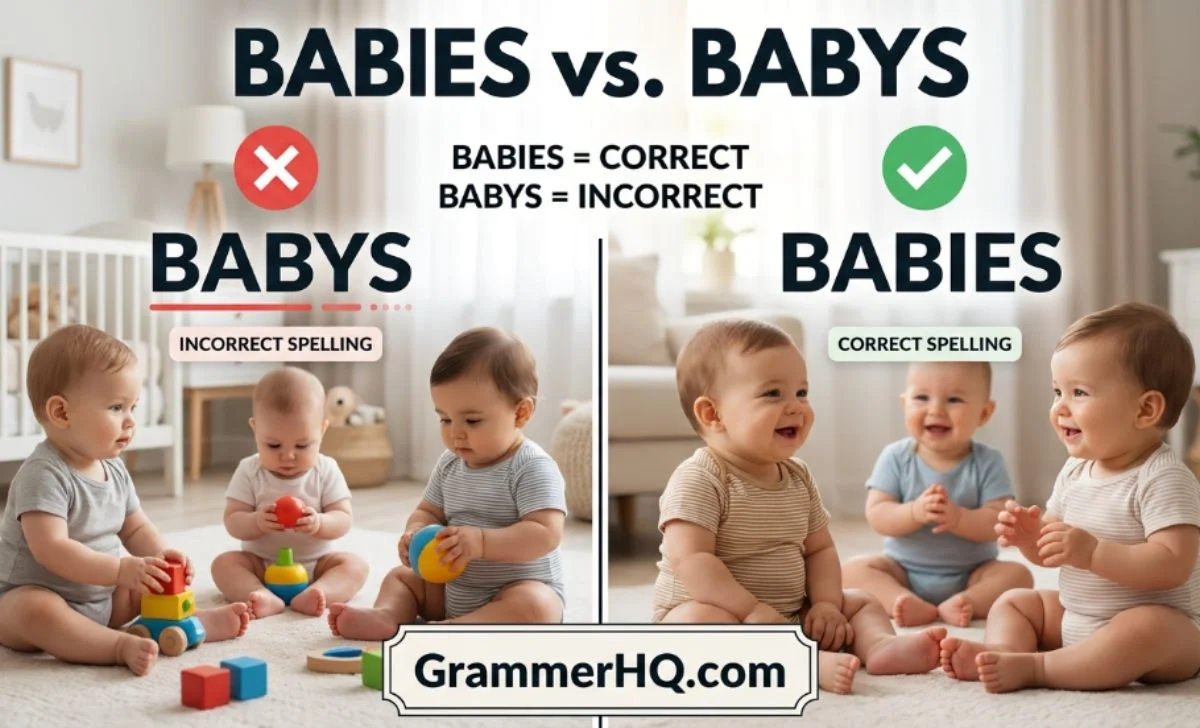
Babies vs babys is a common English spelling confusion. If you are talking about more than one baby, the correct standard-English spelling is babies. The spelling babys is incorrect.
The confusion is easy to understand. Many English nouns form their plural by simply adding -s, so it may seem logical to write baby + s = babys. However, baby follows a different spelling rule because it ends in a consonant + y.
When baby becomes plural, the y changes to i and -es is added:
baby → babies
The same spelling pattern appears in words such as city → cities, family → families, and story → stories.
There is also an important difference between babies, baby’s, and babies’. Understanding these forms can help you avoid both spelling and grammar mistakes.
Quick Answer
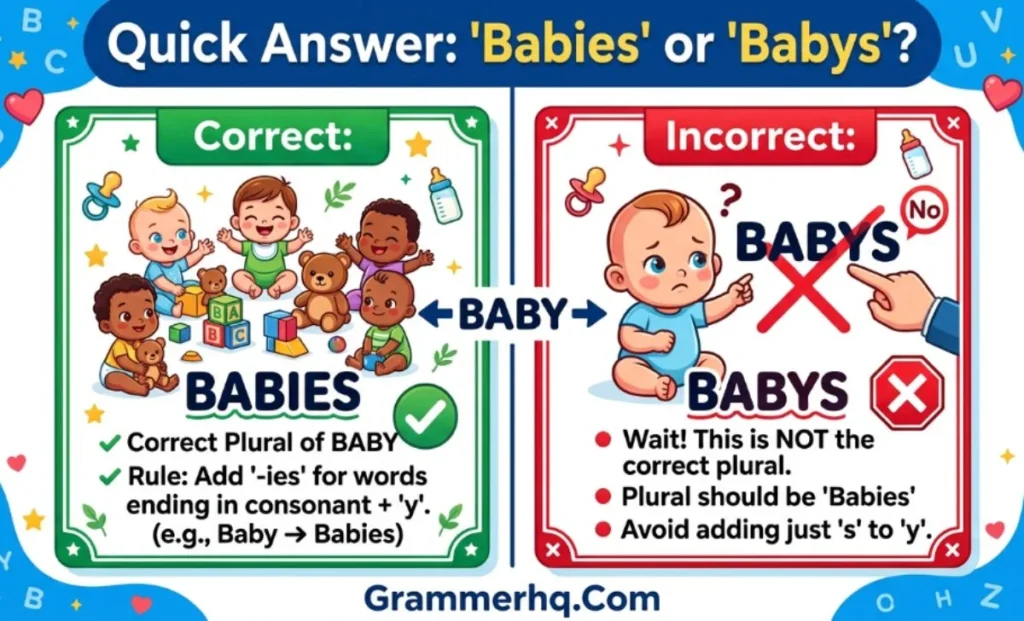
Babies is correct.
Babys is incorrect when you mean more than one baby.
| Word | Correct? | Use |
| baby | ✅ | One baby |
| babies | ✅ | More than one baby |
| baby’s | ✅ | One baby’s possession or a contraction |
| babies’ | ✅ | Possession involving multiple babies |
| babys | ❌ | Incorrect plural spelling |
Examples
- The baby is sleeping.
- The babies are sleeping.
- The baby’s blanket is soft.
- The babies’ blankets are clean.
So, if you are simply making baby plural, the answer is:
baby → babies
Why Is “Babies” the Correct Spelling?
The spelling babies follows a common English pluralization rule.
When a noun ends in a consonant + y, the final y changes to i, and -es is added.
The process looks like this:
baby → bab + ies → babies
The same pattern occurs in:
- city → cities
- party → parties
- country → countries
- family → families
- story → stories
- puppy → puppies
- lady → ladies
Because baby ends in b + y, it follows this pattern.
That is why:
❌ babys
is not the standard plural spelling.
Instead:
✅ babies is correct.
Why Is “Babys” Incorrect?
The mistake usually happens because English has another common plural pattern:
singular + s = plural
For example:
- book → books
- car → cars
- table → tables
- house → houses
It can therefore look natural to write:
baby + s = babys
But the spelling rule for consonant + y is different.
You need to change the y to i before adding -es:
baby → babies
So babys is not simply an alternative spelling. It is a spelling error in standard English.
When Does Y Change to IES?
A useful rule is:
Consonant + y → change y to i + add es
For example:
| Singular | Plural |
| baby | babies |
| city | cities |
| story | stories |
| family | families |
| country | countries |
| party | parties |
But there is an important exception to remember.
When a word ends in a vowel + y, the y usually stays, and you simply add -s.
For example:
| Singular | Plural |
| boy | boys |
| toy | toys |
| key | keys |
| day | days |
| journey | journeys |
| monkey | monkeys |
Compare:
baby → babies
boy → boys
Why?
- baby ends in b + y → consonant + y
- boy ends in o + y → vowel + y
This small distinction explains why babies and boys are spelled differently.
Babies vs. Baby’s
One of the most common mistakes is confusing babies with baby’s.
They do completely different jobs.
Babies
Babies is the plural of baby. It means more than one baby.
The babies are sleeping.
Baby’s
Baby’s usually shows possession by one baby.
The baby’s blanket is blue.
Here, the blanket belongs to one baby.
Compare:
- The baby is crying.
- The babies are crying.
- The baby’s toy is broken.
- The babies’ toys are broken.
The apostrophe is important because it changes the grammatical meaning.
Babies vs. Babies’: What Is the Difference?
The difference between babies and babies’ is also easy once you focus on the apostrophe.
Babies
Use babies when you simply mean more than one baby.
Several babies are playing.
Babies’
Use babies’ when something belongs to or is associated with multiple babies.
The babies’ clothes are in the drawer.
So:
babies = plural
babies’ = plural possessive
The apostrophe comes after the s because babies is already plural.
Is “Baby’s” Always Possessive?
No. Baby’s can also be a contraction.
Depending on the sentence, baby’s can mean baby is or baby has.
For example:
The baby’s sleeping.
This can be expanded to:
The baby is sleeping.
Another example:
The baby’s been fed.
This means:
The baby has been fed.
You can usually determine the meaning from the surrounding sentence.
So baby’s can represent:
- Possession — the baby’s toy
- Baby is — the baby’s sleeping
- Baby has — the baby’s been fed
It does not, however, mean the plural of baby.
Babies in British and American English
There is no spelling difference between British and American English in this case.
Both use:
baby → babies
So whether you are writing for readers in the United States, the United Kingdom, Canada, or Australia, babies is the standard plural form.
You do not need to choose between babies and babys based on the variety of English.
The correct spelling remains:
babies
Common Mistakes With Babies
1: Writing “babys” as the plural
❌ The babys are sleeping.
✅ The babies are sleeping.
2: Using “baby’s” as a plural
❌ The baby’s are playing.
✅ The babies are playing.
3: Forgetting the apostrophe in a plural possessive
❌ The babies clothes are clean.
✅ The babies’ clothes are clean.
4: Using “babies’” when you only need the plural
❌ The babies’ are crying.
✅ The babies are crying.
Remember:
babies tells us there is more than one baby.
babies’ shows possession or association involving multiple babies.
Examples of “Babies” in Sentences
Here are some natural examples:
- The babies are sleeping peacefully.
- Two babies were born yesterday.
- The nurse checked the babies carefully.
- Several babies were playing in the nursery.
- The babies need to be fed.
- The parents bought new clothes for their babies.
- The babies are wearing matching outfits.
- The babies’ toys are on the floor.
- The babies’ blankets were washed this morning.
- The baby’s bottle is on the table.
These examples show why context matters. Babies, baby’s, and babies’ may look similar, but their grammatical functions are different.
A Simple Trick to Remember “Babies”
Here is the easiest way to remember the spelling:
Consonant + Y → IES
So:
baby → babies
Think of the word city:
city → cities
Then apply the same pattern to baby:
baby → babies
A second useful comparison is:
baby → babies
boy → boys
The letter before y tells you which plural pattern to use.
- consonant + y → ies
- vowel + y → s
Once you remember this pattern, babys becomes much easier to recognize as incorrect.
Baby Clothes or Babies’ Clothes?
There is one additional point worth knowing.
You may see phrases such as:
- baby clothes
- baby food
- baby shoes
- baby bottles
- baby toys
Here, baby is being used as a noun modifier to describe another noun.
For example:
We sell baby clothes.
This does not mean that the clothes belong to one particular baby. It means clothes designed or intended for babies.
But if you are talking about clothes belonging to several specific babies, you can use the possessive:
The babies’ clothes are in the washing machine.
So baby clothes and babies’ clothes can both be correct, but they have different meanings.
Babies vs. Babys: Side-by-Side Comparison
| Feature | Babies | Babys |
| Standard English | ✅ Yes | ❌ No |
| Plural of baby | ✅ Yes | ❌ No |
| Correct spelling | ✅ | ❌ |
| Used in British English | ✅ | ❌ |
| Used in American English | ✅ | ❌ |
| Means more than one baby | ✅ | ❌ |
The correct form is therefore very clear:
Babies is correct. Babys is incorrect.
FAQs
1: What is the plural of baby?
The plural of baby is babies.
2: Is “babys” correct?
No. Babys is not the standard English plural of baby. The correct spelling is babies.
3: Why is it “babies” instead of “babys”?
Because baby ends in a consonant followed by y. The y changes to i, and -es is added:
baby → babies
4: Is “baby’s” the plural of baby?
No. Baby’s is usually a singular possessive form or a contraction of baby is or baby has.
5: What does “babies’” mean?
Babies’ is the plural possessive form. It refers to something belonging to or associated with multiple babies.
6: Is “babies” the same in British and American English?
Yes. Both British and American English use babies as the plural of baby.
7: How do you spell the plural of baby?
The correct spelling is:
B-A-B-I-E-S — babies
8: Is it “two babys” or “two babies”?
It is two babies.
❌ Two babys
✅ Two babies
Conclusion
When choosing between babies vs. babys, the correct spelling is babies. The reason is the standard plural rule for nouns ending in a consonant + y: change the y to i and add -es, giving us baby → babies.
It is also important to keep baby, babies, baby’s, and babies’ separate. Baby means one baby, while babies means more than one baby.
Baby’s shows possession by one baby or can mean baby is or baby has, whereas babies’ shows possession involving multiple babies.
A simple rule to remember is consonant + y → ies, which gives you the correct spelling every time: babies, not babys.
Read More Blogs:
- Benefitted or Benefited? Which Spelling Is Correct?
- Email vs Gmail: What’s the Difference and Which Should You Use?