You’re typing an email, a resume line, or a caption, and your fingers pause at the same spot every time: is it consistent or consistant?
You’re not imagining things this is one of the most Googled spelling questions in English, and there’s a good reason it trips up even careful writers.
The short answer: “consistent” is correct. “Consistant” is not a word. But if that were the whole story, you wouldn’t still be second-guessing yourself every few weeks.
The real fix isn’t memorizing one rule it’s understanding why your brain keeps reaching for the wrong ending in the first place. That’s what this guide actually solves.
What “Consistent” Actually Means
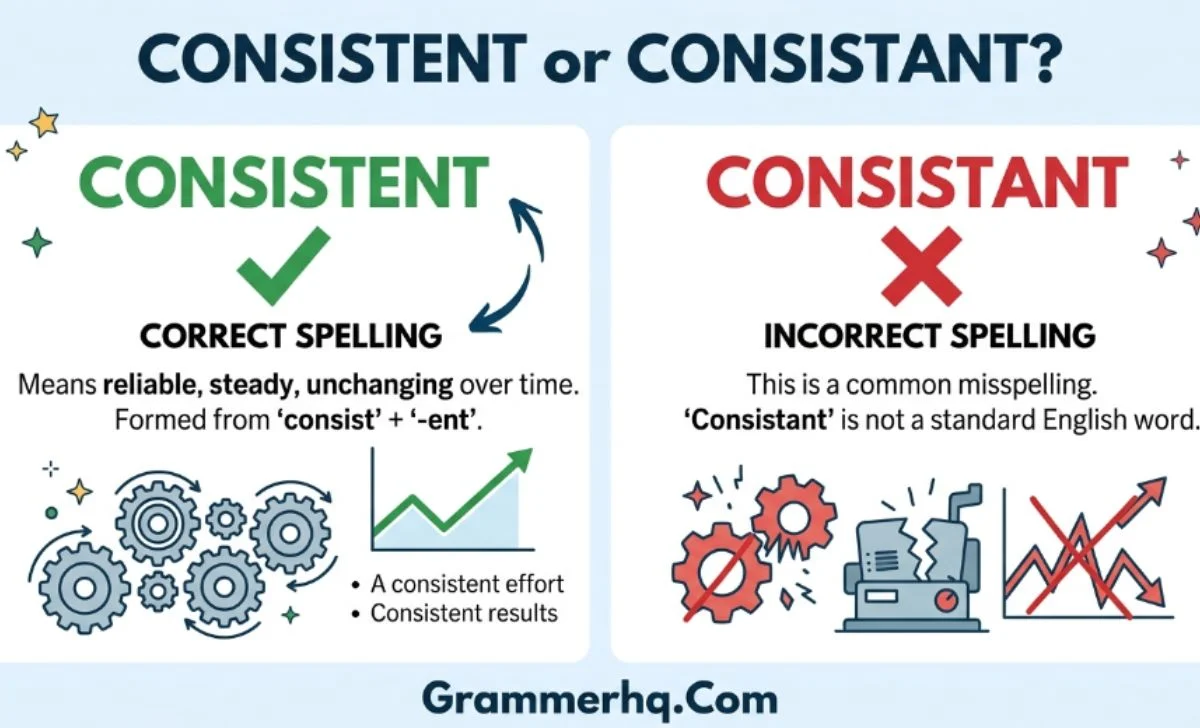
Consistent is an adjective. It describes something that behaves the same way over time — steady, reliable, predictable, without random swings.
Pronunciation: kuhn-SIS-tuhnt (/kənˈsɪstənt/). Notice the stress falls on the second syllable, which is part of why the ending vowel sound gets swallowed and easy to misspell.
A few natural uses:
- Her training schedule has been consistent for the past six months — same days, same intensity.
- The startup’s revenue wasn’t consistent; it spiked in December and nearly flatlined by February.
- A good manager gives consistent feedback, not praise one week and silence the next.
“Consistant,” on the other hand, isn’t a recognized English word in any dictionary — not Merriam-Webster, not Oxford, not Cambridge. It’s purely a misspelling, and a common one at that.
Why This Mistake Happens So Often
Here’s the part most articles skip: this isn’t a careless typo, it’s a predictable one, and it comes down to how English handles unstressed endings.
When you say “consistent” out loud, that final syllable gets reduced to a quick, neutral “uhnt” sound what linguists call a schwa.
Your ear can’t actually tell whether that sound is spelled -ent or -ant, because it’s the same mushy sound either way.
English has hundreds of words ending in both, so your brain doesn’t have a reliable audio cue to fall back on. You end up guessing, and roughly half the time, you guess wrong.
This is exactly why spell-check catches it instantly (more on that below) but your own proofreading often doesn’t you’re not “sounding it out” wrong, you genuinely can’t hear the difference.
The Actual Rule: Why It’s “-ent,” Not “-ant”
There’s a shortcut that works more often than not, and it starts with the root word.
Consistent comes from the verb consist (“to be made up of” or “to exist in”). When a verb ending in a hard consonant takes on an adjective form using this pattern, it typically pulls the -ent suffix rather than -ant. Compare:
| Root Verb | Correct Adjective | Common Misspelling |
|---|---|---|
| consist | consistent | consistant ❌ |
| persist | persistent | persistant ❌ |
| insist | insistent | insistant ❌ |
| confide | confident | confidant (different meaning) |
| depend | dependent | dependant (valid in British English, different use) |
Notice a pattern? Consist, persist, insist all three share the same Latin root family (sistere, “to stand”), and all three take -ent.
If you’ve ever mixed up “persistent” or “insistent” too, that’s not a coincidence — it’s the same underlying confusion, and now you can fix all three at once instead of memorizing them one by one.
One useful exception to flag: confident and dependent look similar but work differently — “confidant” (a trusted person you confide in) and “dependant” (British English for a person who relies on you financially) are legitimate words with their own meanings, just not interchangeable with the -ent adjective form. Worth knowing so you don’t overcorrect.
The Memory Trick That Actually Sticks
Forget rote memorization. Anchor it to a word you already spell correctly without thinking:
Consistent people build consistency.
The noun form, consistency, has an unmistakable “-ency” ending — nobody writes “consistancy.” Since the noun and adjective share the same root spelling, if you’re ever unsure about “consistent,” just think of “consistency” first. The correct ending will follow.
Correct vs. Incorrect: Real Examples
| ❌ Incorrect | ✅ Correct |
|---|---|
| She’s not consistant with her workouts. | She’s not consistent with her workouts. |
| The results were consistant across all three trials. | The results were consistent across all three trials. |
| His story wasn’t consistant with what he told us earlier. | His story wasn’t consistent with what he told us earlier. |
| We need a more consistant approach to grading. | We need a more consistent approach to grading. |
| The brand’s tone stayed consistant across every ad. | The brand’s tone stayed consistent across every ad. |
Read that column on the right out loud a few times — you’re training the visual pattern, not just the rule.
Synonyms and Antonyms
Knowing near-meaning words helps you catch the error in context, not just in isolation.
Synonyms: steady, reliable, uniform, unwavering, dependable, stable, unchanging, coherent
Antonyms: inconsistent, erratic, variable, irregular, unpredictable, contradictory
Interesting side note: inconsistent follows the exact same pattern — never “inconsistant.” If you fix the root confusion, the negative form fixes itself too.
Does Grammarly (or Word) Catch This?
Yes, reliably. “Consistant” is flagged as a spelling error by Microsoft Word, Google Docs, and Grammarly the moment you type it — it’s not a borderline judgment call the way some grammar rules are (like “who” vs. “whom”).
This is actually good news: if you’re prone to this typo, running a quick spell-check pass before sending an email or publishing a post will catch it every time.
The mistake usually slips through in places spell-check doesn’t reach — handwritten notes, whiteboard presentations, or names/headlines where autocorrect is sometimes switched off.
Is There a British vs. American English Difference?
No — and this is worth clearing up because a few similar-looking words (like dependent/dependant) do differ between British and American English, which creates unnecessary doubt. “Consistent” is spelled identically in both.
There’s no regional variant, no British alternate spelling, nothing to double-check. If you’ve seen “consistant” anywhere claiming to be a British spelling, that’s simply incorrect — it’s a typo, not a dialect difference.
FAQ,s
Is “consistant” ever correct in any context?
It’s not accepted in formal writing, casual writing, British English, or American English. It’s a misspelling in every context.
What’s the noun form of consistent? Consistency (never “consistancy”).
What’s the opposite of consistent? Inconsistent — same root spelling rule applies.
Why does spell-check catch “consistant” but I don’t notice it myself when reading?
Because the error is auditory, not visual — the misspelled ending sounds identical when read aloud, so your brain fills in the “correct” sound automatically even when the letters are wrong.
Are “persistent” and “insistent” affected by the same confusion?
All three come from the same Latin root family and follow the identical -ent pattern, so if you’ve mastered “consistent,” you’ve effectively solved “persistent” and “insistent” too.
Key Takeaways
- Consistent is correct; consistant is a misspelling with zero valid use cases.
- The error happens because the ending sound is a schwa — your ear can’t distinguish -ent from -ant, so you have to rely on the rule, not the sound.
- Anchor it with the noun form: consistency → consistent.
- The same root pattern fixes “persistent” and “insistent” too.
- No British/American spelling difference exists for this word.
- Spell-checkers catch it instantly, but proofreading by ear won’t — read your work back, don’t just listen to it in your head.
Once this clicks, it tends to stay fixed for good — because you’re no longer guessing at a sound, you’re recognizing a pattern.
Conclusion
At the end of the day, “consistent vs. consistant” isn’t really a vocabulary problem it’s a listening problem. Your ear can’t tell the two endings apart, so your hand keeps guessing wrong on autopilot.
The fix isn’t willpower or memorizing a long list; it’s one dependable anchor: if you can spell consistency, you can spell consistent, every single time.
Once this clicks, it tends to stay fixed for good because you’re no longer guessing at a sound, you’re recognizing a pattern. And now that you’ve got the root-word logic down, the same trick will quietly fix “persistent” and “insistent” for you too, without any extra effort.
Read More Blogs:
- Already or All Ready: What’s the Difference and Which Is Correct?
- Clutz or Klutz: Which Spelling Is Correct?