
Perfer or prefer? If you are trying to spell the verb meaning “to like or choose one thing more than another,” prefer is the correct spelling. Perfer is a common misspelling of prefer in standard English.
The confusion becomes even easier to understand when you see words such as preferred and preferring, where the r is doubled.
However, the base word is always prefer, not perfer. Once you know the correct spelling and a few common sentence patterns, this word becomes much easier to use correctly.
Quick Answer
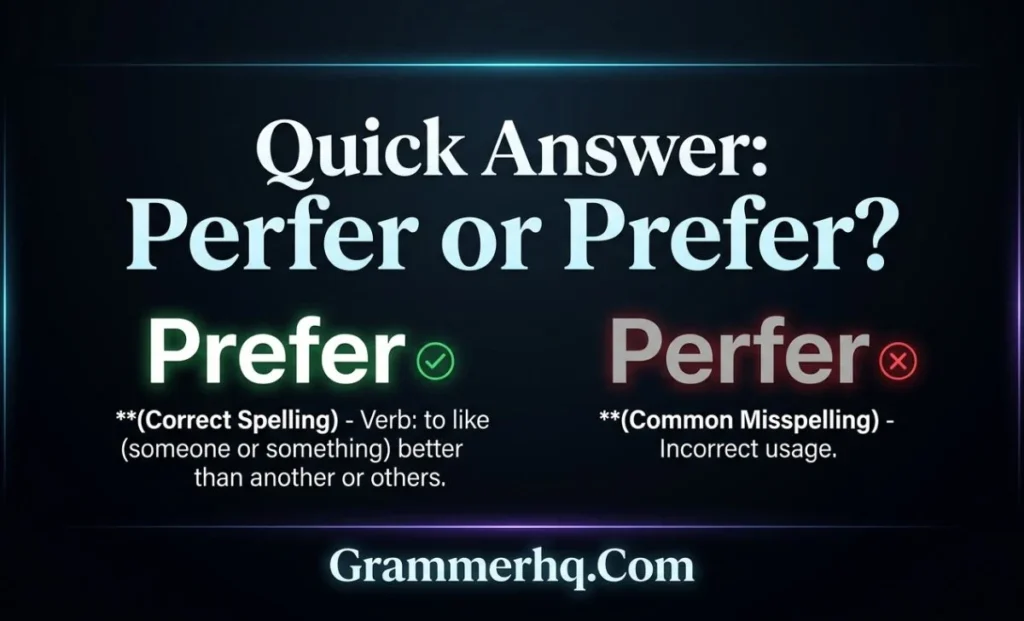
| Word | Correct? | Meaning |
|---|---|---|
| prefer | ✅ Correct | To like, choose, or want one thing more than another |
| perfer | ❌ Incorrect | A misspelling of prefer |
Correct: I prefer tea to coffee.
Incorrect: I perfer tea to coffee.
Cambridge defines prefer as a verb used when someone likes, chooses, or wants one thing rather than another.
Perfer or Prefer: What Is the Difference?
Prefer
Prefer is the standard English spelling. It is a verb used to express a choice or preference.
I prefer summer to winter.
She prefers to work in the morning.
We prefer fresh food.
The word works in both American and British English. The spelling does not change between the two varieties. Dictionary entries give the same written form, although pronunciation can vary.
Perfer
Perfer is not the standard English spelling of the verb prefer.
If you want to say that you like one option more than another, write:
prefer ✅
not:
perfer ❌
A useful point is that it is more accurate to call perfer a misspelling of the English verb prefer than to make a broader claim that the letter sequence can never occur in any language or historical context.
What Does Prefer Mean?
Prefer means to like, choose, or want one person, thing, or activity more than another.
For example:
I prefer tea to coffee.
This means tea is your choice over coffee.
You can use prefer in everyday situations, at work, in school, while shopping, or when discussing personal choices.
I prefer the blue shirt.
She prefers working from home.
They prefer to travel by train.
Would you prefer a window seat?
The core meaning remains the same: one choice is favored over another. Cambridge lists these common patterns with prefer, including a noun, an -ing form, and a to-infinitive.
How to Use Prefer Correctly in a Sentence
Knowing the spelling is only half the job. Prefer also has several common sentence patterns.
Prefer One Thing to Another
The standard comparison pattern is:
prefer + A + to + B
I prefer tea to coffee.
Maya prefers books to magazines.
We prefer quality to quantity.
This is one of the most important patterns to remember. Cambridge specifically recommends to when comparing two things or activities after prefer.
Prefer + -ing
You can use an -ing form after prefer:
I prefer walking to driving.
He prefers reading to watching television.
She prefers cooking at home.
This structure is especially useful when you are comparing activities. Cambridge confirms that prefer can be followed by an -ing form.
Prefer + to-Infinitive
You can also use:
prefer + to + verb
I prefer to walk.
She prefers to work alone.
They prefer to arrive early.
Both the to-infinitive and -ing forms are established patterns. Cambridge notes that the to-infinitive is particularly common with prefer.
Would Prefer
For a present or future choice, would prefer is very common:
I’d prefer to sit near the window.
Would you prefer tea or coffee?
She’d prefer not to drive at night.
Cambridge lists would prefer + to-infinitive as a standard construction for expressing a present or future preference.
Prefer To or Prefer Than?
This is one of the most common grammar questions connected with prefer.
When you directly compare two things, use prefer … to …, not prefer … than ….
Correct
I prefer tea to coffee.
He prefers walking to driving.
She prefers books to magazines.
Incorrect
I prefer tea than coffee. ❌
He prefers walking than driving. ❌
Cambridge’s grammar guidance specifically states that comparisons with prefer use to, rather than a bare than.
What About “Rather Than”?
Rather than can also appear in preference constructions, particularly with would prefer:
I’d prefer to stay home rather than go out.
She’d prefer to take the train rather than drive.
So remember:
prefer A to B ✅
prefer to do A rather than do B ✅
prefer A than B ❌
Prefer or Preferred: Why Does the R Double?
This is where the spelling gets confusing.
The base form is:
prefer ✅
But its past form and past participle are:
preferred ✅
Not:
prefered ❌
For example:
She preferred the original design.
We preferred the smaller room.
Oxford lists preferred as both the past simple and past participle of prefer.
The important thing to remember is that the double r in preferred does not mean the base word is perfer. The base form remains:
prefer
Prefer or Preferring: Which Is Correct?
The correct -ing form is:
preferring ✅
Not:
prefering ❌
For example:
I am preferring…?
In ordinary modern English, prefer is generally not used in progressive tenses, so preferring is mainly encountered in forms such as participial or other grammatical contexts rather than as a routine progressive verb. Oxford lists preferring as the correct -ing form.
The spelling pattern is therefore:
prefer → preferred → preferring
Not:
perfer → perfered → perfering
Is Prefer Spelled Differently in American and British English?
No.
The spelling is:
prefer in American English ✅
prefer in British English ✅
The pronunciation can differ slightly between US and UK English, but the written form remains prefer. Cambridge provides both UK and US pronunciations for the word.
So you do not need to choose between an American and British spelling here.
Why Is “Perfer” Easy to Misspell?
The mistake is understandable because prefer contains a repeated r sound and has related forms such as preferred and preferring, which actually do contain a doubled r.
That can create a visual mix-up:
prefer → correct base form
preferred → correct past form
preferring → correct -ing form
The safest approach is to remember the base form separately:
I prefer this one.
From that base form, the other forms become easier to recognize.
There is no need to invent a complicated pronunciation rule to explain the mistake. The practical solution is simply to distinguish prefer from its forms with the doubled r.
Common Prefer Spelling and Grammar Mistakes
A few common errors can make prefer look more complicated than it really is:
| Incorrect | Correct |
|---|---|
| perfer | prefer |
| prefered | preferred |
| prefering | preferring |
| prefer coffee than tea | prefer coffee to tea |
| prefer walk | prefer to walk / prefer walking |
Here are some common mistakes and their correct forms:
I perfer tea than coffee.
✅ I prefer tea to coffee.
She prefered the old version.
✅ She preferred the old version.
He prefering to stay home.
✅ He prefers to stay home.
I prefer walk to work.
✅ I prefer to walk to work.
✅ I prefer walking to work.
The key grammar point is that prefer can be followed by a to-infinitive or an -ing form when you are talking about an activity. For comparisons, the usual structure is prefer A to B.
For example:
We prefer to walk to work.
They prefer walking to work.
Maya prefers tea to coffee.
Cambridge documents these standard patterns, including prefer + to-infinitive, prefer + -ing, and prefer A to B.
An Easy Way to Remember Prefer
Think of the correct spelling as:
PRE + FER = PREFER
Then connect it to a simple sentence:
I prefer tea to coffee.
The key is not to insert another r into the base word.
prefer ✅
perfer ❌
The extra r appears in forms such as preferred and preferring, not in the base form.
Prefer Word Family
Knowing the related forms can help prevent spelling mistakes:
| Word | Part of speech | Example |
|---|---|---|
| prefer | Verb | I prefer tea. |
| prefers | Verb | She prefers tea. |
| preferred | Verb/adjective | It was my preferred choice. |
| preferring | Verb form | Preferring quality to quantity… |
| preference | Noun | That is my preference. |
| preferable | Adjective | This option is preferable. |
| preferably | Adverb | Preferably, choose the earlier train. |
Oxford lists preferable and preferably among the related vocabulary around prefer, while its main entry gives the verb forms preferred and preferring.
You do not need to memorize every form at once. The most important spelling distinction is:
prefer → preferred → preferring
Prefer or Perfer Examples
Everyday choice
I prefer coffee in the morning.
Work
She prefers to work from home.
School
I prefer studying in the library.
Shopping
He prefers the larger size.
Comparing activities
We prefer walking to driving.
Past choice
They preferred the original design.
These examples show why prefer is useful beyond spelling questions: it is a normal everyday verb for expressing choices and preferences.
FAQs
Is “perfer” a correct spelling?
No. If you mean the English verb that means “to like or choose one thing more than another,” the correct spelling is prefer.
Is “prefer” the correct spelling?
Yes. Prefer is the standard English spelling.
What does “prefer” mean?
Prefer means to like, choose, or want one thing more than another.
Do you say “prefer to” or “prefer than”?
For a direct comparison, use prefer … to …:
I prefer tea to coffee.
A bare prefer … than … construction is not the standard pattern.
Is it “preferred” or “prefered”?
Preferred is correct.
She preferred the blue one.
Is it “preferring” or “prefering”?
Preferring is correct. Oxford lists preferring as the -ing form of prefer.
Is “prefer” the same in American and British English?
Yes. The spelling is prefer in both American and British English, although pronunciation differs.
Conclusion
Prefer is the correct spelling; perfer is a misspelling when you mean the standard English verb for choosing or liking one thing more than another.
The most useful forms to remember are:
prefer ✅
preferred ✅
preferring ✅
For comparisons, use prefer A to B, and when you want to express a choice about an action, use prefer to do or prefer doing.
Once these patterns are familiar, both the spelling and grammar of prefer become much easier to get right.
Read More Blogs
- Tearing or Taring: What Is the Difference?
- A Unique or An Unique? Which One Is Correct?
- Burned or Burnt: Which Spelling Is Correct?
- Puting or Putting: Which Spelling Is Correct?