Have you ever typed “burned” and wondered if “burnt” would be the better choice? Both spellings are correct, but they are not used with exactly the same frequency everywhere.
The difference mainly comes down to regional English and context.In American English, “burned” is generally the preferred form, especially when burn is used as a verb.
In British English, both “burned” and “burnt” are standard, with burnt being especially familiar in everyday usage.
So, should you write “I burned the toast” or “I burnt the toast”? Both can be correct. The right choice depends on the variety of English you are using and, in some cases, how the word functions in the sentence.
Quick Answer
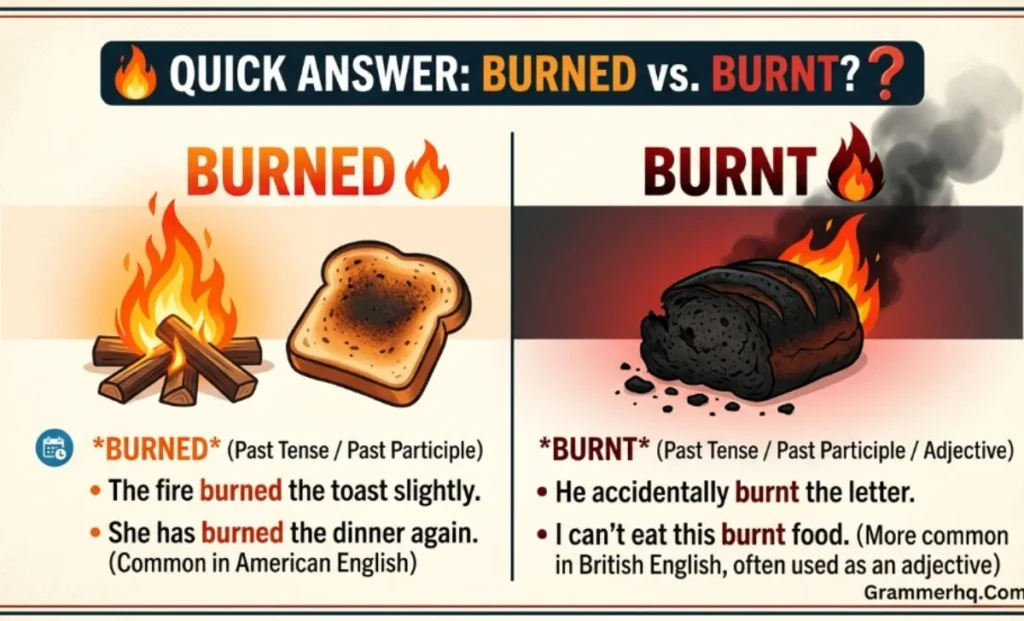
Burned and burnt are both correct forms of the verb burn.
The easiest way to remember the general difference is:
- American English: burned is usually preferred.
- British English: burned and burnt are both commonly used.
- Adjectival expressions: burnt is very common, especially in phrases such as burnt toast and burnt orange.
For example:
American English: I burned the toast.
British English: I burnt the toast.
Neither sentence is grammatically wrong.
Burned or Burnt at a Glance
| Feature | Burned | Burnt |
|---|---|---|
| Past tense | Correct | Correct |
| Past participle | Correct | Correct |
| American English | More common | Also used in some contexts |
| British English | Common | Very common |
| Adjective | Correct | Very common |
| Basic meaning | Same | Same |
The biggest mistake is assuming that burned is correct and burnt is wrong. That is not the case. Both forms are established English forms of burn.
What Does “Burned” Mean?
Burned is the -ed form of the verb burn. It can be used as the simple past and as a past participle.
It describes an action or result involving fire, heat, or intense burning.
Examples
- I burned the toast.
- She burned her hand on the pan.
- The fire burned through the roof.
- He burned the old letters.
- The candle burned all night.
In American English, burned is normally the natural choice when describing a past action. Collins lists burned as the American English past and past participle form.
What Does “Burnt” Mean?
Burnt is another accepted past form of burn. It can also be used as an adjective.
For example:
I burnt the toast.
Here, burnt is the past tense.
The toast had burnt.
Here, burnt is a past participle.
And:
The burnt toast smelled terrible.
Here, burnt describes the toast.
This is why it is inaccurate to say that burnt is only an adjective. Both dictionaries and usage guides recognize burnt as a past form as well as an adjectival form.
Why Are There Two Forms?
English has several verbs that developed both -ed and -t past forms.
For example:
- learned / learnt
- dreamed / dreamt
- smelled / smelt
- spelled / spelt
- burned / burnt
These pairs can vary by region and style.
With burn, the pattern is particularly noticeable because American English generally favors burned, while British English allows both burned and burnt.
So the difference is not simply a spelling mistake. It is part of normal variation in English.
Burned or Burnt in American English
If you are writing for an American audience, burned is usually the safest default.
Consider these examples:
- I burned my finger.
- She burned the cookies.
- The fire burned the building.
- He burned the documents.
- The candle burned for hours.
These sentences use burned as a verb, and this is the standard American preference.
However, burnt has not disappeared from American English. It remains very familiar in descriptive expressions such as burnt toast, burnt sugar, burnt orange, and burnt umber. Merriam-Webster specifically notes that burnt is common when the word functions adjectivally.
Burned or Burnt in British English
British English gives writers more freedom.
Both forms can be used:
I burned the toast.
I burnt the toast.
Both are standard.
The -t form is particularly familiar in British English, but that does not make burned incorrect. Scribbr likewise notes that both forms are commonly used in UK English for both verb and adjective senses.
So if you are writing British English, you can use burnt naturally without worrying that it is a spelling error.
Burned or Burnt as the Past Tense
Both burned and burnt can be the simple past of burn.
Compare:
Yesterday, I burned the cake.
Yesterday, I burnt the cake.
The meaning is essentially the same.
The difference is mainly regional preference.
American English: burned is generally preferred.
British English: burned and burnt are both accepted.
Burned or Burnt as the Past Participle
Both forms can also be used as past participles.
For example:
She has burned the toast.
She has burnt the toast.
And:
The documents were burned.
The documents were burnt.
Again, both forms are recognized. The preferred choice depends largely on regional English and style.
Burned or Burnt as an Adjective
This is where burnt becomes especially noticeable.
When describing something that has been damaged or changed by heat, burnt is very common:
- burnt toast
- burnt sugar
- burnt wood
- burnt paper
- burnt orange
- burnt umber
But burned can also be used adjectivally.
For example:
The burned toast was thrown away.
The burnt toast was thrown away.
Both can be grammatical. Merriam-Webster specifically confirms that both burned and burnt can function as adjectives.
Burned or Burnt Toast?
Both are correct:
I burned the toast.
I ate the burnt toast.
The first sentence focuses naturally on the action.
The second focuses on the condition of the toast.
This distinction can help explain why burnt often sounds particularly natural before a noun.
However, it should not be treated as an absolute rule. Burned toast is also possible, and both forms are recognized in English usage.
Burned or Burnt in Common Expressions
Certain expressions commonly use burnt, especially when describing colors, pigments, and food.
Burnt Orange
A deep, warm shade of orange is commonly known as burnt orange.
She wore a burnt orange dress.
Burnt Umber
Artists often use burnt umber, a traditional brown pigment, for painting and shading.
The artist used burnt umber for the shadows.
Burnt Toast
Toast that has been exposed to too much heat is often described as burnt toast.
The kitchen smelled of burnt toast.
Burnt Sugar
In cooking, burnt sugar refers to sugar heated until it becomes dark and develops a distinctive flavor.
The recipe calls for burnt sugar.
These expressions commonly appear with burnt, including in American English. The form is not mandatory in every context, though. Depending on the sentence, audience, and expression, burned may also be appropriate.
Burned or Burnt Out?
Both burned out and burnt out occur in English.
For example:
The motor burned out.
The motor burnt out.
The same variation appears in the figurative sense:
She felt burned out after months of work.
She felt burnt out after months of work.
The preferred form can depend on regional English and writing style.
If you are following American English consistently, burned out is generally the safer choice.
Burned or Burnt Down?
The same principle applies to burn down.
American English commonly uses:
The house burned down overnight.
British English can naturally use:
The house burnt down overnight.
You may also encounter burned down in British English. The important point is that the -t form is not a mistake. Both forms belong to the English verb burn.
A Simple Way to Remember Burned or Burnt
Use this as a general guide, not an absolute grammar rule:
American English → burned
British English → burned or burnt
And when you see familiar descriptive expressions such as burnt toast or burnt orange, burnt will often sound especially natural.
The key is to remember:
Burned and burnt are two accepted forms of the same verb.
Common Mistakes to Avoid
1: Thinking “burnt” is wrong
It isn’t.
Burnt is a standard English form.
2: Thinking “burned” is only American
British English also uses burned.
3: Saying “burnt” is only an adjective
Not true.
Burnt can also function as the past tense or past participle of burn.
4: Treating UK and US English as completely separate rules
The forms overlap.
British speakers can use burned, and American English uses burnt in established descriptive expressions.
5: Mixing styles without a reason
If your website follows American English, use burned as your normal verb form.
If you follow British English, burnt is a natural choice, but burned remains valid.
Consistency is more important than forcing one form everywhere.
Which One Should You Use?
The best choice depends on your audience.
Choose “burned” when:
- You are writing primarily in American English.
- You are describing a past burning action.
- You want the usual American verb form.
- Your website follows American English spelling conventions.
Example:
The fire burned the wooden fence.
Choose “burnt” when:
- You are writing in British English.
- You want a form that is especially natural in British usage.
- You are using an established expression such as burnt orange or burnt toast.
Example:
The toast was completely burnt.
What if your audience is international?
Pick one English variety and stay consistent.
For a general website using American English conventions, burned is a strong default. If your content follows British English, burnt is equally legitimate.
FAQs
1: Is “burned” or “burnt” correct?
Both are correct. American English generally prefers burned, while British English commonly uses both burned and burnt.
2: Is “burnt” grammatically correct?
Yes. Burnt is a standard form of burn and can be used as a past tense, past participle, or adjective.
3: Is “burned” American or British?
Both. Burned is especially common in American English, but British English also uses it.
4: Is “burnt” British English?
Burnt is especially common in British English, but it is not exclusively British.
6: What is the past tense of “burn”?
The past tense can be burned or burnt.
7: What is the past participle of “burn”?
The past participle can also be burned or burnt.
8: Is “I burnt the toast” correct?
Yes. “I burnt the toast” is correct, particularly in British English.
9: Is “I burned the toast” correct?
Yes. “I burned the toast” is correct and is especially natural in American English.
10: Is “burnt toast” correct?
Yes. Burnt toast is completely correct. Burned toast can also be correct.
11: Which is better, “burned” or “burnt”?
Neither is universally better. Use burned as the normal American English choice and burnt when British English or the context makes it the more natural choice.
Conclusion
Burned and burnt are both correct forms of burn. The main difference is regional preference and context, not correctness.
In American English, burned is generally the preferred form. In British English, both burned and burnt are standard, with burnt especially common in expressions such as burnt toast, burnt orange, and burnt umber.
The easiest rule to remember is:
American English: burned is usually preferred. British English: burned and burnt are both correct.
So, “I burned the toast” is correct, and “I burnt the toast” is also correct, particularly in British English.
Choose the form that best matches your audience and keep your usage consistent.
Read More Blogs