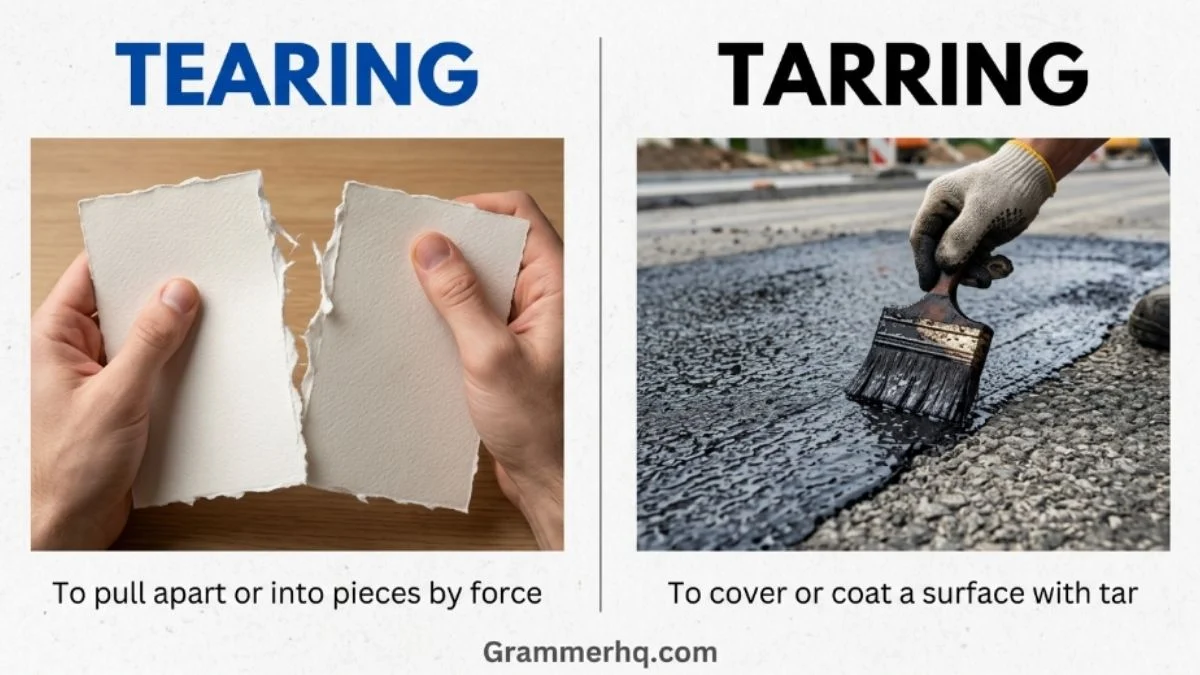
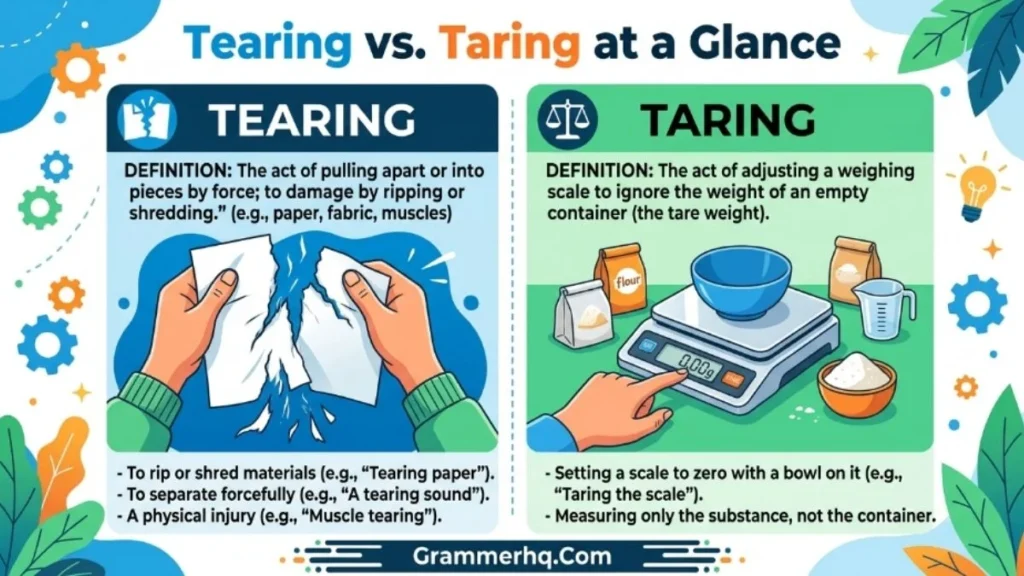
Tearing and taring are different words with different meanings and pronunciations. Tearing comes from tear and can mean ripping something apart or beginning to cry.
Taring comes from tare and means setting a scale to account for the weight of a container before measuring its contents.
In simple terms: tearing is about ripping or crying, while taring is about weighing accurately.
Tearing or Taring at a Glance
| Root Verb | Meaning | Part of Speech | Past Tense | Common Fields | Example |
|---|---|---|---|---|---|
| Tear | Rip apart; produce tears | Verb | Tore | Everyday English, emotions, physical actions | She is tearing the paper. |
| Tare | Subtract container weight from a measurement | Verb | Tared | Scales, laboratories, shipping, manufacturing | He is taring the scale. |
The easiest way to separate them is to remember their root verbs: tear → tearing and tare → taring.
What Does “Taring” Mean?
The Verb “Tare” Explained
Taring is the present participle or gerund form of the verb tare. It means adjusting a weighing scale so that the weight of an empty container is excluded from the measurement.
For example, if you place an empty bowl on a kitchen scale and the scale shows 500 grams, you can press the tare button. The display returns to zero.
When you add flour, the scale measures only the flour rather than the bowl plus the flour.This makes taring an important part of accurate weighing.
How Taring Actually Works
The process is simple:
- Place the empty container on the scale.
- Let the scale register its weight.
- Press the tare button.
- The scale resets the displayed measurement to zero.
- Add the material you want to weigh.
The container is still physically on the scale, but its weight has been mathematically removed from the displayed measurement.
Taring vs. Zeroing: Are They the Same?
They are closely related, but there is an important distinction.
Taring specifically accounts for the weight of a container or other load that should not be included in the final measurement.
Zeroing generally means bringing a scale back to its reference zero when there is no intended load or when the instrument needs calibration or adjustment.
So, although both actions can make the display show 0, they are not always technically identical.
Where Is Taring Used?
Taring is common wherever accurate measurements matter. You may encounter it in:
- Kitchens when weighing ingredients
- Laboratories when measuring chemicals or samples
- Pharmacies when preparing precise quantities
- Shipping when calculating net package weight
- Manufacturing when weighing materials
- Warehouses when measuring products
- Vehicle and trucking operations when dealing with tare weight
In transportation, tare weight refers to the weight of an empty vehicle or container. It helps determine the net weight of the cargo by separating the cargo from the total loaded weight.
Taring in a Sentence
- I am taring the kitchen scale before adding the flour.
- The technician finished taring the laboratory balance.
- Always tare the container before measuring the powder.
- The shipping clerk checked the container’s tare weight.
- She forgot to tare the scale before weighing the ingredients.
- The truck’s tare weight was recorded before loading the cargo.
What Does “Tearing” Mean?
Tearing as Ripping
Tearing is the -ing form of tear when tear means to rip, split, or pull something apart.
For example:
He is tearing the paper into smaller pieces.
Here, tearing describes a physical action. The paper is being ripped.
The word can describe many materials and objects, including paper, fabric, plastic, cardboard, and clothing.
Tearing as Crying
Tearing can also relate to producing tears from the eyes.
When someone says:
She was tearing up during the emotional speech.
it means she was beginning to cry or her eyes were filling with tears.
This meaning is especially common in the phrase tearing up.
The context tells you which meaning is intended. Tearing paper means ripping it, while tearing up in an emotional situation can mean becoming close to tears.
Tearing in a Sentence
Physical meaning:
- He is tearing the old newspaper.
- The child was tearing the wrapping paper.
- Be careful when tearing the fabric.
Emotional meaning:
- She started tearing up during the movie.
- I was tearing up while listening to his speech.
- His emotional story left everyone tearing up.
Are “Tearing” and “Taring” Pronounced the Same?
No. This is one of the most useful differences between the two words.
Tearing and taring may look extremely similar in writing, but their pronunciation is different in standard English.
| Word | Root | Pronunciation Guide | Main Meaning |
|---|---|---|---|
| Tearing | Tear | sounds like TAIR-ing | Ripping or crying |
| Taring | Tare | sounds like TAIR-ing in many accents | Setting a scale for container weight |
Here is the important point: the two words can actually sound the same in many standard English accents.
The root words tear and tare are commonly homophones when tear means “rip.” Both are generally pronounced with the same vowel sound.
That means you often cannot tell “tearing” and “taring” apart by sound alone. The surrounding context becomes essential.
For example:
- “She is tearing the paper.” → ripping
- “She is taring the scale.” → adjusting the weighing measurement
This makes the spelling especially important in technical writing.
Where Do “Tear” and “Tare” Come From?
The Origin of “Tear”
The verb tear, meaning to rip or pull apart, comes from Old English teran, meaning to tear or lacerate. It has developed through the history of Germanic languages into the modern English word we use today.
This history is unrelated to the weighing sense of tare.
The Origin of “Tare”
Tare has a different history. The weighing term is connected through French and Italian to an Arabic word referring to the deduction made for the weight of a container.
The word eventually became established in English for the weight of packaging or a container that must be excluded when calculating net weight.
An interesting historical detail is that the term tare also appears in older records concerning weighing and inventories, including historical references associated with gunpowder and other stored materials.
Tearing and Taring: Grammar & Verb Forms
Understanding the root verbs makes the forms much easier to remember.
| Form | Tear | Tare |
|---|---|---|
| Present | tear | tare |
| Past | tore | tared |
| Past participle | torn | tared |
| -ing form | tearing | taring |
Notice the major difference in the past tense:
tear → tore → torn
but
tare → tared → tared
So if you are talking about ripping something, the past tense is tore, not “tared.”
If you are talking about adjusting a scale, tared is correct.
Tearing or Taring: Key Differences at a Glance
- Tearing comes from tear.
- Taring comes from tare.
- Tearing means ripping something apart or becoming emotional.
- Taring means accounting for container weight during weighing.
- Tearing is common in everyday English.
- Taring is especially common in technical, scientific, commercial, and weighing contexts.
- Their pronunciation can be the same, so context and spelling matter.
- Tore is the past tense of tear.
- Tared is the past tense of tare.
Common Mistakes and How to Fix Them
1: Using “taring” for ripping
❌ He is taring the paper.
✅ He is tearing the paper.
Use tearing when something is being ripped or split.
2: Using “tearing” for a scale
❌ I am tearing the scale before weighing the flour.
✅ I am taring the scale before weighing the flour.
Use taring when you are accounting for the container’s weight.
3: Confusing “tore” and “tared”
❌ She tared the letter yesterday.
✅ She tore the letter yesterday.
4: Assuming similar spelling means similar meaning
The extra a in taring is not just a spelling variation. It connects the word to the verb tare, which has a completely different meaning.
A Simple Memory Trick for Tearing vs. Taring
Use this quick mnemonic:
TEAR = rip or cry.
TARE = weigh.
Think of the A in tare as standing for accuracy.
When you are making a scale accurate by removing the container’s weight, think:
TARE → Accuracy → Weighing
When something is being ripped apart, think:
TEAR → Rip
This simple connection can help you choose the correct spelling quickly.
Did You Know? “Tare” Has Another Meaning
There is another, unrelated word tare.
In older English and biblical contexts, tare can refer to a weed or vetch-like plant. This is the word found in the expression “wheat and tares.”
It is completely different from the weighing term tare.
So English actually has another layer of confusion here: the same spelling can represent different words with different histories and meanings.
Quick Quiz: Can You Tell Them Apart?
Choose tearing or taring in each sentence.
- She is ___ the envelope open.
- The chef is ___ the scale before adding flour.
- He started ___ up during the movie.
- The technician is ___ the laboratory balance.
- The child was ___ the paper into pieces.
- The shipping team recorded the container’s ___ weight.
Answers:
- tearing
- taring
- tearing
- taring
- tearing
- tare
If you got all six right, you have mastered the basic difference.
Related Word Confusions You Might Also Like
If tearing vs. taring helped you, these related comparisons can make your English even stronger:
- Tear vs. Tore vs. Torn — understand all forms of the irregular verb.
- Tare vs. Zero — learn the technical difference when using a scale.
- Rip vs. Tear vs. Shred — compare three words for damaging or separating material.
- Breath vs. Breathe — a common spelling and pronunciation confusion.
- Complement vs. Compliment — two similar words with completely different meanings.
FAQs
1: Is “taring” a real word?
Yes. Taring is the correct -ing form of tare. It means adjusting a scale to exclude the weight of a container or other unwanted load.
2: What is the difference between tear and tare?
Tear can mean to rip something apart, while tare relates to weighing and the deduction of container weight. They have different meanings and origins.
3: Do tearing and taring sound exactly the same?
In many standard English accents, tearing and taring are pronounced the same or nearly the same when tear means “rip.” Because of this, context is often necessary to identify which word is meant.
4: What is the past tense of taring?
The past tense of tare is tared.
Example: “The technician tared the balance before taking the measurement.”
5: What is the past tense of tearing?
The past tense of tear is tore.
Example: “She tore the paper in half.”
6: What is the difference between tare and zero on a scale?
Tare removes the weight of a container or other load from the displayed measurement. Zeroing generally establishes or restores the scale’s zero reference. The two functions can look similar on a digital scale but have different technical purposes.
7: Can “tearing” mean crying?
Yes. Tearing up commonly means becoming emotional or beginning to cry.
Example: “He was tearing up while talking about his family.”
8: Is “tare” used for anything besides scales?
Yes. Tare can refer to the weight of an empty container or vehicle, especially in shipping and transportation. There is also an unrelated older word tare referring to a weed or plant.
Key Takeaways: Tearing or Taring?
The difference becomes easy once you remember the root verbs:
- Tearing → from tear → ripping or crying.
- Taring → from tare → adjusting a scale for container weight.
- Tore → past tense of tear.
- Tared → past tense of tare.
- The two can sound the same, so spelling and context are important.
- Tare weight is especially important in shipping, trucking, manufacturing, and weighing.
- Remember: TEAR = rip; TARE = weigh.
Once you connect each spelling with its root verb and meaning, tearing vs. taring is no longer a confusing pair.
Read More Blogs:
- Dual vs Duel: What’the Difference? Meaning, Usage & Examples
- Blankie vs Blanky: Which Spelling Is Correct?

Hi, I’m Amelia Parker, a grammar enthusiast and writer at GrammarHQ.com. I specialize in explaining spelling differences, confusing words, and common English mistakes through simple, practical, and easy-to-understand guides.