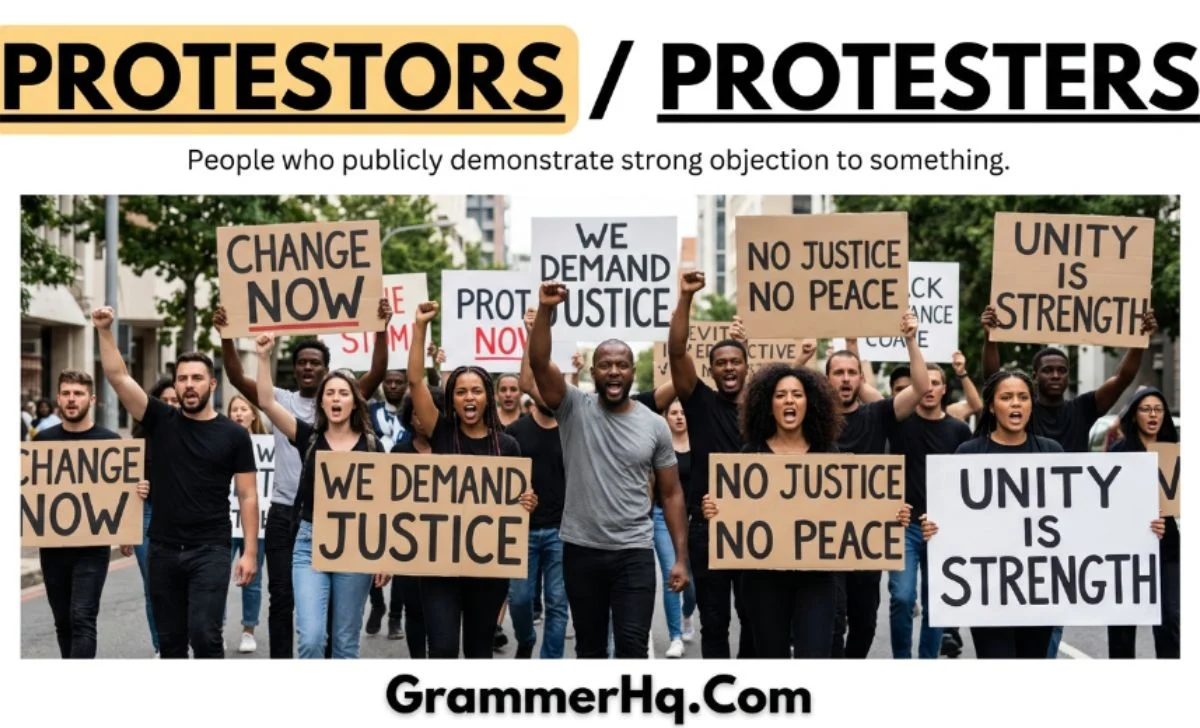
Seeing protestors and protesters in different articles can make a simple spelling choice surprisingly difficult. Both forms appear in modern English, so the question is not whether one is a completely wrong word.
The real issue is which spelling is more common, widely recognized, and suitable for your writing. If you are preparing an essay, publishing a news article, writing for a website, or simply checking your English, choosing the familiar form can make your sentence clearer.
In this guide, we will examine protestors or protesters, explain their meanings, pronunciation, grammar, history, regional usage, and practical differences, and show you when each form works. By the end, you will know which spelling to choose with confidence.
Quick Answer
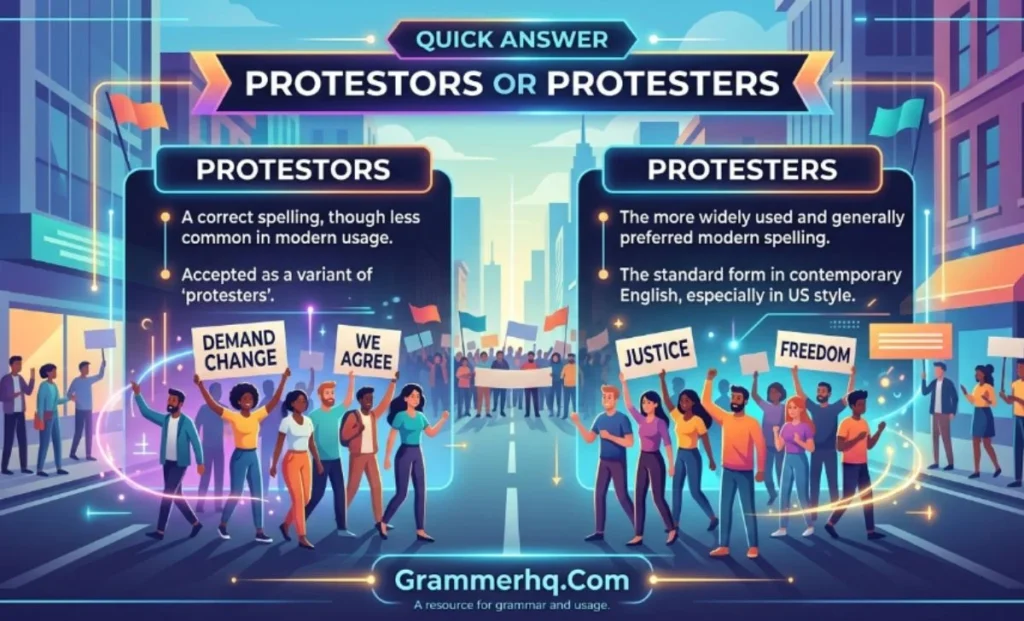
Protesters is the more common spelling and the best general choice for modern English.
However, protestors is also a legitimate English spelling. It is not a spelling mistake. Cambridge Dictionary lists protestor as an alternative form of protester, while Merriam-Webster gives the noun as protester or protestor.
The simplest rule
| Word | Status | Recommendation |
|---|---|---|
| protesters | Standard and more common | Best general choice |
| protestors | Correct alternative | Acceptable |
| protester | Singular form | Correct |
| protestor | Alternative singular form | Correct |
So, if you are unsure which one to type, choose protesters.
Example
Thousands of protesters gathered outside the parliament building.
This is a natural choice for everyday, professional, academic, and journalistic writing.
What Does Protester Mean?
A protester is a person who publicly expresses disagreement, opposition, or support, usually by participating in a protest or demonstration.
Cambridge defines a protester as someone who shows disagreement by actions such as standing somewhere, shouting, or carrying signs. It also lists protestor as an alternative spelling.
The word can describe someone involved in many different causes.
For example:
- environmental protesters
- student protesters
- anti-war protesters
- civil rights protesters
- labor protesters
- climate protesters
- political protesters
- peace protesters
The underlying idea is the same: a person publicly expressing a position or objection.
Real-life example
Imagine a city council announces plans to remove a public park. Local residents organize a peaceful gathering outside the council building and hold signs asking officials to reconsider.
Those people can accurately be called protesters.
The word does not automatically tell us whether their actions are peaceful, disruptive, legal, or illegal. It simply identifies their participation in a protest.
Protesters vs Protestors: Is There a Difference in Meaning?
No.Protester and protestor normally refer to the same thing. The difference is primarily spelling, not meaning.
Merriam-Webster treats protestor as a variant of protester, while Cambridge lists protestor as an alternative form.
Compare these sentences:
The protesters marched through the city.
The protestors marched through the city.
The meaning remains essentially identical.
You do not need to choose one based on whether the people support or oppose a particular issue. The spelling does not change the nature of the demonstration.
Why Do Both Spellings Exist?
English frequently forms nouns for people by adding different endings to verbs.
For example:
- teach → teacher
- work → worker
- drive → driver
- inspect → inspector
- supervise → supervisor
The word protester follows the familiar -er pattern, while protestor uses -or.
That variation is one reason both forms have survived.
It is also important not to assume that every English word ending in -er has an -or alternative, or vice versa. English spelling patterns developed over centuries and are not completely predictable.
A useful way to remember it
Think of:
protest + er = protester
That is the form most readers will recognize immediately.
Protester or Protestor: Which One Is More Common?
Protester is the more common form.
Dictionary.com explicitly notes that the -er spelling is much more common, although the -or spelling has increased in usage.
This explains why you may encounter protestor regularly without it being the preferred choice for general writing.
The difference is therefore not:
correct vs incorrect
It is better understood as:
more common form vs alternative form
That distinction matters because English often accepts more than one spelling for the same word.
British English vs American English
There is no major British-American spelling split here.
Unlike words such as color/colour or organize/organise, the choice between protester and protestor is not primarily a US-versus-UK spelling rule.
Both forms can appear in English-language publications on either side of the Atlantic.
Cambridge provides both pronunciations and identifies protestor as an alternative to protester.
What should you use?
For either American or British English, protester is a strong default.
If you are following a particular publication’s house style, however, follow that publication’s established preference.
Pronunciation of Protester and Protestor
The two spellings are pronounced essentially the same in ordinary English.
American English
protester: /ˈproʊ.tes.tɚ/
British English
protester: /prəˈtes.tər/
Cambridge gives these pronunciations for protester and also lists protestor as an alternative form.
The spelling difference does not normally create a meaningful pronunciation difference.
Easy pronunciation tip
Break the word into three parts:
pro + test + er
→ protester
For protestor, the final spelling changes, but the spoken form remains very similar.
When Should You Use Protesters?
Choose protesters when you want the most familiar and broadly useful form.
It works especially well in:
Academic writing
The researchers interviewed several protesters after the demonstration.
News writing
Hundreds of protesters gathered near the courthouse.
Business communication
Employees reported seeing protesters outside the company’s headquarters.
School assignments
The protesters called for changes to the new policy.
Website content
Protesters marched peacefully through the downtown area.
Everyday conversation
The protesters were carrying signs and chanting slogans.
Because the form is widely recognized, it is an excellent default when you have no reason to choose the alternative.
When Can You Use Protestors?
You can use protestors when a publication, organization, author, or established writing style uses that spelling.
For example:
Several protestors were present outside the building.
This sentence is grammatically acceptable.
The important point is that protestors should not be labeled a spelling error simply because protesters is more common.
Merriam-Webster explicitly lists protestor as a variant, and Cambridge identifies it as an alternative form.
One practical rule
If you start an article with protesters, keep using protesters unless there is a specific reason to change.
Consistency makes your writing cleaner.
Singular and Plural Forms:
The singular forms are:
- protester
- protestor
The plural forms are:
- protesters
- protestors
Examples
Singular:
A protester held a sign near the entrance.
Plural:
Several protesters joined the march.
Alternative singular:
One protestor spoke to the reporter.
Alternative plural:
Several protestors remained outside the building.
Both sets follow normal English plural formation.
Protester, Demonstrator, Activist, or Rioter?
These words are related, but they are not perfect substitutes.
Protester
A person participating in a protest.
The protesters gathered outside the office.
Demonstrator
A person taking part in a demonstration. Cambridge also defines demonstrator in this sense.
The demonstrators marched toward the square.
Activist
A person who actively works to promote or oppose a particular cause.
The environmental activist organized a campaign.
Someone can be both an activist and a protester, but the terms describe different aspects of the person.
Rioter
A person involved in a riot or violent public disorder.
This word should not automatically replace protester. Calling someone a rioter makes a stronger claim about their conduct.
Therefore, careful writing should use the most accurate term rather than treating these words as interchangeable.
Common Mistakes to Avoid
1: Calling Protestors Incorrect
❌ Protestors is always wrong.
This is inaccurate.
✅ Protestors is an accepted alternative spelling.
Major dictionaries support this distinction.
2: Treating the Words as Different People
❌ Protesters are peaceful, while protestors are aggressive.
There is no spelling-based rule like this.
The two forms refer to the same type of person.
3: Mixing Forms Without Reason
The protesters arrived first, followed by several protestors.
This is not grammatically wrong, but switching spellings unnecessarily can make an article look inconsistent.
Better:
The protesters arrived first, followed by several more protesters.
4: Assuming British English Requires Protestor
British English does not require the -or form.
Protester is perfectly suitable for British writing.
Protesters or Protestors in Real-Life Sentences
The spelling protesters appears naturally in news reports, schools, workplaces, public demonstrations, and community discussions. Here are realistic examples showing how the word works in different contexts.
At a University
Outside the administration building, student protesters called for changes to the university’s new policy.
During an Environmental Campaign
Climate protesters marched through the city center while calling for stronger environmental protections.
At a Public Meeting
Before the council meeting began, several protesters gathered near the entrance to voice their concerns.
In a News Report
Police reported that the protesters had dispersed peacefully by late evening.
During a Workplace Dispute
Employees joined the demonstration after proposed changes to working conditions were announced.
In a Historical Context
Peace protesters organized marches and public demonstrations during the anti-war movement.
Using the Alternative Spelling
Several protestors gathered outside the building to express their opposition to the proposed changes.
Although protestors is correct, protesters is the more common spelling and is usually the better choice for general, academic, professional, and online writing.
Protesters or Protestors in Formal Writing
For essays, reports, research papers, websites, and professional documents, protesters is usually the safest default.
Why?
Because it is:
- familiar to a broad readership
- widely recognized
- straightforward to spell
- commonly used in contemporary English
- less likely to distract readers
However, formal writing does not make protestors grammatically wrong.
If your institution or publication has a style preference, follow that rule consistently.
A Simple Memory Trick:
If you often hesitate between the two spellings, remember:
People who protest are protesters.
Think:
protest + ER = PROTESTER
The -er ending is the easiest default.
If you encounter protestor, do not assume you have found an error. Just recognize it as the alternative spelling.
Protesters or Protestors: Quick Comparison
| Feature | Protesters | Protestors |
|---|---|---|
| Correct English | Yes | Yes |
| Singular | Protester | Protestor |
| Plural | Protesters | Protestors |
| Meaning | Person who protests | Person who protests |
| Pronunciation | Essentially the same | Essentially the same |
| Commonness | More common | Less common |
| Best general choice | Yes | Acceptable alternative |
| Suitable for formal writing | Yes | Yes |
| US English | Yes | Yes |
| UK English | Yes | Yes |
The key takeaway is simple: both are valid, but protesters is the better default for most writers.
Why Does the Spelling Matter?
At first glance, choosing between two valid spellings may seem unimportant. In practice, word choice affects how easily readers understand and process your writing.
If you are writing for a broad audience, the more familiar form can reduce unnecessary hesitation.
For example, compare:
The protestors gathered outside the courthouse.
with:
The protesters gathered outside the courthouse.
Both are correct. The second is simply the more familiar choice for many readers.
This does not mean the alternative should be treated as an error. It means frequency and familiarity are useful factors when choosing between accepted variants.
What Is the Best Spelling for SEO Content?
For most SEO articles, protesters is the better primary spelling.
The reason is not that search engines consider protestors grammatically wrong. Instead, protesters is the more common form according to Dictionary.com, while major dictionaries recognize both variants.
A natural SEO strategy is therefore:
- use protestors or protesters in the title if that matches the search intent;
- explain both forms naturally;
- make protesters the primary form;
- mention protestors where useful;
- avoid repeating either spelling unnaturally.
The article should serve the reader first rather than forcing the keyword into every paragraph.
FAQs
1: Is protesters or protestors correct?
Both are correct. Protesters is the more common form, while protestors is an accepted alternative. Cambridge and Merriam-Webster both recognize the two forms.
2: Which is more common: protesters or protestors?
Protesters is more common. Dictionary.com specifically describes the -er form as much more common, while noting that the -or spelling has increased in usage.
3: Is protestors a misspelling?
No. Protestors is a legitimate variant spelling, not simply a typo. Merriam-Webster lists protester or protestor, and Cambridge gives protestor as an alternative.
4: Do protesters and protestors mean the same thing?
Yes. In ordinary modern English, both words refer to a person who protests.
5: Which spelling should I use in an essay?
Use protester unless your teacher, university, publisher, or chosen style guide specifically prefers protestor.
6: Is protesters American or British English?
Protesters is used in both American and British English. The choice is not a simple US-versus-UK spelling difference.
7: What is the singular of protesters?
The singular is protester.
One protester spoke to the journalist.
8: What is the plural of protestor?
The plural is protestors.
Several protestors gathered near the entrance.
9: Can I use protestors in formal writing?
Yes. The spelling is accepted. However, protesters is generally the safer choice when you want the most familiar form.
10: Should I use protesters for website content?
Yes. Protesters is a strong default for general web writing because it is the more common spelling and is widely recognized.
Conclusion
When choosing between protestors or protesters, you do not need to worry about choosing a completely wrong word. Both spellings are recognized in modern English, and both describe people who take part in protests.
The practical difference is frequency: protesters is the more common form and the best default for most readers, while protestors remains an accepted alternative. Cambridge and Merriam-Webster both recognize the variant relationship.
If you are writing an essay, article, report, or website, choose protesters unless a specific style preference tells you otherwise. That simple choice gives your writing a familiar, clear, and polished appearance.
Read More Blogs:

Hi, I’m Amelia Parker, a grammar enthusiast and writer at GrammarHQ.com. I specialize in explaining spelling differences, confusing words, and common English mistakes through simple, practical, and easy-to-understand guides.