Laser vs Lazer can be confusing because both spellings suggest the same pronunciation. But when you mean the technology, device, or beam of light, laser is the correct standard spelling.
Lazer is normally a misspelling, although it can be intentional in a brand name, product name, username, or other proper name.
The confusion mainly comes from pronunciation. Laser is pronounced roughly like “LAY-zer,” with a /z/ sound even though it is written with an s.
The spelling is also the same in American and British English, so lazer is not a British spelling of laser.
Quick Answer
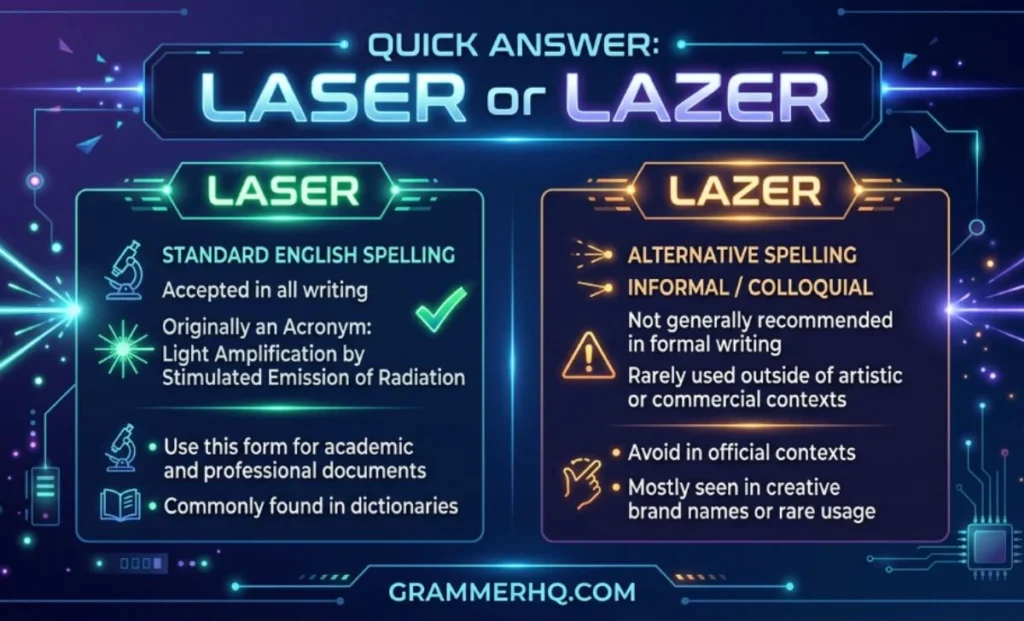
Laser is the correct standard English spelling.
Lazer is normally incorrect when referring to the technology or device that produces a powerful, controlled beam of light.
| Word | Standard English? | Typical use |
|---|---|---|
| Laser | ✅ Yes | Technology, device, beam, treatment, equipment |
| Lazer | ❌ Normally no | Misspelling or intentional name/branding |
Simple rule: If you mean the technology, write laser.
Laser or Lazer: What Is the Difference?
The difference is mainly spelling and standard usage.
Laser is an established English word for a device that produces a powerful, narrow beam of light. It is used in many fields, including medicine, manufacturing, printing, communications, research, and measurement.
Lazer, when used to mean the same thing, is normally a spelling mistake.
For example:
- laser beam ✓
- laser printer ✓
- laser treatment ✓
- laser cutting ✓
- lazer beam ✗
- lazer printer ✗
- lazer treatment ✗
So, if you are writing about the technology in an essay, article, report, email, or technical document, laser is the form to use.
What Does “Laser” Mean?
A laser is a device that produces a powerful, highly controlled beam of light. Lasers are used for many practical purposes, from medical procedures and manufacturing to printing, scanning, communications, and scientific research.
Common expressions include:
- laser beam
- laser pointer
- laser printer
- laser surgery
- laser treatment
- laser therapy
- laser cutting
- laser engraving
- laser scanner
- laser technology
For example:
The engineer aligned the laser beam before testing the equipment.
The clinic offers laser treatment for certain skin conditions.
The factory uses laser cutting to make precise components.
The word therefore belongs naturally to areas such as physics, optics, photonics, medicine, engineering, and manufacturing.
Why Is It Spelled “Laser” Instead of “Lazer”?
The spelling laser comes from a scientific acronym.
LASER stands for:
Light Amplification by Stimulated Emission of Radiation
The letters come from:
- L — Light
- A — Amplification
- S — Stimulated
- E — Emission
- R — Radiation
The word entered English from this scientific term in the 1960s. Oxford records this origin and now treats laser as an established English noun.
That history also gives you an easy way to remember the spelling:
Laser has an S — think “Stimulated.”
One useful distinction is that laser is now normally treated as a regular English word. You do not need to write LASER in all capitals every time you use it in ordinary prose.
Why Do People Spell “Lazer”?
The main reason is pronunciation.
The s in laser is pronounced with a /z/ sound. Cambridge gives the US pronunciation as /ˈleɪ.zɚ/ and the UK pronunciation as /ˈleɪ.zə(r)/.
In simple terms:
laser → “LAY-zer”
Because the spoken sound resembles z, some people naturally write lazer.
That spelling may look logical, but English spelling does not always match pronunciation perfectly. In this case, the standard spelling remains laser.
So:
laser ✓
lazer ✗ when referring to the technology
Is “Lazer” Ever Correct?
There is an important exception.
Lazer can be correct when it is deliberately used as a proper name, brand name, product name, username, fictional name, or other stylized name.
For example, if a company officially calls a product Lazer, that spelling should be preserved when referring to that specific product.
This is different from using lazer as an ordinary spelling of the technology.
Use “laser” when you mean:
- the technology
- a laser device
- a laser beam
- laser treatment
- laser surgery
- laser cutting
- laser engraving
- laser printing
- laser research
Keep “Lazer” when it is:
- an official brand name
- an official product name
- a username
- a fictional or creative name
- an intentionally stylized name
So the safest rule is:
Use laser for the technology. Preserve Lazer when it is part of an official name.
This is why saying that Lazer is never a valid word in any context would be too broad.
Laser in American English vs British English
Laser is the standard spelling in both American English and British English.
American English
laser ✓
British English
laser ✓
The pronunciation can differ slightly between accents, but the spelling does not change. Cambridge lists UK and US pronunciations while using the same spelling, laser.
Therefore:
laser / laser ✓
Not:
laser / lazer ✗
This makes laser vs lazer different from familiar regional spelling pairs such as:
- color / colour
- center / centre
- theater / theatre
If you are writing for either US or UK readers, laser is the standard choice.
How Do You Pronounce “Laser”?
Laser is pronounced approximately:
LAY-zer
Cambridge lists:
- US: /ˈleɪ.zɚ/
- UK: /ˈleɪ.zə(r)/
Notice the /z/ sound.
That explains why lazer is such a common spelling mistake. People often spell unfamiliar words according to how they sound.
But pronunciation does not change the established spelling:
Laser → correct
Lazer → normally incorrect
Is Laser a Noun or a Verb?
Laser is most commonly used as a noun.
The technician switched on the laser.
The surgeon used a laser during the procedure.
The plural is:
lasers
The laboratory uses several lasers for different experiments.
Laser can also function as a verb in contexts where something is treated or processed with a laser.
The doctor lasered the affected tissue.
So the standard forms remain based on laser, not lazer.
Laser or Lazer Examples
The easiest way to see the difference is in real sentences.
Correct: Laser
The technician adjusted the laser before the test.
She bought a laser printer for her office.
The doctor recommended laser treatment.
The factory uses laser cutting to produce precise parts.
The presentation included a laser pointer.
Scientists are researching new uses for laser technology.
Incorrect in standard usage: Lazer
The technician adjusted the lazer before the test.
She bought a lazer printer for her office.
The doctor recommended lazer treatment.
When the writer means the standard technology, these should be changed to laser.
Exception: Official name
The product is officially called Lazer.
Here, Lazer is not being used as a spelling of the technology. It is being preserved as the product’s official name.
Common Laser and Lazer Mistakes
1. Spelling the word by sound
Because laser sounds like “LAY-zer,” people may write lazer.
Correct: laser
2. Assuming Lazer is British English
It is not.
American English: laser
British English: laser
3. Thinking laser and lazer are different technologies
In ordinary English, they are not two different technologies. Laser is the standard term.
4. Changing an official name
If a brand or product deliberately uses Lazer, do not automatically change its spelling to Laser when referring to that specific name.
5. Using LASER in every sentence
The word originated as an acronym, but laser is now an established English noun. Normal prose generally uses the lowercase form.
Laser or Lazer: Quick Comparison
| Feature | Laser | Lazer |
|---|---|---|
| Standard English spelling | ✅ | ❌ Normally |
| Standard technology term | ✅ | ❌ |
| Scientific writing | ✅ | ❌ |
| Medical writing | ✅ | ❌ |
| American English | ✅ | ❌ |
| British English | ✅ | ❌ |
| Pronunciation | “LAY-zer” | Usually intended similarly |
| Proper name | Possible | Possible |
| Brand/product name | Possible | Possible |
| Safe choice when unsure | Laser | No |
How to Remember Laser or Lazer
Use one simple memory trick:
Laser = S for Stimulated
Remember the original phrase:
Light Amplification by Stimulated Emission of Radiation
The S in Stimulated can help you remember why the standard spelling is:
LASER ✓
rather than:
LAZER ✗
You do not need to memorize a complicated spelling rule. Just remember the S.
FAQs
Is laser or lazer correct?
Laser is the correct standard spelling when you mean the technology, device, or beam of light. Lazer is normally a misspelling unless it is part of an intentional name or brand.
Is “lazer” a real word?
Lazer can appear as a proper name, brand, username, product name, or stylized spelling. It is not the standard spelling of the technology term laser.
Is “lazer” the British spelling of laser?
No. Laser is used in both British and American English. The spelling does not change between the two varieties.
Why does laser have an S if it sounds like a Z?
Because the s in laser represents a /z/ sound in pronunciation. This is why lazer can seem like a natural spelling, but the established spelling remains laser.
What does LASER stand for?
LASER stands for Light Amplification by Stimulated Emission of Radiation. The term originated as a scientific acronym and later became an ordinary English word.
What is the plural of laser?
The plural is lasers.
The laboratory uses several lasers.
Is laser a noun or a verb?
Laser is primarily a noun, but it can also be used as a verb in contexts describing an action performed with a laser.
Conclusion
When you mean the technology, device, or beam of light, laser is the correct standard spelling. Lazer is normally a misspelling in this context, not an alternative American or British spelling.
The confusion comes mainly from pronunciation: laser sounds roughly like “LAY-zer,” with a /z/ sound. Its spelling, however, remains laser in both US and UK English.
If Lazer appears as an official brand, product, username, or other proper name, keep that spelling. Otherwise, when you are talking about the technology, the rule is simple:
Laser is correct. Lazer is normally not.
Read More Blogs
- Caribbean vs Carribean: The Correct Spelling?
- Buoy or Bouy: Which Spelling Is Correct?
- Input vs Imput: Which Spelling Is Correct?
- Baptised or Baptized? The Correct Spelling Explained?

Hi, I’m Amelia Parker, a grammar enthusiast and writer at GrammarHQ.com. I specialize in explaining spelling differences, confusing words, and common English mistakes through simple, practical, and easy-to-understand guides.










