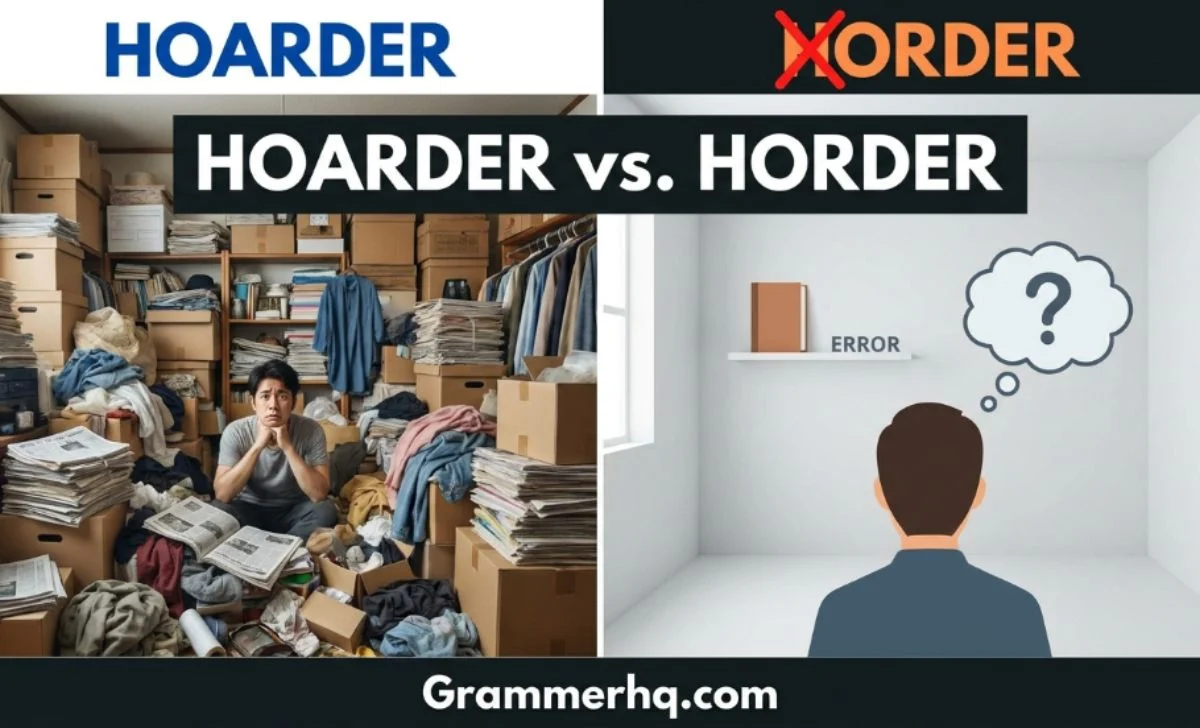
Hoarder vs Horder can be confusing because the two spellings look almost identical. If you are trying to describe someone who collects and keeps a large amount of things, the correct spelling is hoarder.
Horder is not the standard English spelling for this meaning. The word hoarder comes from the verb hoard, meaning to collect and store something, often in large quantities.
Adding -er gives us hoarder, meaning a person or animal that hoards. In this guide, we will explain the difference.
Between hoarder vs horder, why the incorrect spelling looks tempting, how to remember the correct form, and how to use hoarder naturally in everyday and formal writing.
Quick Answer:
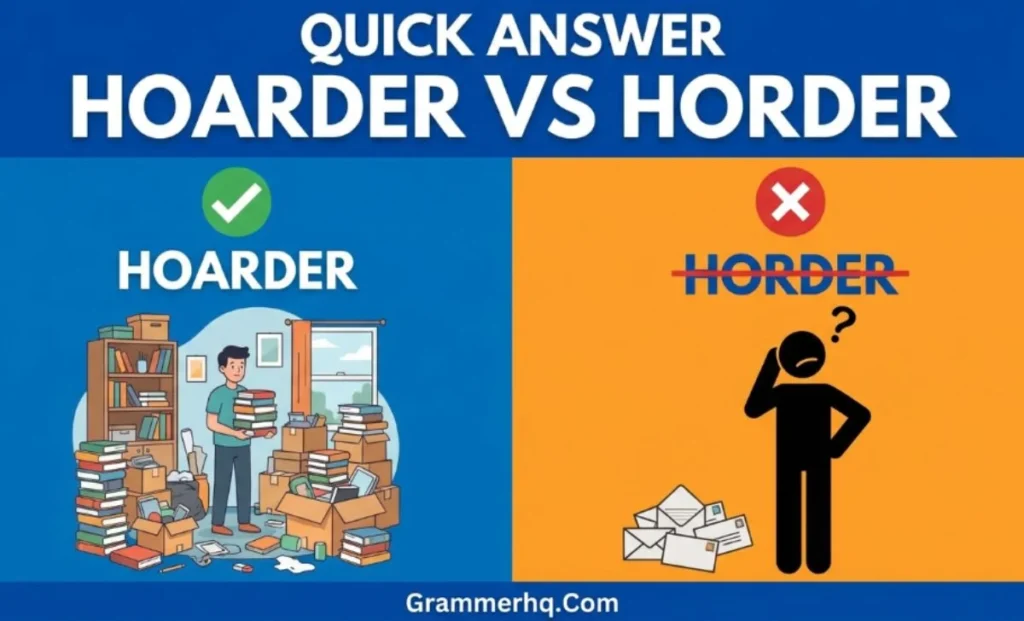
Hoarder is the correct spelling in modern standard English.
Use hoarder when referring to a person or animal that hoards something.
Horder is not the standard modern spelling for this meaning, although the form has historical uses and can appear as a surname.
| Word | Modern standard spelling? | Meaning |
|---|---|---|
| Hoarder | ✅ Yes | A person or animal that hoards |
| Horder | ❌ No | Not the standard modern spelling for this meaning |
| Hoard | ✅ Yes | To collect and keep something |
| Horde | ✅ Yes | A large group |
The spelling trick
HOARD + ER = HOARDER
If you know how to spell hoard, you already know how to spell hoarder.
What Does Hoarder Mean?
A hoarder is someone who accumulates and keeps large amounts of something.
The word can describe someone who keeps:
- clothes
- books
- food
- money
- household items
- supplies
- digital files
- information
- collectibles
For example:
My brother is a book hoarder with hundreds of novels.
Here, hoarder simply describes someone who keeps accumulating books.
The word can also be used in a broader or humorous way:
I’m a coffee-mug hoarder.
This does not necessarily mean the person has a serious problem. It may simply mean they have collected far more mugs than they need.
So hoarder is a context-dependent word. It can be literal, descriptive, humorous, or related to a specific clinical condition when the context calls for it.
Why Is It Hoarder and Not Horder?
The answer is surprisingly simple: look at the base word.
The base word is hoard.
The suffix -er is commonly used to form a noun for someone who performs an action.
For example:
- teach → teacher
- drive → driver
- work → worker
- farm → farmer
- run → runner
- hoard → hoarder
Therefore:
hoard → hoarder
The a is not an extra letter. It belongs to the word hoard, so it remains when -er is added.
This is the key to the spelling.
Why Does Horder Look Correct?
The main reason is pronunciation.
Hoard and horde sound alike in standard English, and hoard is pronounced similarly to hord. When people hear hoarder without seeing it written, the spelling horder can seem perfectly logical.
But English spelling is not always based on sound alone.
Consider the relationship:
hoard → hoarder
The written form preserves the spelling of the base word.
That is why the best strategy is not to spell the word from pronunciation. Instead, identify its base:
What does hoarder come from?
Hoard.
Therefore:
hoard + er = hoarder
How Do You Pronounce Hoarder?
Hoarder is pronounced approximately like:
HOR-der
The pronunciation can make the spelling confusing because the a in hoard is not pronounced as a separate sound.
That creates a common spelling trap:
Sound: hoarder
Possible guess: horder
Correct spelling: hoarder
The pronunciation explains the confusion, but it does not change the spelling.
Hoarder vs Horder: Why Do People Confuse Them?
There are several reasons these spellings get mixed up.
1: They Sound Nearly Identical
When spoken aloud, the difference is difficult or impossible to hear.
2: The A Is Easy to Miss
The a in hoard is part of the written word but does not create a separate vowel sound in pronunciation.
3: People Often Spell From Sound
If someone has heard hoarder many times but rarely seen it written, horder can look natural.
4: The Word “Horde” Adds More Confusion
English also has the word horde, meaning a large group.
Because hoard, horde, and hoarder look similar and sound alike in some forms, they can easily become mixed up.
The solution is to focus on meaning and word structure rather than sound.
Hoard vs Horde vs Hoarder
These words are related in appearance but have different meanings.
Hoard
Hoard can be a noun or a verb.
As a noun, it means a stored collection of valuable or useful things.
Archaeologists discovered a hoard of ancient coins.
As a verb, it means to collect and keep something, often in large quantities.
He tends to hoard old newspapers.
Horde
Horde means a large group or crowd.
A horde of fans gathered outside the stadium.
A horde is not a collection of possessions.
Hoarder
A hoarder is someone or something that hoards.
She is a hoarder of old books.
The simplest distinction is:
Hoard = collect and keep
Horde = large group
Hoarder = one who hoards
Is Horder a Real Word?
This is where the answer needs a little more nuance.
If you are asking whether horder is the standard modern English spelling for someone who hoards, the answer is no.
However, it would be inaccurate to say that the form has never existed.
Horder has historical evidence in English and can also occur as a surname. Historical forms and modern proper-name uses are different from the standard common noun used in everyday English today.
So there are two separate questions:
Was “horder” ever used historically?
Yes.
Should you use “horder” in modern English when you mean someone who hoards?
No. Use hoarder.
This distinction matters because a word can have historical or proper-name uses without being the standard spelling of a modern common noun.
Horder as a Surname
Horder may appear as a family name.
If you encounter Horder as someone’s surname, it should not automatically be “corrected” to Hoarder.
A proper name follows its established spelling.
That is completely different from using horder as the ordinary noun for a person who hoards.
Hoarder vs Collector: Are They the Same?
Not necessarily.
A collector usually gathers specific items because of an interest, hobby, profession, investment, or another clear purpose.
For example:
David collects vintage watches and displays them in a cabinet.
Calling David a collector makes sense because the objects have a particular focus.
Hoarder, on the other hand, often suggests excessive accumulation or difficulty getting rid of possessions.
For example:
He keeps broken appliances, old newspapers, and unused containers because he cannot bring himself to throw them away.
The distinction is not absolute. People often use hoarder humorously:
I’m a serious sneaker hoarder.
In this context, the speaker may simply mean they own a large number of sneakers.
So the meaning depends heavily on context.
Hoarder vs Hoarding vs Hoarding Disorder
Hoarder, hoarding, and hoarding disorder are related terms, but each one refers to something different. Knowing the distinction helps you choose the right word for the context.
Hoarder
A hoarder is a person who collects and keeps large amounts of things. The word can also describe an animal that stores food or other items.
She is a book hoarder with hundreds of novels.
The term can be used casually, too. Calling yourself a shoe hoarder, for example, may simply mean that you own a large collection of shoes.
Hoarding
Hoarding refers to the act or behavior of collecting and keeping large amounts of something, often instead of using, sharing, or discarding it.
Hoarding essential supplies can create shortages for other people.
The word can apply to many things, including food, money, supplies, possessions, information, and digital files.
Hoarding Disorder
Hoarding disorder is a specific mental health condition in which a person has persistent difficulty discarding or parting with possessions because of a strong perceived need to save them.
It is important not to treat the everyday word hoarder as automatically meaning someone with hoarding disorder. A person may jokingly call themselves a clothes hoarder without having a clinical condition.
Similarly, temporarily storing extra supplies does not by itself mean that someone has hoarding disorder.
In simple terms:
- Hoarder = the person or animal
- Hoarding = the behavior or act of accumulating and keeping things
- Hoarding disorder = a specific clinical condition
Using the precise term makes your writing clearer and avoids confusing an everyday description with a clinical diagnosis.
Is Hoarder American or British English?
Hoarder is standard in both American and British English.
There is no standard spelling difference such as:
- American: horder
- British: hoarder
Instead, both varieties use:
hoarder
This makes it different from genuine spelling variations such as:
- American color / British colour
- American center / British centre
- American organize / British organise
So whether you are writing for a US or UK audience, hoarder is the correct choice.
A British Meaning of Hoarding
There is, however, a separate regional difference involving hoarding.
In British English, hoarding can refer to a temporary fence or barrier around a construction site and can also refer to large advertising boards.
In American English, an advertising board is more commonly called a billboard.
This difference concerns hoarding, not the spelling of hoarder.
The Hoarder Word Family
One of the best ways to remember the spelling is to learn the word family.
| Word | Part of Speech | Meaning |
|---|---|---|
| hoard | Noun/verb | A stored collection; to collect and keep |
| hoarder | Noun | A person or animal that hoards |
| hoarding | Noun/verb form | The act of collecting and keeping |
| hoarded | Verb | Collected and stored |
| hoards | Noun/verb | Plural noun or present-tense verb |
The pattern is easy to see:
hoard → hoarder → hoarding → hoarded
The spelling of the base word hoard remains visible.
That is the reason hoarder contains an a.
Real-Life Examples of Hoarder
Here are some natural ways to use hoarder in a sentence.
Books
My sister is a book hoarder and has hundreds of novels.
Digital Files
I’m a digital hoarder with thousands of photos on my laptop.
Clothes
He jokes that he is a clothes hoarder because he never throws anything away.
Food
The shoppers were warned not to become food hoarders.
Money
The report discussed cash hoarders during the economic crisis.
Information
Some employees become information hoarders instead of sharing useful knowledge.
Animals
Squirrels are natural hoarders because they store food for later.
These examples show that hoarder can be used with many different types of things.
Common Spelling Mistakes
❌ Horder
If you mean a person who hoards, write:
✅ hoarder
❌ Hoardor
The standard suffix is -er:
hoard + er = hoarder
❌ Hordeer
This incorrectly combines horde with the ending used in hoarder.
❌ Horde
A horde is a large group, not a person who collects and stores things.
❌ Horded
Do not confuse the word family of hoard with horde.
The correct forms related to hoard include:
hoard → hoards → hoarded → hoarding → hoarder
The Easiest Way to Remember Hoarder
Forget the pronunciation.
Remember the base word:
HOARD + ER = HOARDER
Or use this simple sentence:
A hoarder hoards.
If someone hoards, that person is a hoarder.
The a comes from hoard, so it stays in hoarder.
This is much more reliable than trying to remember the spelling from sound.
Is Hoarder Correct in Formal Writing?
Yes.
Hoarder is the standard modern spelling and is suitable for both formal and informal writing.
You can use it in:
- essays
- reports
- articles
- academic writing
- professional communication
- news writing
- websites
- everyday conversation
For example:
The report examined the behavior of people who excessively accumulate possessions.
If you are specifically discussing the clinical condition, hoarding disorder is the more precise term.
Hoarder vs Horder: At a Glance
| Question | Hoarder | Horder |
|---|---|---|
| Standard modern spelling? | ✅ Yes | ❌ No |
| Means a person who hoards? | ✅ Yes | ❌ Not as the standard noun |
| Comes from hoard? | ✅ Yes | ❌ Not in modern standard usage |
| Used in American English? | ✅ Yes | ❌ No |
| Used in British English? | ✅ Yes | ❌ No |
| Can appear as a surname? | Yes | Yes |
| Has historical connections? | Yes | Yes |
| Best choice for normal writing? | Yes | No |
The important distinction is:
Historical use does not make “horder” the standard modern spelling.
For ordinary modern English, hoarder is the form to choose.
FAQs
1: Is it hoarder or horder?
Hoarder is the correct standard spelling when you mean a person who hoards. Horder is not the standard modern spelling for this meaning.
2: How do you spell hoarder?
The correct spelling is:
H-O-A-R-D-E-R
Hoarder.
3: Why does hoarder have an “a”?
Because it comes from hoard plus the suffix -er:
hoard + er = hoarder
4: Is horder a real word?
It has historical uses and can occur as a surname, but it is not the standard modern spelling of the common noun meaning a person who hoards.
5: What does hoarder mean?
A hoarder is someone or, in some contexts, an animal that collects and keeps large amounts of something.
6: What is the difference between hoard and hoarder?
Hoard can mean a stored collection or the act of collecting and keeping something. Hoarder refers to the person or thing that does the hoarding.
7: What is the difference between hoard and horde?
A hoard is something collected and stored. A horde is a large group.
8: Is hoarder the same in American and British English?
Yes. Hoarder is the standard spelling in both American and British English.
9: Is a hoarder the same as a collector?
Not necessarily. A collector usually gathers particular items for a specific interest or purpose, while hoarder often suggests excessive accumulation or difficulty discarding things.
10: Does hoarder always mean hoarding disorder?
No. Hoarder can be used casually or descriptively. Hoarding disorder is a specific clinical condition.
11: What is the easiest way to remember hoarder?
Remember:
HOARD + ER = HOARDER
Or simply:
A hoarder hoards.
Conclusion
When choosing between hoarder vs horder, the correct modern English spelling is hoarder.
The reason is straightforward: hoarder comes from hoard with the suffix -er:
hoard + er = hoarder
Although horder has historical evidence and can still appear as a surname, it is not the standard modern spelling for someone who hoards.
So if you are writing an email, essay, article, report, or professional document, choose hoarder.
Read More Blogs:
- Soo vs So: Which One Is Correct?
- Channeled or Channelled: American vs British English in 2026?
- Further or Farther: Difference, Meaning, Usage & Examples
- Storey vs Story: What’s the Difference? UK vs US English

Hi, I’m Amelia Parker, a grammar enthusiast and writer at GrammarHQ.com. I specialize in explaining spelling differences, confusing words, and common English mistakes through simple, practical, and easy-to-understand guides.