Offense vs offence can be confusing because both spellings are correct, but they belong to different varieties of English. Offense is the standard spelling in American English, while offence is preferred in British English.
Both words have the same main meanings, including a crime or illegal act, an insult or hurt to someone’s feelings, and the attacking side in some sports.
The main difference is spelling, not meaning. In this guide, you’ll learn when to use each form, how the plural forms work, and which spelling fits your audience.
Quick Answer
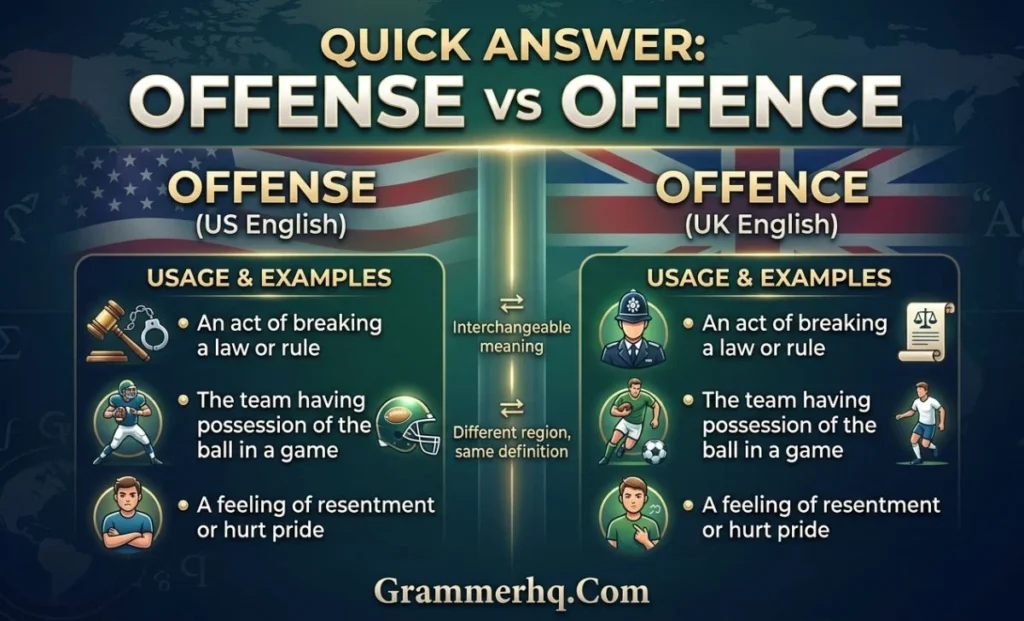
| American English | British English |
|---|---|
| offense | offence |
| offenses | offences |
| Same core meanings | Same core meanings |
Easy rule: Offense = US English. Offence = UK English.
For example:
- US: The driver committed a serious offense.
- UK: The driver committed a serious offence.
Neither spelling is wrong. They are regional spelling variants of the same word. Cambridge and Oxford both identify the US/UK distinction directly.
Offense vs Offence: What’s the Difference?
The main difference is the spelling:
- Offense — American English
- Offence — British English
The underlying word and its major meanings are the same. This means you do not choose between them based on whether you are talking about a crime, someone’s feelings, or sports. You choose based mainly on the English variety you’re using.
Compare:
The court charged him with a serious offense.
The court charged him with a serious offence.
The message is the same; only the regional spelling changes.
This is similar to other American/British spelling pairs such as defense/defence, although each spelling pattern has its own conventions.
What Does “Offense” or “Offence” Mean?
Although the spelling changes between American and British English, the word has several important uses in both varieties.
1. A Crime or Illegal Act
Offense/offence can mean an illegal act or crime.
For example:
Driving without a license is an offense.
In British English:
Driving without a licence is an offence.
You will often see the word with terms such as:
- criminal offense/offence
- serious offense/offence
- minor offense/offence
- traffic offense/offence
- first offense/offence
- capital offense/offence
Oxford lists offense as a countable noun meaning an illegal act and gives examples such as criminal offense, minor offense, and first offense. Its British entry gives the corresponding forms with offence.
2. Hurt Feelings or Insult
The word can also describe the feeling of being upset or insulted because of something rude, disrespectful, or offensive.
For example:
I didn’t mean to cause offense.
British English:
I didn’t mean to cause offence.
This meaning appears in familiar expressions such as:
- take offense / take offence
- cause offense / cause offence
- give offense / give offence
- no offense / no offence
For example:
She took offense at the comment.
She took offence at the comment.
Both sentences have the same meaning. Cambridge specifically documents these uses, including take offence, cause offence, and no offence.
3. Attacking Play in Sports
In sports, offense can refer to the players or side trying to score, or to a team’s attacking play.
For example:
The team’s offense scored quickly in the second half.
In British English, the corresponding form is offence:
The team’s offence created several scoring chances.
This use is especially familiar in American football and basketball. Cambridge and Oxford both recognize the sports meaning, including the sense of the team or players trying to score.
When Should You Use Offense or Offence?
The simplest approach is to match the spelling to your target variety of English.
Use “Offense” in American English
Choose offense when your writing follows American English conventions.
Examples:
It was his first offense.
The court treated it as a serious offense.
I hope you don’t take offense at my comment.
The team’s offense struggled during the first quarter.
This is the form you’ll normally see in US-focused educational, business, legal, and sports writing.
Use “Offence” in British English
Choose offence when you’re following British English conventions.
Examples:
It was his first offence.
The court treated it as a serious offence.
I hope you don’t take offence at my comment.
The remarks caused considerable offence.
Oxford and Cambridge both identify offence as the British form corresponding to American offense.
What About Canadian English?
Canadian English has its own conventions and can overlap with British and American spelling. Canada’s Language Portal notes that Canadians prefer offence over offense, while both forms are acceptable. It also makes an important point about the related adjective: offensive is spelled with an s.
For a website targeting a specific country, the safest approach is to follow that audience’s established style rather than mixing regional forms.
Offenses vs Offences: What Is the Plural?
The same spelling difference appears in the plural.
American English
offense → offenses
He was charged with several offenses.
British English
offence → offences
He was charged with several offences.
The rule is easy to remember:
US: offense → offenses
UK: offence → offences
So if your article uses American English, do not switch to offences later. Likewise, British English normally uses offence and offences.
Common Phrases With Offense and Offence
The spelling changes in familiar expressions too.
| American English | British English |
|---|---|
| take offense | take offence |
| cause offense | cause offence |
| give offense | give offence |
| no offense | no offence |
| criminal offense | criminal offence |
| first offense | first offence |
| serious offense | serious offence |
| traffic offense | traffic offence |
Take offense / Take offence
She took offense at his comment.
She took offence at his comment.
No offense / No offence
No offense, but I think we should try another option.
No offence, but I think we should try another option.
Cause offense / Cause offence
The advertisement caused offense.
The advertisement caused offence.
These are not different expressions with different meanings. The spelling follows the same US/UK pattern. Cambridge and Oxford both document these common constructions.
Offense vs Offensive: Don’t Confuse the Word Forms
Offense/offence is a noun, but its related words perform different grammatical jobs.
- offend — verb
- offense/offence — noun
- offended — adjective
- offensive — adjective
- offender — noun
Compare:
His comment caused offense.
His comment was offensive.
He did not mean to offend anyone.
One useful spelling point is that offensive keeps the s in both American and British English. It is not spelled offencive. Canada’s Language Portal explicitly confirms this distinction.
This is a useful reminder that not every related word follows the exact same US/UK spelling pattern.
Are Offense and Offence Pronounced the Same?
In their ordinary noun uses, offense and offence are generally pronounced the same way.
The written s versus c does not normally create a different pronunciation. Cambridge gives corresponding pronunciations for the American and British forms.
The spelling difference is therefore mainly something you see in writing, rather than something you normally hear in speech.
Offense vs Offence: Which One Should You Use?
Use this simple rule:
Writing for a US audience?
→ Use offense and offenses.
Writing for a UK audience?
→ Use offence and offences.
Writing for Canada?
→ Offence is preferred, although offense is also accepted according to Canada’s Language Portal.
Writing for an international audience?
→ Choose a consistent English variety based on your publication’s style and target readers.
Consistency matters more than trying to make one spelling work everywhere.
For example, a US-focused article might naturally say:
The player was penalized for an offense, and the team’s offense responded with a strong drive.
A British publication would normally use:
The player was penalized for an offence, and the team’s offence responded with a strong attack.
The important thing is that the spelling matches the variety of English used throughout the piece.
Offense vs Offence: Real-Life Examples
Here are the differences in everyday contexts.
Talking About a Crime
American English:
Speeding can be a traffic offense.
British English:
Speeding can be a traffic offence.
Talking About Someone’s Feelings
American English:
I hope my joke didn’t cause offense.
British English:
I hope my joke didn’t cause offence.
Talking About Sports
American English:
The team’s offense scored twice before halftime.
British English:
The team’s offence created several chances before halftime.
Talking About a First Crime
American English:
It was his first offense.
British English:
It was his first offence.
These examples show the central rule clearly: the spelling changes, but the underlying meaning does not simply change because you switch from American to British English.
Common Mistakes to Avoid
1: Calling “offence” a misspelling
Offence is not a misspelling. It is the standard British form of offense.
2: Assuming the two spellings have different meanings
They have the same major uses. The regional spelling does not turn a crime into a different type of crime or change an insult into a different concept.
3: Mixing the forms
If your article follows American English, use offense/offenses consistently. If it follows British English, use offence/offences.
4: Writing “offencive”
The adjective is offensive in both varieties.
5: Choosing based on which spelling “looks right”
Neither form is universally more correct. The better choice depends on the English variety and audience.
FAQs
Is offense or offence correct?
Both are correct. Offense is the standard American English spelling, while offence is the standard British English spelling.
Is offense American or British English?
Offense is the standard American English spelling.
Is offence American or British English?
Offence is the standard British English spelling.
Do offense and offence mean the same thing?
Yes. Their main meanings are the same, including a crime, hurt or insulted feelings, and attacking play in sports.
What is the plural of offense?
The American English plural is offenses. The British English plural is offences.
Is “no offense” American English?
Yes. No offense is the American spelling. British English normally uses no offence.
Is “criminal offense” or “criminal offence” correct?
Both are correct. Use criminal offense in American English and criminal offence in British English.
Is offense used in sports?
Yes. In American English, offense can refer to a team’s attacking side, the players trying to score, or the team’s scoring play. British English uses offence for the corresponding concept.
Is offensive spelled with “c” in British English?
No. Offensive is spelled with an s in both American and British English.
Conclusion
Offense and offence are both correct spellings. Offense is standard in American English, while offence is standard in British English.
Both can refer to a crime, hurt feelings or insult, and attacking play in sports.If you’re writing for US readers, choose offense.
For British readers, choose offence. When in doubt, follow your target audience’s English variety and stay consistent throughout your writing.
The simplest rule to remember is:
Offense = US
Offence = UK
Read More Blogs

Hi, I’m Amelia Parker, a grammar enthusiast and writer at GrammarHQ.com. I specialize in explaining spelling differences, confusing words, and common English mistakes through simple, practical, and easy-to-understand guides.










