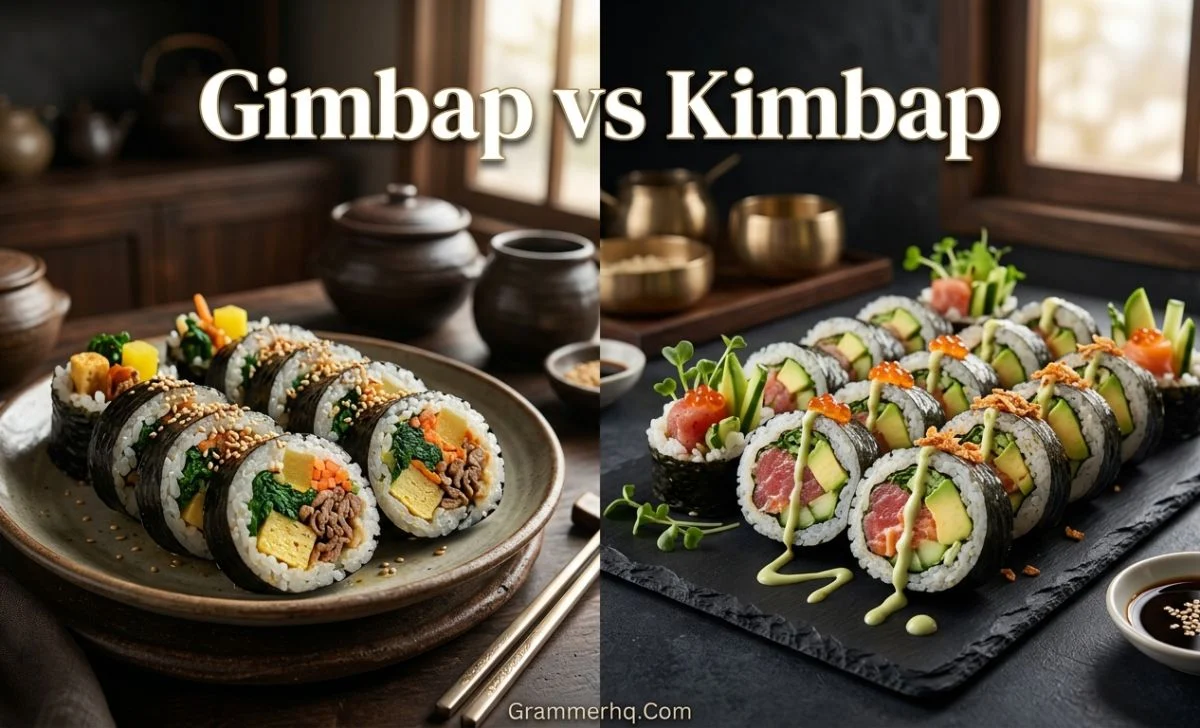
Gimbap vs Kimbap is a common spelling question for anyone writing about this popular Korean dish. Although the two names look different, Gimbap and Kimbap refer to the same Korean food, 김밥.
The difference comes from how the Korean word is represented in the Latin alphabet, rather than from different ingredients, recipes, or types of rolls.
Gimbap is the standard romanized form given by South Korea’s National Institute of Korean Language, while Kimbap remains a widely used spelling in English.
Korea.net also describes the dish as “Gimbap (often spelled ‘kimbap’).” So, neither spelling points to a separate food.
If you are wondering which form to use, when Kimbap is acceptable, or whether this is a British-versus-American spelling difference, the answer is simpler than it first appears.
Quick Answer
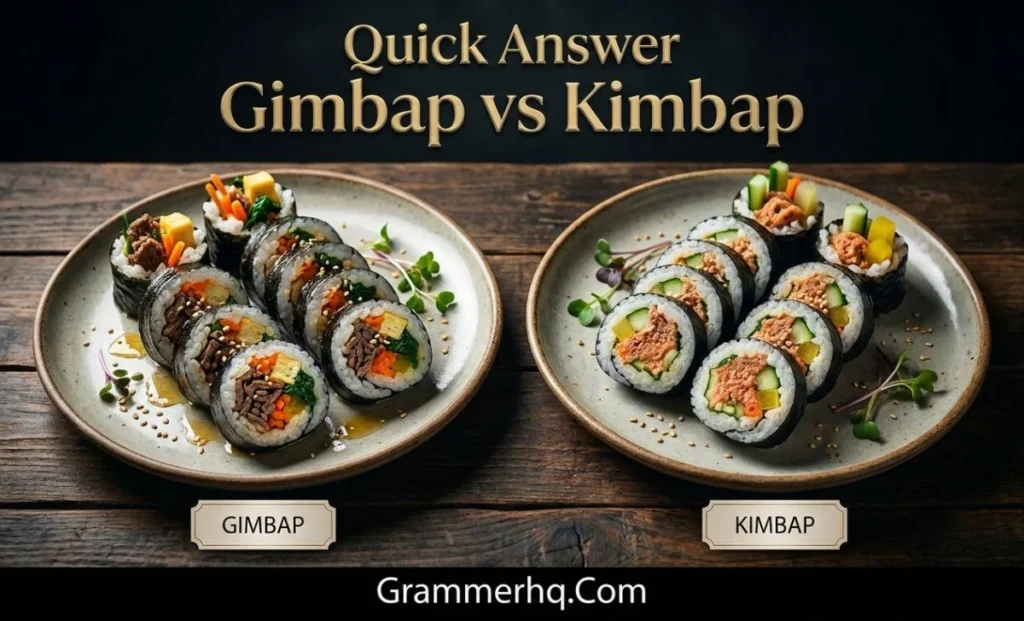
Gimbap is the standard romanized spelling of the Korean word 김밥. Kimbap is a common alternative spelling used in English.
Both refer to the Korean dish made with rice, fillings, and dried seaweed.
| Term | Meaning |
|---|---|
| Gimbap | Standard romanization of 김밥 |
| Kimbap | Common English spelling of the same dish |
| 김밥 | Original Korean Hangul spelling |
The National Institute of Korean Language specifically states that the romanization of 김밥 is Gimbap.
Gimbap vs Kimbap: What’s the Difference?
The main difference is spelling and romanization, not the food itself.
The Korean word is written:
김밥
When that word is represented with the Latin alphabet, it becomes Gimbap under South Korea’s standard Romanization system. Kimbap is another spelling that became established in English-language use.
That means the following sentences can refer to the same type of food:
- I ordered gimbap for lunch.
- I ordered kimbap for lunch.
The spelling alone does not tell you that the fillings or preparation are different.
Korea.net describes gimbap as rice and various ingredients rolled in laver (gim) and specifically notes that the dish is often spelled “kimbap.”
A Simple Comparison
| Feature | Gimbap | Kimbap |
|---|---|---|
| Korean spelling | 김밥 | 김밥 |
| Refers to | Same Korean dish | Same Korean dish |
| Standard romanization | Yes | No |
| Common in English | Yes | Yes |
| Different food? | No | No |
| Main difference | Romanization | Alternative spelling |
So, Gimbap vs Kimbap is primarily a romanization and usage question, not a food comparison.
Why Is Gimbap the Standard Spelling?
The answer comes from Korean romanization.
Romanization means representing a language written in a non-Latin script using the Latin alphabet. South Korea’s National Institute of Korean Language explains that its Romanization of Korean is based on standard Korean pronunciation.
For 김밥, the institute’s current guidance is especially clear. In a December 2025 answer to a question asking whether Gimbap or Kimbap was correct, the National Institute of Korean Language stated:
“‘김밥’의 로마자는 ‘Gimbap’으로 표기합니다.”
In other words, 김밥 is romanized as Gimbap.
Official Korean food-translation guidance also uses Gimbap, including forms such as Tuna Gimbap, Bulgogi and Octopus Gimbap, and Chungmu Gimbap.
This gives Gimbap a clear advantage when the goal is to follow current Korean romanization or official Korean terminology.
Why Do People Spell It Kimbap?
If Gimbap is the standard romanization, why is Kimbap everywhere?
The answer is simple: language usage does not always change as quickly as official standards.
Kimbap has been used widely in English-language recipes, restaurant menus, books, food websites, and everyday conversation.
Once an alternative spelling becomes familiar, people continue using it even when an official romanization system prefers another form.
There is also a pronunciation reason behind the variation. The Korean consonant ㄱ can be represented as g or k in the Romanization system depending on its position and pronunciation.
The National Institute of Korean Language’s Romanization guide lists ㄱ as g, k in its consonant rules.
That helps explain why English readers may encounter both forms.
The important point is that Kimbap does not identify a different Korean dish.
Is Kimbap a Misspelling of Gimbap?
Not simply.
If you are following the current Korean Romanization standard, Gimbap is the form to use. However, Kimbap is a well-established English spelling and is widely understood.
This distinction matters.
Calling Kimbap an ordinary typo ignores its long-standing use in English. Korea.net itself uses the heading Gimbap while noting that it is often spelled “kimbap.”
So a useful rule is:
Gimbap is the standardized romanized form; Kimbap is a common established English spelling.
For formal Korean-language, educational, or reference content, Gimbap is the safer choice.
For general English food writing, readers may encounter either form.
Is Gimbap vs Kimbap a British or American Spelling Difference?
No.
This is an important distinction.
Some English spelling differences are clearly associated with American and British English:
- color / colour
- center / centre
- favorite / favourite
Gimbap and Kimbap do not work the same way.
The difference is primarily connected to Korean romanization and established English usage, not a rule that assigns Gimbap to American English and Kimbap to British English.
A British writer can use gimbap or kimbap, and an American writer can encounter or use either form.
So it would be misleading to describe Gimbap vs Kimbap as a normal US-versus-UK spelling pair.
When Should You Use Gimbap or Kimbap?
The best choice depends on what you are writing.
Use Gimbap When Standardization Matters
Gimbap is a strong choice for:
- Korean language resources
- educational articles
- academic writing
- cultural guides
- tourism content
- formal references
- content following Korean Romanization
Official Korean sources consistently use Gimbap for 김밥.
Kimbap in General English
Kimbap can still appear naturally in:
- recipes
- restaurant menus
- food blogs
- social media
- informal English writing
- existing English-language sources
If you are discussing a restaurant, recipe, or publication that uses Kimbap, there is no need to silently change its established spelling.
For Your Own Article
A practical approach is to introduce both forms once:
Gimbap, also commonly spelled kimbap, is a Korean dish made with rice, fillings, and dried seaweed.
After that, choose one spelling and use it consistently.
That gives readers the variant they may recognize while keeping your article clear.
What Is Gimbap?
Gimbap is a Korean dish made by rolling rice and various fillings in dried laver, known as gim, and slicing the roll into individual pieces.
Official Korean sources list ingredients such as:
- rice
- laver
- pickled radish (danmuji)
- spinach
- carrots
- burdock root
- eggs
- ham
- sesame oil
There are also many variations, including tuna gimbap, cheese gimbap, and Chungmu gimbap.
The fillings can vary considerably, so the spelling Gimbap does not describe one fixed recipe.
What Do “Gim” and “Bap” Mean?
The name itself provides a useful clue.
Gim (김) refers to dried edible seaweed or laver.
Bap (밥) means cooked rice.
Together, gimbap is the romanized Korean name of the dish.
However, Gimbap is not an English translation of 김밥. It is a way of representing the Korean word in the Latin alphabet.
That distinction is important when discussing Korean food names because romanization and translation are two different processes.
Is Gimbap the Same as Sushi?
No.
Gimbap and sushi can look similar because both can involve rice and seaweed, but they belong to different culinary traditions.
Gimbap is part of Korean cuisine, while sushi belongs to Japanese cuisine. Their preparation, typical fillings, seasoning, and culinary traditions also differ.
For example, gimbap commonly features cooked or seasoned fillings such as vegetables, egg, pickled radish, meat, fish cake, or tuna. Korea.net lists several such variations.
So calling gimbap simply “Korean sushi” may help someone visualize it, but it is not an exact description of the dish.
How Do You Pronounce Gimbap?
The Korean pronunciation is more nuanced than the English spelling suggests.
The National Institute of Korean Language gives the standard pronunciations of 김밥 as [김ː밥] and [김ː빱]. The second pronunciation was recognized as a standard pronunciation in 2016 in response to actual usage.
For English readers, a simple approximation is:
gim-bap
However, English spelling cannot reproduce every detail of Korean pronunciation. That is one reason romanized Korean words can sometimes appear easier or more straightforward than they actually sound.
Common Gimbap and Kimbap Mistakes
1. Treating Them as Different Foods
❌ Kimbap and gimbap are two different Korean dishes.
✅ Kimbap and gimbap are two spellings for the same Korean dish.
The spelling does not determine the ingredients.
2. Calling Kimbap Completely Wrong
❌ Kimbap is always an incorrect spelling.
✅ Gimbap is the standard romanized form, while Kimbap remains a common English spelling.
3. Confusing Gimbap With Sushi
❌ Gimbap is simply Korean sushi.
✅ Gimbap is a Korean dish with its own culinary tradition.
4. Switching Between Spellings Without a Reason
If an article starts with gimbap, repeatedly switching to kimbap can make the terminology look inconsistent.
A better approach is to mention both forms early and then select one for the rest of the article.
5. Adding a Space
❌ gim bap
✅ gimbap
When referring to the dish in standard English text, gimbap or kimbap is the clearer form.
Gimbap vs Kimbap in Real-Life Writing
1: Restaurant Menu
Tuna Gimbap — rice, tuna, vegetables, and other fillings wrapped in dried seaweed.
This follows the standardized Gimbap form used in official Korean food terminology.
2: Food Blog
I made kimbap at home with spinach, egg, carrots, and pickled radish.
Here, kimbap works naturally as an established English spelling.
3: Educational Article
Gimbap, also commonly spelled kimbap, is a Korean rice-and-seaweed dish.
This is especially useful when your readers may know either spelling.
4: Language Article
The Korean word 김밥 is romanized as Gimbap.
This is the clearest choice when the focus is Korean romanization.
Gimbap or Kimbap: Which One Should You Use?
Use this simple rule:
Writing about Korean Romanization?
→ Use Gimbap.
Writing formal educational or cultural content?
→ Prefer Gimbap.
Following an existing English source or restaurant’s spelling?
→ Keep its established spelling.
Writing for a general English audience?
→ Either form can be understood, but introduce both once if the spelling may cause confusion.
Want consistency in your article?
→ Choose one form and stick with it.
The key is to separate standardization from ordinary English usage. They are related, but they are not exactly the same thing.
FAQs
Is gimbap the same as kimbap?
Yes. Gimbap and kimbap refer to the same Korean dish, 김밥. The difference is mainly the Latin-alphabet spelling, not the food itself. Korea.net explicitly describes gimbap as being often spelled “kimbap.”
Which spelling is correct: gimbap or kimbap?
Gimbap is the standard romanized spelling of 김밥 according to the National Institute of Korean Language. Kimbap remains a common English spelling.
Is kimbap a misspelling?
Not simply. Kimbap is a widely established English spelling. However, when following the current Korean Romanization standard, Gimbap is the appropriate form.
Why is it spelled gimbap instead of kimbap?
The difference comes from Korean romanization. The Korean consonant ㄱ can be represented as g or k under the Romanization rules depending on its position and pronunciation.
How do you spell gimbap in Korean?
Gimbap is written 김밥 in Korean Hangul.
What is gimbap made of?
Gimbap commonly contains rice, dried laver, and fillings such as pickled radish, spinach, carrots, eggs, burdock root, meat, fish, or other ingredients. Recipes vary by type.
Is gimbap Korean sushi?
No. Gimbap and sushi may look similar, but they come from different culinary traditions and have different typical ingredients, preparation methods, and seasonings.
Is gimbap an American or British spelling?
No. Gimbap vs Kimbap is not primarily an American-versus-British English difference. It is mainly a Korean romanization and English-usage issue.
How do you pronounce gimbap?
The Korean word 김밥 has recognized standard pronunciations represented as [김ː밥] and [김ː빱]. An approximate English guide is gim-bap, although English spelling does not capture every feature of the Korean pronunciation.
Final Answer
Gimbap and Kimbap are two spellings for the same Korean dish, 김밥.
The important difference is not the food. It is romanization and English usage.
Gimbap is the standard romanized form given by South Korea’s National Institute of Korean Language, and official Korean food terminology also uses Gimbap.
Kimbap, however, remains a widely used English spelling and is explicitly recognized as an alternative spelling by Korea.net.
So, if you need the standardized Korean form, choose Gimbap. If you encounter Kimbap in an English recipe, menu, or article, it generally refers to the same food.
Gimbap is the standard form; Kimbap is the established alternative.
Read More Blogs