
Propose vs purpose is a common word-choice problem because the two words look and sound similar, but they have different meanings and grammatical roles.
Propose is mainly a verb used when someone suggests or puts forward an idea, plan, action, or person. It can also mean to ask someone to marry you.
Purpose is mainly a noun that means the reason, aim, or intended use of something.In simple terms, you propose an idea, but you explain its purpose. Once you understand that difference, choosing between these two words becomes much easier.
Quick Answer
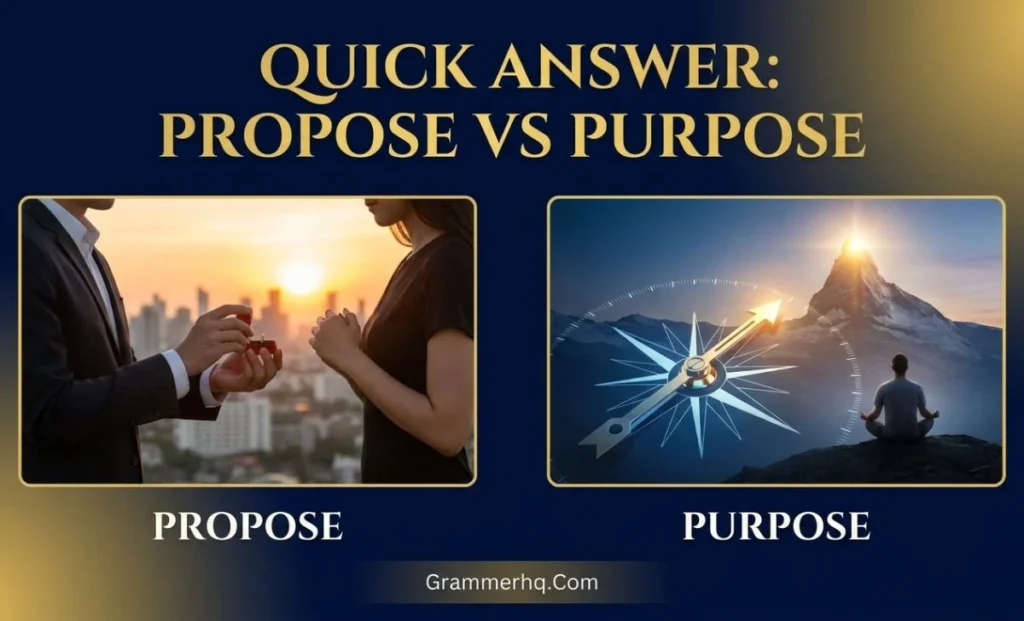
Propose means to suggest, put forward, or formally present something.
Purpose means the reason, aim, or intended use of something.
The manager proposed a new training plan.
The purpose of the training plan is to improve employee skills.
Propose is a verb, while purpose is normally used as a noun in this context.
Propose vs Purpose: The Key Difference
| Word | Main role | Meaning | Example |
|---|---|---|---|
| Propose | Verb | Suggest or put something forward | She proposed a new solution. |
| Purpose | Noun | Reason, aim, or intended use | The purpose of the solution is to save time. |
| Proposal | Noun | A suggested plan, idea, or offer | They submitted a proposal. |
The easiest distinction is:
Propose = suggest something.
Purpose = explain why something exists or is done.
These words can appear in the same sentence or topic, but they do not replace each other.
What Does “Propose” Mean?
Propose has several important uses.
To suggest an idea or plan
When you propose something, you put it forward for other people to consider.
The team proposed a new marketing strategy.
She proposed a different solution to the problem.
I propose that we start the meeting at nine.
This use is common in workplaces, meetings, academic writing, research, and formal discussions. Standard grammar patterns include propose + noun, propose + -ing, and propose + that-clause.
To formally put something forward
Propose can also be used for motions, candidates, policies, or other formal actions.
The committee proposed a change to the policy.
He proposed a motion at the meeting.
She was proposed as a candidate for the position.
To ask someone to marry you
In a personal context, propose can mean to ask someone to marry you.
Alex proposed to Maya last Saturday.
The usual structure is:
propose to + person
Not:
❌ Alex purposed to Maya.
✅ Alex proposed to Maya.
What Does “Purpose” Mean?
Purpose is mainly a noun. It refers to the reason something is done, its aim, or its intended use.
The purpose of the meeting is to review the results.
The main purpose of this tool is to save time.
What is the purpose of this question?
It is also common in expressions such as:
- the purpose of
- on purpose
- for the purpose of
- with the purpose of
- serve a purpose
For example:
He broke the vase on purpose.
The survey was created for the purpose of collecting feedback.
Here, purpose is about the reason or intended function—not a suggestion.
Propose vs Purpose in Real Sentences
Seeing the words side by side makes the difference clearer.
The director proposed a new hiring policy.
The director suggested the policy.
The purpose of the policy is to improve recruitment.
The sentence explains why the policy exists.
Another example:
The researcher proposed a new method.
The purpose of the method is to reduce errors.
And:
The company proposed several changes.
The purpose of the changes is to improve efficiency.
A useful question can help you decide:
Am I talking about a suggestion? → propose
Am I talking about a reason or aim? → purpose
Common Grammar Patterns for Propose and Purpose
Learning the usual sentence patterns can make these two words much easier to use correctly.
How to Use “Propose”
Several structures commonly follow propose. A noun can come directly after it:
They proposed a new strategy.
When the next action is expressed with an -ing form, use:
She proposed changing the schedule.
A that-clause is also common:
I propose that we wait until Monday.
In formal English, propose can also mean intend. In this sense, it is often followed by to + verb:
How do you propose to solve the problem?
We do not propose to change the agreement.
When talking about marriage, the usual structure is propose to + person:
He proposed to his partner.
How to Use “Purpose”
Purpose is commonly followed by of + noun when you are explaining the reason or aim of something:
The purpose of the meeting is to discuss the budget.
The -ing form can also follow of:
The purpose of exercising is to improve fitness.
For a more formal expression, use for the purpose of + -ing:
The form is used for the purpose of collecting information.
Another very common expression is on purpose, which means intentionally:
She left the door open on purpose.
These patterns reinforce the key distinction: propose is generally used for suggesting or putting something forward, while purpose refers to a reason, aim, or intended use.
Propose, Proposal, and Purpose
Propose and proposal belong to the same word family. Purpose does not.
Think of the relationship like this:
propose → proposal
They proposed a new project.
They submitted a proposal for the new project.
A proposal can be a suggested plan, formal idea, written proposal, or an offer of marriage.
But purpose answers a different question:
The purpose of the project is to reduce costs.
So remember:
- Propose = suggest
- Proposal = suggested plan or formal offer
- Purpose = reason or aim
Is “Purpose” a Verb?
This question causes confusion because English has many words that can work as more than one part of speech.
For normal modern writing, especially everyday, academic, and professional English, purpose is overwhelmingly used as a noun when you mean a reason, aim, or intended use.
Write:
The purpose of the project is to improve safety.
Do not replace purpose with propose in this structure:
❌ The propose of the project is to improve safety.
✅ The purpose of the project is to improve safety.
The important point is that propose and purpose are not interchangeable simply because they look similar.
Propose or Purpose for Marriage?
If you mean asking someone to marry you, the correct word is propose.
She proposed to him.
He proposed after dinner.
The noun is proposal:
She accepted his marriage proposal.
Purpose is not used for a marriage proposal.
❌ He purposed to her.
✅ He proposed to her.
This distinction is especially useful because proposal can refer both to a formal plan and an offer of marriage.
Common Propose vs Purpose Mistakes
| Incorrect | Correct |
|---|---|
| The propose of the project | The purpose of the project |
| She purposed a new solution. | She proposed a new solution. |
| He purposed to her. | He proposed to her. |
| They submitted a propose. | They submitted a proposal. |
| The manager propose a new plan yesterday. | The manager proposed a new plan yesterday. |
The biggest trap is often propose vs proposal, not just propose vs purpose.
Use propose when you mean the action of suggesting or putting an idea forward. The suggested plan or idea itself is a proposal.
When you are talking about the reason, aim, or intended use of something, purpose is the correct word.
Propose vs Purpose: Pronunciation
The words are pronounced differently.
- Propose: US /prəˈpoʊz/, UK /prəˈpəʊz/
- Purpose: US /ˈpɝː.pəs/, UK /ˈpɜː.pəs/
The stress also helps distinguish them:
pro-POSE
PUR-pose
Notice the final sound:
- propose ends with a /z/ sound.
- purpose ends with an /s/ sound.
American vs British English
Both propose and purpose are standard in American and British English. They are not alternative US and UK spellings.
The main difference is pronunciation, particularly the vowel sounds:
US: propose /prəˈpoʊz/
UK: propose /prəˈpəʊz/
US: purpose /ˈpɝː.pəs/
UK: purpose /ˈpɜː.pəs/
The basic meanings and grammar do not change between the two varieties.
How to Remember Propose vs Purpose
Use this simple rule:
Propose = put an idea forward.
Purpose = explain why it exists.
For example:
I propose a new plan.
The purpose of the plan is to save money.
If you can replace the word with suggest, choose propose.
If you can replace it with reason, aim, or intended use, choose purpose.
FAQs
Is “propose” the same as “purpose”?
No. Propose mainly means to suggest or put something forward, while purpose usually means the reason, aim, or intended use of something.
What is the noun form of “propose”?
The related noun is proposal.
The company submitted a proposal.
Is it “purpose of” or “propose of”?
Use purpose of when you mean the reason or aim.
The purpose of the meeting is to discuss the issue.
Is it “propose to” or “purpose to” someone?
Use propose to someone when talking about marriage.
He proposed to his girlfriend.
Can “propose” mean “intend”?
Yes. In formal English, propose can mean intend, especially before an infinitive or an -ing form.
How do you propose to solve the problem?
What is the difference between a proposal and a purpose?
A proposal is a suggested plan, idea, or formal offer. A purpose is the reason, aim, or intended use behind something.
Conclusion
Propose vs purpose becomes easy once you focus on what the sentence is trying to say.
Use propose when someone suggests, puts forward, or formally presents an idea, plan, action, or person. It is also the correct word for asking someone to marry you.
Use purpose when you mean the reason, aim, or intended use of something.
And remember the third word that often causes confusion:
Propose = suggest
Proposal = suggested plan or offer
Purpose = reason or aim
When you know which role the word needs to play in the sentence, you can choose the correct word confidently.
Read More Blogs

Hi, I’m Amelia Parker, a grammar enthusiast and writer at GrammarHQ.com. I specialize in explaining spelling differences, confusing words, and common English mistakes through simple, practical, and easy-to-understand guides.










