Choosing between discreet or discrete is confusing because these two words look almost identical and are pronounced the same, but they have completely different meanings.
The correct choice depends on your sentence: discreet means careful, private, or tactful, while discrete means separate, distinct, or individual.
Many writers mistakenly use one in place of the other, which can completely change the meaning of a sentence.
In this guide, you’ll learn the difference between discreet and discrete, their pronunciation, common mistakes, easy memory tricks, and real-life examples so you can always choose the correct word with confidence.
Quick Answer
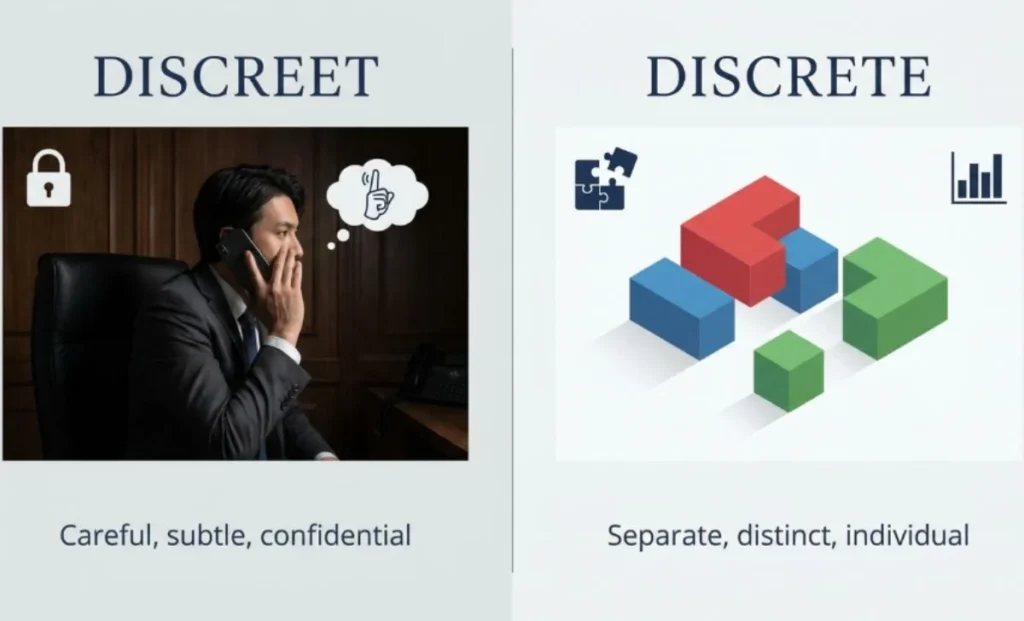
The difference between discreet and discrete is simple:
- Discreet means careful, private, or tactful, especially to avoid embarrassment or attracting attention.
- Discrete means separate, distinct, or independent from other things.
Quick Comparison
| Word | Meaning | Example |
|---|---|---|
| Discreet | Careful and private | She was discreet about the surprise party. |
| Discrete | Separate or distinct | The report is divided into three discrete sections. |
Correct Examples
- Please be discreet when discussing confidential information.
- The software consists of several discrete modules.
- He handled the situation in a discreet manner.
- Each experiment was treated as a discrete event.
- A discreet conversation helped avoid unnecessary gossip.
- The project includes five discrete phases.
Incorrect Examples
❌ Please be discrete when discussing confidential information.
✅ Please be discreet when discussing confidential information.
❌ The report contains three discreet sections.
✅ The report contains three discrete sections.
Quick Tip:
If you’re talking about privacy or being careful, choose discreet. If you’re talking about separate parts or individual items, choose discrete.
Pronunciation of Discreet or Discrete
Although discreet and discrete have different meanings, they are pronounced the same way in English. This makes them homophones, which is one reason many writers confuse them.
Pronunciation
- Discreet: dih-SKREET
- Discrete: dih-SKREET
IPA: /dɪˈskriːt/
Both words have:
- The stress on the second syllable.
- The same vowel and consonant sounds.
- No pronunciation difference in American or British English.
Why Pronunciation Causes Confusion
Because both words sound identical, listeners cannot tell which spelling is correct without seeing the written sentence or understanding the context.
For example:
- “She was very discreet about the matter.”
- “The data is stored in discrete files.”
When spoken, both sentences sound almost identical, but the meanings are completely different.
Pronunciation Examples
- The manager remained discreet during the meeting.
- The machine contains several discrete components.
- We need a discreet approach to this issue.
- The chart shows discrete categories of data.
Remember: Pronunciation will not help you choose the correct spelling. Only the meaning of the sentence determines whether discreet or discrete is correct.
Why People Confuse Discreet or Discrete
Many English learners and even native speakers confuse discreet and discrete because the words share several similarities.
1. They Look Almost Identical
The only visible difference is the last two letters:
- Discreet
- Discrete
A small spelling difference is easy to overlook while writing quickly.
2. They Sound Exactly the Same
Since both words are pronounced dih-SKREET, you cannot identify the correct spelling by listening alone.
3. Both Are Common in Formal Writing
These words often appear in:
- Business emails
- Academic papers
- Technical documents
- Legal writing
- News articles
People may recognize the word but choose the wrong spelling because they remember only the pronunciation.
4. Spell Check Cannot Always Help
Most grammar and spell-check tools only verify whether a word exists. Since discreet and discrete are both correct English words, software may not flag the mistake if the wrong word still forms a grammatically correct sentence.
Example:
❌ The company remained discrete about the investigation.
The spelling is valid, but the meaning is incorrect.
✅ The company remained discreet about the investigation.
5. Their Meanings Are Unrelated
Unlike many spelling variations, these words do not share the same meaning.
- Discreet relates to privacy, caution, and tact.
- Discrete relates to separate, distinct, and individual units.
Understanding this difference is the key to using them correctly.
Easy Trick to Remember Discreet or Discrete
A simple memory trick can help you choose the correct word every time.
Remember the Double EE in Discreet
The double EE in discrEEt can remind you of:
- Keep Everything Else private
- Eyes Everywhere—be careful
Since discreet is about being careful and keeping information private, the double EE is your clue.
Example:
- A discreet employee never shares confidential information.
- She gave a discreet smile without drawing attention.
Remember the Ending ETE in Discrete
Think of discrete as describing things that are separate entities.
The ending ETE can remind you of entities, elements, or individual parts.
Example:
- The application has several discrete features.
- The survey measured discrete groups of participants.
One-Line Memory Rule
- Discreet = Careful and Private
- Discrete = Separate and Distinct
Quick Practice
Choose the correct word.
- Please remain ______ during the negotiations.✅ Discreet
- The presentation has four ______ topics.✅ Discrete
- We need a ______ way to handle customer complaints.✅ Discreet
- The research separates the results into ______ categories.✅ Discrete
After practicing this simple rule a few times, choosing between discreet and discrete becomes much easier.
The Origin of Discreet or Discrete
Although discreet and discrete look almost identical today, they developed different meanings over time. Both words come from the Latin verb discernere, meaning “to separate” or “to distinguish.” As English evolved, each word followed its own path.
Origin of Discreet
Discreet comes from the Latin adjective discretus, which originally described someone who showed good judgment or wisdom. Over the centuries, the meaning shifted toward being careful, tactful, and private.
Today, discreet is commonly used when talking about:
- Protecting confidential information
- Acting with tact
- Avoiding unnecessary attention
- Respecting someone’s privacy
Examples:
- The lawyer gave discreet legal advice.
- The hotel offers a discreet check-in service.
- She made a discreet phone call before the meeting.
- The company handled customer complaints discreetly.
Origin of Discrete
Discrete also comes from the Latin discretus, but it kept the original idea of being separated or distinct.
Today, discrete is widely used in:
- Mathematics
- Computer science
- Statistics
- Engineering
- Scientific writing
It describes things that exist as individual units rather than as a continuous whole.
Examples:
- The graph contains discrete data points.
- The system consists of several discrete components.
- Each department works as a discrete unit.
- The project was divided into discrete stages.
How Their Meanings Split
Although both words started from the same Latin root, English gave each word a specialized meaning.
| Word | Original Idea | Modern Meaning |
|---|---|---|
| Discreet | Good judgment | Careful, private, tactful |
| Discrete | Separated | Distinct, individual, separate |
This historical change explains why the words are spelled similarly but should never be used interchangeably.
British English vs American English Spelling
Unlike many English words, discreet and discrete are not examples of British and American spelling differences.
Both British English and American English use exactly the same spellings because these are two different words with different meanings.
Comparison
| Meaning | British English | American English |
|---|---|---|
| Careful and private | Discreet | Discreet |
| Separate or distinct | Discrete | Discrete |
Example Sentences
| Context | British English | American English |
|---|---|---|
| Privacy | Please be discreet. | Please be discreet. |
| Mathematics | These are discrete values. | These are discrete values. |
| Business | The manager remained discreet. | The manager remained discreet. |
| Technology | The system has discrete modules. | The system has discrete modules. |
Are There Regional Differences?
No.
Whether you’re writing for:
- The United States
- The United Kingdom
- Canada
- Australia
- New Zealand
- Ireland
the spellings remain the same.
The only thing that changes is which meaning fits the sentence.
Key Point:
This is a meaning difference, not a regional spelling difference.
Which Spelling Should You Use?
The correct spelling depends entirely on what you want to say, not where your audience lives.
Use Discreet When You Mean:
- Careful
- Private
- Tactful
- Confidential
- Unobtrusive
Examples:
- The doctor remained discreet about the patient’s condition.
- We need a discreet way to discuss salaries.
- She asked a discreet question after the meeting.
- The security team handled the matter discreetly.
Use Discrete When You Mean:
- Separate
- Individual
- Distinct
- Independent
- Not connected
Examples:
- The software includes five discrete functions.
- Each lesson focuses on a discrete skill.
- Scientists studied discrete populations.
- The machine contains several discrete parts.
Audience Guide
| Audience | Recommended Word |
|---|---|
| Business communication | Discreet (for confidentiality) |
| Legal writing | Discreet (for private matters) |
| Academic writing | Depends on meaning |
| Mathematics | Discrete |
| Statistics | Discrete |
| Computer science | Discrete |
| General writing | Choose the word that matches the intended meaning |
Quick Decision Rule
Ask yourself one question:
Am I talking about privacy or separate things?
- Privacy → Discreet
- Separate things → Discrete
If you answer this question before writing, you’ll almost always choose the correct word.
Common Mistakes with Discreet or Discrete
Because these words are homophones, writers often replace one with the other. Here are the mistakes you should avoid.
Mistake 1: Using Discrete for Privacy
❌ The company was discrete about customer information.
✅ The company was discreet about customer information.
Why?
The sentence is about confidentiality, not separate parts.
Mistake 2: Using Discreet for Separate Objects
❌ The report contains three discreet sections.
✅ The report contains three discrete sections.
Why?
The sections are individual parts, so discrete is correct.
Mistake 3: Choosing by Pronunciation
Some people assume pronunciation will reveal the correct spelling.
❌ They sound different.
✅ They sound exactly the same.
Always decide based on the meaning of the sentence.
Mistake 4: Assuming One Is British and the Other Is American
Many learners believe:
❌ Discreet is British.
❌ Discrete is American.
This is incorrect.
Both spellings are standard worldwide because they represent different words.
Mistake 5: Trusting Spell Check Completely
Spell-check software may accept both words because both exist in English.
Example:
❌ The witness remained discrete during questioning.
A spell checker may not flag this sentence.
✅ The witness remained discreet during questioning.
Always read the sentence for meaning instead of relying only on spelling tools.
Common Error Summary
| Incorrect | Correct | Reason |
|---|---|---|
| discrete information | discreet information | Information is confidential. |
| discreet categories | discrete categories | Categories are separate groups. |
| discreet units | discrete units | Units are individual parts. |
| discrete conversation | discreet conversation | A conversation can be private, not separate. |
Discreet or Discrete in Everyday Examples
Understanding the difference between discreet and discrete becomes much easier when you see them in real-life situations. Here are examples from emails, business communication, news, social media, and formal writing.
In Business Emails
Discreet
- Please be discreet when discussing the client’s financial information.
- We appreciate your discreet handling of this matter.
- The HR team managed the complaint discreetly.
Discrete
- The proposal is divided into four discrete sections.
- Each department has a discrete budget.
- The software includes several discrete features.
In News Reports
Discreet
- Police carried out a discreet investigation before making arrests.
- Officials held a discreet meeting to discuss national security.
Discrete
- Scientists identified several discrete climate zones.
- The report examines discrete economic sectors.
On Social Media
Discreet
- Thank you for being so discreet about my surprise party!
- Please keep this information discreet until the announcement.
Discrete
- I organize my tasks into discrete categories.
- Each photo belongs to a discrete album.
In Formal Writing
Discreet
- The lawyer provided discreet legal advice.
- Diplomats held discreet discussions before the agreement.
Discrete
- The research analyzes discrete variables.
- The experiment consists of three discrete stages.
Everyday Sentence Practice
| Correct Sentence | Why It Is Correct |
|---|---|
| She remained discreet during the interview. | She acted carefully and privately. |
| The project has five discrete phases. | The phases are separate. |
| We need a discreet conversation. | The conversation should be private. |
| The machine contains discrete components. | The components are individual parts. |
| His discreet approach earned everyone’s trust. | The focus is on tact and confidentiality. |
| The software processes discrete pieces of data. | The data exists as separate units. |
Discreet or Discrete – Google Trends & Usage Data
Although discreet and discrete are both correct English words, they are searched for different reasons.
Where Are These Words Commonly Searched?
Discreet is frequently searched in countries such as:
- United States
- United Kingdom
- Canada
- Australia
Users usually search it when writing:
- Business emails
- Professional documents
- Privacy policies
- Customer communication
Where Is Discrete Commonly Used?
Discrete appears more often in technical and educational fields, including:
- Mathematics
- Statistics
- Computer Science
- Engineering
- Data Analysis
Students and professionals often search for its meaning while studying technical subjects.
Why Do People Search “Discreet or Discrete”?
Common search queries include:
- discreet or discrete
- discreet vs discrete
- difference between discreet and discrete
- discreet meaning
- discrete meaning
- discreet in a sentence
- discrete in a sentence
- how to remember discreet and discrete
- discreet pronunciation
- discrete pronunciation
Most users want a quick explanation with examples because the words sound identical but have different meanings.
Usage Comparison
| Word | Common Contexts |
|---|---|
| Discreet | Privacy, business, customer service, legal writing, personal communication |
| Discrete | Mathematics, science, technology, engineering, research |
Search Intent Summary
People searching “discreet or discrete” usually want to:
- Understand the difference.
- Learn the correct meaning.
- Avoid writing mistakes.
- See practical examples.
- Remember the correct spelling.
Discreet vs Discrete Comparison Table
| Feature | Discreet | Discrete |
|---|---|---|
| Meaning | Careful, private, tactful | Separate, distinct, individual |
| Part of Speech | Adjective | Adjective |
| Pronunciation | dih-SKREET | dih-SKREET |
| Used For | Privacy and confidentiality | Separate parts or units |
| Common Fields | Business, law, customer service | Mathematics, science, technology |
| Example | She gave a discreet reply. | The report has discrete sections. |
| Can They Replace Each Other? | No | No |
Discrete or Discreet Relationship
The correct phrase is discreet relationship when you mean a relationship that is kept private or handled with care.
Discreet means confidential, tactful, or not attracting attention. Discrete relationship is only correct if you mean a relationship that is separate or independent from others, which is uncommon in everyday English.
In most conversations, emails, and articles, discreet relationship is the natural and correct choice. Always choose the word based on whether you mean private or separate.
Examples:
- They kept their discreet relationship away from public attention.
- The couple maintained a discreet relationship for several years.
- Their business and personal lives remained discrete relationships, with no overlap.
- Each partnership was treated as a discrete relationship within the research project.
FAQ,s
1. What is the difference between discreet and discrete?
Discreet means careful, private, or tactful, while discrete means separate, distinct, or individual.
2. Are discreet and discrete pronounced the same?
Yes. Both words are pronounced /dɪˈskriːt/, making them homophones.
3. Is it “discreet information” or “discrete information”?
Discreet information is correct because confidential information should be kept private.
4. Is discrete used in mathematics?
Yes. In mathematics, discrete describes values or objects that are separate rather than continuous.
5. Is discreet a positive word?
Yes. It usually describes someone who is careful, respectful, and trustworthy when handling sensitive situations.
6. Can I use discreet and discrete interchangeably?
No. Although they look and sound similar, they have different meanings and should never replace each other.
7. How can I remember the difference?
Remember this simple rule:
- Discreet = Private and Careful
- Discrete = Separate and Distinct
Conclusion
Choosing between discreet and discrete is easy once you understand their meanings. Discreet describes someone or something that is careful, private, and tactful, making it the correct choice for confidential conversations, professional communication, and sensitive situations.
Discrete, on the other hand, refers to things that are separate, distinct, or independent, so it commonly appears in mathematics, science, technology, and academic writing.
Although both words are pronounced the same, their meanings are completely different. Before writing, ask yourself whether you are talking about privacy or separate parts.
This simple check will help you choose the correct spelling every time and avoid one of the most common English word mistakes.
Read More Blogs:
- “Molding or Moulding? Correct Spelling & Meaning Explained”
- Lay or Lie? What’s the Difference and Which One Should You Use?