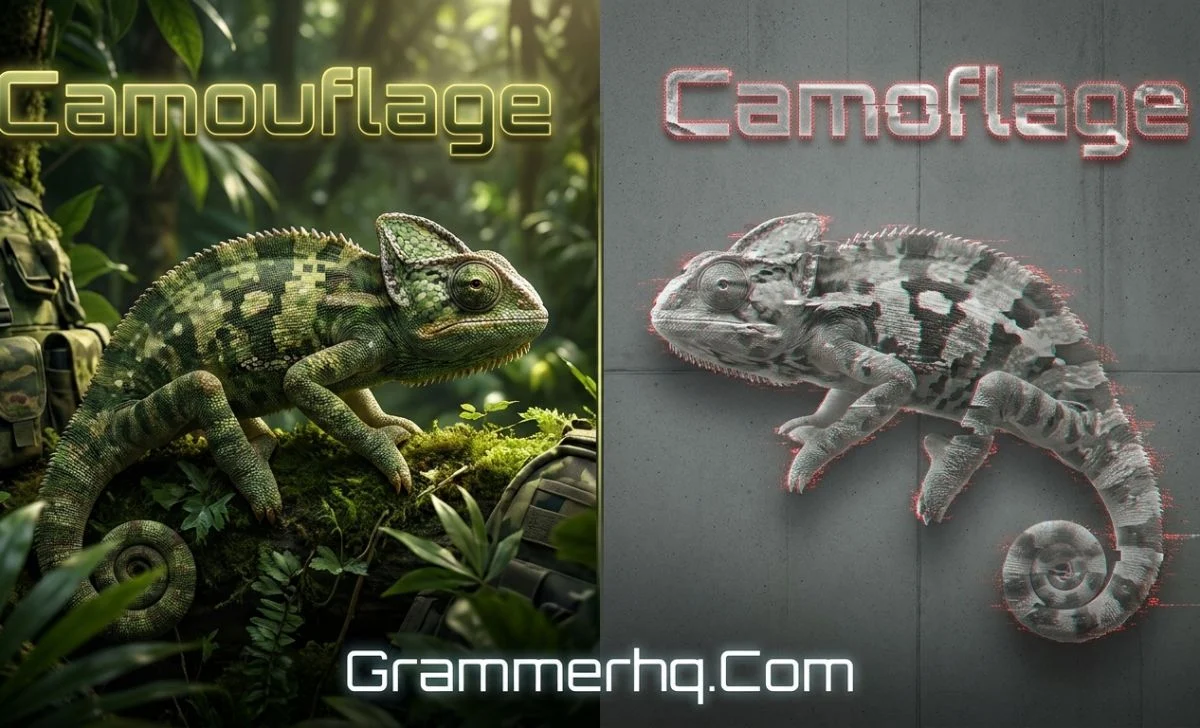
Camouflage vs camoflage is a common spelling question, but only one form is correct: camouflage. Camoflage is a misspelling, not an alternative spelling.
The word camouflage describes a way of hiding or disguising a person, animal, object, or even an idea by making it harder to notice.
The easiest part to forget is the u in the middle:
cam + ou + flage = camouflage ✅
camoflage ❌
The word is also more versatile than it may first appear. Camouflage can be used as both a noun and a verb, and it appears in discussions of wildlife, military clothing, outdoor gear, concealment, and figurative hiding.
Quick Answer
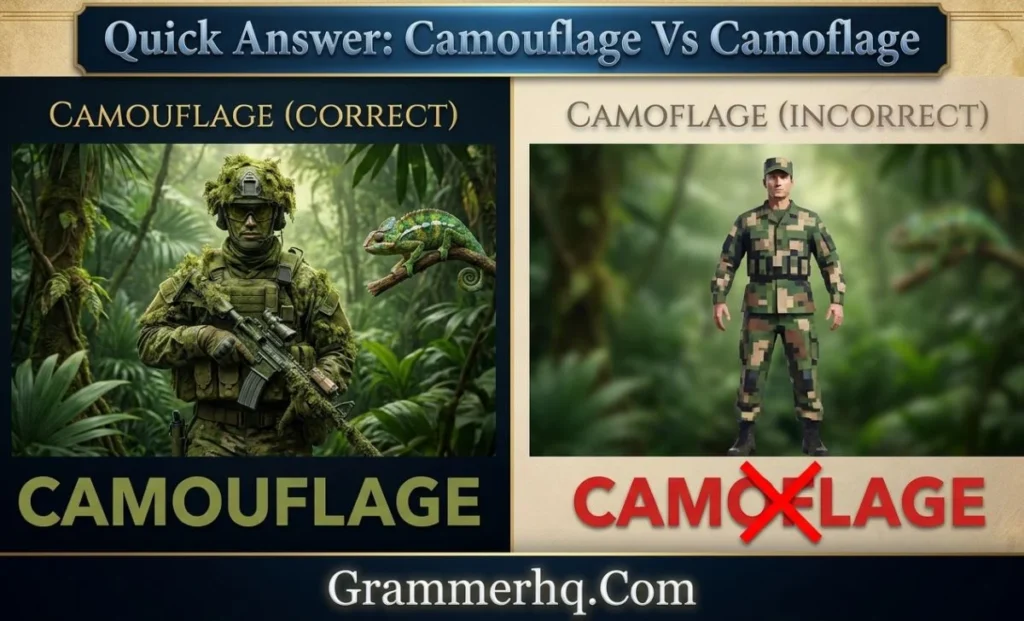
Camouflage is the correct spelling.
Camoflage is incorrect.
| Spelling | Status | Meaning |
|---|---|---|
| camouflage | ✅ Correct | Hiding, disguising, or blending into surroundings |
| camoflage | ❌ Incorrect | A misspelling of camouflage |
If you are writing an essay, email, article, report, or professional document, use camouflage.
Why Do People Spell Camouflage as Camoflage?
The spelling can be difficult because the middle ou is easy to overlook.
When people hear camouflage, the pronunciation does not make every letter obvious. That can lead someone to write camoflage, leaving out the u.
The two forms look almost identical:
camouflage
camoflage
However, they are not two spellings with different regional preferences. Camouflage is the standard English form, while camoflage is simply a spelling error.
A useful memory cue is:
camOUflage
Think of OU as one unit rather than trying to remember every letter separately.
What Does Camouflage Mean?
Camouflage means hiding or disguising someone or something so that it becomes difficult to see, recognize, or notice.
The meaning can vary slightly depending on the context.
Camouflage in Nature
Animals often use natural camouflage to blend into their surroundings.
A green insect can disappear among leaves. A brown moth can become difficult to see against tree bark. An animal with a pale winter coat may become less noticeable in snow.
For example:
The insect’s green body provides camouflage among the leaves.
Here, camouflage describes a natural feature that helps the animal remain unnoticed.
Camouflage in Military Use
Military camouflage is designed to make people, vehicles, equipment, or other objects less visible against a particular environment.
For example:
The soldiers wore camouflage uniforms during the field exercise.
The term can refer to the concealment method itself as well as the patterns, colors, clothing, or materials used for concealment.
Camouflage in Everyday and Figurative Use
The idea of camouflage is not limited to animals and military settings.
Something can also act as camouflage when it hides a feeling, intention, fact, or problem.
His cheerful attitude was camouflage for his disappointment.
In this sentence, nothing is physically hidden. The cheerful behavior makes the person’s real feelings less obvious.
Is Camouflage a Noun or a Verb?
Camouflage can be both a noun and a verb. The meaning remains connected to the same basic idea: hiding or disguising something.
Camouflage as a Noun
As a noun, camouflage refers to concealment or something used to help conceal a person or object.
Common expressions include:
- camouflage clothing
- camouflage pattern
- camouflage jacket
- camouflage uniform
- camouflage net
- natural camouflage
Examples:
The bird’s feathers provide excellent camouflage.
He bought a camouflage jacket for the outdoor trip.
The rocks gave the small animal natural camouflage.
In these sentences, camouflage is the thing or method that provides concealment.
Camouflage as a Verb
As a verb, camouflage means to hide or disguise something by making it blend into its surroundings or otherwise making it less noticeable.
Examples:
The workers camouflaged the equipment with branches.
The pattern helped camouflage the vehicle.
The hikers camouflaged themselves among the trees.
The verb can also be used figuratively:
His jokes camouflaged how nervous he really was.
Here, the jokes helped hide his actual emotional state.
Camouflage Vs Camoflage: What Is the Difference?
The difference is spelling, not meaning.
Camouflage is the standard English word.
Camoflage is an incorrect spelling of that word.
The important difference is the u:
camouflage → ou ✅
camoflage → o only ❌
So there is no separate definition to learn for camoflage. If you see that form in your writing, it should be corrected to camouflage.
How Do You Spell Camouflage Correctly?
The correct spelling is:
C-A-M-O-U-F-L-A-G-E
A simple way to break it down is:
CAM — OU — FLAGE
The middle section is the key:
camOUflage
If you often write camoflage, pause after cam and check that ou comes next.
This is especially useful when proofreading because the missing u can be easy to overlook at a glance.
How Is Camouflage Pronounced?
The spelling may look complicated, but the pronunciation follows a different pattern.
The word is pronounced roughly like:
KAM-uh-flahzh
The final sound is similar to the sound in words such as mirage.
The important point for spelling is that pronunciation alone may not make the ou obvious. That can help explain why camoflage appears as a common misspelling.
Regardless of pronunciation, the written form remains:
camouflage.
Common Misspellings of Camouflage
The most common incorrect form is:
camoflage ❌
Another misspelling you may encounter is:
camoflauge ❌
In camoflauge, the middle letters have been rearranged.
The standard form is:
camouflage ✅
Instead of memorizing every incorrect variation, remember the unusual sequence:
OU → camouflage
That gives you a quick way to check the spelling whenever you are unsure.
Camouflage Examples in Real Life
The word appears in many situations, so seeing it in different contexts can make its meaning easier to remember.
In nature
The moth’s patterned wings provide camouflage against the tree bark.
In the military
The soldiers wore camouflage uniforms during the exercise.
With equipment
The crew used branches to camouflage the equipment.
With clothing
She wore a camouflage jacket on the hiking trip.
In an outdoor environment
The lizard’s coloring gives it effective camouflage in the dry grass.
In a figurative sense
His calm expression was camouflage for his concern.
As a verb
The team camouflaged the structure so it would blend into the landscape.
These examples show that camouflage is not simply another word for military clothing. It can describe natural concealment, deliberate disguise, physical hiding, clothing patterns, and figurative concealment.
What Are the Forms of Camouflage?
When camouflage is used as a verb, its common forms include:
| Verb form | Example |
|---|---|
| camouflage | They camouflage the equipment. |
| camouflages | The pattern camouflages the vehicle. |
| camouflaged | The vehicle was camouflaged. |
| camouflaging | They are camouflaging the structure. |
The same spelling pattern remains throughout the word family:
camouflage → camouflages → camouflaged → camouflaging
The ou does not disappear when the verb changes form.
Where Does the Word Camouflage Come From?
The unusual spelling has a foreign-language history.
English camouflage came through French camoufler, meaning “to disguise,” and is connected with Italian camuffare. The English word became established around the time of the First World War.
Its history helps explain why the spelling may not look like a typical English word. The deeper origin of the Italian form is uncertain, so it is better not to treat speculative explanations as established fact.
Is Camouflage Spelled Differently in American and British English?
No.
Camouflage is the standard spelling in both American and British English.
Unlike some words that have different US and UK forms, such as color/colour or center/centre, camouflage keeps the same spelling in both varieties.
So whether you are writing for readers in the United States or the United Kingdom, use:
camouflage ✅
FAQs
Is camouflage or camoflage correct?
Camouflage is correct. Camoflage is a misspelling.
Is camoflage a real word?
No. Camoflage is not a standard alternative spelling. The correct word is camouflage.
How do you spell camouflage?
It is spelled:
C-A-M-O-U-F-L-A-G-E
Remember the middle:
CAM + OU + FLAGE
What does camouflage mean?
Camouflage means hiding or disguising someone or something so that it becomes harder to see, recognize, or notice. It can describe physical concealment as well as figurative hiding.
Is camouflage a noun or a verb?
It is both. As a noun, it can describe concealment or something used for concealment. As a verb, it means to hide or disguise something.
Why is camouflage sometimes spelled camoflage?
The middle ou can be easy to miss because the pronunciation does not make every letter obvious. As a result, people sometimes leave out the u when spelling the word.
How can I remember the spelling of camouflage?
Remember:
camOUflage
The OU in the middle is the key.
What is another common spelling mistake for camouflage?
Camoflauge is another incorrect form. The letters in the middle have been rearranged. The standard spelling is camouflage.
Final Answer
When choosing between camouflage vs camoflage, use camouflage.
Camouflage is the standard spelling and can refer to natural coloring, military concealment, clothing patterns, hidden objects, or figurative attempts to hide something. It also works as both a noun and a verb.
Camoflage is simply a misspelling.
If you need one spelling trick to remember, keep this in mind:
CAM + OU + FLAGE = CAMOUFLAGE ✅
That middle OU is the small detail that keeps the spelling correct.
Read More Blogs

Hi, I’m Amelia Parker, a grammar enthusiast and writer at GrammarHQ.com. I specialize in explaining spelling differences, confusing words, and common English mistakes through simple, practical, and easy-to-understand guides.










