Have you ever typed “knaw” and paused for a second because something didn’t look right? You’re not alone. This is a common spelling mistake, especially among English learners and even native speakers who rely on pronunciation instead of spelling.
Since the G in gnaw is silent, it’s easy to assume the word begins with K or even wonder whether both spellings are acceptable.The short answer is simple: gnaw is the correct spelling, while knaw is a misspelling that doesn’t appear in standard English dictionaries.
In this guide, you’ll learn the difference, why people make this mistake, how to pronounce gnaw, and practical ways to remember the correct spelling.
Along the way, you’ll also see real-life examples, usage tips, and the history behind this unusual-looking word.
Quick Answer
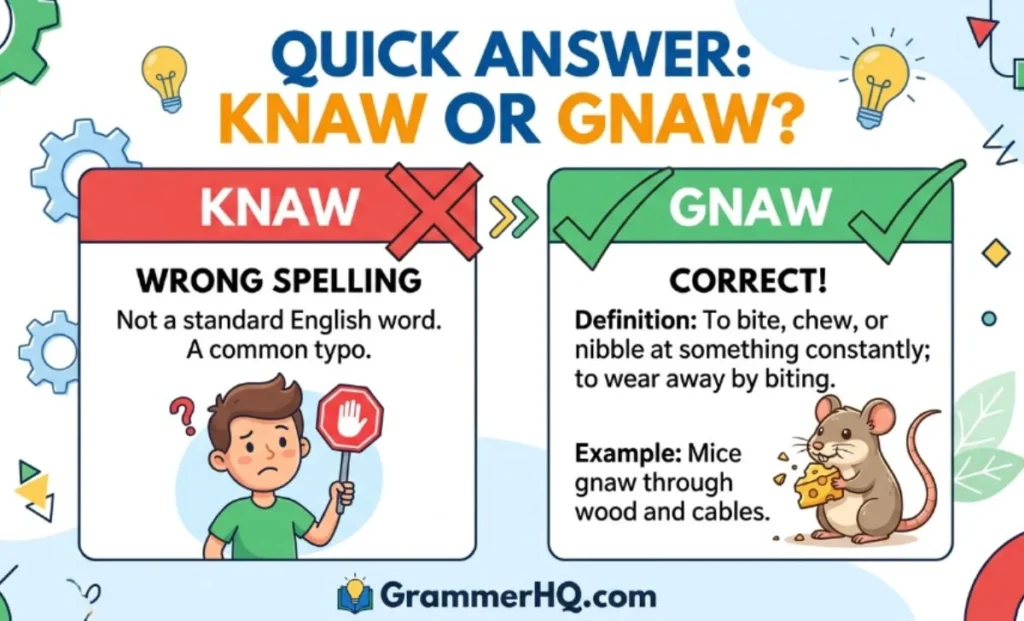
Which Spelling Is Correct?
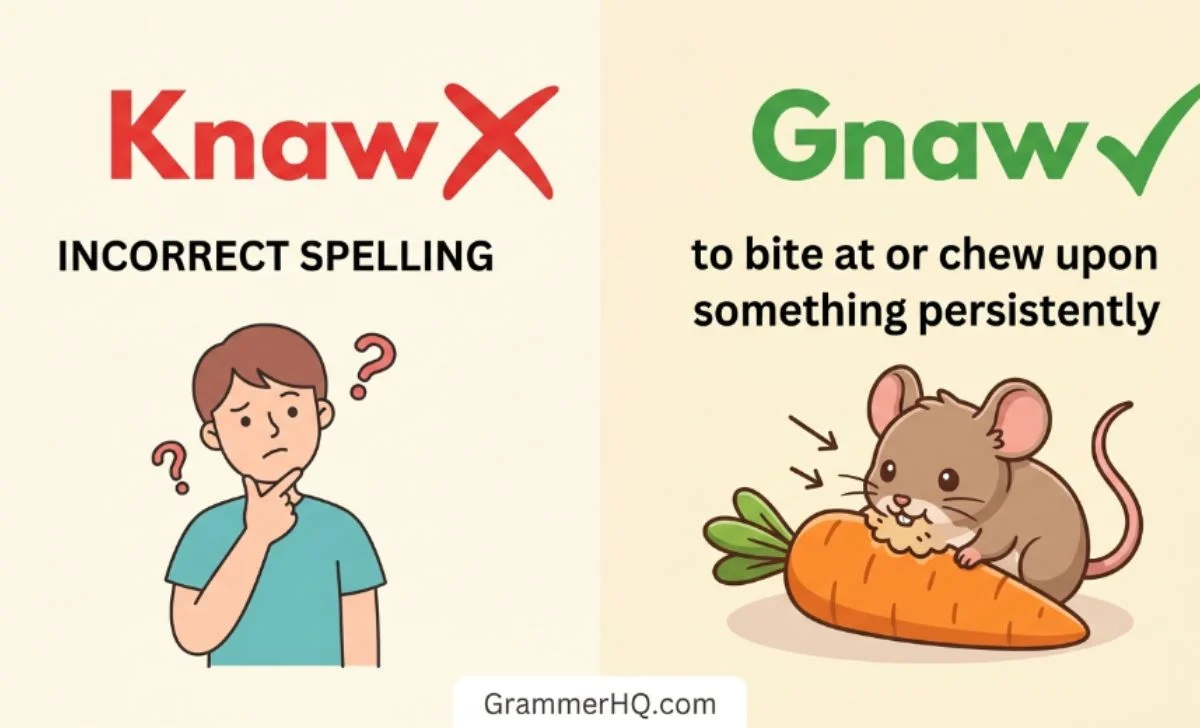
Gnaw is the correct spelling.
Knaw is incorrect and isn’t recognized as a standard English word. If you’re writing an essay, email, report, or social media post, always use gnaw.
| Word | Correct? | Meaning |
|---|---|---|
| Gnaw | ✅ Yes | To bite, chew, or wear away gradually |
| Knaw | ❌ No | Misspelling of gnaw |
Whether you’re using British English or American English, the spelling remains gnaw. There is no regional variation where knaw is considered correct.
Featured Snippet Answer
If you’re wondering whether to write knaw or gnaw, the correct spelling is gnaw. The word means to bite or chew repeatedly, or to cause gradual damage over time. Knaw is simply a spelling mistake and isn’t accepted in standard English.
What Does “Gnaw” Mean?
The verb gnaw describes the action of biting or chewing something repeatedly, often with small, persistent bites. It can also be used figuratively to describe emotions, worries, or thoughts that slowly trouble someone over time.
Literal Meaning
In its most common sense, gnaw refers to chewing something hard or tough.
Examples:
- A puppy gnawed on its favorite toy all afternoon.
- Rats can gnaw through wood, plastic, and even soft metal.
- The beaver gnawed the tree trunk until it fell.
In each example, the action involves repeated biting rather than a single bite.
Figurative Meaning
English speakers also use gnaw in a metaphorical sense to describe something that causes ongoing emotional discomfort.
Examples:
- Guilt continued to gnaw at him after the argument.
- Uncertainty began to gnaw at her confidence.
- The unanswered question gnawed at his mind for weeks.
Here, nothing is being physically chewed. Instead, the word creates a vivid image of a feeling that slowly wears someone down.
Everyday Usage
Although gnaw isn’t one of the most frequently used verbs in everyday conversation, it regularly appears in:
- Books and novels
- News articles
- Academic writing
- Business communication
- Everyday speech when describing persistent worries or physical chewing
Because it has both literal and figurative meanings, it’s a useful addition to any English learner’s vocabulary.
Why Do People Write “Knaw” Instead of “Gnaw”?
Misspellings don’t always happen because someone doesn’t know the word. Often, they happen because English spelling doesn’t always match pronunciation. Knaw is a perfect example.
The Silent G Creates Confusion
The biggest reason people write knaw is the silent G.
When spoken aloud, gnaw sounds exactly like “naw.” Since the first letter isn’t pronounced, many writers instinctively replace it with another letter or assume it should begin with K, similar to words like knife, knee, or knock.
This is a natural mistake because English contains many silent-letter patterns that don’t follow simple phonetic rules.
Pronunciation Doesn’t Match Spelling
Many English words preserve historical spellings even after pronunciation changes over centuries.
For example:
- Gnaw → sounds like naw
- Gnome → sounds like nome
- Gnat → sounds like nat
If you’ve only heard the word in conversation and never seen it written, spelling it as knaw may seem logical—even though it’s incorrect.
Keyboard and Typing Habits
Another reason is simple typing behavior.
People often search for words the way they think they sound. Search engines receive thousands of spelling-error queries every day, including incorrect versions of common words. That’s why searches such as “knaw or gnaw” or “is knaw correct” appear online.
Fortunately, modern spell checkers and dictionaries quickly recognize gnaw as the correct form.
How to Pronounce “Gnaw”
Correct pronunciation often helps you remember the correct spelling.
IPA Pronunciation
Gnaw
IPA: /nɔː/ (British English)
IPA: /nɔ/ (American English)
Notice that the G is completely silent.
The word begins with the N sound, not the G sound.
Why Is the G Silent?
The silent G is a feature inherited from earlier stages of the English language. Over time, pronunciation changed while the traditional spelling remained.
English contains several words where historical spellings have survived even though certain letters are no longer spoken.
Examples include:
- Gnat
- Gnome
- Gnash
- Sign (silent G in the final position)
Understanding this historical pattern makes the spelling gnaw easier to remember.
Knaw vs Gnaw: What’s the Difference?
At first glance, the two words look similar, but only one belongs in standard English.
| Feature | Gnaw | Knaw |
|---|---|---|
| Standard English word | ✅ Yes | ❌ No |
| Found in major dictionaries | ✅ Yes | ❌ No |
| Correct spelling | ✅ Yes | ❌ No |
| Accepted in academic writing | ✅ Yes | ❌ No |
| Used by native speakers | ✅ Yes | ❌ Only as a typo |
The difference is straightforward:
- Gnaw is the correct English verb.
- Knaw is an incorrect spelling created by pronunciation-based guessing.
Whenever you’re unsure, remember that dictionaries, style guides, and professional editors all recognize only gnaw.
Real-Life Examples of “Gnaw” in Context
Seeing a word in context is one of the fastest ways to remember it.
Animals
- The rabbit gnawed the wooden fence.
- A squirrel gnawed through the shell to reach the nut.
- Mice can gnaw electrical wires, causing serious damage.
Everyday Conversation
- Stop letting small problems gnaw at your peace of mind.
- The child gnawed on a pencil while thinking about the answer.
- Hunger began to gnaw at the hikers after several hours on the trail.
Professional Writing
You may also encounter gnaw in articles, research papers, or business communication:
Rising uncertainty continued to gnaw at investor confidence throughout the quarter.
In this sentence, the word conveys a slow, persistent feeling rather than physical chewing, showing why gnaw is such a versatile verb.
How to Remember the Correct Spelling of Gnaw
Spelling becomes much easier when you associate a word with a simple memory trick instead of trying to memorize letters.
Memory Trick #1: The G Is Silent, Not Missing
Think of this sentence:
“The G stays in the word, even if it stays silent.”
You don’t hear the G, but it still belongs there. Whenever you’re tempted to write knaw, remind yourself that English often keeps historical letters even when they aren’t pronounced.
Memory Trick #2: Connect It With Other Silent-G Words
The spelling pattern becomes easier once you notice similar words.
| Word | Pronunciation |
|---|---|
| Gnat | nat |
| Gnome | nome |
| Gnash | nash |
| Gnaw | naw |
Instead of treating gnaw as a unique exception, think of it as part of a family of words that begin with a silent G.
Memory Trick #3: Picture an Animal Chewing
Imagine a beaver chewing through a tree or a puppy chewing a toy.
Now say:
“Animals gnaw things.”
The image makes the word easier to recall than memorizing letters alone.
Word Origin: Why Is It Spelled “Gnaw”?
English spelling often reflects history rather than modern pronunciation, and gnaw is a good example.
Old English Roots
The word comes from Old English gnagan, which meant to bite, chew, or nibble repeatedly. Over time, the language evolved, pronunciation became simpler, but the traditional spelling remained.
This explains why today’s pronunciation no longer includes the G sound.
Germanic Connection
Gnaw belongs to a group of words inherited from the Germanic languages. Similar forms appeared in several early Germanic dialects, where the initial G was once pronounced.
As spoken English changed over centuries, many initial consonant sounds disappeared, while written forms stayed largely the same.
Why Didn’t English Change the Spelling?
Unlike some languages that regularly update spellings to match pronunciation, English preserves many historical spellings.
That’s why words such as:
- gnat
- gnome
- gnash
- gnaw
still begin with G, even though native speakers don’t pronounce it.
Understanding this historical background makes the spelling feel much more logical.
Common Mistakes People Make
Learning what not to write can be just as valuable as learning the correct form.
Mistake 1: Writing “Knaw”
❌ The dog knawed the bone.
✅ The dog gnawed the bone.
Mistake 2: Spelling by Sound
Many learners spell words exactly as they hear them.
Since gnaw sounds like “naw,” they assume the spelling should follow the pronunciation.
English, however, doesn’t always work that way.
Mistake 3: Confusing It With Silent-K Words
Words such as:
- knife
- knee
- knock
- knot
all begin with a silent K.
Because of this familiar pattern, some writers mistakenly assume gnaw should follow the same rule and replace the silent G with K.
In reality, these are completely different spelling patterns.
Mistake 4: Trusting Pronunciation Alone
Pronunciation is helpful, but it shouldn’t be your only guide when spelling English words.
Many commonly confused words have spellings that don’t perfectly match how they’re spoken.
Examples include:
- receipt
- debt
- subtle
- aisle
- gnaw
Reading regularly is one of the best ways to become familiar with these patterns.
Real-Life Examples of “Gnaw”
Understanding a word becomes much easier when you see it used naturally in different situations.
Animals
Animals often gnaw objects to eat, build nests, or wear down their teeth.
Examples:
- The hamster gnawed through the cardboard box overnight.
- A beaver can gnaw large tree trunks surprisingly quickly.
- Rabbits constantly gnaw to keep their teeth from becoming too long.
Everyday Life
People also use gnaw in ordinary conversations.
Examples:
- He absent-mindedly gnawed on the end of his pen during the meeting.
- The child gnawed the corner of the pencil while thinking.
- My dog loves to gnaw on rubber toys.
Figurative Usage
One of the most powerful uses of gnaw is in figurative writing.
Examples:
- Doubt continued to gnaw at her confidence.
- Regret slowly gnawed at his conscience.
- Financial worries gnawed at the family for months.
- Curiosity gnawed at the detective until he solved the case.
This figurative meaning appears frequently in novels, newspapers, speeches, and professional writing because it vividly describes persistent emotional pressure.
Synonyms of “Gnaw”
Depending on the context, you can replace gnaw with similar words.
Physical Actions
- Chew
- Bite
- Nibble
- Chomp
- Crunch
- Munch
Figurative Meanings
- Trouble
- Disturb
- Torment
- Consume
- Wear away
- Bother
- Eat away
Choosing the right synonym depends on whether you’re describing physical chewing or emotional discomfort.
When Should You Use “Gnaw”?
Use gnaw whenever you’re describing repeated biting, chewing, or something that gradually wears away physically or emotionally.
Correct examples:
- The puppy gnawed the chair leg.
- Anxiety gnawed at him before the interview.
- The insects gnawed tiny holes in the leaves.
- Hunger gnawed at the travelers after hours without food.
- Years of neglect had gnawed away at the old building’s wooden frame.
In each sentence, the idea is one of continuous, gradual action, which is exactly what gnaw expresses.
Quick Recap:
Before moving to the final section, remember these key points:
- ✅ Gnaw is the only correct spelling.
- ❌ Knaw is a common misspelling.
- The G is silent, but it should never be removed.
- Gnaw can describe both physical chewing and emotional distress.
- The word comes from Old English, which explains its unusual spelling.
- Reading and using the word in context is the best way to remember it.
Quick Practice Quiz
A short quiz is a great way to check whether you’ve understood the difference between knaw and gnaw.
Choose the Correct Spelling
1. The puppy _______ the wooden stick for hours.
- A. Knawed
- B. Gnawed
✅ Answer: B. Gnawed
2. Constant worry began to _______ at her confidence.
- A. Gnaw
- B. Knaw
✅ Answer: A. Gnaw
3. Which sentence is correct?
- A. The mouse knawed through the box.
- B. The mouse gnawed through the box.
✅ Answer: B. The mouse gnawed through the box.
4. Which word is recognized in standard English dictionaries?
- A. Knaw
- B. Gnaw
✅ Answer: B. Gnaw
5. Which statement is true?
- A. Knaw is the British spelling.
- B. Gnaw is the correct spelling in both British and American English.
✅ Answer: B. Gnaw is the correct spelling in both British and American English.
If you answered all five correctly, you’ve mastered one of the most common spelling confusions involving silent letters.
FAQ,s
Is “Knaw” a Real English Word?
No. Knaw is not a standard English word and doesn’t appear as a correct entry in major dictionaries. It is simply a common misspelling of gnaw.
Is “Gnaw” the Correct Spelling?
Yes. Gnaw is the only correct spelling in modern English. It is accepted in academic, professional, and everyday writing.
Why Is the G Silent in “Gnaw”?
The silent G comes from the word’s historical development. In earlier forms of English and related Germanic languages, the initial G was pronounced. Over time, pronunciation changed, but the traditional spelling remained.
How Do You Pronounce “Gnaw”?
Gnaw is pronounced /nɔː/ in British English and /nɔ/ in American English. The G is silent, so the word begins with the N sound.
What Does “Gnaw” Mean?
Gnaw means to bite or chew something repeatedly. It can also mean to trouble or wear away gradually, especially when referring to emotions such as guilt, fear, or worry.
Can “Gnaw” Be Used Figuratively?
Yes. Besides describing physical chewing, gnaw is commonly used in a figurative sense.
Examples:
- A sense of regret gnawed at him.
- Doubt continued to gnaw at her confidence.
In these examples, the word describes a feeling that slowly becomes more difficult to ignore.
Is There a British and American Spelling Difference?
No. Unlike words such as colour/color or humour/humor, gnaw has the same spelling in both British and American English.
What Are Some Similar Words With a Silent G?
Several English words follow the same spelling pattern, including:
- Gnat
- Gnome
- Gnash
Learning these words together can make the spelling of gnaw easier to remember.
Is “Gnaw” a Verb?
Yes. Gnaw is a verb. Depending on the context, it can describe physical chewing or something that gradually affects a person or object.
How Can I Remember the Correct Spelling?
Remember this simple rule:
You don’t hear the G, but you still write the G.
Associating gnaw with other silent-G words such as gnat and gnome also helps reinforce the correct spelling.
Final Verdict
If you’re deciding between knaw and gnaw, the answer is straightforward: gnaw is the correct spelling, while knaw is an incorrect variant that results from spelling the word as it sounds.
Although the silent G can make the word seem unusual at first, it follows a historical spelling pattern shared by words like gnat, gnome, and gnash.
The easiest way to avoid this mistake is to remember that English spelling doesn’t always match pronunciation. Whenever you’re writing about biting, chewing, or a feeling that slowly troubles someone, choose gnaw with confidence.
Reading the word in context, practicing it in your own sentences, and recalling the silent-G pattern will make the correct spelling feel natural over time.
As your vocabulary grows, paying attention to commonly confused words like knaw and gnaw will not only improve your spelling but also make your writing clearer, more accurate, and more professional.
Read More Blogs:

Hi, I’m Amelia Parker, a grammar enthusiast and writer at GrammarHQ.com. I specialize in explaining spelling differences, confusing words, and common English mistakes through simple, practical, and easy-to-understand guides.