Have you ever written “I ment to call you” and then wondered whether something was missing? The confusion is understandable because meant is pronounced /ment/, so it sounds exactly like the spelling many people expect.
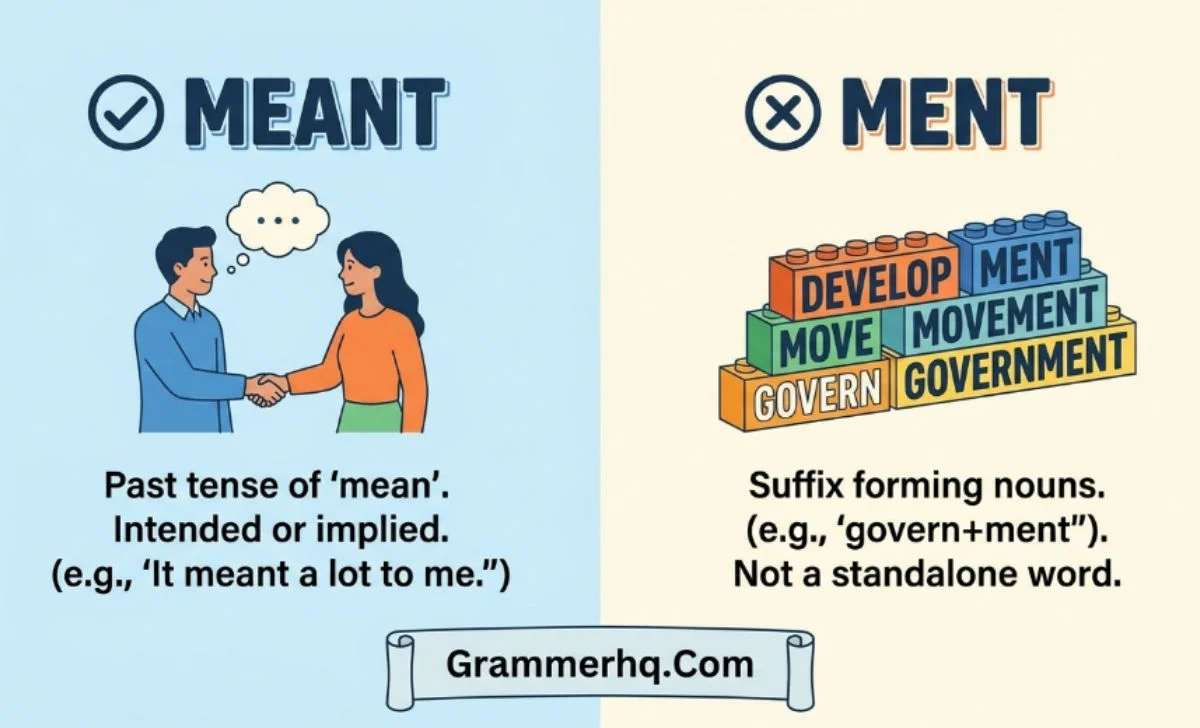
But when you are using the past form of mean, there is only one standard spelling: meant. The word ment is not the past tense of mean.
In this guide, you will learn the difference between meant and ment, why the mistake happens, how meant works grammatically, when to use mean instead, and how to use both forms naturally in everyday English.
Quick Answer
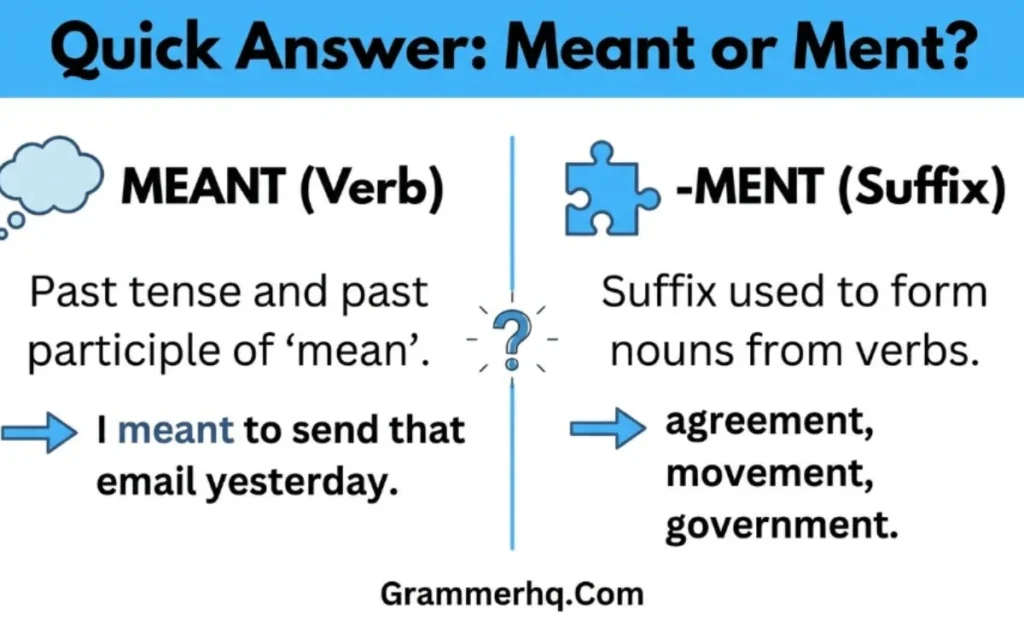
Meant is correct. Ment is incorrect when you mean the past tense or past participle of the verb “mean.”
The basic form is:
mean → meant → meant
- Mean = base/present form
- Meant = past tense
- Meant = past participle
- Ment = not the standard past form of mean
For example:
I meant to call you yesterday. ✅
Not:
I ment to call you yesterday. ❌
Cambridge Dictionary lists meant as both the past simple and past participle of mean.
So if your sentence means “intended,” “signified,” or “had importance” in the past, meant is the spelling you need.
Why Is It “Meant,” Not “Ment”?
The easiest answer is that mean is an irregular verb. Its past form is not made by simply adding -ed.
Instead:
mean → meant
Compare:
I mean what I say.
I meant what I said.
The change from mean to meant is part of the verb’s established English form. Cambridge’s grammar guidance explains that irregular verbs can have past forms that do not follow the usual -ed pattern.
This is why ment is not an alternative spelling of meant. It may sound right when you hear the word, but standard English spelling uses the letters m-e-a-n-t.
Why Do “Meant” and “Ment” Sound the Same?
This is where the confusion really starts.
Meant is pronounced /ment/. Cambridge gives the same pronunciation in its learner dictionary.
So you may hear:
“I meant to tell you.”
and think:
“Did they say ment?”
The sound is not a reliable guide to the spelling here.
Think of it as:
What you hear: “ment”
What you write: meant
That small difference between pronunciation and spelling is why this mistake is common.
Mean and meant have different vowel sounds
There is another useful distinction:
- mean → /miːn/
- meant → /ment/
So although the two words are closely related, their vowel sounds are different.
What Does “Meant” Mean?
The meaning of meant depends on the context. It commonly describes intention, meaning, result, or importance.
1. Meant = Intended
This is one of the most common uses.
I meant to send you the document.
The speaker intended to send the document.
Another example:
She meant to arrive early, but her train was delayed.
Here, meant to means intended to.
2. Meant = Signified or Expressed
Meant can also refer to the meaning of a word, statement, sign, or action.
I finally understood what he meant.
Or:
What did that message mean?
The present form mean is used in the second sentence because the question uses did. More on that important rule below.
3. Meant = Had Importance
Sometimes meant describes emotional value or importance.
Your advice meant a lot to me.
The advice was important to the speaker.
Cambridge gives this sense of mean as having importance or value and uses examples involving something that “meant a lot.”
4. Meant = Intended for a Purpose
The phrase meant for describes intended use or purpose.
This guide was meant for beginners.
The room was meant for meetings.
Again, meant for expresses the idea of intended for.
Mean vs. Meant: What’s the Difference?
The difference is mainly grammatical.
| Word | Typical role | Example |
|---|---|---|
| mean | Base/present form | I mean what I say. |
| meant | Past form | I meant what I said. |
| meant | Past participle | It has meant a lot to me. |
Compare the meaning
I mean no harm.
This describes the speaker’s current intention.
I meant no harm.
This describes an intention in the past.
The verb mean can express several ideas, including expressing or representing something, intending something, having a particular result, or having importance.
“What Did You Mean?” or “What Did You Meant?”
This is one of the most useful rules to remember.
Correct:
What did you mean? ✅
Incorrect:
What did you meant? ❌
Why?
Because did already marks the sentence as past tense. The main verb then returns to its base form.
So:
did + mean ✅
not:
did + meant ❌
More examples:
Did you mean that?
What did she mean by that?
Did they mean to leave early?
This is an important distinction because someone can know that meant is the past form of mean and still make the mistake of using it after did.
Is “Ment” a Word?
If you are asking whether ment can replace meant in a sentence such as “I ment to call you,” the answer is no.
Write:
I meant to call you. ✅
Not:
I ment to call you. ❌
However, there is an important reason ment may look familiar.
The suffix “-ment”
-ment is used at the end of many English nouns.
For example:
- payment
- movement
- agreement
- development
- achievement
- management
- statement
- treatment
In these words, -ment is part of the word. It is not the past form of the verb mean.
So keep the distinction clear:
meant = the past tense/past participle of mean
-ment = a suffix found in many English words
That is why saying simply “ment does not exist” can be misleading. The spelling ment can occur inside English words; it is just not the standard standalone past form of mean.
Meant as a Past Tense and Past Participle
One reason meant can seem confusing is that the same form is used in more than one grammatical construction.
Simple past
I meant to call you.
Present perfect
I have meant to discuss this with you for weeks.
Past perfect
I had meant to finish the report earlier.
The pattern is:
mean → meant → meant
Cambridge specifically identifies meant as both the past simple and past participle of mean.
Common Phrases With “Meant”
Learning common phrases can make the word easier to recognize in real English.
Meant to
I meant to email you yesterday.
Meaning: intended to.
Meant for
This program was meant for new students.
Meaning: intended for.
Meant well
She meant well, but her advice was not helpful.
Meaning: had good intentions.
Meant no harm
I meant no harm by my comment.
Meaning: did not intend to cause harm.
Meant a lot
Your support meant a lot to our family.
Meaning: was very important.
Meant every word
I meant every word I said.
Meaning: was completely sincere.
These are common, natural patterns rather than isolated dictionary definitions. Cambridge also lists related expressions such as mean well, be meant to, and be meant for.
Meant or Ment: Common Mistakes
Here are some mistakes worth watching for:
| Incorrect | Correct |
|---|---|
| I ment to call you. | I meant to call you. |
| She ment no harm. | She meant no harm. |
| It ment a lot to me. | It meant a lot to me. |
| They ment every word. | They meant every word. |
| I ment to explain it. | I meant to explain it. |
But remember that mean/meant can create a different kind of mistake:
| Incorrect | Correct |
|---|---|
| What did you meant? | What did you mean? |
| Did she meant that? | Did she mean that? |
The first group is a spelling mistake. The second is a verb-form mistake caused by using meant after did.
Meant Pronunciation
Meant is pronounced:
/ment/
It sounds like “ment.”
That is why a sentence such as:
I meant what I said.
can be confusing when you are learning English.
But spelling it as ment is still incorrect when you need the past form of mean.
A useful comparison is:
| Word | Pronunciation |
|---|---|
| mean | /miːn/ |
| meant | /ment/ |
Cambridge lists mean as /miːn/ and meant as /ment/.
British English vs. American English
There is no spelling difference between British and American English here.
British English: meant
American English: meant
So you should write:
I meant to tell you.
regardless of which variety of standard English you are using.
An Easy Trick to Remember “Meant”
Use this simple pattern:
MEAN + T = MEANT
Then connect the form to time:
I mean it today. I meant it yesterday.
If you hear “ment” and are unsure how to spell it, ask yourself:
“Is this the past form of mean?”
If the answer is yes, write:
MEANT
That one habit can prevent the most common spelling mistake.
Meant or Ment: Real-Life Examples
Here are some natural examples showing how mean and meant are used in everyday English:
- Text message: “Sorry, I meant to reply earlier.”
- At work: “I meant to send the updated report before lunch.”
- In conversation: “What did you mean by that?”
- After an apology: “I didn’t mean to offend you.”
- Talking about the past: “I meant every word I said.”
- Showing importance: “Your help meant more than you realize.”
- Explaining purpose: “This feature was meant for experienced users.”
- Describing intentions: “He meant well, even though the plan failed.”
- Describing a past intention: “I had meant to visit you last week.”
- Clarifying a statement: “That’s not what I meant.”
These examples show how the correct form changes according to the tense, grammar, and meaning of the sentence.
FAQs
1: Is “meant” the correct spelling?
Yes. Meant is the correct spelling when you need the past tense or past participle of mean.
2: Is “ment” the past tense of “mean”?
No. The correct past form is meant.
3: Is “ment” a word?
It is not the standard standalone past form of mean. However, -ment occurs as a suffix in many English words, such as payment and development.
4: What is the past tense of “mean”?
The past tense of mean is meant.
I mean it.
I meant it.
5: What is the past participle of “mean”?
The past participle is also meant.
It has meant a great deal to me.
6: Why is “meant” pronounced like “ment”?
Because the standard pronunciation of meant is /ment/. The pronunciation does not change its spelling.
7: Is “I ment to call you” correct?
No. The correct sentence is:
I meant to call you.
8: Is “What did you meant?” correct?
No. Write:
What did you mean?
After did, use the base form mean.
9: Is “meant” an irregular verb?
Meant is the irregular past and past participle form of mean. It does not follow the regular pattern of simply adding -ed.
10: Is “meant” the same in British and American English?
Yes. The standard spelling is meant in both varieties.
11: How can I remember the spelling of “meant”?
Remember:
Mean + T = Meant
And:
I mean it today; I meant it yesterday.
Conclusion
If you are choosing between meant and ment, use meant when you need the past tense or past participle of mean. The confusion is understandable because meant is pronounced /ment/, but its standard spelling includes ea.
The key pattern is simple: mean → meant → meant. Also remember the related grammar rule: after did, use mean, as in “What did you mean?”
Finally, do not confuse meant with the -ment suffix found in words such as payment and development. Once these distinctions are clear, the spelling becomes easy to remember.
Read More Blogs:
- Women vs Woman: Singular or Plural? Learn the Correct Usage
- Further or Farther: Difference, Meaning, Usage & Examples