Women vs Woman, which one is correct? The answer is simple: woman is the singular form, while women is the plural form. Although these words look and sound similar, they are used differently in English sentences.
Understanding the difference can help you avoid common mistakes such as “a women” or “many woman.”
In this guide, you’ll learn how to use woman and women correctly, understand their pronunciation, distinguish woman’s from women’s, and use both forms naturally in everyday, academic, and professional English.
Quick Answer
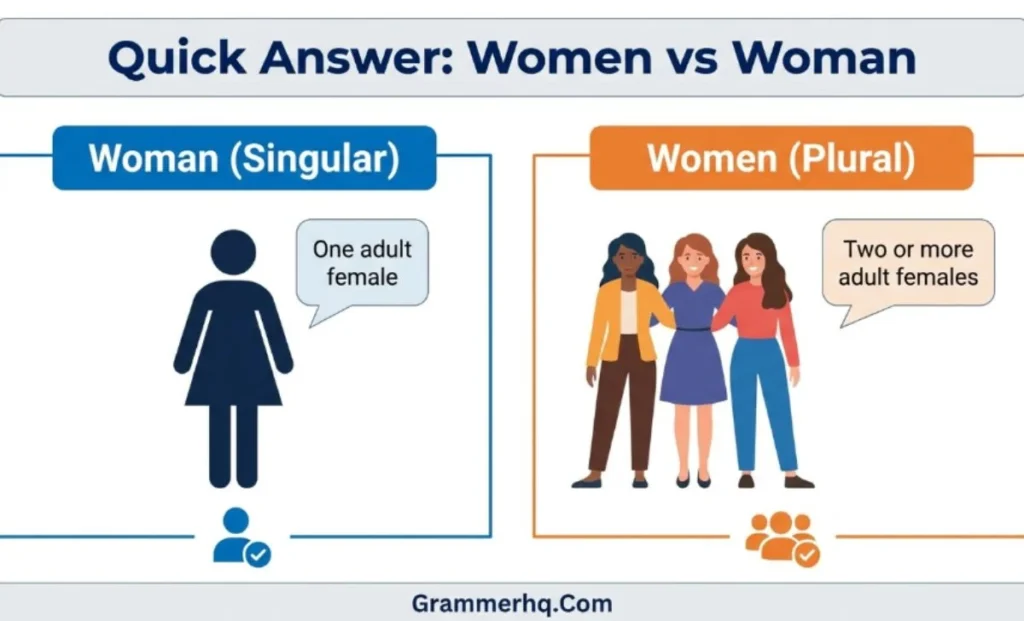
Woman is the singular form, meaning one adult female person.
Women is the plural form, meaning more than one adult female person. Cambridge Dictionary lists woman as singular and women as its plural form. (Cambridge Dictionary)
- One woman is waiting outside.
- Two women are waiting outside.
A useful rule is:
One woman → two or more women
So:
- a woman ✅
- three women ✅
- a women ❌
- three woman ❌
The difference is grammatical, not a British-versus-American spelling difference. Both British and American English use woman for singular and women for plural.
Woman vs Women: At a Glance
| Word | Number | Meaning | Example |
|---|---|---|---|
| woman | Singular | One adult female person | A woman called me. |
| women | Plural | More than one adult female person | Three women called me. |
The most important thing to remember is that woman and women are not interchangeable. The form you choose depends on whether you are referring to one person or more than one.
What Does “Woman” Mean?
Woman is a singular countable noun referring to one adult female person. (Cambridge Dictionary)
For example:
- She is a talented woman.
- I spoke to a woman at the reception desk.
- That woman is my neighbor.
- One woman answered the question.
Woman With “A,” “One,” “This,” and “That”
Because woman is singular, it can be used with singular determiners such as a, one, this, and that.
- a woman
- one woman
- this woman
- that woman
For example:
A woman left her umbrella at the café.
That woman works in our office.
A common mistake is adding a plural word after a:
❌ A women is waiting outside.
✅ A woman is waiting outside.
What Does “Women” Mean?
Women is the plural form of woman. It refers to two or more adult female people. Cambridge lists women as the plural of woman. (Cambridge Dictionary)
Examples include:
- The women are talking.
- Three women joined the meeting.
- Many women work in the industry.
- Those women are teachers.
Because women is plural, it can be used with plural numbers and quantifiers:
- two women
- several women
- many women
- some women
- these women
- those women
You would not normally say one women because one requires a singular noun:
❌ One women called earlier.
✅ One woman called earlier.
Is Woman Singular or Plural?
Woman is singular.
Use it when talking about one person.
Examples
- The woman is waiting outside.
- A woman was sitting near the window.
- One woman has applied for the position.
- This woman works with my sister.
Notice the verbs:
- woman is
- woman was
- woman has
- woman works
This is an example of subject–verb agreement. A singular subject normally takes a singular verb in these structures.
Is Women Singular or Plural?
Women is plural.
Use it when talking about more than one person.
Examples
- The women are waiting outside.
- Several women were invited.
- Many women have applied for the position.
- These women work in the same company.
Compare the two:
The woman is speaking.
The women are speaking.
This simple contrast is one of the easiest ways to remember the difference.
Why Is the Plural of Woman “Women”?
Unlike regular nouns such as book → books or car → cars, woman does not form its plural by simply adding -s.
Instead:
woman → women
This is an irregular plural. English has several familiar irregular patterns, including:
- man → men
- woman → women
- tooth → teeth
- foot → feet
- mouse → mice
- child → children
Cambridge specifically lists woman → women among nouns whose plural forms do not follow the regular -s pattern. (Cambridge Dictionary)
That is why womans is not the standard plural form.
❌ womans
✅ women
Woman vs Women Pronunciation
Spelling is not the only difference. Woman and women also have different standard pronunciations.
According to Cambridge Dictionary:
- woman: /ˈwʊm.ən/
- women: /ˈwɪm.ɪn/ (Cambridge Dictionary)
A simple learner-friendly approximation is:
- woman → “WUHM-ən”
- women → “WIM-in”
The exact sound can vary somewhat with accent, but the two words are normally distinguished in standard pronunciation.
A Simple Way to Practice
Say these pairs slowly:
one woman
two women
Then compare:
The woman is here.
The women are here.
This connects pronunciation with the singular/plural grammar rule.
Woman’s vs Women’s: What’s the Difference?
Another common source of confusion is the difference between woman’s and women’s.
The apostrophe changes the form because these are possessive constructions.
Woman’s
Woman’s usually refers to something belonging to, associated with, or connected to one woman.
Examples:
- a woman’s handbag
- a woman’s opinion
- one woman’s decision
- a woman’s experience
For example:
I respected the woman’s decision.
Here, the decision belongs to or is associated with one woman.
Women’s
Women’s refers to something associated with women as a plural group.
Examples:
- women’s rights
- women’s health
- women’s clothing
- women’s education
For example:
The organization supports women’s education.
A useful comparison is:
one woman → woman’s
multiple women → women’s
Woman vs Women in Compound Expressions
You may see both woman and women before another noun.
For example:
- a woman doctor
- women doctors
- a woman leader
- women leaders
- a woman-owned business
- women-owned businesses
The choice depends on whether the noun refers to one woman or more than one.
Compare:
She is a woman doctor.
The hospital employs several women doctors.
The same singular/plural distinction remains even when the word is part of a larger noun phrase.
Subject–Verb Agreement With Woman and Women
One of the most useful practical rules is to match woman with a singular verb and women with a plural verb.
Singular
❌ The woman are waiting.
✅ The woman is waiting.
❌ The woman have a ticket.
✅ The woman has a ticket.
Plural
❌ The women is waiting.
✅ The women are waiting.
❌ The women has tickets.
✅ The women have tickets.
The pattern is straightforward:
woman → is / was / has
women → are / were / have
Learning this pattern helps you recognize mistakes quickly when writing.
Common Mistakes With Woman and Women
Here are some of the mistakes English learners commonly make:
| Incorrect | Correct |
|---|---|
| a women | a woman |
| one women | one woman |
| many woman | many women |
| two woman | two women |
| several woman | several women |
| those woman | those women |
| the women is | the women are |
| the woman are | the woman is |
| womans | women |
Why These Mistakes Happen
The words look very similar, and the vowel change from a to e is easy to overlook in writing. In speech, the pronunciation difference can also be difficult for learners to hear clearly.
The best solution is not to memorize isolated spellings. Instead, connect each word to its number:
one woman
many women
That gives you both the spelling and the grammar rule at the same time.
Woman vs Women in Everyday Examples
The distinction appears constantly in ordinary English.
Everyday Conversation
I met a woman at the bus stop.
I met two women at the bus stop.
Workplace and Email
The woman I spoke with will send the documents tomorrow.
Several women from the marketing team attended the meeting.
Academic Writing
The study included one woman from each group.
The researchers interviewed 50 women.
News and Media
A woman was appointed to the position.
Several women were recognized for their achievements.
Social Media
She is an inspiring woman.
These women have built successful businesses.
In each case, the choice depends on the number of people being discussed.
Easy Trick to Remember Woman vs Women
Use this simple two-part rule:
Woman = one
Women = more than one
Then connect the nouns to their verbs:
The woman is.
The women are.
For example:
One woman is speaking.
Three women are speaking.
If you can identify whether you mean one or more than one, choosing the correct form becomes much easier.
Woman vs Women in British and American English
Unlike spelling differences such as colour/color or fulfil/fulfill, there is no British-American spelling split here.
Both British and American English use:
- woman for singular
- women for plural
Cambridge’s UK and US dictionary entries both give women as the plural form of woman. (Cambridge Dictionary)
Pronunciation can vary slightly between accents, but the basic grammatical distinction stays the same.
So you do not need to choose woman for British English and women for American English. The correct form depends on number, not region.
Woman vs Women: Quick Reference
| Question | Answer |
|---|---|
| Singular form | woman |
| Plural form | women |
| One person | one woman |
| More than one | two women |
| Singular article | a woman |
| Plural quantifier | many women |
| Singular verb | the woman is |
| Plural verb | the women are |
| Singular possessive | woman’s |
| Plural possessive | women’s |
| Standard plural | women, not womans |
FAQ,s
Is woman singular or plural?
Woman is singular. Use it when referring to one adult female person, such as “a woman” or “one woman.” (Cambridge Dictionary)
Is women singular or plural?
Women is plural. It refers to more than one adult female person. For example, “three women” and “many women.” (Cambridge Dictionary)
Is “a women” grammatically correct?
No. The correct phrase is “a woman.” The article a is used with a singular countable noun, while women is plural.
Is “women” the plural of “woman”?
Yes. Women is the irregular plural form of woman. It does not become plural by adding -s. (Cambridge Dictionary)
What is the difference between woman and women?
Woman refers to one person, while women refers to more than one. For example, “a woman” is singular, whereas “three women” is plural.
What is the difference between woman’s and women’s?
Woman’s usually refers to one woman, while women’s refers to multiple women or women as a group. For example, “a woman’s opinion” and “women’s rights.”
How do you pronounce woman and women?
Woman is commonly pronounced /ˈwʊm.ən/, while women is commonly pronounced /ˈwɪm.ɪn/. (Cambridge Dictionary)
Should I say “women are” or “women is”?
Use “women are” because women is plural. For example: “The women are working together.”
Why is “womans” incorrect?
Womans is not the standard plural form of woman. The correct irregular plural is women. (Cambridge Dictionary)
Can woman and women be used interchangeably?
No. They serve different grammatical roles. Use woman for one person and women for more than one.
Conclusion
The difference between woman and women comes down to one basic grammatical idea: number. Woman is singular, so it refers to one adult female person. Women is plural, so it refers to two or more.
The same distinction appears in related forms such as woman’s and women’s, as well as in subject–verb agreement: “the woman is” but “the women are.”
Once you connect woman with one and women with more than one, the correct form becomes much easier to choose in everyday, academic, and professional writing.
Read More Blogs:
- And vs Or: What’s the Difference and When Should You Use Each?
- Shute vs Chute: Which Spelling Is Correct?