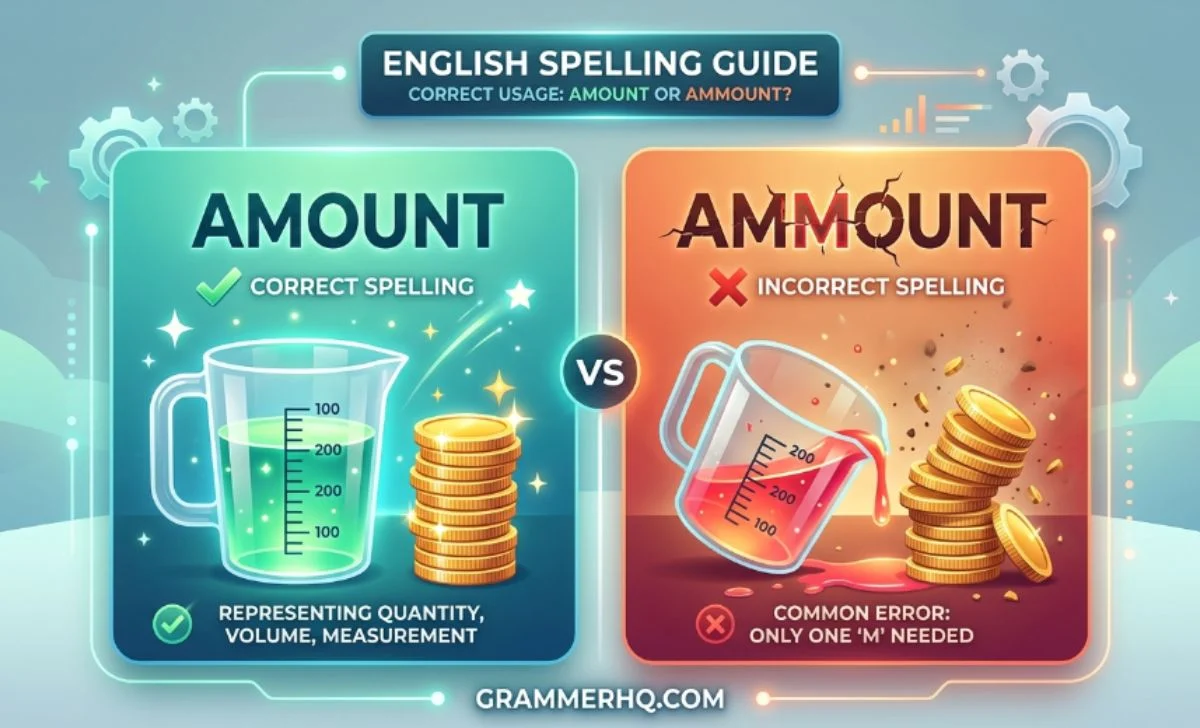
Have you ever wondered whether amount or ammount is the correct spelling? You are not alone. This small spelling mistake is surprisingly common because English has many words with double consonants, making ammount look reasonable at first glance.
However, there is only one standard spelling: amount. Whether you are talking about money, time, water, information, work, or another quantity, amount is the correct word.
Ammount is simply a misspelling, not an alternative British or American English form. In this guide, you will learn why amount is correct, how to pronounce it, how to use it naturally, and how it differs from number and quantity.
Quick Answer
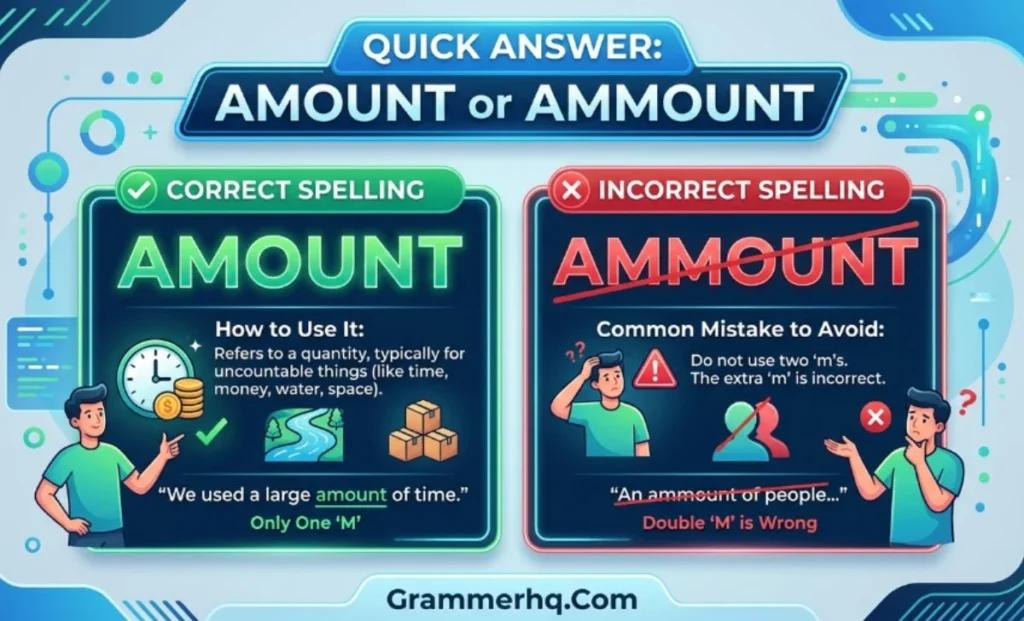
Amount is correct. Ammount is incorrect.
| Spelling | Status | Example |
|---|---|---|
| Amount | ✅ Correct | The amount of money was higher than expected. |
| Ammount | ❌ Incorrect | The ammount of money was higher than expected. |
The simplest rule is:
Amount has only one “m.”
So, if you are checking the spelling in an email, assignment, report, or document, choose amount.
What Does Amount Mean?
Amount refers to a quantity, total, or sum of something.
It is especially common when discussing things that are measured rather than counted as separate items.
For example:
- the amount of water in a tank
- the amount of money in an account
- the amount of time available
- the amount of information provided
You will encounter this word regularly in everyday conversation, business communication, academic writing, banking, finance, and formal documents.
Why Is “Ammount” Incorrect?
Ammount is simply a misspelling. It is not a separate English word and does not represent a British or American spelling variation.
Why does the error look convincing? English has plenty of words containing doubled consonants, such as common, summer, hammer, and grammar. Because of that pattern, adding another m may seem natural.
Typing quickly can cause the same problem. An extra letter may slip in without the writer noticing.
Nevertheless, the standard spelling remains amount.
An Easy Way to Remember It
Try this simple memory aid:
A + MOUNT = AMOUNT
This is only a spelling trick, not an explanation of the word’s modern structure.
The key point is easy to remember:
One m = amount.
How Do You Spell Amount?
The correct spelling is:
A-M-O-U-N-T
Compare the two forms:
Correct
The total amount is $500.
Incorrect
The total ammount is $500.
If you often make this mistake, look specifically for the second m before submitting your writing.
How Do You Pronounce Amount?
The word is commonly pronounced:
uh-MOUNT
Its standard pronunciation is written as:
/əˈmaʊnt/
The main stress falls on the second syllable:
a-MOUNT
Although speakers may have different accents, the standard pronunciation is broadly similar in British and American English.
Amount as a Noun
As a noun, amount describes a quantity or total.
A common structure is:
amount + of + noun
You may see it in phrases such as:
- amount of money
- amount of water
- amount of time
- amount of information
- amount of work
- amount of energy
Examples
The amount of money required was higher than expected.
We have only a small amount of time left.
A large amount of information was collected.
This is one of the most common ways the word appears in everyday English.
Amount as a Verb
The word can also function as a verb, although learners usually encounter the noun form first.
The most familiar construction is amount to. Depending on the context, it can mean to reach a particular total or to have a particular significance.
For example:
The repairs amounted to $800.
Here, the phrase tells us that the total cost was $800.
It can also describe significance:
His actions amounted to a serious violation of the rules.
Common forms include amount, amounts, amounted, and amounting.
The expression amount to is particularly useful in formal, academic, legal, and professional writing.
Amount or Number: What’s the Difference?
This distinction is important because the two words are not normally interchangeable.
Generally, amount is used with uncountable nouns, while number is used with countable plural nouns.
Use Amount With Uncountable Nouns
- amount of money
- amount of water
- amount of time
- amount of information
- amount of work
- amount of sugar
Use Number With Countable Nouns
- number of students
- number of books
- number of people
- number of questions
- number of mistakes
Consider these examples:
We spent a large amount of money.
A large number of people attended the event.
The difference depends on how the noun is grammatically treated, not simply on whether the quantity is large or small.
Amount of vs. Number of
A useful rule is:
amount of + uncountable noun
number of + countable plural noun
| Correct phrase | Why? |
|---|---|
| amount of money | Money is treated as an uncountable quantity. |
| amount of water | Water is uncountable. |
| amount of time | Time is generally uncountable in this sense. |
| number of students | Students can be counted individually. |
| number of books | Books are countable. |
| number of questions | Questions are countable. |
Compare These Examples
❌ The amount of students increased.
✅ The number of students increased.
❌ A large number of water was wasted.
✅ A large amount of water was wasted.
For formal and academic writing, this distinction is a useful way to avoid common grammar mistakes.
Amount vs. Quantity
Amount and quantity are closely related, but they can have slightly different uses.
In ordinary conversation, amount sounds very natural:
The amount of water is too low.
By comparison, quantity can sound more formal and may emphasize a measurable supply:
The factory ordered a large quantity of raw materials.
Therefore, both words can describe how much of something exists, but the best choice depends on the context and the noun that follows.
Amount in Real-Life Examples
This word appears in many practical situations.
Money
Please enter the correct amount on the payment form.
Banking
The bank confirmed the amount of the deposit.
Time
I spent a considerable amount of time preparing the report.
Food
Add a small amount of salt to the soup.
Work
The project requires a significant amount of work.
Information
We have a limited amount of information about the incident.
Business
The invoice shows the total amount due.
Everyday Conversation
That’s a huge amount of money for such a small house.
These examples show why this word is useful far beyond spelling exercises. You will find it in casual speech, professional communication, academic writing, financial documents, and everyday transactions.
Common Spelling Mistakes With Amount
The most common error is adding an unnecessary second m.
❌ The ammount of money is incorrect.
✅ The amount of money is incorrect.
❌ Please enter the payment ammount.
✅ Please enter the payment amount.
❌ We need a large ammount of water.
✅ We need a large amount of water.
❌ The total ammount was $500.
✅ The total amount was $500.
❌ What is the exact ammount?
✅ What is the exact amount?
In every example, the solution is the same: remove the extra m.
Is “Ammount” Ever Correct?
No. Ammount is not a standard English spelling.
You may occasionally encounter it in comments, social media posts, user-generated content, or other informal writing. However, its appearance online does not make it an accepted spelling.
The standard form is amount.
There is also no British-American spelling difference that would make ammount acceptable.
British English vs. American English
Some English words have different spellings in British and American English, such as colour/color and organise/organize. This word is different.
| British English | amount |
| American English | amount |
| Canadian English | amount |
Therefore, amount is the correct spelling regardless of which major English variety you use.
The Origin of Amount
The history of amount goes back through Anglo-French and Middle English. Its development is connected with the idea of a total, quantity, or sum.
Over time, the word became established in English as a noun referring to a quantity or total. It also developed a verb use, particularly in the expression amount to, which can indicate a total or significance.
Understanding the history is interesting, but you do not need to memorize it to spell the word correctly. The practical rule remains much simpler: amount has one m.
FAQs
1: Is it amount or ammount?
Amount is correct. Ammount is a misspelling.
2: Is ammount a word?
No. Ammount is not a standard English word. It is a common misspelling of amount.
3: How do you spell amount?
The correct spelling is A-M-O-U-N-T.
4: What does amount mean?
Amount means a quantity, total, or sum of something.
5: How do you pronounce amount?
It is pronounced approximately uh-MOUNT, with the main stress on the second syllable.
6: Is amount British or American?
It is used in both British and American English, with the same spelling.
7: Should I use amount or number?
Generally, use amount with uncountable nouns and number with countable plural nouns.
8: Can amount be a verb?
Yes. For example:
The expenses amounted to $1,000.
9: What is the difference between amount and quantity?
Both can refer to a measurable quantity. However, amount is very common in everyday English, while quantity can sound more formal or emphasize a measurable supply.
10: Is “ammount” a common spelling mistake?
Yes. It is a common misspelling of amount, but it is not an accepted alternative spelling.
Conclusion
The correct spelling is amount, not ammount. The two forms are not alternative spellings, and the difference is not related to British or American English. Instead, ammount is simply an incorrect form with an extra m.
Use amount for quantities and totals, especially with uncountable nouns such as money, water, time, information, and work. On the other hand, use number with countable plural nouns such as students, books, people, and questions.
If you remember only one rule, make it this:
Amount has one “m.”
Read More Blogs:
- Channeled or Channelled: American vs British English in 2026?
- Further or Farther: Difference, Meaning, Usage & Examples

Hi, I’m Amelia Parker, a grammar enthusiast and writer at GrammarHQ.com. I specialize in explaining spelling differences, confusing words, and common English mistakes through simple, practical, and easy-to-understand guides.