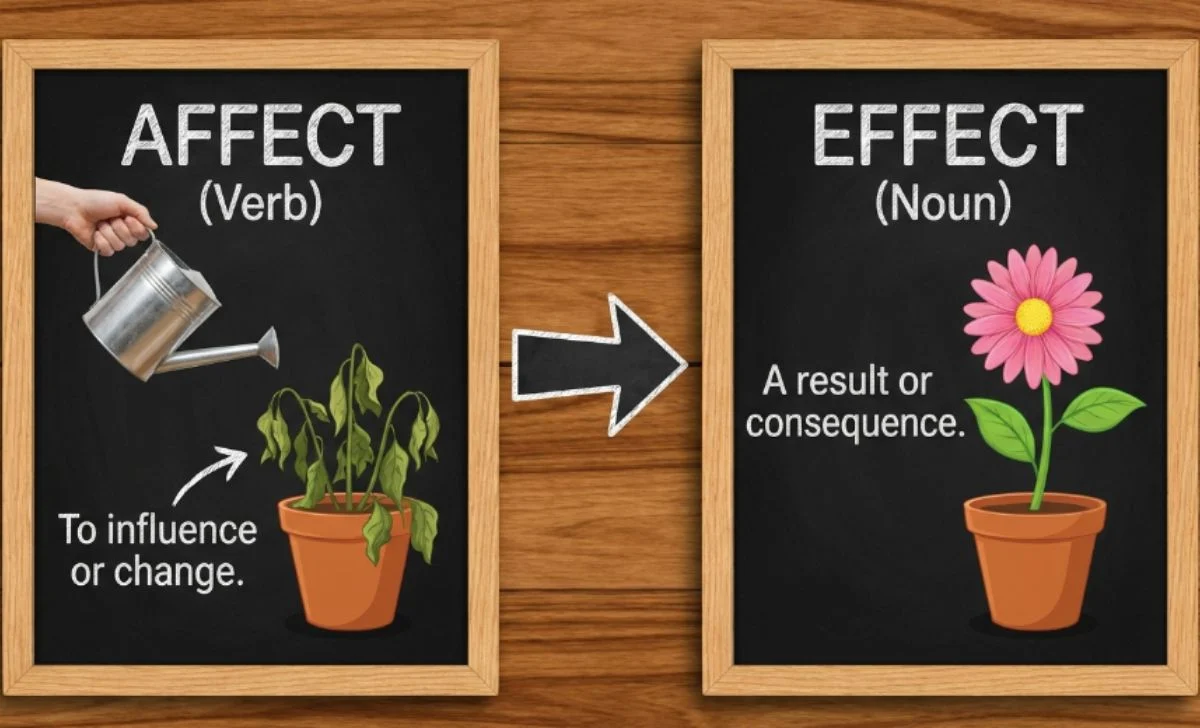
Confused between affect or effect? You’re not alone , this is one of the most common grammar mix-ups in the English language, even among native speakers and professional writers.
At first glance, these two words look almost identical, sound similar, and are often used interchangeably by mistake.
But understanding the difference between affect and effect can instantly improve your writing, whether you’re drafting an email, writing an essay, or creating content for your blog.
In simple terms, “affect” is usually a verb, while “effect” is typically a noun. In this complete, up-to-date guide, we’ll break down clear definitions, real-life examples, easy memory tricks, and common mistakes to avoid — so you’ll never second-guess yourself again.
Quick Answer
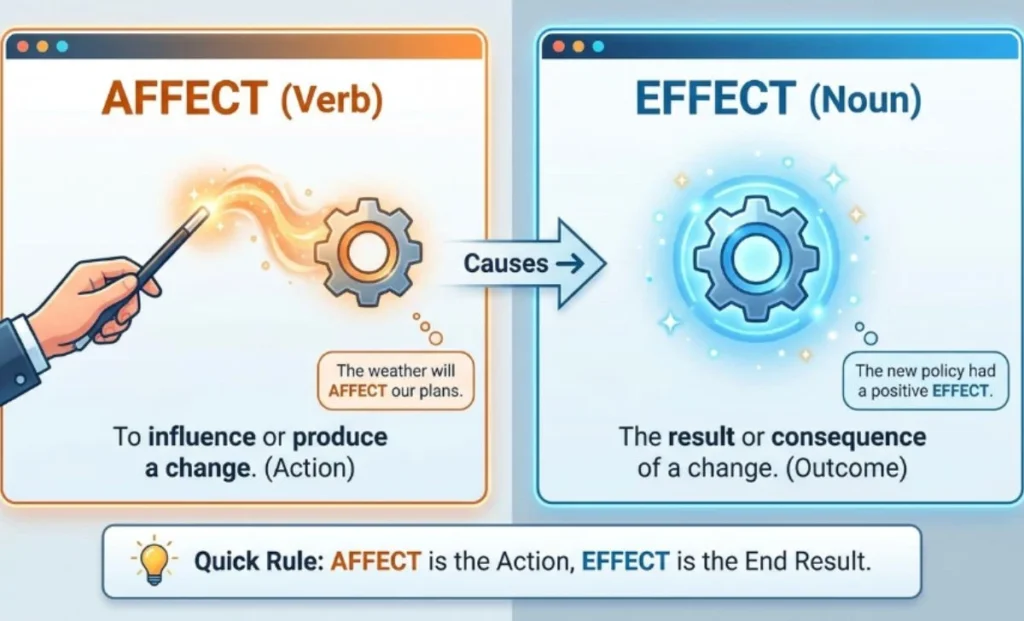
The easiest way to remember the difference is this:
- Affect = Verb = To influence or change something.
- Effect = Noun = The result or outcome of a change.
Quick Comparison
| Word | Part of Speech | Meaning | Example |
|---|---|---|---|
| Affect | Verb | To influence or change | The weather affected our travel plans. |
| Effect | Noun | A result or consequence | The new law had a positive effect on road safety. |
Examples
- Lack of sleep can affect your concentration.
- The medicine had an immediate effect on the patient’s fever.
- Rising prices affect everyone.
- The new training program produced a positive effect on employee performance.
Quick Tip:
If you can replace the word with influence, choose affect. If you mean result, choose effect.
Pronunciation of Affect or Effect
Although affect and effect are spelled differently, their pronunciations are very similar. The main difference is the first vowel sound.
| Word | IPA Pronunciation | Sounds Like |
|---|---|---|
| Affect | /əˈfekt/ | uh-FEKT |
| Effect | /ɪˈfekt/ | ih-FEKT |
How They Sound
- Affect begins with a soft “uh” sound.
- Effect begins with a short “ih” sound.
In everyday conversation, many people pronounce them so similarly that the difference is almost impossible to hear. Because of this, writers often confuse the spellings even when they know the meanings.
Do British and American English Pronounce Them Differently?
Both British English and American English pronounce these words almost the same. The small difference in the first vowel sound is consistent across both accents, and it rarely changes the meaning in spoken English.
Pronunciation Examples
- The heavy rain affected the football match.
- The policy had a significant effect on the economy.
- Stress can affect your health.
- The treatment showed a positive effect within days.
Why People Confuse Affect or Effect
There are several reasons why these words are among the most commonly confused terms in English.
They Look Almost Identical
The spellings differ by only one letter at the beginning. When reading or writing quickly, it’s easy to choose the wrong word.
They Sound Very Similar
The pronunciation difference is subtle. In fast speech, both words often sound nearly identical, making spelling mistakes more common.
They Are Closely Related
The meanings are connected because one word describes the action and the other describes the result.
- An event affects something.
- That change creates an effect.
For example:
- Exercise affects your body.
- Better health is the effect of regular exercise.
They Often Appear Together
Many articles, news reports, and academic papers use both words in the same sentence.
Example:
Climate change affects weather patterns, and one major effect is more frequent heatwaves.
Because both words commonly appear together, writers sometimes accidentally swap them.
Most Learners Memorize Without Understanding
Many people try to remember the spelling instead of learning the grammar rule. Once you understand that affect is usually an action and effect is usually a result, choosing the correct word becomes much easier.
Easy Trick to Remember Affect or Effect
You do not need to memorize long grammar rules. A simple memory trick can help you choose the correct word every time.
Trick 1: A = Action, E = End Result
- Affect starts with A, and A stands for Action.
- Effect starts with E, and E stands for End Result.
Example:
- The loud noise affected my sleep. (Action)
- Poor sleep was the effect of the loud noise. (Result)
Trick 2: Think “Influence” vs. “Result”
Ask yourself one question:
Is something causing a change?
- Yes → Use affect.
- No, you’re talking about the result → Use effect.
Examples:
- Social media can affect people’s opinions.
- One effect of social media is faster communication.
- Pollution affects air quality.
- Cleaner air is a positive effect of environmental policies.
Trick 3: AVEN
Many students remember the acronym AVEN:
- Affect = Verb
- Effect = Noun
This works in most everyday writing and speaking situations.
Note: In advanced English, there are rare exceptions where effect can be used as a verb (“to effect change”) and affect can be a noun in psychology, but these meanings are uncommon. For everyday English, the AVEN rule is reliable.
The Origin of Affect or Effect
The words affect and effect have different histories, even though they share similar roots.
Origin of Affect
The word affect comes from the Latin word afficere, meaning to influence, act upon, or do something to. It entered English through Old French and Middle English, keeping the idea of influencing or changing something.
Over time, affect became the standard verb used to describe an action that changes a person, object, or situation.
Examples:
- Weather can affect crop production.
- Stress may affect your memory.
Origin of Effect
The word effect comes from the Latin word effectus, meaning result, outcome, or accomplishment. It entered English with the meaning of something produced by a cause.
Today, effect is commonly used as a noun that refers to the consequence of an action or event.
Examples:
- The new policy had a positive effect on employment.
- Exercise has a healthy effect on the heart.
Why They Are Still Confused
Because both words come from related Latin roots and deal with cause and result, they developed similar spellings and pronunciations. However, their grammatical roles became different:
- Affect usually describes the cause or action.
- Effect usually describes the result or consequence.
Understanding this relationship makes the difference much easier to remember.
British English vs American English Spelling
Unlike many English words, affect and effect have the same spelling in both British English and American English. There is no spelling difference between the two varieties of English.
Whether you are writing for readers in the United States, the United Kingdom, Canada, Australia, New Zealand, or other English-speaking countries, you should always spell these words the same way.
Comparison Table
| Feature | British English | American English |
|---|---|---|
| Spelling of affect | Affect | Affect |
| Spelling of effect | Effect | Effect |
| Meaning | Same | Same |
| Grammar Rules | Same | Same |
| Everyday Usage | Same | Same |
Examples in British English
- The rainy weather affected the cricket match.
- The new transport system had a positive effect on commuters.
Examples in American English
- The storm affected travel across the state.
- The new law had an immediate effect on public schools.
Key Takeaway
Unlike pairs such as colour/color, centre/center, or organise/organize, affect and effect do not change spelling between British and American English. The only challenge is choosing the correct word based on its meaning and grammatical role—not the variety of English you use.
Which Word Should You Use?
The correct choice depends on what you want to say, not whether you are writing British or American English.
Use Affect When You Mean “To Influence”
Choose affect if you are talking about an action that changes or influences someone or something. In most sentences, affect is a verb.
Examples:
- Poor lighting can affect your eyesight.
- A positive attitude affects workplace performance.
- Heavy traffic affected our arrival time.
- Changes in temperature affect plant growth.
Use Effect When You Mean “A Result”
Choose effect if you are talking about the outcome or consequence of an action. In most cases, effect is a noun.
Examples:
- The new policy had a positive effect on local businesses.
- Regular exercise has a good effect on mental health.
- The medicine produced an immediate effect.
- The new teaching method showed a noticeable effect on student performance.
Quick Decision Guide
Ask yourself this simple question:
Am I describing an action or a result?
- Action or influence → Affect
- Result or outcome → Effect
Rare Exceptions
Although uncommon, English has two exceptions:
- Effect can be a verb meaning to bring about or accomplish.
- The company hopes to effect major changes next year.
- Affect can be a noun in psychology, referring to a person’s emotional expression.
- The patient showed a calm affect during the interview.
These meanings are mainly used in professional or academic writing. For everyday English, remember:
Affect = Verb
Effect = Noun
Common Mistakes with Affect or Effect
Many writers know the meanings but still use the wrong word because both terms look similar. Here are some common mistakes and their corrections.
| ❌ Incorrect | ✅ Correct |
|---|---|
| The weather had a bad affect on the trip. | The weather had a bad effect on the trip. |
| Lack of sleep can effect your health. | Lack of sleep can affect your health. |
| The medicine quickly effected my headache. | The medicine quickly affected my headache. |
| The new rule had no affect on employees. | The new rule had no effect on employees. |
| Noise can effect concentration. | Noise can affect concentration. |
Tips to Avoid Mistakes
- Remember A = Action = Affect.
- Remember E = End Result = Effect.
- Replace affect with influence. If the sentence still makes sense, affect is probably correct.
- Replace effect with result. If it fits naturally, effect is likely the right choice.
- Proofread carefully because spell check may not catch the error.
Affect or Effect in Everyday Examples
Understanding the rule is helpful, but seeing real-life examples makes it much easier to remember.
In Emails
- Your feedback will affect our future updates.
- The recent changes had a positive effect on customer satisfaction.
- Delayed deliveries may affect the project schedule.
In News Reports
- Rising fuel prices affect millions of drivers.
- The new education policy is expected to have a long-term effect on schools.
- Heavy rainfall affected transportation across the region.
On Social Media
- Negative comments can affect someone’s confidence.
- The campaign had a huge effect online.
- Viral trends often affect buying decisions.
In Business Writing
- Inflation may affect operating costs.
- The marketing campaign had a measurable effect on sales.
- Customer reviews can affect a company’s reputation.
In Everyday Conversation
- Coffee doesn’t affect everyone in the same way.
- The movie had a strong emotional effect on the audience.
- Exercise can affect your energy levels throughout the day.
- The new software had little effect on productivity.
Affect or Effect Synonyms
- English grammar mein affect aur effect ke liye kai powerful synonyms use kiye ja sakte hain jo aapki writing ko aur professional bana dete hain.
- Affect ke liye common synonyms hain: influence, impact, alter, aur change, jo verb ke roop mein action show karte hain.
- Dusri taraf, effect ke liye best synonyms hain: result, outcome, consequence, aur impact, jo noun ke roop mein final result batate hain. In synonyms ka sahi istemal aapki writing ko repetitive hone se bachata hai aur reader ke liye interesting banata hai.
- Chahe aap content writer hon ya student, in words ki variety seekhna aapke vocabulary ko strong karta hai.
Examples:
- Affect (Influence): The bad weather will influence our travel plans tomorrow.
- Affect (Impact): Social media has a huge impact on teenagers’ mental health.
- Effect (Result): The new policy had a positive result on employee performance.
- Effect (Outcome): The outcome of the meeting was better than expected.
Side Effect vs Affect
- A side effect is an unexpected or secondary result, usually caused by medicine, treatment, or an action, while affect is a verb that means to influence or change something.
- These words are not interchangeable because they serve different grammatical purposes. Use side effect when discussing a consequence and affect when describing an action that changes a person, object, or situation.
- Understanding this difference helps you write and speak more accurately in medical, academic, and everyday English.
Examples:
- Drowsiness is a common side effect of this medicine, but it does not affect everyone.
- Stress can affect your sleep, and poor sleep may be a side effect of ongoing anxiety.
- The treatment had only one mild side effect, and it did not affect the patient’s daily routine.
Negatively affect or effect
Negatively affect or effect means understanding whether to use affect or effect after the word negatively. In most cases, negatively affect is correct because affect is a verb meaning to harm or influence something in a bad way.
Use negative effect when talking about the result or consequence, not the action itself. A simple rule is: negatively affect = action, while negative effect = outcome. Choosing the right word makes your writing clearer and grammatically correct.
Examples
- Rising food prices can negatively affect low-income families.
- Lack of sleep has a negative effect on memory and concentration.
- Excessive screen time may negatively affect children’s eye health.
It doesn t affect or effect me
- It doesn’t affect or effect me is correct as “It doesn’t affect me.” Here’s a user-intent-focused explanation:
- It doesn’t affect me is the correct phrase because affect is a verb that means to influence or change someone or something. In this sentence, you’re describing the action of influencing you, so affect is the right choice.
- Effect is usually a noun meaning a result or outcome, so it does not fit after doesn’t. Remember: Affect = Action, Effect = Result.
Examples
- It doesn’t affect me if they arrive late.
- His opinion doesn’t affect my decision.
- The bad weather didn’t affect our travel plans.
FAQs
1. What is the difference between affect and effect?
The main difference is that affect is usually a verb meaning to influence or change something, while effect is usually a noun meaning the result or outcome of that change.
Example:
- Lack of sleep affects your mood.
- A bad mood is one effect of lack of sleep.
2. Is it affect or effect on someone?
When talking about a result, use effect.
- ✅ The new policy had a positive effect on employees.
When talking about influencing someone, use affect.
- ✅ The new policy affected employee morale.
3. Can effect be used as a verb?
Yes, but it is uncommon. As a verb, effect means to bring about or accomplish.
Example:
- The organization hopes to effect positive change.
In everyday English, most people use effect as a noun.
4. Can affect be a noun?
Yes. In psychology and psychiatry, affect is a noun that describes a person’s outward emotional expression.
Example:
- The doctor observed the patient’s calm affect.
This meaning is specialized and rarely used in everyday conversation.
5. What is the easiest way to remember affect and effect?
Use this simple rule:
- Affect = Action = Verb
- Effect = End Result = Noun
This memory trick works correctly in most everyday situations.
6. Do British and American English use different spellings?
No. Both British English and American English use the same spellings:
- affect
- effect
Only the meanings and grammar determine which word you should choose.
7. Why do people confuse affect and effect?
People confuse these words because they:
- Look almost identical.
- Sound very similar.
- Have closely related meanings.
- Often appear together in the same sentence.
Learning that affect usually describes the action and effect describes the result makes the difference much easier to remember.
Conclusion
- Understanding the difference between affect and effect is essential for writing clear, professional, and mistake-free English.
- In simple terms, affect is mostly used as a verb, meaning to influence something, while effect is commonly used as a noun, referring to the result of an action.
- Once you master this small but powerful grammar rule, your writing instantly becomes more accurate and polished.
- Whether you’re a student, blogger, content writer, or professional, using affect and effect correctly boosts your credibility and communication skills.
- Keep practicing with real-life examples, and soon this common English mistake will disappear from your writing forever. Bookmark this guide for quick reference whenever confusion strikes!
Read More Blogs:
- Successful or Succesful: Which Spelling Is Correct?
- Successful or Succesful: Which Spelling Is Correct?

Hi, I’m Amelia Parker, a grammar enthusiast and writer at GrammarHQ.com. I specialize in explaining spelling differences, confusing words, and common English mistakes through simple, practical, and easy-to-understand guides.