Catalog and catalogue are both correct spellings. Catalog is the standard form in American English, while catalogue is preferred in British English.
Both words have the same basic meaning: a systematic list or record of items, such as products, books, courses, or works of art. The choice depends on the variety of English you are using.
Catalog vs Catalogue: At a Glance
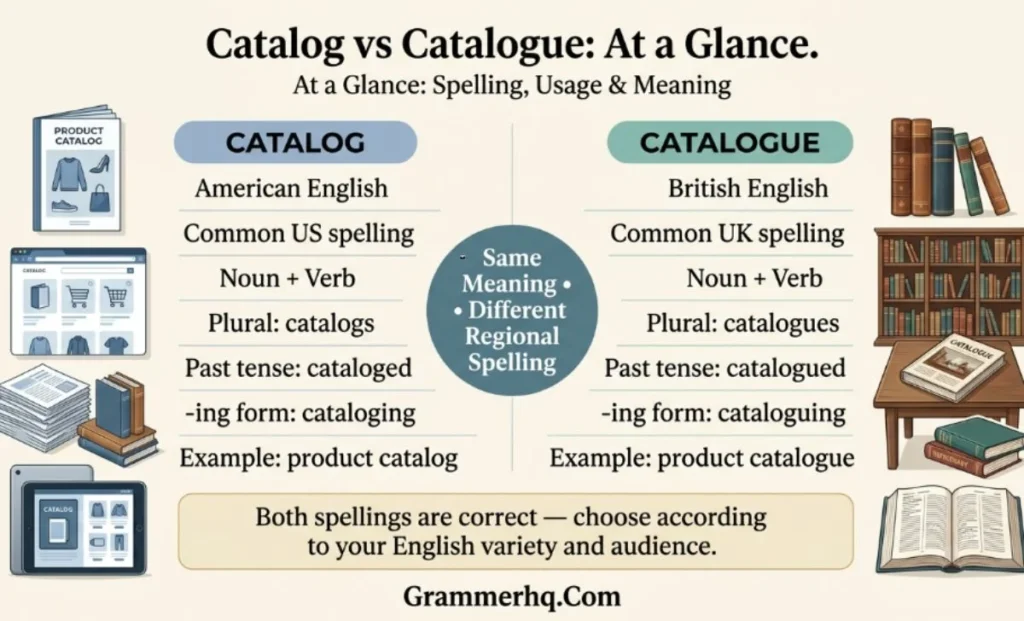
| Catalog | Catalogue | |
|---|---|---|
| Main variety | American English | British English |
| Basic meaning | A systematic list or record | A systematic list or record |
| Noun | Yes | Yes |
| Verb | Yes | Yes |
| Plural | catalogs | catalogues |
| Past tense | cataloged | catalogued |
| -ing form | cataloging | cataloguing |
| Example | product catalog | product catalogue |
The important point is that this is primarily a spelling difference, not a difference in meaning.
If you normally write American English, use catalog. If you follow British English, use catalogue.
Is “Catalog” or “Catalogue” Correct?
Both are correct.
The spelling you choose should match your audience, publication style, or preferred variety of English.
For example, an American university might publish a:
course catalog
A British university might publish a:
course catalogue
The underlying document is essentially the same. The spelling changes because the two varieties of English use different conventions.
Major dictionaries support this distinction. Cambridge identifies catalog as the US spelling of catalogue, while Merriam-Webster lists catalogue as a variant of catalog.
When “catalog” is the natural choice
Use catalog when writing in American English:
The new product catalog is available online.
I searched the library catalog for the title.
The university updated its course catalog.
When “catalogue” is the natural choice
Use catalogue when writing in British English:
The new product catalogue is available online.
I searched the library catalogue for the title.
The university updated its course catalogue.
Neither spelling is automatically more formal, sophisticated, or correct.
What Does “Catalog” Mean?
A catalog is an organized list or record of items, usually with information that identifies or describes them.
The word is used in many contexts, not just retail.
A catalog as a noun
A catalog can be a:
- product catalog listing goods for sale
- library catalog listing books and other resources
- course catalog describing classes and programs
- museum catalog documenting objects or artworks
- online catalog containing searchable information
- sales catalog presenting products to customers
For example:
The furniture company mailed customers its latest catalog.
The library’s online catalog makes it easy to find books by author or subject.
The museum created a digital catalog of its collection.
A catalog can be a printed publication, a website, a database, or another organized record.
A catalog as a verb
Catalog is also a verb. It means to list, organize, record, or classify something systematically.
The librarian cataloged the new books.
Researchers cataloged the specimens before analyzing them.
The company cataloged every item in its inventory.
So the word does not only describe the list itself. It can also describe the process of creating or maintaining that list.
What Does “Catalogue” Mean?
Catalogue has the same core meanings as catalog.
The difference is primarily the spelling used in British English.
As a noun:
The museum published an exhibition catalogue.
As a verb:
The archivist catalogued thousands of historical photographs.
British English can therefore use catalogue for both the organized record and the act of organizing or recording information.
Oxford Learner’s Dictionaries and Collins both document these noun and verb uses of catalogue.
Cataloged vs Catalogued: Which Is Correct?
The regional difference continues when the word is used in the past tense.
American English: cataloged
The librarian cataloged the new arrivals.
British English: catalogued
The librarian catalogued the new arrivals.
Both are correct.
If the rest of your writing follows American spelling, cataloged will normally look more natural. If you are using British spelling, catalogued is the expected form.
Merriam-Webster recognizes both forms.
Cataloging vs Cataloguing
The same pattern appears in the present participle or gerund.
American English: cataloging
The team is cataloging the historical records.
British English: cataloguing
The team is cataloguing the historical records.
The extra u in cataloguing is part of the British spelling convention. It does not indicate a different process or meaning.
How Do You Pronounce Catalog and Catalogue?
In ordinary speech, catalog and catalogue are pronounced essentially the same.
A simple pronunciation guide is:
catalog: KAT-uh-log
catalogue: KAT-uh-log
The -ue at the end of catalogue does not add another syllable.
Exact pronunciation can vary slightly between British and American speakers, so dictionary audio is the best reference when pronunciation matters. Cambridge provides both UK and US pronunciation information for the word.
Where Are Catalogs and Catalogues Used?
The word appears in far more situations than traditional mail-order shopping.
Product catalogs
A retailer may create a catalog containing:
- product names
- photographs
- prices
- descriptions
- specifications
- product numbers
Customers can browse the company’s online product catalog.
Library catalogs
A library catalog organizes information about books and other resources.
Search the library catalog before assuming the book is unavailable.
Course catalogs
Universities and colleges use course catalogs to describe:
- courses
- degree programs
- prerequisites
- academic policies
- graduation requirements
Students should check the course catalog before choosing their classes.
Museum and exhibition catalogues
Museums often produce catalogues that document exhibitions and collections.
The exhibition catalogue includes photographs and essays about the featured artists.
Digital catalogs
Modern catalogs are often searchable databases rather than printed books.
An ecommerce website, for example, may contain thousands of products without ever producing a physical catalog.
This broader usage is important because catalog does not simply mean “a book of products.”
Can “Catalog” or “Catalogue” Mean a Long List?
Yes.
Both words can have a broader or figurative meaning referring to a series or collection of things, especially when those things are being considered one after another.
For example:
The report presented a catalog of errors.
The investigation revealed a catalogue of failures.
The season became a catalog of missed opportunities.
In this sense, the word does not refer to a physical publication. It means something closer to a long or systematic list.
Oxford and Collins both recognize this broader use of catalogue.
This is why phrases such as catalog of complaints, catalogue of problems, and catalogue of failures can appear in serious journalism and formal writing.
Why Does One Word Have Two Spellings?
The word has a long history in English.
It ultimately comes through French and Latin from Greek katalogos, relating to a list or register. The word entered English centuries ago and developed alongside the spelling conventions of the language.
Over time, American and British English developed different preferences for many spellings. Catalog/catalogue became one of those differences.
You can see similar patterns in:
- color / colour
- center / centre
- organize / organise
- traveled / travelled
These differences do not mean that one variety is “real English” and the other is not. They are established regional conventions.
Is “Catalogue” More Formal Than “Catalog”?
No.
This is a common misconception.
Catalogue may look more elaborate because it contains additional letters, but that does not make it inherently more formal.
For example, both of these can appear in professional writing:
The company published its annual product catalog.
The company published its annual product catalogue.
The difference is mainly regional.
A US business would normally choose catalog. A UK business would normally choose catalogue.
Which Spelling Should You Use?
The best choice is usually determined by your audience and your style guide.
Choose “catalog” if you are writing for:
- a US audience
- an American company
- an American publication
- a document using American English
- an organization whose established style uses American spelling
Example:
Please download our latest product catalog.
Choose “catalogue” if you are writing for:
- a UK audience
- a British company
- a British publication
- a document using British English
- an organization whose established style uses British spelling
Example:
Please download our latest product catalogue.
What about an international audience?
There is no need to alternate between the two spellings simply because your readers come from different countries.
Instead, choose a consistent editorial style.
For example, an international website written in American English can consistently use:
catalog → catalogs → cataloged → cataloging
A website following British English can consistently use:
catalogue → catalogues → catalogued → cataloguing
Consistency makes the writing feel deliberate and professional.
Catalog or Catalogue for SEO: Does It Matter?
For SEO, neither spelling is universally better.
What matters is the audience you’re targeting and the search intent behind the page.
If you’re creating content specifically for US readers, catalog is the natural primary spelling.
If you’re targeting UK readers, catalogue is the natural choice.
For a page targeting the comparison query “catalog or catalogue,” using both terms naturally is appropriate because the user is explicitly asking about both spellings.
What you should avoid is artificial repetition such as:
catalog or catalogue, catalog vs catalogue, catalogue or catalog…
over and over again simply to increase keyword frequency.
Search engines don’t need a page to repeat the same two words dozens of times to understand the topic. A stronger page covers the surrounding concepts naturally:
- American English
- British English
- product catalog
- library catalog
- course catalog
- cataloged vs catalogued
- cataloging vs cataloguing
- pronunciation
- spelling conventions
- usage examples
The result is better for readers and gives the page broader topical relevance without keyword stuffing.
Common Catalog and Catalogue Combinations
The following examples show how the spelling changes while the meaning stays the same:
| American English | British English |
|---|---|
| product catalog | product catalogue |
| online catalog | online catalogue |
| library catalog | library catalogue |
| course catalog | course catalogue |
| sales catalog | sales catalogue |
| exhibition catalog | exhibition catalogue |
| mail-order catalog | mail-order catalogue |
| museum catalog | museum catalogue |
| catalog of products | catalogue of products |
| catalog of errors | catalogue of errors |
These aren’t different concepts. They are regional spelling choices.
Common Mistakes to Avoid
1. Calling “catalogue” incorrect
Catalogue is not a misspelling. It is the standard British form.
2. Calling “catalog” informal
Catalog is not an informal version of catalogue. It is the standard American spelling and is used in formal, academic, business, and professional contexts.
3. Mixing regional forms without a reason
If an article otherwise follows American English, using catalogued in one paragraph and cataloged in the next can make the writing look inconsistent.
Choose one style and maintain it.
4. Assuming the spelling changes the meaning
It doesn’t. In normal usage, catalog and catalogue refer to the same basic concept.
5. Assuming online content must use “catalog”
The word online does not determine the spelling.
Both are correct:
online catalog
online catalogue
The choice still depends on the English variety.
Catalog or Catalogue: Quick Decision Guide
If you need the answer in a few seconds:
US English: catalog
UK English: catalogue
US past tense: cataloged
UK past tense: catalogued
US -ing form: cataloging
UK -ing form: cataloguing
Meaning: essentially the same
Pronunciation: essentially the same
SEO: choose according to audience and search intent
Are both correct? Yes.
FAQs
1: Is catalog or catalogue correct?
Both are correct. Catalog is the standard American English spelling, while catalogue is the standard British English spelling.
2: Is catalog American or British English?
Catalog is primarily the American English spelling.
3: Is catalogue American or British English?
Catalogue is primarily the British English spelling.
4: Do catalog and catalogue mean the same thing?
Yes. They have the same basic meanings as nouns and verbs. The main difference is regional spelling.
5: Is catalog a verb?
Yes. Catalog can mean to list, organize, record, or classify something systematically.
6: Is catalogue a verb?
Yes. Catalogue has the same verb use in British English.
7: Is it cataloged or catalogued?
Cataloged is the usual American form, while catalogued is the usual British form.
8: Is it cataloging or cataloguing?
Cataloging is the usual American form, while cataloguing is the usual British form.
9: Is catalog or catalogue better for SEO?
Neither is automatically better. Use the spelling that matches your target audience and maintain a consistent English style.
10: Which is correct: product catalog or product catalogue?
Both are correct. Product catalog is the American form; product catalogue is the British form.
11: Which is correct: library catalog or library catalogue?
Both are correct. American English generally uses library catalog, while British English generally uses library catalogue.
12: Is catalogue more formal than catalog?
No. The difference is primarily regional, not one of formality.
Final Answer
Catalog and catalogue are both correct.
Use catalog for American English and catalogue for British English. The same distinction applies to their related forms: cataloged/catalogued and cataloging/cataloguing.
If you’re writing for a specific country, follow that variety’s spelling conventions. If you’re writing for an international audience, choose a consistent style rather than switching between forms.
In short:
American English → catalog
British English → catalogue
Neither one is “more correct.” The correct choice is the one that fits the English variety and audience you’re writing for.
Read More Blogs
- Inequity vs Inequality: What’s the Difference? Examples & Meaning
- Habit vs Habbit: Which Is Correct? Spelling, Meaning & Examples