
Jobsite or job site? If you have ever stopped while writing a construction report, work email, safety document, or article, you may have wondered whether these two forms are actually different.
The good news is that both “jobsite” and “job site” are established forms used in English. When they refer to a physical place where a particular job or project is being performed, they usually have the same basic meaning.
However, job site can also refer to an online platform where people search for jobs, so context matters. Current English usage shows both the one-word and two-word forms in professional and industry contexts.
So, which should you use? The answer depends less on “right versus wrong” and more on meaning, audience, style, and consistency.
Quick Answer
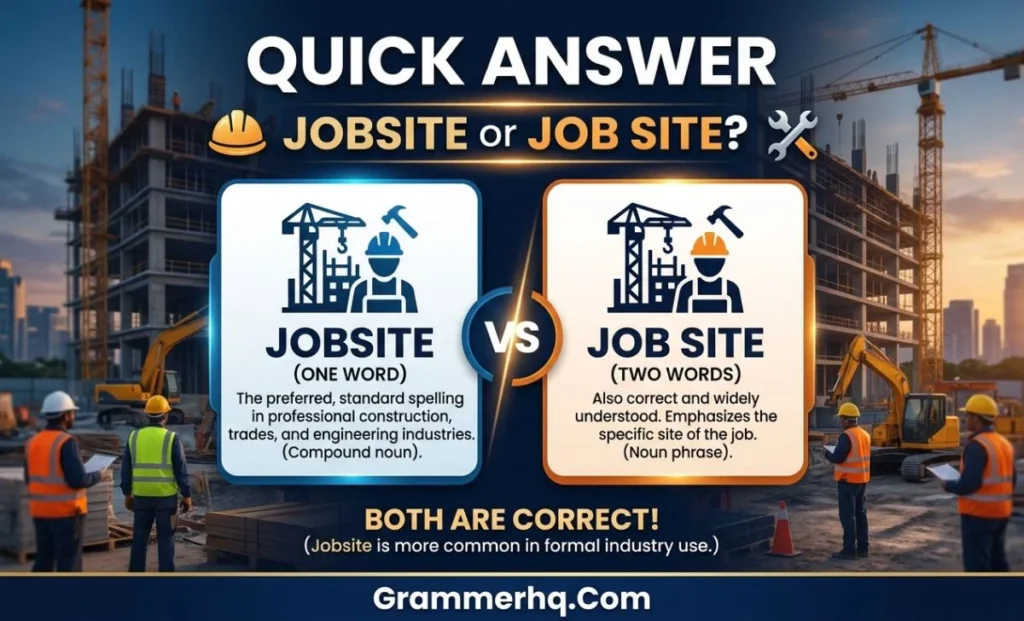
Both “jobsite” and “job site” can be correct.
- Jobsite is the closed, one-word form.
- Job site is the open, two-word form.
- Both can describe the physical location where a job or project is being performed.
- Job site can also mean an online employment website or job-search platform.
- Job-site may appear in certain hyphenated constructions, but it is not required every time.
If you are writing for a general audience and have no specific house style, job site is a clear and familiar choice. If your industry, employer, or publication consistently uses jobsite, that form is also appropriate.
The most important rule is simple: choose the form that fits your context and use it consistently.
Jobsite vs Job Site: At a Glance
| Form | What it means | Typical use |
|---|---|---|
| jobsite | A physical place where a job is performed | Construction, trades, industry |
| job site | A physical place where a job is performed | General and professional writing |
| job site | An online place for finding jobs | Employment and recruitment |
| job-site | A hyphenated form in certain constructions | Style- or context-dependent |
The spelling difference does not normally change the meaning when you are talking about a physical work location.
For example:
The crew arrived at the jobsite early.
The crew arrived at the job site early.
Both sentences describe the same basic situation.
What Does “Job Site” Mean?
A job site is a physical location where people carry out work connected with a particular job or project.
The term is especially common in construction, repair, maintenance, engineering, installation, and other field-based work.
For example:
The contractor inspected the job site before work began.
Workers must follow all safety rules at the job site.
The equipment was delivered to the job site yesterday.
A job site might be a building under construction, a road project, a customer’s property, an industrial facility, or another location where a specific project is taking place.
The term is therefore broader than construction site. A construction site is a type of job site, but a job site does not always involve construction.
What Does “Jobsite” Mean?
Jobsite is the closed, one-word form of the same compound.
It generally means a physical location where work related to a particular job or project is being performed.
For example:
The workers arrived at the jobsite before sunrise.
The supervisor inspected the jobsite for safety hazards.
Materials were delivered directly to the jobsite.
The one-word form is especially visible in construction, contracting, trades, engineering, workplace safety, and other industry-related content.
Current search results show jobsite being used naturally in phrases such as jobsite safety, jobsite conditions, and jobsite inspection.
That does not mean job site is incorrect in these contexts. Both forms are found in actual usage.
Is “Jobsite” or “Job Site” More Correct?
There is no universal rule that makes one form correct and the other incorrect.
When the term means a physical work location, compare:
The electrician went to the job site.
The electrician went to the jobsite.
The meaning is essentially the same.
The difference is primarily orthographic and stylistic: one form is open, while the other is closed.
This is common with English compounds. Frequently used word combinations can develop different spellings across dictionaries, industries, publications, and periods of usage.
That is why a better question is:
Which form fits my audience and style?
A practical rule
Use job site if that is the spelling preferred by your publication, employer, school, or style guide.
Use jobsite if that is the established spelling used by your organization or industry.
If there is no specific requirement, choose one and remain consistent throughout your document.
Why Are Both Forms Used?
English has many compound terms that can appear as separate words or as a single word.
For example:
- web site / website
- work space / workspace
- work place / workplace
- job site / jobsite
Compound spelling is not always determined by one simple grammar rule. Usage, dictionaries, editorial standards, industry terminology, and common practice can all influence how a compound is written.
So seeing jobsite and job site does not automatically mean that one writer has made a spelling mistake.
The same principle explains why different publications may use different forms while still communicating the same meaning clearly.
The Important Difference: Physical Job Site vs Job Website
This is the distinction that can actually change the meaning.
“Job site” as a physical location
The crew arrived at the job site at 7 a.m.
Here, job site means the physical place where the work is being performed.
It could be a construction project, repair location, installation site, or another work location.
“Job site” as an employment platform
She found the position on a job site.
Here, job site means an online platform or website where people search for employment opportunities.
Related terms include:
- job board
- employment website
- career site
- job-search website
- recruitment platform
- job listing site
This second meaning is why job site is especially useful when the context involves online employment.
For example:
I created a profile on a job site.
This does not mean you created a profile at a construction location. The surrounding words make the online meaning clear.
Jobsite vs Job Site in Construction
Construction is one of the clearest contexts for this term.
A jobsite or job site may include:
- construction workers
- contractors
- subcontractors
- tools
- building materials
- machinery
- safety equipment
- temporary structures
- project offices
- access areas
- storage areas
For example:
The contractor delivered the materials to the jobsite.
Or:
The contractor delivered the materials to the job site.
Both sentences identify the location where the construction work is taking place.
Common construction phrases
You may encounter:
- jobsite safety
- jobsite inspection
- jobsite conditions
- jobsite hazards
- jobsite access
- jobsite equipment
- jobsite management
- jobsite supervisor
- jobsite meeting
- jobsite address
These phrases are particularly useful when discussing the practical conditions surrounding a project.
Job Site vs Construction Site
These expressions are related, but they are not exact synonyms in every situation.
Job site
A location where a particular job or project is being carried out.
The technician drove to the job site.
Construction site
A location where construction work is taking place.
The workers entered the construction site.
Worksite
A broader term for a location where people perform their work.
Employees must follow the company’s worksite safety rules.
A construction site can therefore be a job site, but a job site does not have to be a construction site.
For example, a technician repairing an air-conditioning system at a customer’s building could call that location a job site, even though it is not a construction site.
Jobsite vs Job Site in Professional Writing
In professional writing, consistency is more important than switching between forms unnecessarily.
Consider this:
The manager inspected the job site in the morning. Later, she returned to the jobsite.
The sentence is understandable, but the spelling changes without a clear reason.
A cleaner version is:
The manager inspected the job site in the morning. Later, she returned to the job site.
Or:
The manager inspected the jobsite in the morning. Later, she returned to the jobsite.
This is particularly important in:
- reports
- safety manuals
- company policies
- construction documentation
- technical writing
- websites
- training materials
- business communication
If your organization already has a preferred spelling, follow it.
Is “Job-Site” Correct?
You may also encounter job-site with a hyphen.
The hyphenated form can appear in certain compound constructions or according to a particular editorial style.
However, that does not mean job-site should be used every time you write the expression.
For example, as a noun, you will commonly see:
The workers arrived at the job site.
or:
The workers arrived at the jobsite.
Do not add a hyphen automatically simply because two words are working together.
If your publication or style guide specifically requires a hyphen in a particular construction, follow that rule. Otherwise, use the established form appropriate to your context.
American English: Jobsite or Job Site?
Both forms appear in American English.
Jobsite is particularly visible in American construction, trade, safety, and industry-related writing, while job site is also widely recognized and used in general writing.
Current 2026 search results show multiple American-oriented grammar resources describing both forms as established usage rather than treating one as an outright spelling error.
Because usage varies, it is better not to turn a tendency into an absolute rule such as:
“Americans always write jobsite.”
They do not.
The stronger rule is:
Follow the style used by your audience, organization, or publication, and remain consistent.
British English: Jobsite or Job Site?
Job site is also used in British English and in international English.
Some online grammar resources claim that British English always prefers the two-word form, but that is too broad to use as a universal rule. Usage can vary by publication, industry, and context.
For international content, therefore, it is safer to focus on the established meaning and your chosen editorial style rather than presenting a rigid US-versus-UK rule.
Jobsite or Job Site: Real-Life Examples
Construction
The crew arrived at the jobsite before sunrise.
General workplace writing
The manager visited the job site to review the project.
Safety
Everyone must wear protective equipment at the job site.
Electrical work
The electrician inspected the jobsite before installing the new panel.
Plumbing
The plumber could not begin work until the job site was accessible.
Landscaping
The landscaping crew brought the equipment to the jobsite.
Project management
The project manager visited the job site to check the progress.
Employment website
She found the opening on a job site.
Recruitment
The company posted the vacancy on an online job site.
These examples show why context matters more than simply memorizing one spelling.
Common Mistakes With Jobsite and Job Site
1: Calling “jobsite” incorrect
❌ Jobsite is wrong.
This is too absolute.
Jobsite is an established closed form used in real construction and industry writing.
2: Assuming “job site” only means construction
❌ A job site always means a construction location.
Not necessarily.
Job site can also refer to an online employment platform.
3: Using “jobsite” for an online job platform
❌ I found the vacancy on a jobsite.
For maximum clarity, write:
✅ I found the vacancy on a job site.
Or:
✅ I found the vacancy on a job board.
4: Changing spelling randomly
❌ The supervisor inspected the jobsite and later returned to the job site.
✅ The supervisor inspected the jobsite and later returned to the jobsite.
Consistency makes professional writing cleaner.
5: Adding a hyphen automatically
❌ The crew arrived at the job-site.
✅ The crew arrived at the job site.
or
✅ The crew arrived at the jobsite.
Use the hyphen only when the construction or style specifically calls for it.
How to Choose the Right Form
When you are unsure, use this four-step approach.
1. Identify the meaning
If you mean a physical place where work is being performed, both jobsite and job site may fit.
If you mean an online employment platform, job site is the clearer choice.
2. Check your style guide
Your employer, publication, academic institution, or client may already have a preferred form.
Use that form.
3. Consider your audience
Construction and trade audiences may be very familiar with jobsite.
A broad general audience will also readily understand job site.
There is usually no need to force a change when the intended meaning is already clear.
4. Stay consistent
Once you select a form, use it consistently throughout the same piece of writing.
That is especially important for professional documents and website content.
Which Form Should You Use?
If you need a simple recommendation for general English writing, job site is a clear and widely recognizable choice.
If you are writing for a construction, contracting, trade, or industry audience and jobsite is the established form used by that audience or organization, using jobsite is perfectly reasonable.
For an online employment platform, use job site:
I found the position on a job site.
The goal is not to force every writer to use one spelling. The goal is to make the meaning clear and the usage consistent.
FAQs
Is “jobsite” one word?
Yes. Jobsite is written as one word and is used as a compound noun meaning a place where a particular job or project is performed.
Is “job site” two words?
Yes. Job site is the open, two-word form. It commonly refers to a physical work location and can also refer to an online employment platform.
Are “jobsite” and “job site” both correct?
Yes. Both forms are established in English usage. When referring to a physical work location, they generally have the same basic meaning.
Is jobsite more common in construction?
Jobsite is particularly common in construction, contracting, trades, and industry-related writing. However, job site is also widely used in construction contexts.
Can “job site” mean a website for jobs?
Yes. Job site can mean an online platform where employers post openings or people search for employment.
Should I write job site or jobsite in a formal document?
Follow the style guide or house style for the document. If there is no specific rule, either established form can work for a physical work location; consistency is the key consideration.
Is “job-site” correct?
It can appear in certain hyphenated constructions, but you should not automatically hyphenate the term every time. Follow the relevant style and grammatical context.
What is the difference between a job site and a worksite?
A job site usually refers to the location of a particular job or project. Worksite is a broader term for a place where work is performed.
What is another word for job site?
Depending on context, alternatives include worksite, construction site, project site, workplace, and work area.
How do you pronounce jobsite and job site?
They are normally pronounced the same way: “job site.” The difference is in the written form, not the basic pronunciation.
Final Answer
Jobsite and job site are both established forms when you mean a physical location where a job or project is performed.
Use jobsite if it matches the terminology and style of your construction, trade, or industry audience. Use job site when you prefer the open form for general writing or when you mean an online employment platform.
So remember:
Physical work location: jobsite or job site
Online employment platform: job site
Hyphenated form: only when the specific construction or style requires it
The best writing is not about forcing one spelling everywhere. It is about choosing the form that fits the context and using it consistently.
Read More Blogs

Hi, I’m Amelia Parker, a grammar enthusiast and writer at GrammarHQ.com. I specialize in explaining spelling differences, confusing words, and common English mistakes through simple, practical, and easy-to-understand guides.










