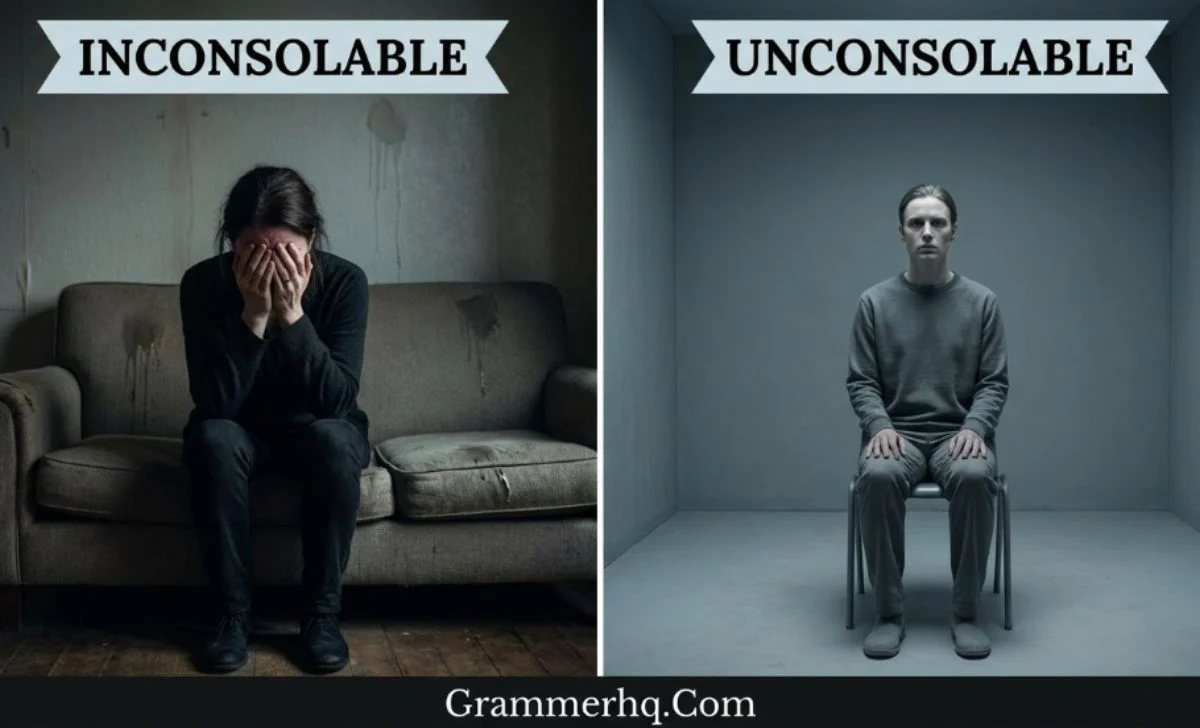
Inconsolable vs Unconsolable is a common spelling and word-choice question for English learners, writers, and anyone unsure how to describe a person who cannot be comforted.
Although the two forms look similar and seem to carry the same meaning, they are not equally common in standard English.
Inconsolable is the established and preferred word when describing someone who cannot be consoled, comforted, or made to feel better. Unconsolable is much less common and is generally not the best choice for standard writing.
Understanding Inconsolable vs Unconsolable can help you avoid an unusual word choice and make your English sound more natural.
In this guide, we will compare their meanings, usage, pronunciation, examples, and differences so you can confidently choose the right word whenever this confusion comes up.
Quick Answer
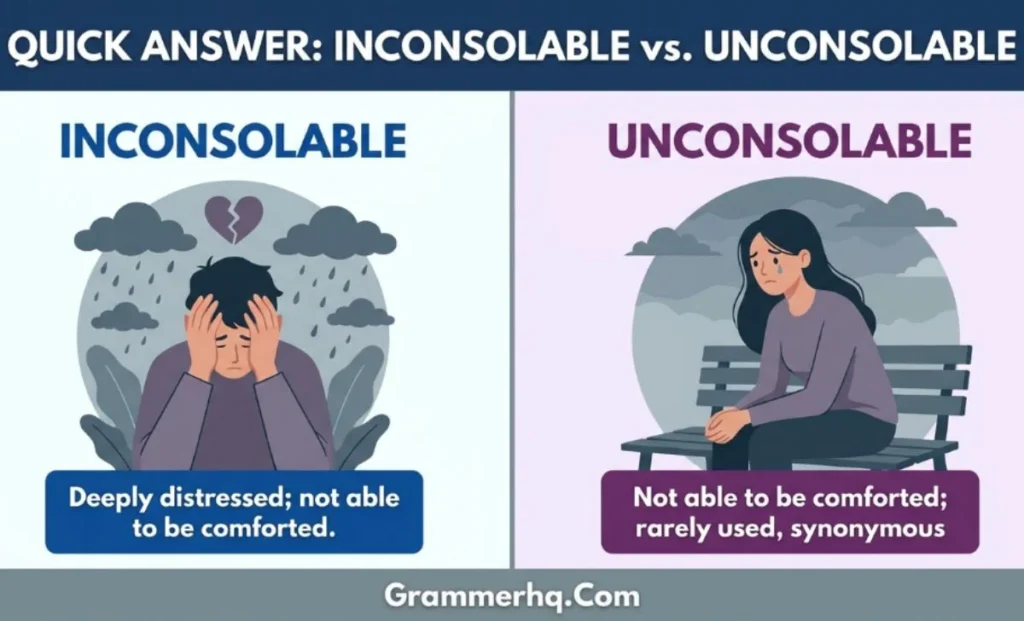
- Inconsolable = very sad or distressed and unable to be comforted
- Unconsolable = essentially the same meaning
- Preferred form = inconsolable
- Less frequent form = unconsolable
- Part of speech = adjective
For example:
She was inconsolable after hearing the devastating news.
You can also use:
She was unconsolable after hearing the devastating news.
The meaning does not materially change. The main difference is frequency and usage preference, not correctness. Oxford explicitly labels unconsolable as less frequent and inconsolable as more frequent.
The simple rule
When in doubt, use “inconsolable.”
What Does Inconsolable Mean?
Inconsolable is an adjective used for someone who is so sad, distressed, disappointed, or grief-stricken that they cannot be comforted.
Cambridge defines it as being so sad or disappointed that it is impossible for anyone to make you feel better.
For example:
The child was inconsolable after losing her mother.
He was inconsolable after the death of his best friend.
The family was inconsolable with grief.
The word is particularly common when describing grief, loss, heartbreak, tragedy, emotional shock, or profound disappointment.
Inconsolable in simple English
If someone is inconsolable, they are so emotionally upset that attempts to comfort them do not make them feel better.
It is therefore stronger than simply saying someone is sad or upset.
What Does Unconsolable Mean?
Unconsolable is also an adjective meaning very sad and unable to be comforted.
For example:
The child was unconsolable after the accident.
She remained unconsolable after the loss.
The grieving family seemed unconsolable.
The important point is that unconsolable is a real English word. It is not simply a spelling mistake.
Oxford has a separate dictionary entry for unconsolable and identifies inconsolable as the more frequent form.
So it is more accurate to say:
Unconsolable is correct but less common.
rather than:
Unconsolable is incorrect.
That distinction is important.
Inconsolable vs Unconsolable: What Is the Difference?
The two words have essentially the same meaning.
The real difference is how frequently they are used.
| Feature | Inconsolable | Unconsolable |
| Part of speech | Adjective | Adjective |
| Meaning | Unable to be comforted | Unable to be comforted |
| Dictionary status | Recognized | Recognized |
| Frequency | More frequent | Less frequent |
| General writing | Preferred | Less common |
| Formal writing | Preferred | Possible but unusual |
| Best default choice | Yes | No |
Oxford’s treatment makes this distinction especially clear: its inconsolable entry gives unconsolable as a less frequent form, while its unconsolable entry points readers toward the more frequent inconsolable.
So this is not really a “right vs. wrong” spelling pair.
It is better understood as:
more common form vs. less common form
Is Unconsolable a Correct Word?
Yes.
This is probably the most important answer for anyone searching this comparison.
Some online articles describe unconsolable as incorrect or nonstandard. However, that claim is too strong when compared with current dictionary evidence.
Oxford explicitly includes unconsolable as an adjective and defines it as “very sad and unable to accept help or comfort.” It also identifies inconsolable as the more frequent form.
Therefore:
- Inconsolable — correct and more frequent
- Unconsolable — correct but less frequent
If your goal is polished modern English, however, inconsolable remains the better default.
Why Do People Confuse Inconsolable and Unconsolable?
The confusion makes sense because English uses both in- and un- to create negative words.
Consider:
- happy → unhappy
- fair → unfair
- certain → uncertain
- comfortable → uncomfortable
- visible → invisible
- possible → impossible
Because un- is such a common negative prefix, unconsolable looks perfectly logical.
The base word also seems to encourage the pattern:
console → consolable → unconsolable
That formation makes sense grammatically. And English did, in fact, develop the word unconsolable.
But languages are not always perfectly logical. Historical usage determines which forms become common, and in this case inconsolable became the dominant form.
That is why simply applying the most familiar negative prefix does not always produce the preferred English word.
The Word Family: Console, Consolable, and Inconsolable
Understanding the word family makes the meaning much easier to remember.
Console
Console is a verb meaning to comfort someone who is sad or distressed.
Her friends tried to console her after the loss.
Consolation
Consolation is a noun referring to comfort or something that provides comfort.
Her family offered consolation during her grief.
Consolable
Consolable means capable of being comforted.
Inconsolable
Inconsolable means unable to be comforted.
The relationship can be remembered as:
console → consolable → inconsolable
This also explains why inconsolable is closely associated with emotional pain, grief, and distress.
Inconsolable Word Origin
Inconsolable has a long history in English.
Oxford dates the word to the late 16th century and traces it through French or Latin inconsolabilis, from in- meaning “not” and consolabilis, meaning “able to be consoled.” The deeper Latin verb consolari meant to soothe or comfort.
This gives the word a useful underlying idea:
in- + consolable = not able to be consoled
That historical background also helps explain why inconsolable became the established form.
Which One Should You Use?
If you are choosing between the two, use inconsolable.
It is the more frequent form and will generally sound more natural to English readers.
Use inconsolable in:
- School assignments
- Essays
- Academic writing
- Articles
- Professional writing
- Business communication
- Journalism
- Everyday English
- Creative writing
For example:
The family was inconsolable after the tragedy.
This does not mean unconsolable is forbidden. It simply means that inconsolable is the stronger default choice.
A useful distinction
Remember:
Correct does not always mean equally common.
English contains many words that are legitimate but far less frequent than another accepted form.
That is exactly the situation here.
Inconsolable vs Unconsolable Examples
Examples of Inconsolable
She was inconsolable after losing her beloved dog.
The child became inconsolable when his mother left.
He was inconsolable after hearing the tragic news.
The family remained inconsolable during the funeral.
The fans were inconsolable after the heartbreaking defeat.
She was inconsolable with grief.
Examples of Unconsolable
The child appeared unconsolable after the accident.
She remained unconsolable following the loss.
The family seemed unconsolable with grief.
He was unconsolable after receiving the devastating news.
All of these examples communicate essentially the same idea.
However, if you want the more familiar and frequent form, choose inconsolable.
Inconsolable in Formal and Informal Writing
Inconsolable works naturally in both formal and informal contexts.
Formal writing
The witness appeared inconsolable following the tragedy.
The family remained inconsolable after the unexpected loss.
The report described the parents as inconsolable.
Informal writing
She was inconsolable after her cat ran away.
He looked absolutely inconsolable.
The toddler became inconsolable when his favorite toy disappeared.
The preferred spelling does not change with the level of formality.
How Strong Is the Word Inconsolable?
One important detail is often missed in simple dictionary articles: inconsolable is a strong emotional word.
It does not merely mean:
- slightly sad
- annoyed
- disappointed
- unhappy
It usually describes intense emotional distress in which comfort does not seem to help.
Compare:
She was disappointed that the event was canceled.
with:
She was inconsolable after the devastating loss.
The second sentence describes a much more serious emotional state.
So do not use inconsolable simply as a dramatic synonym for “sad” in every situation.
Inconsolable vs Disconsolate
Disconsolate is another word that can cause confusion because it is closely related in meaning.
Both words describe unhappiness or emotional distress, but inconsolable strongly emphasizes the inability to be comforted.
Inconsolable
She was inconsolable after her father’s death.
The focus is on the fact that she could not be comforted.
Disconsolate
He looked disconsolate after the defeat.
The focus is on his deep unhappiness or dejection.
Cambridge lists disconsolate as a formal synonym of inconsolable, but the words can still have slightly different emphasis in actual sentences.
Inconsolable vs Distraught vs Heartbroken
These words are related, but they are not perfect synonyms.
Inconsolable
Unable to be comforted.
The mother was inconsolable after the loss.
Distraught
Extremely worried, upset, or emotionally disturbed.
He was distraught after hearing the news.
Heartbroken
Extremely sad because of loss, separation, or emotional pain.
She was heartbroken after the breakup.
Devastated
Extremely shocked or distressed by something painful or tragic.
The family was devastated by the accident.
The best word depends on the exact emotional situation.
Common Mistakes With Inconsolable
1. Saying Unconsolable Is Always Wrong
This is the biggest mistake.
Unconsolable is recognized by Oxford, so calling it simply “wrong” is too absolute. It is the less frequent form.
2. Assuming Both Words Are Equally Common
They are not.
Inconsolable is more frequent.
3. Using Inconsolable for Mild Problems
For example:
He was inconsolable because the restaurant was closed.
This may sound exaggerated unless the context genuinely involves severe emotional distress.
Better:
He was disappointed because the restaurant was closed.
4. Using Inconsolable for an Inanimate Object
Usually, inconsolable describes a person or another being capable of experiencing emotion.
Awkward:
The computer was inconsolable.
Better:
I was inconsolable after my computer crashed.
5. Confusing the Adjective and Adverb
Inconsolable is an adjective:
She was inconsolable.
Inconsolably is an adverb:
She cried inconsolably.
Inconsolable vs Inconsolably
This is another useful distinction.
Inconsolable
Describes a person or noun.
The child was inconsolable.
Inconsolably
Describes an action.
The child cried inconsolably.
Oxford lists inconsolably as the adverbial form.
Similarly, unconsolably exists as the corresponding adverbial form.
Related Words and Forms
Here are useful words from the same semantic family:
| Word | Part of Speech | Meaning |
| console | Verb | To comfort |
| consolation | Noun | Comfort or relief |
| consolable | Adjective | Able to be comforted |
| inconsolable | Adjective | Unable to be comforted |
| inconsolably | Adverb | In an inconsolable manner |
| inconsolability | Noun | The state of being inconsolable |
| unconsolable | Adjective | Less frequent form of inconsolable |
| unconsolably | Adverb | In an unconsolable manner |
| disconsolate | Adjective | Deeply unhappy or dejected |
| distraught | Adjective | Extremely upset or troubled |
| heartbroken | Adjective | Deeply saddened by emotional loss |
These related terms give the topic broader semantic depth without forcing unrelated keywords into the article.
Easy Trick to Remember
If you are unsure which form to use, remember:
Console means comfort. Inconsolable means unable to be comforted.
Think:
console → comfort
inconsolable → cannot be comforted
And when choosing between the two spellings:
Use INCONSOLABLE by default.
You can recognize unconsolable as a legitimate but less frequent alternative rather than treating it as a spelling error.
Inconsolable vs Unconsolable: Quick Comparison
| Question | Answer |
| Are both words real? | Yes |
| Do they have the same basic meaning? | Yes |
| Which is more frequent? | Inconsolable |
| Which should most writers use? | Inconsolable |
| Is unconsolable a misspelling? | No |
| Part of speech? | Adjective |
| Does inconsolable mean simply sad? | No, it usually implies intense distress |
| Can inconsolable describe grief? | Yes |
| Is inconsolably an adverb? | Yes |
| Is disconsolate related? | Yes |
FAQs
1: Is “inconsolable” correct?
Yes. Inconsolable is a correct English adjective meaning extremely sad or distressed and unable to be comforted.
2: Is “unconsolable” a real word?
Yes. Unconsolable is a recognized English word, but Oxford identifies it as the less frequent form of inconsolable.
3: Which is correct: inconsolable or unconsolable?
Both are correct, but inconsolable is more common and generally preferred.
4: Are inconsolable and unconsolable synonyms?
Yes. They have essentially the same meaning: unable to be comforted.
5: Which word should I use in formal writing?
Use inconsolable. It is the more frequent and familiar form.
6: Is unconsolable a misspelling?
No. It is recognized by Oxford as an adjective. It is simply less frequent than inconsolable.
7: What does inconsolable mean in simple English?
It means so upset or sad that you cannot be comforted.
8: What is the difference between sad and inconsolable?
Sad is a broad term for unhappiness. Inconsolable describes a much stronger emotional state in which comfort does not seem to help.
9: What is the noun form of inconsolable?
Inconsolability is a noun meaning the state or quality of being inconsolable.
10: What is the adverb form of inconsolable?
The adverb is inconsolably.
She wept inconsolably.
11: Can I use unconsolable in an essay?
Yes, but inconsolable is the better choice because it is more frequent and familiar to modern English readers.
12: Is disconsolate the same as inconsolable?
They are closely related, but not identical in emphasis. Inconsolable specifically emphasizes being unable to be comforted, while disconsolate generally emphasizes deep unhappiness or dejection.
Final Verdict:
Both “inconsolable” and “unconsolable” are legitimate English words, and both describe someone who is unable to be comforted. However, “inconsolable” is the more frequent and generally preferred form.
So if you are writing an essay, article, email, school assignment, professional document, or everyday message, choose “inconsolable.”
At the same time, don’t automatically mark unconsolable as a spelling mistake. Major dictionary evidence recognizes it as a genuine, less frequent variant.
In short:
Inconsolable = preferred and more common
Unconsolable = correct but less frequent
That is the clearest and most accurate way to understand the difference.
Read More Blogs:
- Dual vs Duel: What’s the Difference? Meaning, Usage & Examples
- Refer or Reffer: Which Spelling Is Correct? Meaning & Usage

Hi, I’m Amelia Parker, a grammar enthusiast and writer at GrammarHQ.com. I specialize in explaining spelling differences, confusing words, and common English mistakes through simple, practical, and easy-to-understand guides.