Have you ever typed hopeing and wondered if it looked right? You’re not alone. Many English learners, students, and even experienced writers hesitate when adding -ing to verbs ending in e.
Because English spelling rules can seem inconsistent, it’s easy to assume that hopeing might be correct.
The good news is that this one follows a simple rule. Once you understand it, you’ll never make the mistake again.
In this guide, you’ll learn the correct spelling, the grammar rule behind it, why people often confuse these words, and how to remember the correct form with easy examples.
Hoping or Hopeing – Quick Answer
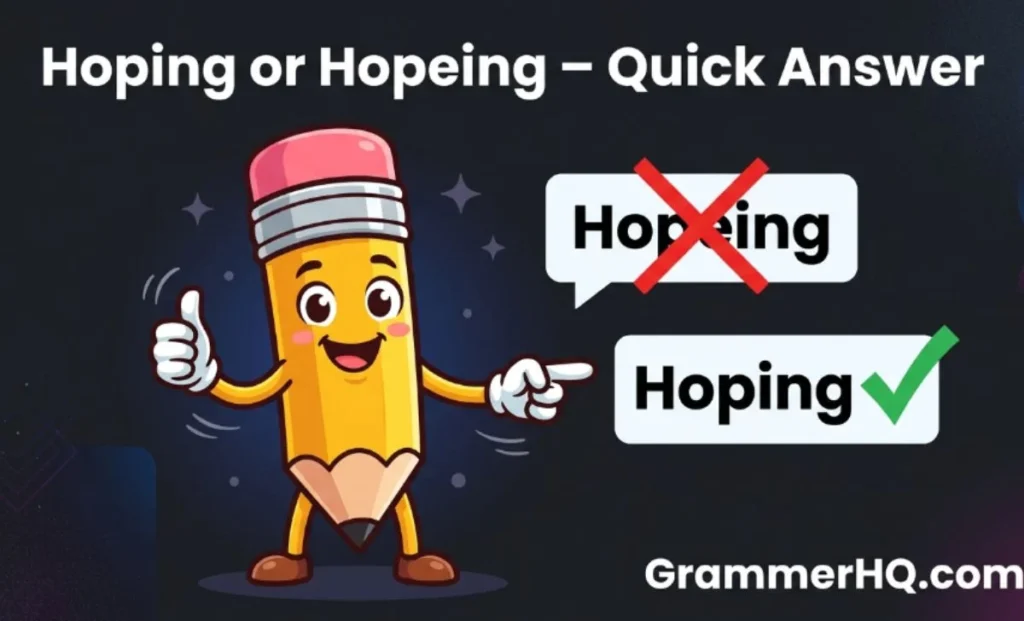
The correct spelling is hoping. ✅
Hopeing is always incorrect and is not recognized as a standard English word.
Correct: I am hoping to see you tomorrow.
Incorrect: I am hopeing to see you tomorrow.
Quick Rule: If a verb ends with a silent e, drop the e before adding -ing.
Examples:
- Hope → Hoping ✅
- Make → Making ✅
- Write → Writing ✅
- Smile → Smiling ✅
Why Is “Hoping” the Correct Spelling?
The word hoping is the present participle and gerund form of the verb hope. It follows one of the most common English spelling rules.
When a verb ends with a silent e, the e is usually removed before adding -ing.
The Rule
Verb ending in silent e → Remove e → Add -ing
Examples:
| Base Verb | Correct Form | Incorrect Form |
|---|---|---|
| Hope | Hoping | Hopeing ❌ |
| Love | Loving | Loveing ❌ |
| Make | Making | Makeing ❌ |
| Write | Writing | Writeing ❌ |
| Drive | Driving | Driveing ❌ |
| Smile | Smiling | Smileing ❌ |
Removing the silent e makes the word easier to read while keeping the pronunciation the same. That’s why hoping is correct and hopeing is not.
Why Do People Confuse “Hoping” and “Hopeing”?
The confusion is understandable because English spelling doesn’t always follow obvious patterns. Many writers instinctively keep every letter from the original word.
Here are the most common reasons people write hopeing instead of hoping.
They Keep the Original Word
Since the base verb is hope, some people assume every letter should stay when adding -ing. However, verbs ending in a silent e usually lose that final letter.
They Rely on Pronunciation
Both hoping and hopeing sound nearly identical when spoken. Because the pronunciation doesn’t change, many writers mistakenly believe both spellings are acceptable.
They Forget the Silent “E” Rule
English has several spelling rules, and it’s easy to forget when to drop a letter or keep it. Once you remember the silent e rule, this mistake becomes much easier to avoid.
Fast Typing or Autocorrect
Typing quickly can lead to accidental spelling errors. Some writing tools may also fail to catch uncommon misspellings, so it’s always worth proofreading important documents.
The Spelling Rule Behind “Hoping”
The word hoping follows the Drop the Silent E Rule, one of the most useful spelling rules in English.
Drop the Silent “E” Before Adding -ing
If a verb ends with a silent e, remove the e before adding -ing.
Formula:
Verb ending in e − e + ing = Correct spelling
Examples:
- Hope → Hoping
- Bake → Baking
- Move → Moving
- Arrive → Arriving
- Save → Saving
- Share → Sharing
This same rule applies to hundreds of common English verbs, making it one of the easiest grammar patterns to remember.
Why Does English Drop the Silent “E”?
Dropping the silent e keeps words shorter and follows standard English spelling conventions without changing their pronunciation.
Compare these two spellings:
- Hoping ✅ — clean, standard, and correct
- Hopeing ❌ — unnecessary extra letter and incorrect
Once you know this pattern, you’ll also spell many other -ing verbs correctly.
When Should You Use “Hoping”?
Use hoping whenever you describe an ongoing wish, expectation, or desire. It commonly appears after forms of the verb be (am, is, are, was, were) and can also function as a gerund.
As a Present Participle
- I am hoping for good news.
- She is hoping to get the job.
- They are hoping for better weather.
As a Gerund
- Hoping for success kept him motivated.
- Hoping alone is not enough; action matters.
- Hoping can help people stay optimistic during difficult times.
In every case, hoping is the only correct spelling. Hopeing should never be used in formal or informal English.
Common Mistakes When Writing “Hoping”
Even native English speakers occasionally misspell hoping. Most mistakes happen because writers apply the wrong spelling pattern or type too quickly.
Mistake 1: Keeping the Silent E
The most common error is writing hopeing because the base word is hope.
❌ I am hopeing to finish early.
✅ I am hoping to finish early.
Remember, the silent e is dropped before adding -ing.
Mistake 2: Confusing Similar Spelling Rules
Some English words keep the e before -ing, while others do not. This makes learners think hopeing might also be acceptable.
However, hope is not an exception. It always becomes hoping.
Mistake 3: Typing Without Proofreading
Simple typing mistakes are common in emails, assignments, blog posts, and social media.
A quick proofread can catch errors like hopeing before you publish or send your writing.
Common Grammar Mistakes
Here are some incorrect and correct examples to help you avoid this spelling mistake.
| Incorrect ❌ | Correct ✅ |
|---|---|
| I am hopeing for the best. | I am hoping for the best. |
| She is hopeing to travel next month. | She is hoping to travel next month. |
| We were hopeing for a quick response. | We were hoping for a quick response. |
| They are hopeing everything goes well. | They are hoping everything goes well. |
| He kept hopeing someone would help. | He kept hoping someone would help. |
If you see hopeing, it should always be corrected to hoping.
Easy Trick to Remember
You don’t have to memorize dozens of spelling rules. One simple trick is enough.
Memory Trick
Drop the silent “E” before adding “-ING.”
Think of it like this:
- Hope → Hoping
- Love → Loving
- Bake → Baking
- Smile → Smiling
If the final e is silent, remove it before adding -ing.
Visual Reminder
❌ Hopeing
⬇ Remove the silent e
✅ Hoping
Whenever you’re unsure, ask yourself:
“Does this verb end with a silent e?”
If the answer is yes, remove the e before adding -ing.
Everyday Examples of “Hoping”
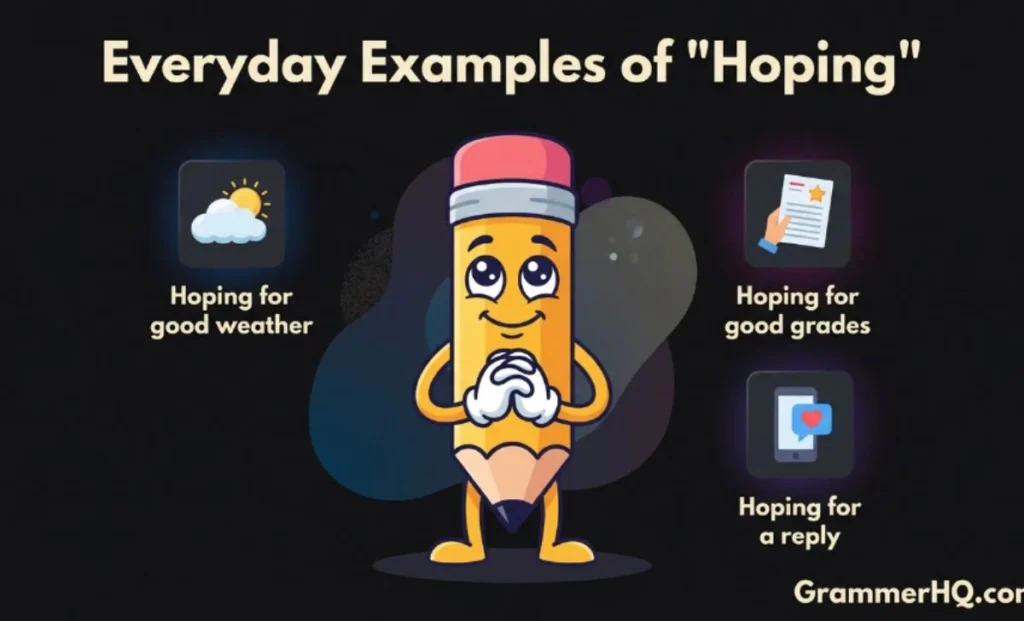
Seeing words in context makes them much easier to remember.
In Everyday Conversation
- I’m hoping to see you this weekend.
- She’s hoping her interview goes well.
- We’re hoping for sunny weather tomorrow.
- They’re hoping to buy a new house this year.
At School
- The students are hoping for good exam results.
- My teacher is hoping everyone submits the assignment on time.
At Work
- The company is hoping to launch the product next month.
- Our team is hoping to complete the project before the deadline.
In Daily Life
- I’m hoping everything works out.
- He spent the evening hoping for good news.
- They are hoping to spend more time with their family.
- Everyone is hoping for a peaceful future.
These examples all use hoping correctly. Hopeing would be incorrect in every sentence.
Pronunciation
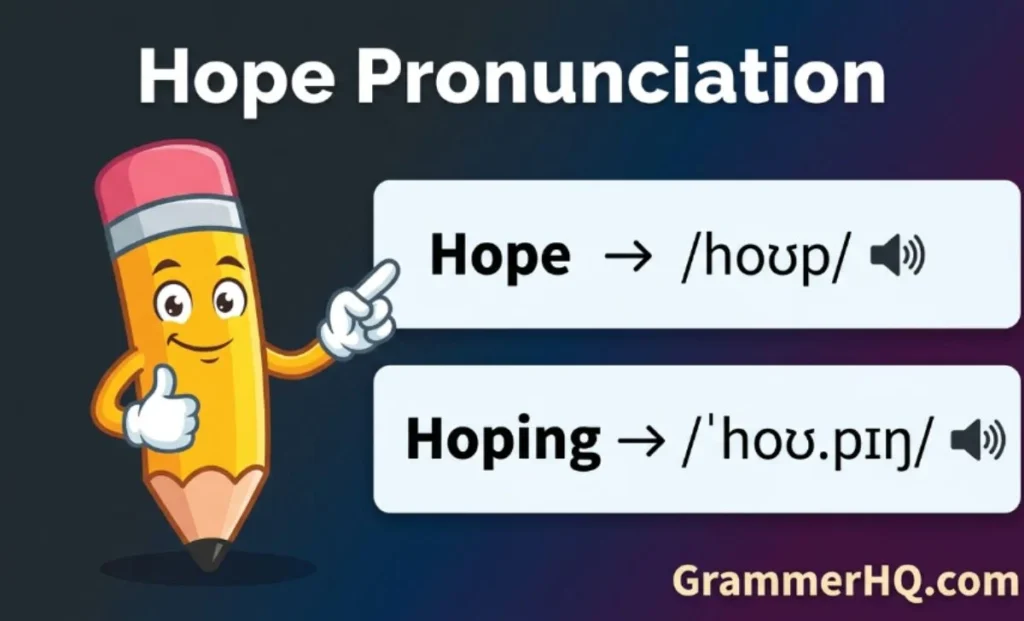
The spelling changes, but the pronunciation remains almost the same.
- Hope — /hoʊp/
- Hoping — /ˈhoʊ.pɪŋ/
Notice that the silent e disappears in spelling, but the word is still pronounced naturally as HOPE-ing.
British English vs. American English
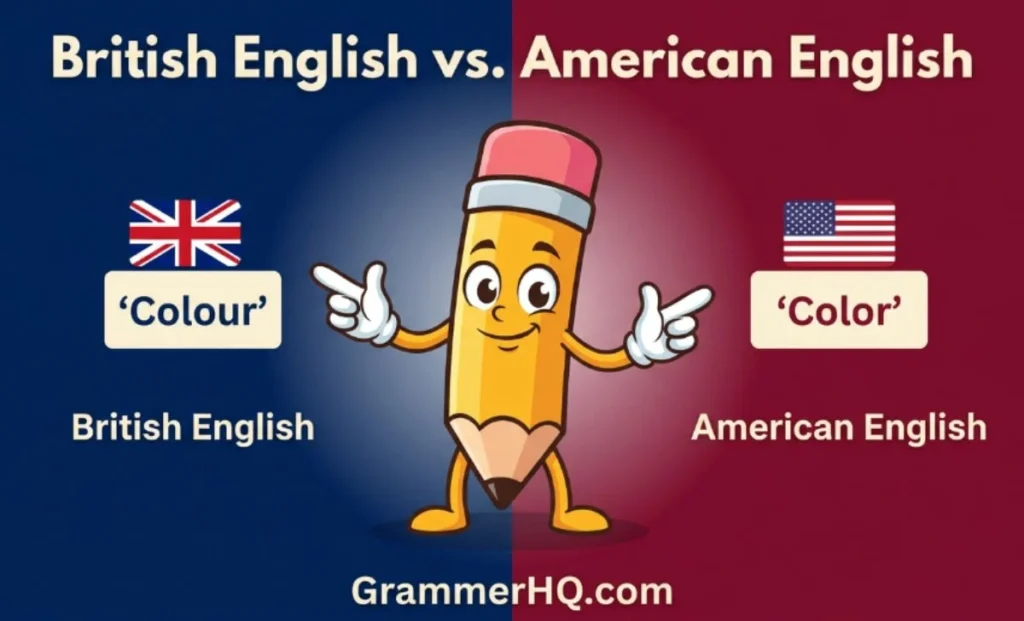
Unlike words such as colour/color or organise/organize, there is no spelling difference between British and American English.
| English Variety | Correct Spelling |
|---|---|
| American English | Hoping ✅ |
| British English | Hoping ✅ |
| Canadian English | Hoping ✅ |
| Australian English | Hoping ✅ |
No matter where you’re writing English, hoping is always the correct spelling.
Related Forms of “Hope”
Understanding the different forms of hope can help you use the word more confidently.
| Word Form | Example |
|---|---|
| Hope (verb) | I hope you enjoy the trip. |
| Hope (noun) | There is still hope. |
| Hopes | She hopes to become a doctor. |
| Hoped | We hoped for better weather. |
| Hoping | They are hoping to win. |
| Hopeful | He feels hopeful about the future. |
| Hopefully | Hopefully, everything will go as planned. |
| Hopeless | The situation seemed hopeless. |
Learning these related words improves both your vocabulary and your understanding of how hope changes in different contexts.
Hoping vs. Hopeing
The table below summarizes the differences between the two spellings.
| Feature | Hoping ✅ | Hopeing ❌ |
|---|---|---|
| Correct English spelling | Yes | No |
| Standard dictionary word | Yes | No |
| Follows English spelling rules | Yes | No |
| Used in formal writing | Yes | Never |
| Used in academic writing | Yes | Never |
| Accepted in British English | Yes | No |
| Accepted in American English | Yes | No |
| Suitable for professional communication | Yes | No |
Bottom line: Always use hoping. The spelling hopeing is incorrect in every variety of standard English.
Commonly Confused Words
Many English learners confuse hoping with other similar-looking or related words. Here’s how they differ.
Hoping vs. Hopping
Hoping means wishing or expecting something to happen.
- I’m hoping for good news.
Hopping means jumping on one foot or moving by making small jumps.
- The rabbit was hopping across the field.
FAQs
Is “hopeing” ever correct?
No. Hopeing is always incorrect. The correct spelling is hoping because the silent e is dropped before adding -ing.
Why do we remove the “e” from “hope”?
English spelling rules generally require dropping a silent e before adding -ing. That’s why hope becomes hoping.
Is “hoping” a verb?
Yes. Hoping is the present participle and gerund form of the verb hope.
Can I use “hoping” in formal writing?
Yes. Hoping is appropriate in academic papers, business emails, professional documents, and everyday communication.
Does British English spell it differently?
No. Both British English and American English use the spelling hoping.
Are there verbs that keep the final “e” before adding “-ing”?
Yes. A few verbs are exceptions to the general rule. For example:
- see → seeing
- agree → agreeing
- flee → fleeing
These words keep the e because it is part of the vowel combination rather than a silent final e.
How can I remember the correct spelling?
Use this simple rule:
Silent e + ing = Drop the e
For example:
- Hope → Hoping
- Love → Loving
- Bake → Baking
Does spelling matter in professional writing?
Absolutely. Correct spelling improves readability, creates a professional impression, and helps readers trust your writing. Whether you’re writing an email, assignment, article, or blog post, using the correct spelling shows attention to detail.
Conclusion
The correct spelling is hoping, while hopeing is always incorrect. This simple difference comes from a common English spelling rule: when a verb ends with a silent e, drop the e before adding -ing.
If you’re ever in doubt, remember this easy formula:
Hope → Hoping
The same pattern applies to many other verbs, including make → making, love → loving, and write → writing.
By understanding this rule, you’ll avoid one of the most common spelling mistakes in English and write with greater confidence. Whether you’re writing an email, an assignment, or a blog post, using hoping instead of hopeing helps your writing look accurate, natural, and professional.
Read More Bloogs:
- Email or Gmail: Understanding the Difference in Simple Terms
- Capital or Capitol: Which Word Is Correct and Why Does It Matter?

Hi, I’m Amelia Parker, a grammar enthusiast and writer at GrammarHQ.com. I specialize in explaining spelling differences, confusing words, and common English mistakes through simple, practical, and easy-to-understand guides.