Momento or memento? The correct and standard spelling in English is memento when you mean a keepsake, souvenir, or object that helps you remember a person, place, event, or special occasion.
Momento is a common spelling variant, often treated as a misspelling in English, although some dictionaries record it as a variant because it appears frequently in edited writing.
The confusion is understandable. Memento looks and sounds close to moment, so it is easy to write momento by mistake.
But the word actually comes from Latin and is connected to the idea of remembering, not simply a moment in time.
Quick Answer
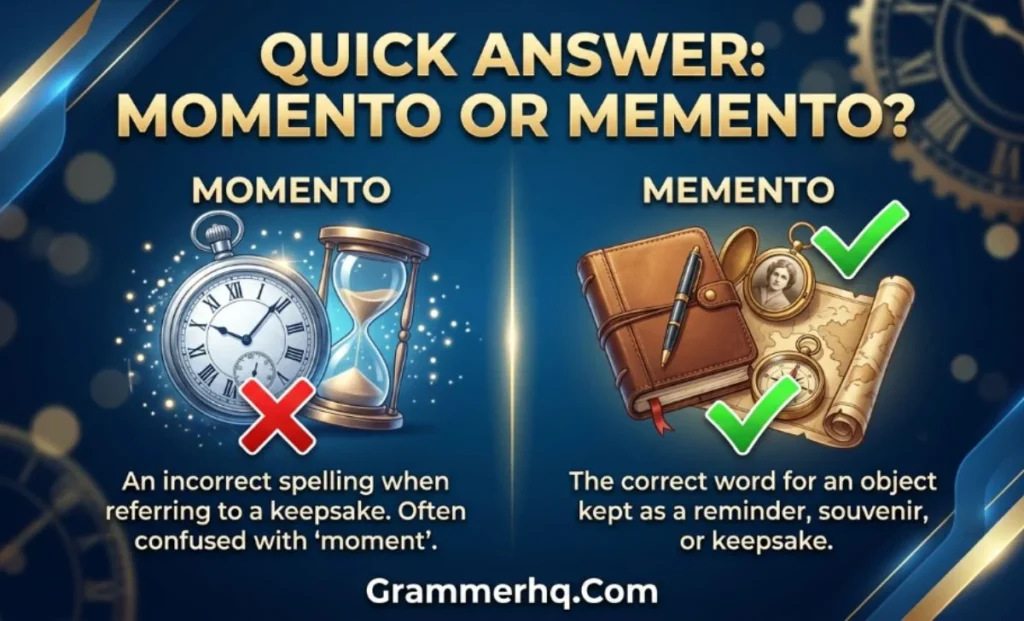
Memento is the standard spelling to use in careful English writing.
- Memento ✓ — standard English spelling
- Momento — commonly seen, but generally considered a nonstandard or disputed variant in English
For example:
She kept the old photograph as a memento of her childhood.
If you are writing a school assignment, article, business document, email, or other polished English, memento is the safer choice.
What Does Memento Mean?
A memento is an object that you keep because it reminds you of a person, place, event, or experience. Cambridge and Oxford both give this basic meaning and connect the word with things kept as reminders or souvenirs.
A memento can be almost anything with personal meaning, such as:
- A photograph from a family trip
- A ticket from a memorable concert
- A medal from a graduation ceremony
- A letter from someone special
- A small souvenir from a vacation
- A wedding invitation kept for sentimental reasons
For example:
The seashell became a memento of their vacation.
Here, the shell is not valuable because of what it costs. Its value comes from the memory it represents.
Why Do People Write “Momento” Instead of “Memento”?
The spelling momento is easy to understand as a mistake because the word is closely associated with a moment.
People often think of a memento as something that preserves a special moment, so the spelling can naturally shift from:
memento → momento
There is also a more interesting reason: momento is not simply a made-up form that dictionaries ignore.
Merriam-Webster says momento is typically considered a misspelling, but it occurs often enough in edited prose that dictionaries have recorded it as an acceptable variant spelling. Collins similarly notes that many people consider it a misspelling while acknowledging its frequent use as a variant.
That means the most accurate answer is not simply “momento is not a word.”
For standard English usage, memento remains the preferred spelling.
Is “Momento” a Word?
Momento does appear in English dictionaries, but its status is different from the standard form memento.
Merriam-Webster describes momento as a spelling that is typically considered a misspelling but is also recorded as an acceptable variant because of its established use.
Collins gives a similar explanation, saying that many people regard it as a misspelling while some treat it as a variant.
So, if someone asks:
“Is momento completely meaningless?”
No.
But if they ask:
“Which spelling should I use in formal English?”
Use memento.
That distinction makes the answer more accurate than simply labeling momento as a nonexistent word.
Memento vs Moment
The two words are related in people’s minds, but they do not have the same meaning.
| Word | Meaning | Example |
|---|---|---|
| Moment | A point or short period of time | It was a special moment. |
| Memento | An object kept as a reminder | The photo is a memento of that day. |
A moment is the experience in time.
A memento is something you may keep afterward to remember it.
For example:
Winning the championship was a special moment.
He kept the medal as a memento of the championship.
This difference is one of the easiest ways to understand why memento has an extra e.
How Do You Spell Memento?
The spelling is:
M-E-M-E-N-T-O
A useful way to remember it is to connect memento with memory and remembering.
The word comes from Latin mementō, meaning “remember!” It comes from meminisse, a Latin verb meaning “to remember.” Oxford and Merriam-Webster both trace the word to this Latin origin.
So remember:
Memento → remember → memory
That connection is more useful than trying to remember the spelling through the word moment.
Memento Pronunciation
Memento is pronounced slightly differently in American and British English.
- US: /məˈmen.toʊ/
- UK: /məˈmen.təʊ/
In simple pronunciation, you can think of it as:
muh-MEN-toh
Cambridge lists both the American and British pronunciations.
The spelling does not change between American and British English.
Memento or Mementoes: What Is the Plural?
Both mementos and mementoes are accepted plural forms.
Singular
memento
Plural
mementos
mementoes
Cambridge and Oxford both list these two plural forms.
Examples:
The museum displayed several historical mementos.
Her desk was filled with old photographs and mementoes.
In modern everyday writing, mementos is a simple choice.
Memento vs. Souvenir vs. Keepsake
These words overlap, but they are not always interchangeable.
Memento is something kept as a reminder of a person, place, event, or experience.
Souvenir usually refers to something kept or bought to remember a place or occasion.
Keepsake emphasizes something retained because it has sentimental or personal value.
For example, a small gift bought during a trip may be a souvenir. If you keep it for years because it reminds you of that trip, it can also be a memento or keepsake.
Real-Life Examples of “Memento”
Here are natural examples of how memento is used:
She kept her grandfather’s watch as a memento of him.
The graduation medal became a special memento of her school years.
I bought a small painting as a memento of my trip to Italy.
The concert ticket is now a memento of that unforgettable night.
They saved the wedding invitation as a memento of the occasion.
The old photograph served as a memento of a happier time.
Notice that the object itself does not have to be expensive. Its importance comes from the memory attached to it.
Is Memento American or British English?
Memento is used in both American and British English.
The spelling remains the same in both varieties:
memento
The main difference is pronunciation. Cambridge gives /məˈmen.toʊ/ for American English and /məˈmen.təʊ/ for British English.
So there is no American spelling momento and British spelling memento distinction.
Common Mistake: Momento or Memento?
If you mean a keepsake or reminder, write:
❌ momento
✅ memento
For example:
❌ She kept the necklace as a momento of her mother.
✅ She kept the necklace as a memento of her mother.
The second sentence uses the standard English spelling.
FAQs
Is memento or momento correct?
Memento is the standard and preferred spelling in English for an object kept as a reminder. Momento is also recorded by some dictionaries as a variant, but it is commonly treated as a misspelling or nonstandard form.
Is “momento” a real word?
Yes, momento is documented as a variant spelling in some dictionaries. However, memento is the standard form to use in polished English writing.
What does memento mean?
A memento is an object kept to remind you of a person, place, event, or special occasion.
What is the plural of memento?
The plural can be mementos or mementoes.
Is memento the same as souvenir?
They can overlap. A souvenir is usually something associated with a place or experience, while memento has the broader meaning of something kept as a reminder.
How do you pronounce memento?
In American English, it is /məˈmen.toʊ/. In British English, it is /məˈmen.təʊ/.
Conclusion
When choosing between momento or memento, use memento for standard English.
A memento is a keepsake or reminder of a person, place, event, or special experience. The spelling comes from Latin and is connected with the idea of remembering, which explains the extra e.
Momento is a common form that appears in real English usage and is recorded as a variant by some dictionaries, but memento is the clearest choice for formal, academic, professional, and polished writing.
Quick memory tip:
Memento = something that helps you remember.
Read More Blogs
- Experience vs Experiance: Which Spelling Is Correct?
- Jibe vs Jive: What’s the Difference?
- Burned or Burnt: Which Spelling Is Correct?
- Learned or Learnt: What’s the Difference?