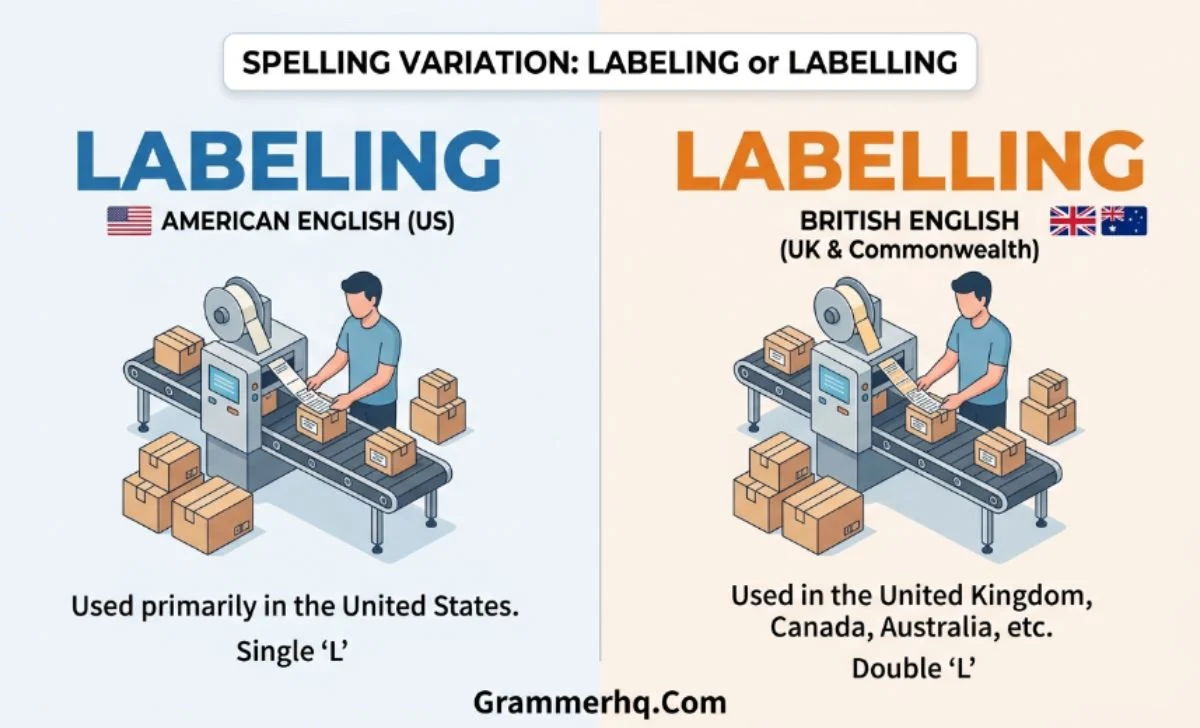
Labeling vs Labelling can look like a spelling mistake, especially when you see both forms used by reputable websites, dictionaries, and publications.
But here is the important part: neither spelling is wrong. The difference comes from the variety of English you are using. Labeling is the standard American English spelling, while labelling is the standard British English spelling.
Both forms have the same meaning and grammatical uses, and the difference also appears in related forms such as labeled/laballed and labeling/labelling.
If you are unsure which form to use, don’t guess based on which one looks more familiar. Instead, check the English style of your writing and follow it consistently. This guide explains the difference with clear rules, examples, and an easy memory trick.
Quick Answer
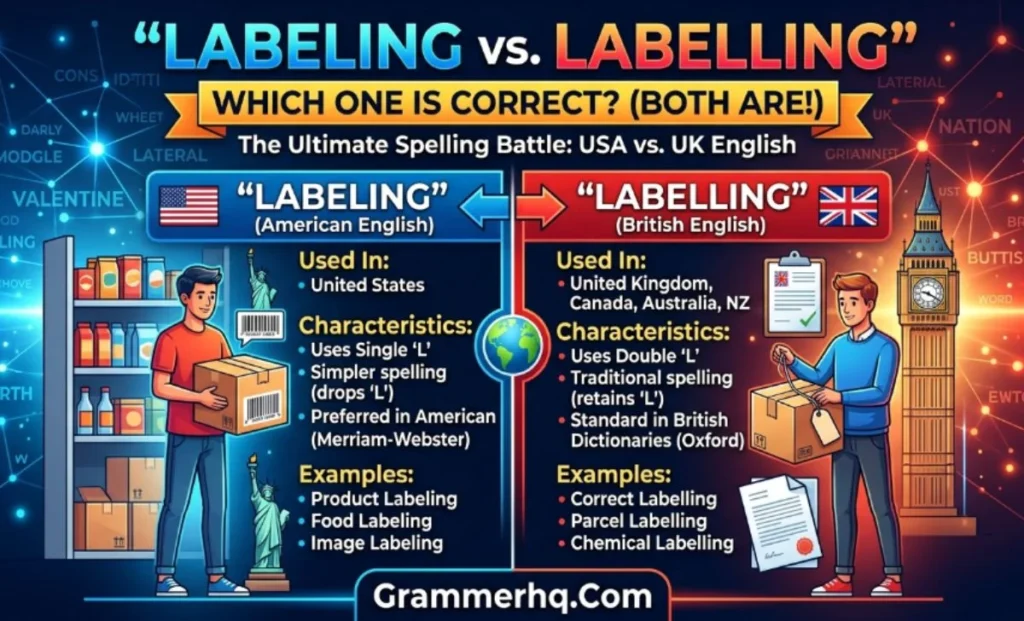
Labeling and labelling are two regional spellings of the same word.
- Labeling = American English
- Labelling = British English
- Meaning = the same
- Pronunciation = essentially the same word; the spelling does not create a separate meaning
- Base word = label
- US forms = labeled, labeling
- UK forms = labelled, labelling
For example:
American English:
The staff is labeling the boxes.
British English:
The staff is labelling the boxes.
Both sentences mean that the staff is putting identifying information on the boxes.
Merriam-Webster lists labeled or labelled and labeling or labelling as forms of label, while Cambridge identifies labelling as the UK form and gives labeling as the US equivalent.
Why Are There Two Spellings?
The difference comes from regional spelling conventions.
The base word is spelled label in both American and British English. The variation appears when endings such as -ed and -ing are added.
The two common patterns are:
| Form | American English | British English |
|---|---|---|
| Base | label | label |
| Past tense | labeled | labelled |
| -ing form | labeling | labelling |
This means labeling and labelling are not different words. They belong to the same spelling family.
A useful way to see the pattern is:
US: label → labeled → labeling
UK: label → labelled → labelling
Once you remember that sequence, the spelling becomes much easier.
Labeling or Labelling: One L or Two?
This is probably the easiest question to remember.
American English keeps one l before the endings:
- labeling
- labeled
British English uses two l’s:
- labelling
- labelled
So think of it this way:
US = labeling
UK = labelling
The same distinction appears in other words, such as traveled/travelled and modeled/modelled, although spelling conventions can vary across different words and English varieties.
The important point is that labeling is not a misspelling of labelling, and labelling is not a misspelling of labeling. Each fits a different regional spelling convention.
Do Labeling and Labelling Have Different Meanings?
Labeling and labelling have the same basic meanings. The spelling does not tell you whether someone is attaching a physical label or describing something figuratively.
The verb label can mean to attach a label to something, or to describe or designate something with a label. Merriam-Webster gives both of these uses.
Putting a Label on Something
You can use either spelling when referring to physical labels.
US:
The workers are labeling every package.
UK:
The workers are labelling every package.
The meaning is identical.
Giving Something Identifying Information
The word is also common in product, food, medicine, packaging, and manufacturing contexts.
US:
Clear product labeling helps customers understand what they are buying.
UK:
Clear product labelling helps customers understand what they are buying.
Cambridge specifically lists business uses such as food, product, nutritional, and country-of-origin labelling.
Describing or Categorizing Someone
The word can also be used figuratively.
US:
Labeling someone after one mistake can be unfair.
UK:
Labelling someone after one mistake can be unfair.
Again, the meaning does not change.
Labeling vs Labelling in American and British English
The easiest rule is to match the spelling to your overall English style.
American English: Labeling
Use labeling when your content follows American English conventions.
Examples include:
- labeling products
- labeling boxes
- food labeling
- product labeling
- data labeling
- labeling requirements
- labeling instructions
Example:
The company updated its product labeling requirements.
British English: Labelling
Use labelling when your content follows British English conventions.
Examples include:
- labelling products
- labelling boxes
- food labelling
- product labelling
- data labelling
- labelling requirements
- labelling instructions
Example:
The company updated its product labelling requirements.
Neither form is more formal or more correct in every context. The appropriate spelling depends on the English variety and style you are following.
How to Choose the Right Spelling
You can usually decide in a few seconds.
Choose Labeling If You Use American English
Use labeling if your document is primarily written for a US audience or follows an American style guide.
For example:
The company is labeling its new products.
Accurate labeling helps customers compare products.
The researchers are labeling the samples.
Choose Labelling If You Use British English
Use labelling if your document follows British English.
For example:
The company is labelling its new products.
Accurate labelling helps customers compare products.
The researchers are labelling the samples.
Follow Your Organization’s Style Guide
If you are writing for a school, university, company, publisher, or website, its style guide should come first.
For example, an international company may use American English throughout its website even though its customers live in many countries.
In that situation, use labeling consistently rather than switching between the two forms.
The Fastest Way to Remember Labeling vs Labelling
Here is a simple memory trick:
American English = one L → labeling
British English = two L’s → labelling
You can also check the words around it.
If your writing uses:
- color
- favorite
- organize
- traveled
then labeling will usually fit an American English style.
If your writing uses:
- colour
- favourite
- organise
- travelled
then labelling will usually fit a British English style.
The goal is not to memorize every word separately. Instead, identify the overall spelling system of your document.
Labeling vs Labelling in Real-World Writing
The word appears in many everyday and professional contexts.
Packaging
US:
The company is labeling the packages before shipment.
UK:
The company is labelling the packages before shipment.
Food
US:
New food labeling rules were introduced.
UK:
New food labelling rules were introduced.
Medicine
US:
The pharmacy reviewed the medication labeling.
UK:
The pharmacy reviewed the medication labelling.
Files and Folders
US:
She spent the morning labeling folders.
UK:
She spent the morning labelling folders.
Science and Research
US:
The scientist finished labeling the samples.
UK:
The scientist finished labelling the samples.
Figurative Description
US:
Labeling people based on stereotypes can be misleading.
UK:
Labelling people based on stereotypes can be misleading.
These examples show the central rule: the spelling changes, but the meaning stays the same.
Labeling vs Labelling as a Verb and Noun
Both spellings can appear in different grammatical roles.
As a Verb Form
Labeling and labelling are the present participle forms of label.
American English:
She is labeling the files.
British English:
She is labelling the files.
They can also appear after verbs such as avoid, continue, or finish:
We finished labeling the boxes.
We finished labelling the boxes.
As a Noun
The same forms can refer to the act or process of applying labels.
American English:
Accurate food labeling is important.
British English:
Accurate food labelling is important.
Cambridge specifically recognizes labelling as a noun in business contexts, including the act of putting labels on something.
Labeled vs Labelled: What About the Past Tense?
If you understand labeling vs labelling, the past tense follows the same regional pattern.
American English
labeled
The company labeled every box.
British English
labelled
The company labelled every box.
The same rule applies to the related forms:
US: label → labeled → labeling
UK: label → labelled → labelling
This is important because mixing the forms can make your writing look inconsistent.
For example:
The company labelled the products and is now labeling the boxes.
This combines British labelled with American labeling.
If you are using American English, write:
The company labeled the products and is now labeling the boxes.
If you are using British English, write:
The company labelled the products and is now labelling the boxes.
Common Mistakes With Labeling and Labelling
1: Thinking Labelling Is Wrong
Some writers see the extra l and assume that labelling is a typo.
It is not.
Labelling is the standard British spelling.
2: Thinking the Two Spellings Have Different Meanings
They do not.
Both can describe attaching labels or describing something with a label.
3: Mixing American and British Forms
For example:
The products were labelled and the company is labeling the boxes.
The sentence is understandable, but it mixes regional forms.
Choose one style instead.
4: Using Labeling and Labelled Together Without a Reason
This is another common consistency problem.
For American English:
labeled and labeling
For British English:
labelled and labelling
5: Assuming the Extra L Changes Pronunciation
The spelling difference does not create a different dictionary word. Both forms represent the same verb form, with pronunciation differences mainly attributable to accent rather than the spelling distinction itself.
Labeling vs Labelling: Which One Is Correct?
Both are correct.
The correct choice depends on your English variety:
| If you are writing in… | Use… |
|---|---|
| American English | labeling |
| British English | labelling |
| American English past tense | labeled |
| British English past tense | labelled |
There is no need to change one into the other simply because you see a different spelling online.
Instead, ask:
What English style am I using?
That question usually solves the problem immediately.
What If You Are Writing for an International Audience?
If your readers come from different countries, either spelling can be understood.
The better approach is to choose a consistent editorial style.
For example, if your website uses American spellings such as color, organize, and traveling, use labeling.
If your website uses British spellings such as colour, organise, and travelling, use labelling.
Consistency makes the writing feel intentional and professionally edited.
Labeling vs Labelling in Official Names and Quotes
If you reproduce an exact title, organization name, or direct quotation, do not automatically change its spelling simply to match your preferred English variety.
For example, if an official source uses labelling in an exact title, preserve that spelling when reproducing the title exactly.
The same principle applies to direct quotations: do not silently convert labelling to labeling, or the other way around, unless your editorial rules specifically allow spelling changes.
Synonyms for Labeling and Labelling
When you mean putting a label on something, possible alternatives include:
- tagging
- marking
- identifying
- naming
- designating
For example:
Labeling the boxes
can sometimes be replaced with:
Tagging the boxes
When you mean placing something into a category, alternatives may include:
- classifying
- categorizing
- describing
- designating
These are not perfect replacements in every sentence, so choose the word according to the intended meaning.
Word History of Label
The difference between labeling and labelling is not a difference in origin. Both forms come from the same base word, label.
Merriam-Webster traces label to Middle English, from Anglo-French labelle, and records the noun from the 14th century and the verb from the 17th century.
The modern spelling difference developed through regional English spelling conventions.
That is why today’s forms are:
American English: labeling
British English: labelling
They are two regional spellings of the same word rather than two separate vocabulary items.
Common Phrases With Labeling and Labelling
You may encounter these expressions frequently:
American English
- food labeling
- product labeling
- nutritional labeling
- package labeling
- data labeling
- labeling requirements
- labeling system
- labeling process
- labeling instructions
British English
- food labelling
- product labelling
- nutritional labelling
- package labelling
- data labelling
- labelling requirements
- labelling system
- labelling process
- labelling instructions
The meaning remains the same; only the regional spelling changes.
Labeling vs Labelling: Final Rule
If you remember just one rule, make it this:
Labeling = American English
Labelling = British English
Both spellings are correct and have the same meaning. The related past-tense forms follow the same pattern:
US: labeled
UK: labelled
For a quick consistency check, if your writing uses color, organize, and traveled, choose labeling. If it uses colour, organise, and travelled, choose labelling.
Choose the spelling that matches your English variety, and use it consistently throughout your writing.
FAQ,s
Is labeling or labelling correct?
Both are correct. Labeling is the standard American English spelling, while labelling is the standard British English spelling.
Is labeling American or British?
Labeling is the standard American English spelling.
Is labelling British English?
Yes. Labelling is the standard British English spelling.
Do labeling and labelling mean the same thing?
Yes. They have the same meaning. The difference is primarily regional spelling.
Are labeling and labelling pronounced differently?
They represent the same word and spelling distinction. Any noticeable pronunciation difference is generally related to the speaker’s accent rather than the extra l.
Is labeled or labelled correct?
Both are correct. Labeled is the American English form, while labelled is the British English form.
Which spelling should I use in the US?
Use labeling and labeled for standard American English.
Which spelling should I use in the UK?
Use labelling and labelled for standard British English.
Can I use labeling and labelling in the same article?
You can, but you generally should not switch between them without a reason. Choose the spelling convention that matches your audience or publication style and use it consistently.
What is an easy way to remember the difference?
Remember:
US → labeling → one L
UK → labelling → two L’s
Conclusion
Labeling and labelling are both correct spellings of the same word. The difference is regional rather than semantic.
Use labeling in American English and labelling in British English. The same distinction appears in the related past-tense forms: labeled in American English and labelled in British English.
Both spellings can describe attaching information to a product, package, file, or other object, as well as describing or categorizing someone or something.
The easiest rule is:
American English → labeling
British English → labelling
Whatever spelling you choose, use it consistently throughout your article, website, assignment, or document.
Read More Blogs:

Hi, I’m Amelia Parker, a grammar enthusiast and writer at GrammarHQ.com. I specialize in explaining spelling differences, confusing words, and common English mistakes through simple, practical, and easy-to-understand guides.