If you’ve ever typed “meating” instead of “meeting,” you’re not alone. This is a surprisingly common spelling mistake because both words sound similar when spoken quickly.
Many students, professionals, and English learners pause before sending an email or writing a report, wondering which spelling is actually correct.
The short answer is simple: meeting is the correct word when you’re referring to a gathering, discussion, appointment, or event where people come together.
Meating is not the standard English word in this context and is almost always a misspelling. In this guide, you’ll learn the difference, understand why the confusion happens, and see plenty of real-life examples so you can use the correct spelling with confidence.
Quick Answer
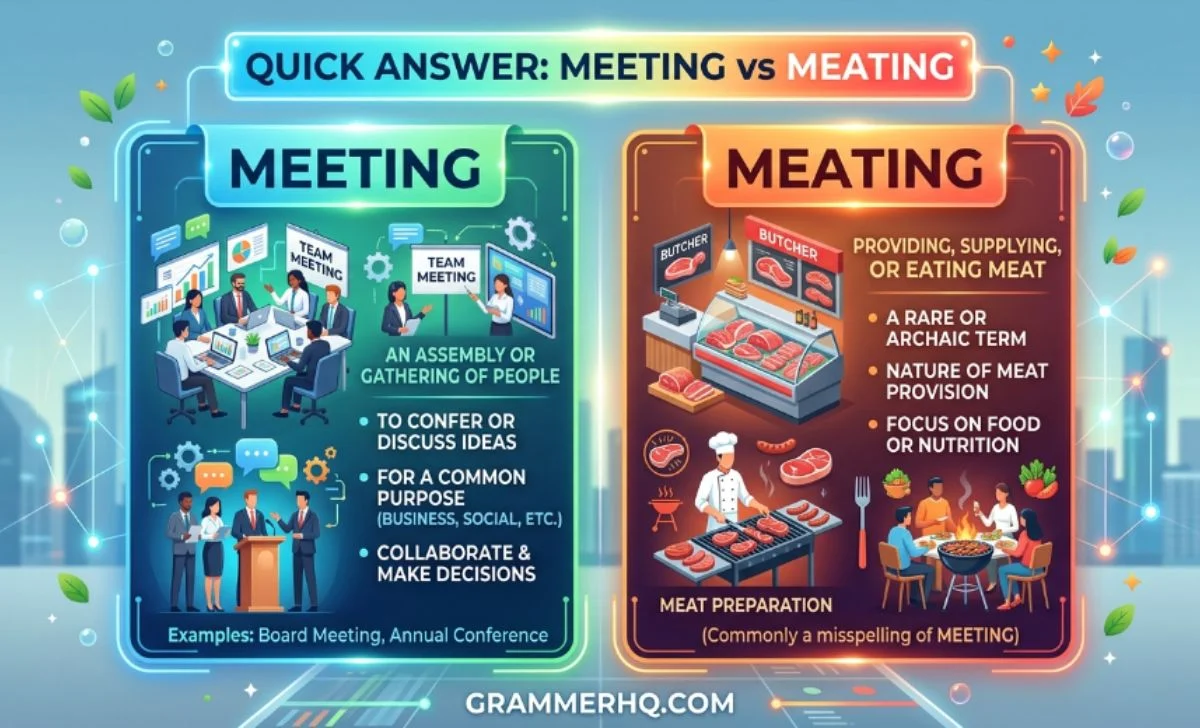
If you’re talking about people coming together for a discussion, class, interview, conference, or online call, meeting is the correct spelling.
| Word | Correct? | Meaning |
|---|---|---|
| Meeting | ✅ Yes | A gathering, discussion, appointment, or the act of people coming together. |
| Meating | ❌ Usually No | Generally a misspelling of meeting. In very rare niche contexts, it may literally refer to processing or supplying meat, but this is not standard everyday English. |
Example:
✔ We have a meeting at 10 a.m.
❌ We have a meating at 10 a.m.
Quick rule: If the sentence is about work, school, business, or an online discussion, always choose meeting.
What Is the Difference Between Meating and Meeting?
Although these two words differ by only one letter, their meanings are completely different in normal English.
Meeting
Meeting is a standard English noun and can also function as the -ing form of the verb meet.
It describes:
- A business meeting
- A team discussion
- A school meeting
- A client appointment
- A conference
- An online video call
- A social gathering
Examples:
- Our weekly meeting starts at 9:30.
- The project meeting lasted two hours.
- We scheduled another meeting for Friday.
- She missed yesterday’s parent-teacher meeting.
You’ll see this word every day in workplaces, schools, universities, calendars, email invitations, and communication tools like Google Meet, Microsoft Teams, and Zoom.
Meating
In everyday English, meating is not the correct spelling when you mean a gathering.
Most of the time, people write meating because:
- they type too quickly,
- they hear the word incorrectly,
- autocorrect fails to catch it,
- or they accidentally think of the word meat instead of meet.
Outside of grammar mistakes, meating can occasionally appear in highly specialized industries as a literal form related to handling or processing meat. However, this usage is extremely uncommon and has nothing to do with business meetings, classroom discussions, or appointments.
For almost every reader searching this keyword, meeting is the word they need.
Is “Meating” a Real English Word?
This is one of the biggest questions people ask online.
The answer depends on the context.
In Everyday English
If you’re writing:
- an email,
- a school assignment,
- a business proposal,
- a report,
- or a text message,
then meating is considered incorrect.
Examples:
❌ I’m attending a meating tomorrow.
✔ I’m attending a meeting tomorrow.
❌ The manager cancelled today’s meating.
✔ The manager cancelled today’s meeting.
In these situations, using meating can make your writing look unprofessional and may distract readers from your message.
In Rare Technical Contexts
English sometimes creates -ing forms from nouns or verbs for highly specialized activities. Because of that, you may occasionally encounter meating in documents related to:
- meat processing,
- livestock production,
- food manufacturing,
- or butchery.
Here, the word refers to activities involving meat, not a gathering of people.
For example:
The machine is used during the meating process.
This type of usage is uncommon, industry-specific, and not something most English learners or office workers will ever need.
That’s why grammar guides generally teach that meeting is the correct choice for almost every everyday situation.
What Does “Meeting” Mean?
Understanding the meaning of meeting makes it much easier to remember the correct spelling.
A meeting is an event where two or more people come together to discuss ideas, share information, solve problems, or make decisions.
Meetings happen in many settings, including:
- offices,
- schools,
- universities,
- government organizations,
- hospitals,
- community groups,
- online platforms,
- and social events.
Examples include:
- team meeting
- board meeting
- client meeting
- staff meeting
- parents’ meeting
- project meeting
- sales meeting
- strategy meeting
- online meeting
- annual meeting
Whether the discussion happens in a conference room or through a video call, the correct word remains meeting.
Meeting as a Noun
Most often, meeting functions as a noun.
Examples:
- The meeting begins at noon.
- Everyone attended the budget meeting.
- Today’s meeting was productive.
Meeting as the -ing Form of “Meet”
Meeting can also be the present participle or gerund of the verb meet.
Examples:
- We are meeting the new client tomorrow.
- She enjoys meeting people from different cultures.
- They are meeting with the legal team this afternoon.
Notice that both uses come from the verb meet, not meat.
How to Pronounce “Meeting”
Correct pronunciation also helps prevent spelling mistakes.
Pronunciation
Meeting
IPA (UK): /ˈmiː.tɪŋ/
IPA (US): /ˈmiː.t̬ɪŋ/
It sounds like:
MEE-ting
The long “ee” sound comes from the verb meet, which explains why the spelling contains double e.
Many learners mistakenly replace meet with meat because both words share the same pronunciation.
Although meet and meat are homophones, they have different meanings and different spellings. That similarity is exactly why meating appears so often as a typing mistake.
Why “Meeting” Has Double E
A simple understanding of word formation can eliminate this mistake forever.
The word develops like this:
Meet → Meeting
Not:
Meat → Meating
The base verb is meet, meaning to come together.
When English adds -ing to the verb, the spelling becomes:
Meet + ing = Meeting
The word has nothing to do with meat, even though both words sound identical.
Remember this one rule, and you’ll rarely confuse the two spellings again.
Why Do People Confuse Meating and Meeting?
At first glance, the two words look almost identical. They differ by just one letter, yet that small change completely changes whether the word is correct in everyday English.
Here are the main reasons this mistake happens.
They Sound Exactly the Same
The biggest reason is pronunciation.
The words meet and meat are homophones—they sound the same but have different meanings and spellings.
- Meet = to come together
- Meat = animal flesh used as food
Because they share the same pronunciation, many writers instinctively type meating instead of meeting, especially when writing quickly.
Fast Typing
Most spelling mistakes happen because people focus on ideas rather than individual letters.
Imagine you’re replying to a work email:
“Let’s have a meating tomorrow.”
Your fingers may type meat automatically without you noticing. This is one of the most common keyboard errors in professional writing.
English Learners
People learning English often write words based on how they sound rather than how they are spelled.
Since meet and meat are pronounced alike, it’s natural for learners to wonder which spelling is correct.
Autocorrect Isn’t Perfect
Spell-check tools have improved, but they don’t catch every mistake.
If meating appears in a technical document or specialized vocabulary, some writing tools may not immediately flag it. That’s why proofreading remains important before sending emails, reports, or assignments.
Meating vs Meeting: Side-by-Side Comparison
| Feature | Meeting | Meating |
|---|---|---|
| Standard English word | ✅ Yes | ❌ Usually no |
| Correct for business discussions | ✅ Yes | ❌ No |
| Correct for school or college | ✅ Yes | ❌ No |
| Used in emails | ✅ Yes | ❌ No |
| Refers to people gathering | ✅ Yes | ❌ No |
| Derived from the verb meet | ✅ Yes | ❌ No |
| Rare technical use related to meat processing | ❌ No | ✅ Occasionally |
| Recommended in everyday writing | ✅ Always | ❌ Almost never |
Bottom line: If you’re talking about people coming together, choose meeting every time.
When Should You Use Meeting?
The word meeting fits almost every situation where people gather to communicate, plan, or make decisions.
In the Workplace
Business communication relies on meetings every day.
Examples:
- We have a strategy meeting after lunch.
- The manager scheduled an emergency meeting.
- Everyone joined the weekly team meeting.
At School or University
Teachers, students, and parents regularly use this word.
Examples:
- The parent-teacher meeting is next Monday.
- Our study group meeting starts at six.
- She missed the orientation meeting.
Online Communication
Remote work has made virtual meetings part of everyday life.
Examples:
- I’ll send the Google Meet invitation before the meeting.
- Our Zoom meeting begins in fifteen minutes.
- The client requested another online meeting.
Everyday Conversations
Outside work or school, the word is just as common.
Examples:
- Our family meeting lasted an hour.
- Thanks for arranging today’s meeting.
- It was great meeting your parents.
Notice that the last sentence uses meeting as the -ing form of meet, not as a noun.
Can Meating Ever Be Correct?
This question often surprises people.
The answer is yes—but only in very limited, specialized contexts.
In industries such as food production or meat processing, you might occasionally encounter meating as a literal term connected with handling or processing meat.
For example:
The equipment is designed for efficient meating during production.
However, this usage is extremely uncommon and rarely appears in general dictionaries, newspapers, business communication, or everyday conversation.
If your sentence involves:
- a conference,
- a class,
- an appointment,
- a discussion,
- an interview,
- a video call,
- or a gathering,
meeting is always the correct choice.
Real-Life Examples
Learning through examples is one of the easiest ways to remember the correct spelling.
Correct Examples
- Our sales meeting begins at 10 a.m.
- She attended the monthly board meeting.
- We are meeting the new client this afternoon.
- The principal called a staff meeting.
- Thank you for meeting with us today.
- The online meeting ended earlier than expected.
- Every project starts with a planning meeting.
- They are meeting to discuss next year’s budget.
Incorrect Examples
❌ We have a meating at three o’clock.
✅ We have a meeting at three o’clock.
❌ The manager cancelled today’s meating.
✅ The manager cancelled today’s meeting.
❌ I’m meating my professor tomorrow.
✅ I’m meeting my professor tomorrow.
❌ Did you receive the meating invitation?
✅ Did you receive the meeting invitation?
Email Example
Professional writing is where this spelling mistake can leave a poor impression.
Incorrect
We have a meating with the client tomorrow at 2:00 p.m.
Correct
We have a meeting with the client tomorrow at 2:00 p.m.
A single spelling mistake may seem minor, but in business communication it can affect how polished and professional your writing appears.
Student Example
Incorrect:
Our science meating starts after lunch.
Correct:
Our science meeting starts after lunch.
Office Example
Incorrect:
The CEO postponed the quarterly meating.
Correct:
The CEO postponed the quarterly meeting.
Easy Trick to Remember
Simple memory tricks often work better than memorizing spelling rules.
Start with the Verb
Ask yourself:
What are people doing?
They’re meeting each other.
Since the verb is meet, the noun becomes:
Meet → Meeting
Never:
Meat → Meating
Think About Food
Meat belongs in the kitchen.
Meet belongs in conversations.
If people are sitting around a conference table, discussing a project, or joining a video call, you’re talking about a meeting, not meating.
Double “E” Means “Meet”
Whenever you think of:
- team
- conference
- discussion
- interview
- appointment
- presentation
remember the base verb meet.
That automatically leads to the correct spelling:
Meeting
Common Mistakes to Avoid
Many writers repeat the same errors. Avoid these habits to improve your English writing.
- Confusing meet with meat because they sound alike.
- Writing meating in emails, reports, or assignments.
- Assuming every -ing word is spelled phonetically.
- Relying only on autocorrect instead of proofreading.
- Forgetting that meeting comes directly from the verb meet.
Quick Self-Check Before You Write
Before you hit Send or Submit, ask yourself:
- Am I talking about people gathering?
- Does the sentence describe a discussion or appointment?
- Does the word come from the verb meet?
If the answer is yes, the correct spelling is meeting.
Following this quick check can help you avoid one of the most common spelling mistakes in everyday English.
FAQ,s
Is meating a real English word?
In everyday English, no. If you’re referring to a discussion, appointment, conference, or gathering, meeting is the correct spelling.
The word meating may occasionally appear in very specialized contexts related to meat processing or food production, but this usage is rare and unrelated to business, education, or general communication.
Which is correct: meating or meeting?
For almost every everyday situation, meeting is correct.
Examples:
- ✔ Team meeting
- ✔ Parent-teacher meeting
- ✔ Online meeting
- ✔ Staff meeting
- ✔ Client meeting
Why do people write meating instead of meeting?
The mistake usually happens because:
- meet and meat sound exactly alike.
- People type quickly.
- English learners spell words based on pronunciation.
- Autocorrect doesn’t always catch uncommon spelling mistakes.
Is meeting a noun or a verb?
It can be both, depending on the sentence.
As a noun:
- The meeting starts at 2 p.m.
As the -ing form (present participle or gerund) of the verb meet:
- We are meeting the new client tomorrow.
- She enjoys meeting new people.
Why is meeting spelled with double e?
Because it comes from the verb meet.
The word is formed like this:
Meet + ing = Meeting
It does not come from meat, even though both words have the same pronunciation.
Is meating accepted in formal writing?
If you’re writing:
- emails,
- reports,
- resumes,
- presentations,
- academic assignments,
- business proposals,
always use meeting when referring to people coming together.
Can spell-check miss this mistake?
Sometimes, yes.
While many modern writing tools flag meating, some may not, especially if the word appears in a technical or industry-specific context.
A quick proofread is still the safest way to catch spelling errors before publishing or sending your work.
How can I remember the correct spelling?
Think of the base verb:
Meet → Meeting
A simple reminder is:
People meet. Food is meat.
If people are gathering to talk, learn, plan, or make decisions, the correct word is meeting.
Final Verdict
Although meating and meeting may sound identical, they have very different meanings. If you’re referring to a discussion, appointment, conference, classroom session, video call, or any situation where people come together, meeting is the only correct spelling in standard English.
The word meating is not appropriate for everyday writing. Outside of a few highly specialized meat-processing contexts, it’s almost always a spelling mistake.
Using meeting in emails, reports, assignments, and professional communication ensures your writing is accurate, polished, and easy to understand.Whenever you’re unsure, remember this simple rule:
People meet, so they have a meeting. Meat belongs on your plate not in your calendar.
It’s a small spelling difference, but choosing the right word makes a big difference in how clearly and professionally you communicate. The next time you hesitate between meating and meeting, you’ll know exactly which one belongs in your sentence.
Read More Blogs: