Have you ever typed “divet” and wondered if it was the correct spelling? You’re not alone. This is a common mistake, especially among people who hear the word more often than they see it written.
The confusion usually comes from pronunciation, not meaning. The correct spelling is divot, a word most closely associated with golf but also used in landscaping and turf care.
In this guide, you’ll learn the difference between divet or divot, why the mistake happens, how dictionaries define the word, and simple ways to remember the correct spelling.
Quick Answer
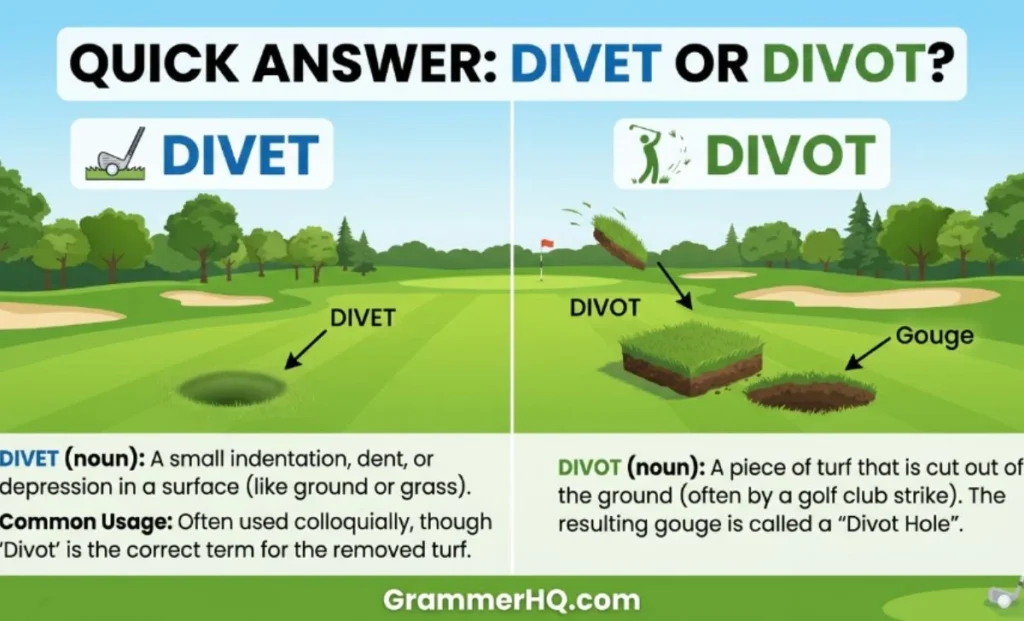
If you’re choosing between divet and divot, the correct spelling is divot.
- ✅ Divot is the correct English word.
- ❌ Divet is a misspelling and isn’t recognized in standard English dictionaries.
A divot usually refers to a small piece of grass and soil that is cut or torn from the ground, most commonly when a golfer strikes the ball. Although many people search for “divet,” they almost always mean divot.
Divet vs Divot: What’s the Difference?
| Feature | Divet | Divot |
|---|---|---|
| Correct spelling | ❌ No | ✅ Yes |
| Dictionary entry | ❌ Not recognized | ✅ Recognized |
| Meaning | None in standard English | A piece of turf removed from the ground |
| Common usage | Misspelling | Golf, landscaping, lawn care |
| Recommended for writing | ❌ Never | ✅ Always |
The difference is simple: divot is the accepted spelling, while divet is a typing or spelling mistake caused by pronunciation.
What Does Divot Mean?
Definition
A divot is a small section of grass, soil, or turf that has been removed from the ground. The term is most commonly used in golf when a club cuts into the fairway during a swing.
Pronunciation
Divot is pronounced:
DIV-it (/ˈdɪvət/)
Because the ending sounds like “-it,” many people mistakenly spell it as divet instead of divot.
Part of Speech
- Noun: A piece of turf removed from the ground.
- Verb (less common): To create or remove a divot.
Is “Divet” a Real Word?
No. Divet is not considered a standard English word.
Major dictionaries recognize divot, but not divet. If you use divet in academic writing, business communication, or published content, it will generally be treated as a spelling error.
You may still see “divet” in online searches, forum posts, or social media because many users spell the word based on how it sounds rather than how it’s written.
Why Do People Confuse Divet and Divot?
Pronunciation Leads the Mistake
English spelling doesn’t always match pronunciation. Since divot ends with a soft “-it” sound, many people naturally assume the word ends in “-et.”
Limited Exposure
Unless someone plays golf or reads sports content regularly, they may have heard the word without ever seeing its correct spelling.
Typing Habits
Quick typing and autocorrect suggestions can also contribute to the mistake, especially on mobile devices.
Similar English Patterns
English includes words ending in -et, such as packet or blanket, making divet seem believable even though it isn’t correct.
The Origin of the Word “Divot”
The word divot comes from Scottish English, where it originally referred to a cut piece of turf used for fuel or building purposes.
Over time, the meaning evolved. As golf became popular, the word began describing the chunk of grass removed when a golfer’s club strikes the ground after hitting the ball. Today, this is its most widely recognized meaning.
What Is a Divot in Golf?
How a Divot Is Created
When a golfer makes a proper iron shot, the club often contacts the ground immediately after striking the ball. This action removes a small piece of turf, creating a divot.
Why Golfers Replace Divots
Replacing or repairing divots helps:
- Protect the fairway
- Maintain healthy grass
- Keep the playing surface smooth
- Improve conditions for other golfers
Most golf courses encourage players to replace the divot or fill the damaged area with a sand-and-seed mixture.
Divot vs Pitch Mark
These terms are often confused.
- Divot: A piece of turf removed from the fairway by a golf club.
- Pitch mark: A small dent created when the golf ball lands on the putting green.
They are different types of course damage and require different repair methods.
Divot Beyond Golf
Although golf is the most common context, divot can also appear in:
- Lawn maintenance
- Landscaping
- Groundskeeping
- Sports field management
For example, groundskeepers may repair divots after football or rugby matches to keep the playing surface safe and even.
Divot in Everyday Sentences
Here are a few natural examples:
- The golfer replaced the divot before leaving the fairway.
- His swing created a large divot in the grass.
- The grounds crew repaired every divot after the tournament.
- She accidentally stepped into a divot while walking across the field.
- The coach inspected the turf for loose divots before practice.
Notice that every example uses divot, never divet.
Common Mistakes to Avoid
Many writers accidentally introduce spelling errors because they rely on pronunciation rather than verified spelling.
Avoid mistakes like:
❌ The golfer repaired the divet.
✅ The golfer repaired the divot.
❌ Several divets covered the fairway.
✅ Several divots covered the fairway.
Before publishing any document, it’s worth running a quick spell check or confirming unfamiliar words with a trusted dictionary.
Easy Trick to Remember the Correct Spelling
A simple memory tip is:
Think of “divot” as the “original” spelling—both contain the letter “O.”
Another easy reminder:
Golf courses have divots, not divets.
Repeating this sentence a few times makes the correct spelling much easier to remember.
FAQ,s
Is divet a real English word?
No. Divet is a common misspelling of divot and is not recognized as a standard English word.
Is divot only used in golf?
No. While golf is the most common context, divot can also describe pieces of damaged turf in landscaping, parks, and sports fields.
Why do people spell divot as divet?
The mistake usually happens because divot is pronounced with an “-it” sound, leading many people to guess the spelling incorrectly.
How do you pronounce divot?
It is pronounced DIV-it (/ˈdɪvət/).
Should I ever use “divet” in writing?
No. In professional, academic, and everyday English, always use divot.
Conclusion
The answer is clear: divot is the correct spelling, while divet is simply a common misspelling caused by pronunciation and typing habits.
Whether you’re writing about golf, lawn care, or sports fields, using the correct form improves clarity and credibility.
If you ever hesitate between the two, remember that dictionaries, style guides, and professional writers consistently use divot and that’s the spelling you should use every time.
Read More Blogs: