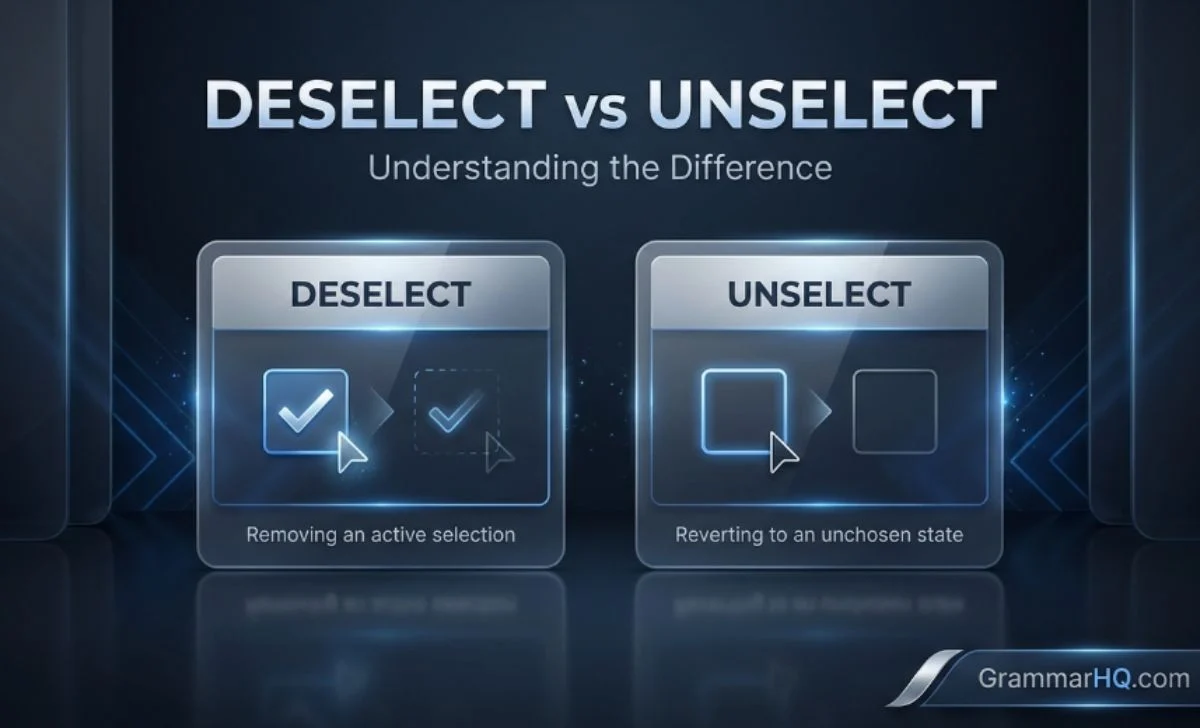
Deselect vs Unselect is a common word-choice question, especially when writing software instructions, website content, or user-interface labels.
Both words can describe reversing a previous selection, but they are not equally established in standard English. Deselect is the preferred and more widely recognized term, while unselect is understandable but less conventional in professional writing.
The choice becomes even more interesting when you consider related terms such as uncheck, clear selection, and deselect all, which may be more accurate depending on the action.
In this guide, you’ll learn the exact difference between deselect and unselect, see real-world examples, understand when uncheck is better, and discover the wording used in modern software and technical documentation. By the end, choosing the right term will be simple.
Quick Answer
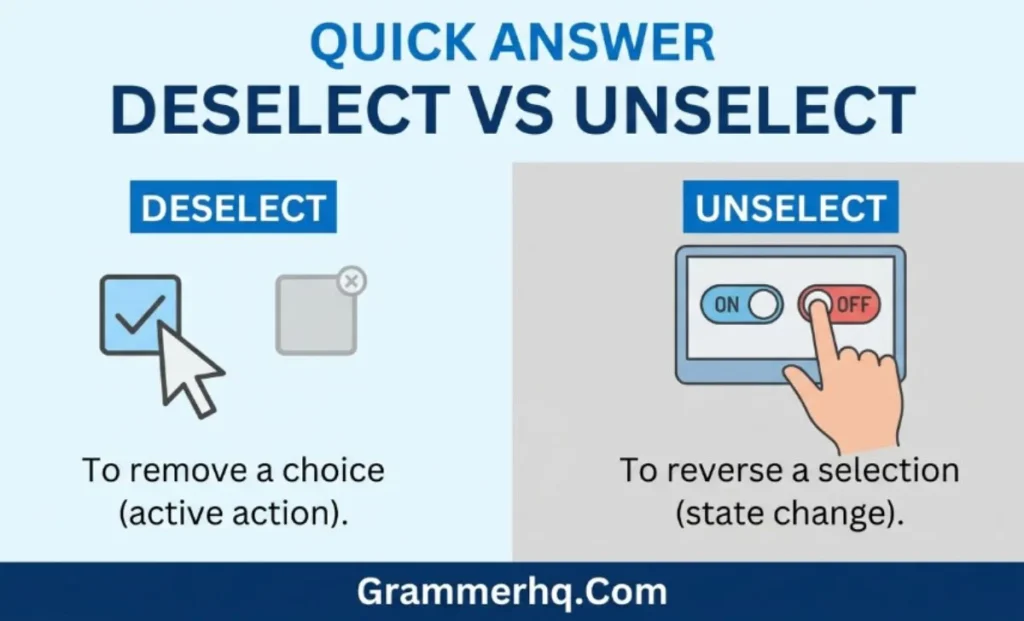
Deselect is the preferred word. Use deselect when you mean “remove something that has already been selected.”
Unselect is understandable and sometimes used in computing, but deselect is the more established choice for professional and technical English. For a checkbox, however, uncheck is often more precise.
Quick Comparison
| Word | Meaning | Best use | Recommendation |
|---|---|---|---|
| Deselect | Remove a selection | Software, documents, general English | ✅ Best choice |
| Unselect | Reverse a selection | Informal/technical usage | ⚠️ Understandable |
| Uncheck | Remove a check mark | Checkboxes and forms | ✅ Best for checkboxes |
| Clear selection | Remove current selections | Filters, forms, bulk actions | ✅ Very useful |
The simplest pattern is:
Select → Deselect
Check → Uncheck
Select everything → Deselect All / Clear Selection
What Does “Deselect” Mean?
Deselect means to remove something from a group or list of things that have been selected.
Oxford defines the computing sense as removing something from the list of possible choices on a computer menu. It also lists deselect as a verb with forms such as deselected and deselecting.
Deselect in Everyday and Digital English
You might see deselect in instructions such as:
- Deselect the option if you do not want notifications.
- Click the photo again to deselect it.
- Deselect all files before closing the folder.
- Deselect any filters you do not need.
- The program automatically deselects the previous item.
The important idea is that something was selected first.
You cannot normally “deselect” something that was never selected.
Deselect: Word Forms
| Form | Example |
|---|---|
| deselect | Please deselect this option. |
| deselects | The app deselects the previous item. |
| deselected | The file has been deselected. |
| deselecting | She is deselecting several photos. |
| deselection | The system supports automatic deselection. |
Oxford also lists deselection as a noun.
Why Is “Deselect” Correct?
The word follows a familiar English pattern in which de- can indicate reversal or removal.
For example:
- activate → deactivate
- code → decode
- centralize → decentralize
- select → deselect
That does not mean every English verb must use de- when an action is reversed. English has several different patterns for expressing reversal.
That is exactly why unselect can feel logical while deselect remains the more established choice.
The question is not simply:
“Does un- mean the opposite?”
It does.
The better question is:
“Which verb is established for this particular action?”
For selection, deselect has the stronger established usage.
What Does “Unselect” Mean?
Unselect generally means to reverse or cancel a previous selection.
For example:
Click the item again to unselect it.
Most readers will understand the sentence immediately.
The problem is not that unselect is impossible to understand. The problem is that it is less established than deselect in standard professional English.
That distinction matters when you are writing:
- software documentation
- help articles
- user-interface instructions
- educational material
- technical manuals
- professional websites
In those situations, there is little benefit in choosing unselect when deselect is already clear and established.
Why Does “Unselect” Sound Natural?
Because English frequently uses un- to express reversal:
- undo
- unlock
- unplug
- unfollow
- unfriend
- uncheck
So the logic appears straightforward:
select → unselect
But English is not a perfectly mathematical system. A word can be logically constructed and still be less conventional than another established word.
That is what happens here.
Deselect vs Unselect: The Real Difference
There is usually very little difference in meaning. Both words can communicate that a previous selection should be reversed.
The difference is mainly usage, convention, and register.
| Feature | Deselect | Unselect |
|---|---|---|
| Meaning is understandable | ✅ | ✅ |
| Established computing term | ✅ | Less established |
| Professional writing | Preferred | Less preferred |
| Technical documentation | Preferred | Sometimes used |
| UI instructions | Preferred | Usually avoid |
| Casual conversation | Fine | Understandable |
| Best default choice | Yes | No |
So if you are choosing one word for an article, manual, application, or website:
Choose deselect.
Deselect vs Uncheck: They Are Not Always the Same
This is one of the most useful distinctions.
Imagine an online form containing this checkbox:
☑ Send me product updates
If the user wants to remove the check mark, the clearest instruction is:
Uncheck “Send me product updates.”
Now imagine a photo editor where a person has selected part of an image:
Deselect the image.
There is no checkbox to uncheck. The user is changing a selection state.
So:
Checkbox → uncheck
Selection → deselect
This small distinction makes UI writing much more precise.
Deselect All vs Clear Selection
What about multiple selected items?
Suppose a file manager has ten selected files.
You could write:
Deselect All
That is perfectly natural because it directly reverses Select All.
Another possibility is:
Clear Selection
This is especially useful when an interface treats the current selections as a group or state.
For example:
- Select All
- Deselect All
- Clear Selection
All three can work, but the best choice depends on what the interface actually does.
A Practical Rule
Use Deselect All when you want to emphasize the reversal of selection.
Use Clear Selection when you want to emphasize removing the current selection state.
Real-Life Examples of Deselect
1: Photo Editing
I selected the person in the photo, then clicked Deselect to remove the selection.
2: Online Shopping
Deselect the “Free Shipping” filter to see all available products.
3: File Management
Select the documents you want to move, then deselect any files you added by mistake.
4: Online Forms
Uncheck the newsletter box if you do not want promotional emails.
Notice that uncheck is better than deselect because the control is specifically a checkbox.
5: Website Filters
Click Clear Selection to remove all selected categories.
These examples show why good word choice depends on the action, not simply on finding a universal opposite of select.
Deselect in UK Politics
There is an interesting meaning of deselect that has nothing to do with computers.
In UK politics, a political party can deselect an existing MP, meaning the local party does not choose that person as its candidate for the next election. Oxford lists this as a separate political meaning.
For example:
The local party voted to deselect the sitting MP.
Here, deselect does not mean clicking a button. It refers to a political candidate-selection process.
The related noun deselection is also used for this political process. Cambridge describes deselection as a specialized UK political term.
This is a useful reminder that deselect has a broader history of use than many people realize.
Deselect for Software and Developers
Developers regularly deal with selected and unselected states.
For example, an accessible interface may expose whether an item is selected using the ARIA aria-selected state:
<button aria-selected="true">Reports</button>
When the item is no longer selected:
<button aria-selected="false">Reports</button>
In documentation, it is natural to describe the action as:
Deselect the Reports tab.
You may also see these related terms:
- selected
- unselected
- selection
- deselect
- deselected
- selection state
- active state
- inactive state
An important detail is that unselected is perfectly normal English even though unselect is less established as the preferred verb.
For example:
The unselected items remain visible.
That sentence sounds completely natural.
What Should You Use in UI Copy?
When writing interface text, choose the word that describes the actual user action.
| Interface action | Best wording |
|---|---|
| Remove an item from a selection | Deselect |
| Remove a checkbox mark | Uncheck |
| Remove all selected items | Clear Selection |
| Reverse Select All | Deselect All |
| Switch a setting from on to off | Turn Off |
| Remove an item from a list | Remove |
This is better than automatically using deselect everywhere.
For example:
❌ Deselect the checkbox.
✅ Uncheck the checkbox.
But:
❌ Uncheck the selected photo.
✅ Deselect the selected photo.
Precision improves both readability and user experience.
Common Mistakes to Avoid
| Weak or incorrect wording | Better wording |
|---|---|
| Please unselect the option. | Please deselect the option. |
| Click unselect. | Click Deselect. |
| Unselect all files. | Deselect all files. |
| Deselect the checkbox. | Uncheck the checkbox. |
| Uncheck the selected image. | Deselect the selected image. |
| The option is unselect. | The option is unselected. |
| Click de-select. | Click deselect. |
Is “De-Select” or “De-select” Correct?
For modern standard usage, write deselect as one word.
Oxford’s current entry uses the closed form deselect, with deselected and deselecting as its verb forms.
So:
deselect ✅
is preferable to:
de-select ⚠️
Deselect vs Unselect: The One-Second Test
When you are unsure, ask:
Did I select something and now want to reverse that selection?
→ Deselect
Is it a checkbox with a check mark?
→ Uncheck
Am I removing every current selection?
→ Deselect All or Clear Selection
Am I switching a setting from on to off?
→ Turn Off or Toggle Off
This test solves most real-world cases.
FAQs
1: Is “unselect” a real word?
Yes, unselect is understandable and is used in some technical contexts. However, deselect is the stronger and more established choice for professional English.
2: Is “deselect” grammatically correct?
Yes. Deselect is a standard verb, and Oxford lists it specifically as a computing term for removing something from a list of possible choices.
3: What is the opposite of “select”?
In most software contexts, deselect is the clearest opposite. Depending on the interface, uncheck, clear, or remove may be more precise.
4: Is “unselected” correct?
Yes. Unselected is a normal adjective describing something that has not been selected.
For example:
The unselected options are still available.
This does not make unselect the preferred verb.
5: Should I use “deselect” or “uncheck”?
Use deselect for a selection and uncheck for a checkbox.
Deselect the image.
Uncheck the box.
6: Is “deselect all” correct?
Yes. Deselect All is a natural interface command and is the direct counterpart of Select All.
7: Is “de-select” correct?
Deselect is the preferred modern spelling. Oxford lists it as one word.
8: What does “deselect” mean in UK politics?
It means that a political party does not select an existing MP as its candidate for the next election. Oxford identifies this as a UK political meaning.
9: Which word should developers use?
For documentation and user-facing interface language, deselect is the safest default. Use more specific terms such as uncheck or clear selection when they describe the action more accurately.
Conclusion
Deselect is the better choice.
Both deselect and unselect can communicate the idea of reversing a selection, but deselect is the established term you should normally choose in professional, technical, and user-interface writing.
Oxford explicitly recognizes its computing use and its separate UK political meaning.The important point is not to treat deselect as the answer to every situation. Good writing uses the most precise word for the action:
Select → Deselect
Checkbox → Uncheck
All selections → Deselect All / Clear Selection
Setting → Turn Off
If you remember that four-part rule, you will rarely need to wonder whether deselect or unselect is the right choice again.
Read More Blogs:

Hi, I’m Amelia Parker, a grammar enthusiast and writer at GrammarHQ.com. I specialize in explaining spelling differences, confusing words, and common English mistakes through simple, practical, and easy-to-understand guides.