One evening, Sarah was writing an important email to her manager. She carefully typed, “I have attached a peice of the report for review.”
A few seconds later, her spell checker highlighted the word peice in red. Sarah paused and wondered, “Is it peice or piece?”
If you have ever faced the same confusion, you are not alone. Thousands of people search for peice or piece every month because these words look similar, and many writers accidentally switch the letters i and e.
The confusion is even greater because English spelling rules are not always simple.This guide explains the correct spelling, pronunciation, usage, history, and memory tricks so you will never confuse these words again.
Quick Answer
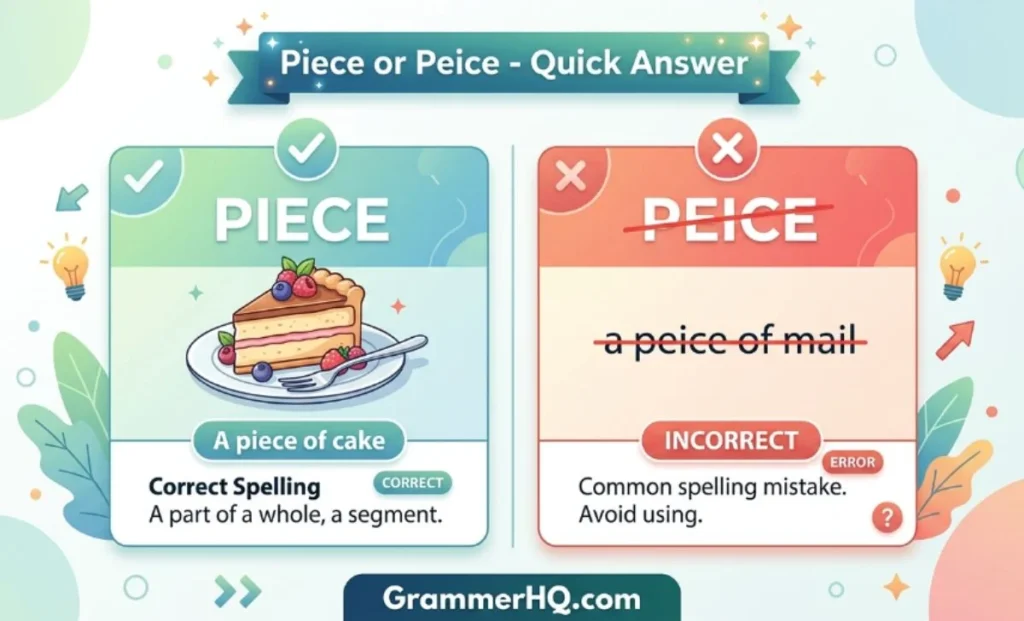
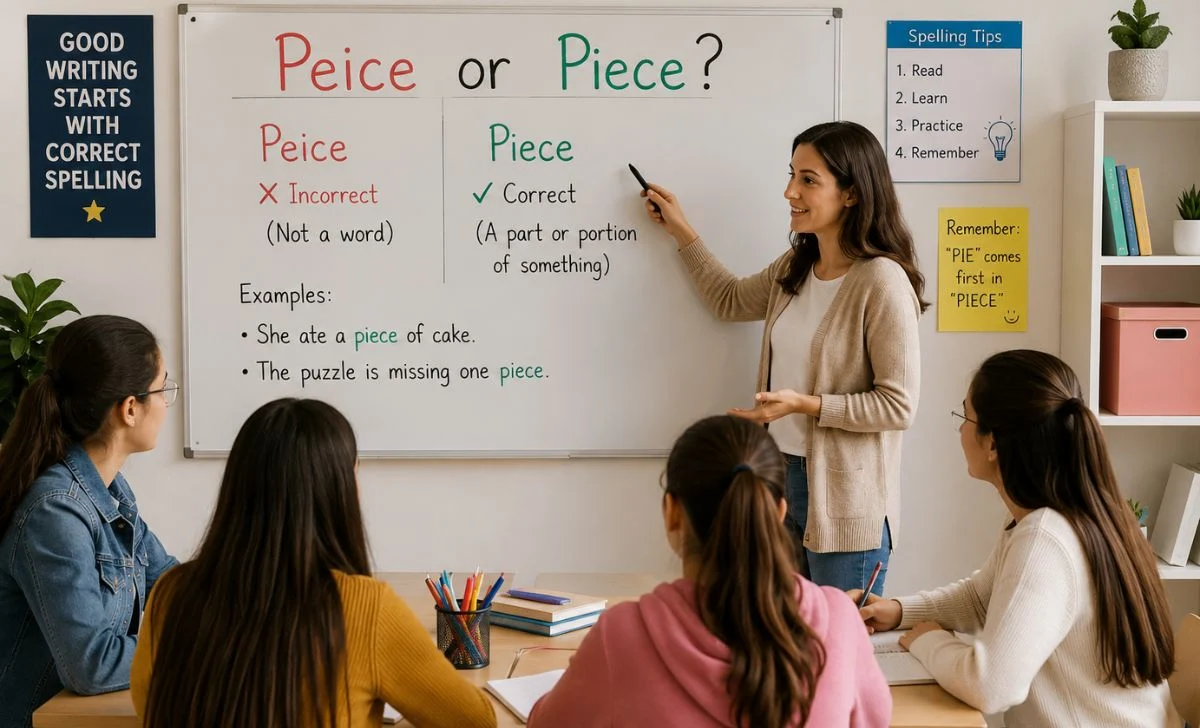
The correct spelling is piece.
Peice is a misspelling and is not accepted in standard English.
✅ Correct: Please give me a piece of cake.
❌ Incorrect: Please give me a peice of cake.
The word piece means a part, portion, object, item, or section of something.
Examples:
- I ate a piece of pizza.
- She bought a beautiful piece of art.
- The puzzle is missing one piece.
- He shared an interesting piece of news.
If you are writing in formal, academic, professional, or everyday English, always use piece.
Pronunciation of Peice or Piece

The word piece is pronounced:
/pees/
It sounds exactly like the word peace.
Phonetic pronunciation:
Piece = PEES
Examples:
- piece of cake → pees of cake
- puzzle piece → puzzle pees
Many people become confused because piece and peace sound identical. These words are called homophones. Homophones are words that share the same pronunciation but have different meanings and spellings.
Examples:
| Word | Meaning |
|---|---|
| Piece | A part or portion |
| Peace | Calm, harmony, absence of conflict |
Example:
- I need one more piece of the puzzle.
- The countries signed a peace agreement.
Although they sound alike, their meanings are completely different.
Why People Confuse Peice or Piece

Several reasons explain why writers mix up these spellings.
1. Letter Reversal
The biggest reason is the position of the letters i and e.
Many people accidentally type:
peice
instead of
piece
because the letters appear in reverse order.
2. Fast Typing Habits
Modern typing often happens quickly on phones, tablets, and computers. While typing fast, writers may unintentionally reverse letters.
3. The “I Before E” Rule
English learners often remember the famous rule:
“I before E except after C.”
However, remembering exactly where the letters belong can still be difficult.
Since piece follows this rule, many people second-guess themselves.
4. Similar Sound
Because pronunciation does not reveal spelling, hearing the word alone provides no clue about letter order.
5. English Spelling Complexity
English contains many irregular spellings. Words like their, weird, receive, and friend often confuse learners, making mistakes like peice common.
Easy Trick to Remember Peice or Piece

A simple mnemonic can help.
Memory Trick:
A piece of pie starts with PIE.
Notice:
PIEce
The word pie appears at the beginning of piece.
Since most people can easily remember “pie,” this trick helps preserve the correct order.
Another trick:
Piece follows “I before E.”
Remember:
P-I-E-C-E
Never write:
P-E-I-C-E
Visual reminder:
✅ P I E C E
❌ P E I C E
Using these memory tricks consistently will help you avoid future spelling mistakes.
The Origin of Peice or Piece
The word piece has a long history.
It originated from the Old French word piece, meaning “part, portion, or fragment.”
During the Middle Ages, English borrowed many words from French after the Norman Conquest of England in 1066.
Over time, the spelling remained largely unchanged.
Historical timeline:
- Old French: piece
- Middle English: pece or piece
- Modern English: piece
Because the word entered English from French, its spelling reflects historical language influences rather than simple phonetic rules.
The spelling peice has never been recognized as the standard form in major dictionaries.
Leading dictionaries, including those published by organizations such as the Merriam-Webster and the Oxford University Press, list only piece as correct.
British English vs American English Spelling
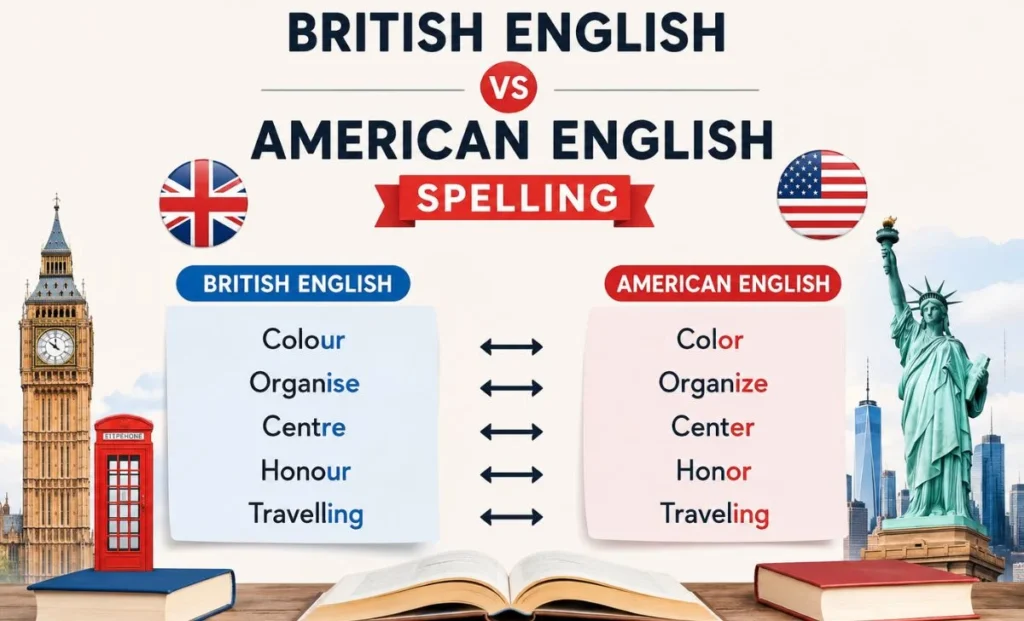
Unlike many English words, piece has identical spelling in both British and American English.
There is no regional variation.
Comparison Table
| Feature | British English | American English |
|---|---|---|
| Correct spelling | piece | piece |
| Incorrect spelling | peice | peice |
| Pronunciation | /pees/ | /pees/ |
| Meaning | Part or portion | Part or portion |
Examples:
British English:
- I would like a piece of cheese.
American English:
- Please send me a piece of the report.
Both varieties use exactly the same spelling.
This consistency makes the word easier compared with variations such as:
| British | American |
|---|---|
| colour | color |
| organise | organize |
| travelling | traveling |
Fortunately, piece never changes.
Which Spelling Should You Use?
The answer is simple.
Always use piece.
Audience recommendations:
For U.S. Readers
Use piece.
For U.K. Readers
Use piece.
For Canada, Australia, and New Zealand
Use piece.
For International Audiences
Use piece.
No English-speaking country recognizes peice as standard spelling.
Whether you write emails, essays, blog posts, social media updates, or business reports, always choose piece.
Common Mistakes with Peice or Piece
Below are frequent mistakes writers make.
| Incorrect | Correct |
|---|---|
| peice of cake | piece of cake |
| art peice | art piece |
| peice of information | piece of information |
| one peice missing | one piece missing |
| puzzle peice | puzzle piece |
Sentence corrections:
❌ She bought an art peice.
✅ She bought an art piece.
❌ I need one more peice.
✅ I need one more piece.
❌ Please attach a peice of evidence.
✅ Please attach a piece of evidence.
Avoid relying entirely on spellcheck because proofreading remains important.
Peice or Piece in Everyday Examples
Understanding real-world usage helps reinforce correct spelling.
In Emails
Correct:
“Could you send me a piece of the presentation?”
Incorrect:
“Could you send me a peice of the presentation?”
In News Writing
Journalists often write:
“The newspaper published a detailed piece on climate change.”
In Social Media
Examples:
- What a beautiful piece of music!
- This piece of advice changed my life.
- I finally completed the last puzzle piece.
In Academic Writing
- This research paper provides an important piece of evidence.
- The article contains a valuable piece of information.
In Everyday Conversation
- May I have another piece of bread?
- That was an inspiring piece of art.
Peice or Piece – Google Trends & Usage Data
Search behavior shows that many people regularly type peice or piece into search engines.
The majority of searches come from countries where English is widely spoken, including:
- United States
- United Kingdom
- Canada
- Australia
- India
The reason is simple: spelling confusion.
Google search data also shows that users commonly search:
- Is peice correct?
- How do you spell piece?
- Piece meaning
- Piece vs peace
- Correct spelling of piece
Educational websites, grammar blogs, teachers, and students frequently discuss this topic because spelling accuracy remains essential in professional communication.
In modern digital communication, even small spelling mistakes can affect credibility.
Comparison Table: Peice vs Piece
| Feature | Piece | Peice |
|---|---|---|
| Correct spelling | Yes | No |
| Dictionary accepted | Yes | No |
| Used in formal writing | Yes | No |
| Used in academic writing | Yes | No |
| Used worldwide | Yes | No |
| Recommended spelling | Yes | Never |
FAQs
Is peice ever correct?
No. Peice is always considered a spelling error.
Why do people write peice instead of piece?
People often reverse the letters i and e while typing or spelling.
Is piece the same as peace?
No. They sound the same but have different meanings.
How do you pronounce piece?
Piece is pronounced /pees/.
Do British people spell piece differently?
No. British and American English both use piece.
What part of speech is piece?
The word piece is usually a noun.
Example:
“I need a piece of paper.”
Is piece a commonly misspelled word?
Yes. It is one of the most frequently misspelled English words.
Conclusion
The confusion between peice or piece is extremely common, but the answer is simple: piece is always correct, while peice is always wrong.
The mistake usually happens because writers reverse the letters i and e or type too quickly. Thankfully, remembering the phrase “PIE comes first in piece” makes the spelling much easier to recall.
Both British and American English use the same spelling, so you never need to change it for different audiences.
Whether you are writing an email, school assignment, social media post, or business document, choosing piece will ensure your writing remains clear, professional, and grammatically correct.

Hi, I’m Amelia Parker, a grammar enthusiast and writer at GrammarHQ.com. I specialize in explaining spelling differences, confusing words, and common English mistakes through simple, practical, and easy-to-understand guides.