Imagine you’re about to send an important email or post a message online. You type, “Thank you for your curtesy,” hit send, and move on.
Later, your spell checker highlights the word, leaving you wondering whether you made a mistake. If you’ve ever found yourself choosing between curtesy or courtesy, you’re not alone.
Thousands of English learners, students, and even native speakers search for this spelling every month because the two words sound almost identical.
Here’s the quick answer: courtesy is the correct spelling, while curtesy is simply a common misspelling in modern English. The confusion happens because the first syllable of courtesy is often pronounced softly, making it easy to hear it as “cur.”
In this guide, you’ll discover the correct spelling, meaning, pronunciation, real-life examples, common mistakes to avoid, memory tricks, and the difference between curtesy and courtesy. By the end, you’ll know exactly which word to use and never hesitate over this spelling again.
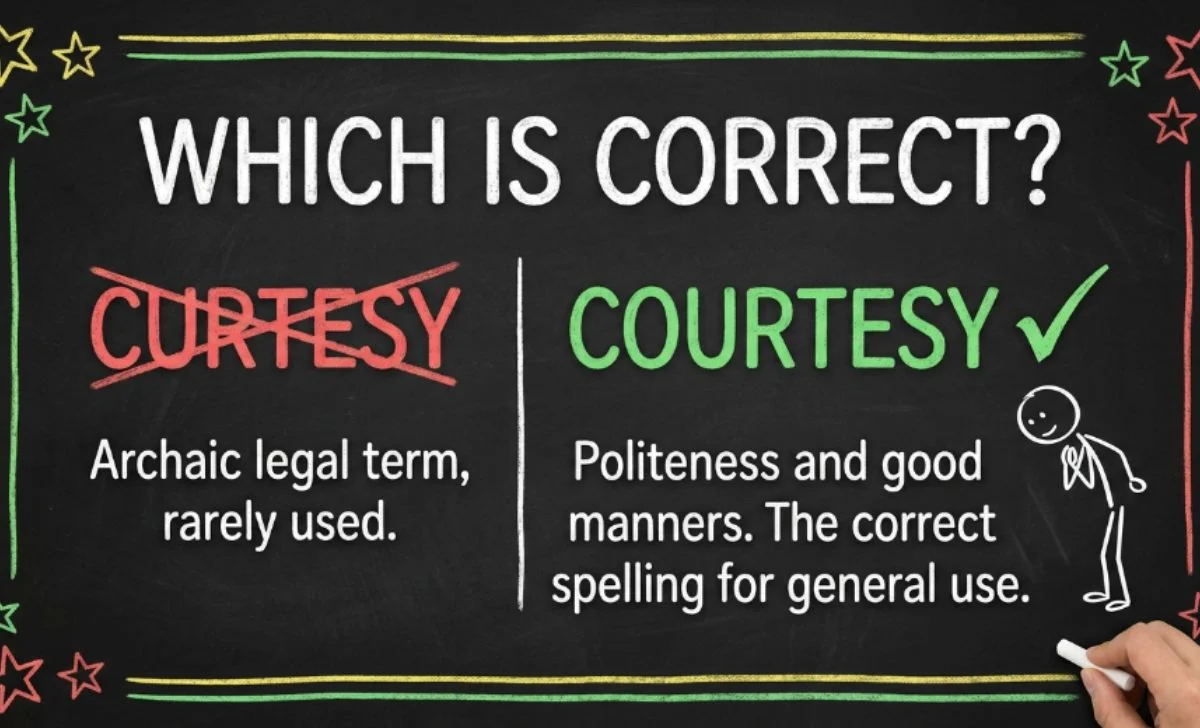
If you’ve ever wondered whether curtesy or courtesy is correct, the short answer is simple: courtesy is the correct spelling in almost every modern writing situation.
Many people accidentally type curtesy because the two words sound similar, and English spelling can be confusing. Spell checkers usually correct the mistake, but it still appears in emails, school assignments, business writing, and social media.
In this guide, you’ll learn the correct spelling, pronunciation, meaning, common mistakes, word history, practical examples, and easy memory tricks. Whether you’re a student, writer, professional, or English learner, this article will help you use the right word with confidence.
Curtesy or Courtesy – Quick Answer
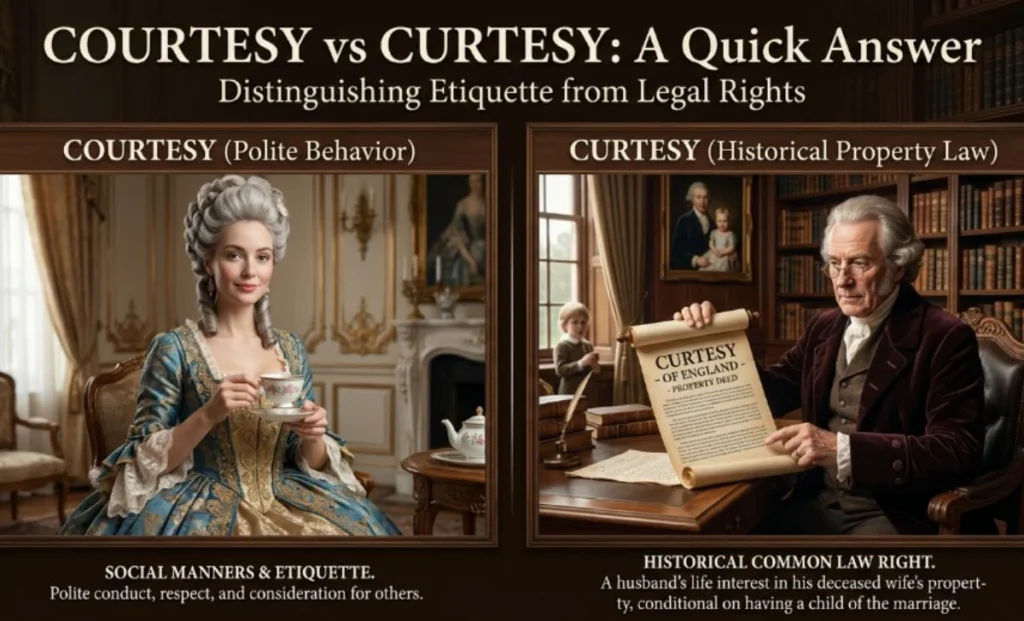
The correct spelling is courtesy.
People use courtesy to describe polite behavior, respect, kindness, or good manners. It is the standard spelling used in schools, workplaces, books, newspapers, and everyday English.
The spelling curtesy is incorrect when referring to politeness. Most people write it by mistake because they pronounce the word quickly or spell it the way it sounds.
Correct Examples
She thanked everyone for their courtesy.
Please show courtesy to other passengers.
It is common courtesy to reply to an invitation.
Incorrect Examples
Thank you for your curtesy.
Please show some curtesy.
We appreciate your curtesy.
Quick Comparison
| Word | Correct? | Meaning |
|---|---|---|
| Courtesy | ✅ Yes | Politeness, respect, good manners |
| Curtesy | ❌ Usually No | Common misspelling of courtesy (except a rare historical legal term) |
Featured Snippet Answer:
Courtesy is the correct spelling for polite behavior or respect. Curtesy is usually a misspelling, although it also exists as an old legal term that is rarely used today.Table of Contents
- Curtesy or Courtesy – Quick Answer
- Pronunciation of Curtesy or Courtesy
- Is “Curtesy” a Real Word?
- Why People Confuse Curtesy and Courtesy
- Easy Trick to Remember Courtesy
- The Origin of Courtesy
Pronunciation of Curtesy or Courtesy
The correct pronunciation of courtesy is:
IPA
UK: /ˈkɜː.tə.si/
US: /ˈkɝː.t̬ə.si/
Easy Phonetic Spelling
KUR-tuh-see
It has three syllables:
KUR + tuh + see
Many learners mistakenly think the middle sound should produce the spelling curtesy, but English spelling doesn’t always match pronunciation. The written form has “te”, even though it sounds like “tuh.”
Say it Naturally
✔ “Thank you for your courtesy.”
✔ “She treated everyone with courtesy.”
Pronunciation Tip
Remember that pronunciation does not determine spelling in English. Even though courtesy sounds similar to curtesy, only courtesy is correct for polite behavior.
Is “Curtesy” a Real Word?
This is one of the most common questions people ask.
Yes—but not in the way most people think.
When people search “Is curtesy a word?”, they usually want to know whether it’s the correct spelling of courtesy.
The answer is:
No. If you mean politeness, respect, or good manners, you should always write courtesy.
However, curtesy does exist as a historical legal term. In old English law, curtesy referred to a husband’s legal right to use his deceased wife’s property under specific conditions. This meaning is now obsolete in everyday English and rarely appears outside legal history.
Modern Usage
| Meaning | Correct Word |
|---|---|
| Good manners | ✅ Courtesy |
| Polite behavior | ✅ Courtesy |
| Respect | ✅ Courtesy |
| Historical legal right | ✅ Curtesy (rare legal term only) |
Should You Ever Use “Curtesy”?
Only if you’re discussing historical property law or reading old legal documents.
For everyday writing, emails, business communication, academic work, and conversations, courtesy is always the correct choice.
Why People Confuse Curtesy and Courtesy
The confusion between curtesy and courtesy is easy to understand. Several factors make this one of the most common English spelling mistakes.
1. They Sound Almost the Same
When spoken naturally, courtesy is pronounced KUR-tuh-see. Since the middle sound is weak, many people assume the word should be spelled curtesy.
2. English Spelling Is Not Always Phonetic
English contains many words whose spelling doesn’t exactly match their pronunciation.
For example:
- Wednesday
- Business
- Separate
- Courtesy
Because of this, writers often spell words the way they hear them.
3. Fast Typing
Many spelling mistakes happen while typing quickly. The letters “te” are easily replaced with “t”, creating curtesy.
4. Lack of Exposure
People who rarely see the word in books, articles, or professional writing are more likely to rely on pronunciation instead of remembering the correct spelling.
Expert Tip
Whenever you’re writing about kindness, respect, manners, or polite behavior, pause for a second and check that you’ve written courtesy, not curtesy.
Easy Trick to Remember Courtesy
A simple memory trick can help you remember the correct spelling forever.
Memory Trick
Think of the word Court.
People at a royal court were expected to behave politely and respectfully.
Court → Courtesy
Both words begin with COUR.
That makes it easy to remember that the correct spelling is courtesy, not curtesy.
Another Easy Reminder
Ask yourself:
“Am I talking about good manners?”
If the answer is yes, write courtesy.
Quick Memory Box
✅ COUR = Court = Courtesy = Polite behavior
❌ CUR = Wrong spelling for everyday English
This small trick helps students, professionals, and English learners avoid the mistake every time.
The Origin of Courtesy
The word courtesy has a long history that explains both its meaning and spelling.
It comes from the Old French word courtoisie, meaning politeness, good manners, or behavior suitable for a royal court. That word was derived from court, referring to the king’s or queen’s court, where respectful behavior was expected.
After entering Middle English, the spelling gradually evolved into the modern form courtesy, while keeping its connection to respectful and considerate behavior.
This history also explains why the word begins with COUR- rather than CUR-. Its spelling reflects its origin from court, not the way it sounds in modern speech.
Today, courtesy continues to mean showing kindness, respect, and consideration toward others in everyday life, professional settings, and formal communication.
British English vs American English Spelling
One common question is whether courtesy is spelled differently in British and American English.
The answer is simple:
No. Both British English and American English use the spelling courtesy. There is no regional spelling difference for this word.
This is different from words such as:
| American English | British English |
|---|---|
| Color | Colour |
| Honor | Honour |
| Center | Centre |
| Organize | Organise (also accepted in UK) |
For courtesy, the spelling stays exactly the same everywhere.
Comparison Table
| Feature | American English | British English |
|---|---|---|
| Correct spelling | Courtesy | Courtesy |
| Accepted in schools | ✅ Yes | ✅ Yes |
| Used in business writing | ✅ Yes | ✅ Yes |
| Used in newspapers | ✅ Yes | ✅ Yes |
| Is Curtesy correct? | ❌ No | ❌ No |
Important Note
Some people believe curtesy is the British spelling. This is not true.
Whether you are writing for readers in the United States, the United Kingdom, Canada, Australia, New Zealand, or anywhere else, courtesy is the correct spelling.
Which Spelling Should You Use?
If your meaning is politeness, respect, kindness, or good manners, always use courtesy.
It is the standard spelling accepted in:
- Academic writing
- Business emails
- Professional reports
- Newspapers
- Books
- Websites
- Social media
- Everyday communication
Audience-Based Advice
| Audience | Recommended Spelling |
|---|---|
| United States | ✅ Courtesy |
| United Kingdom | ✅ Courtesy |
| Canada | ✅ Courtesy |
| Australia | ✅ Courtesy |
| International English | ✅ Courtesy |
| English learners | ✅ Courtesy |
When Can You Use “Curtesy”?
Only in one rare situation:
When discussing the historical legal term curtesy, which referred to a husband’s property rights under old English common law.
For almost every modern writing situation, courtesy is the only correct choice.
Professional Tip: If you’re unsure, choose courtesy. It is correct in virtually every context.
Curtesy vs Courtesy – Comparison Table
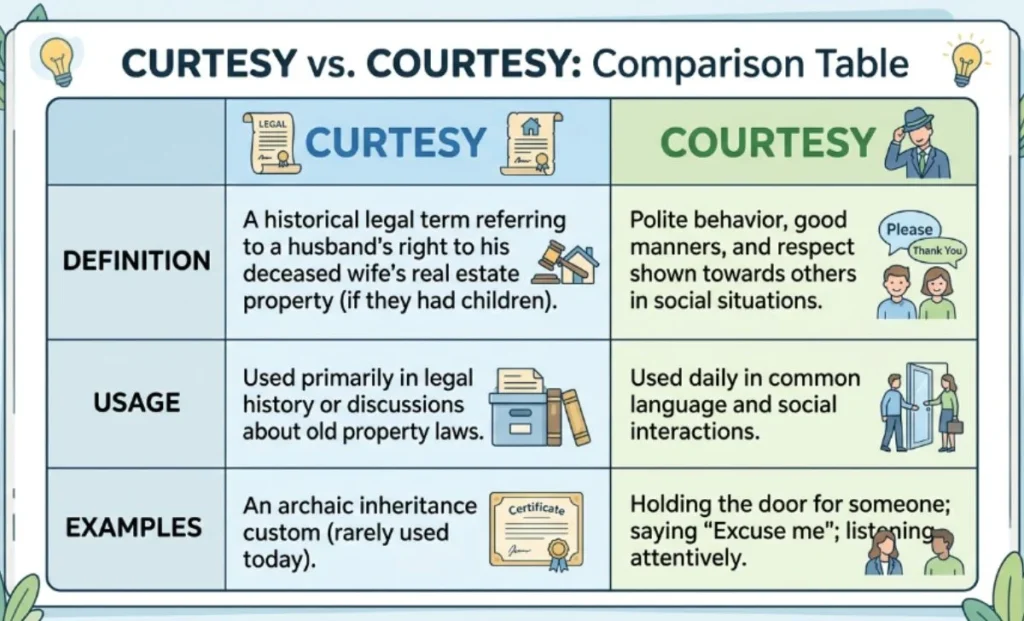
| Feature | Courtesy | Curtesy |
|---|---|---|
| Correct modern spelling | ✅ Yes | ❌ No (except historical legal use) |
| Meaning | Politeness, respect, good manners | Historical legal term |
| Everyday English | ✅ Yes | ❌ No |
| Business writing | ✅ Yes | ❌ Never |
| Academic writing | ✅ Yes | ❌ Never |
| Emails | ✅ Yes | ❌ No |
| Social media | ✅ Yes | ❌ No |
| Professional documents | ✅ Yes | ❌ No |
| Dictionary status | Modern English word | Rare historical legal word |
Quick Summary
If you’re writing about kindness or respectful behavior, choose courtesy every time.
Common Mistakes with Curtesy or Courtesy

Many writers make the same spelling mistakes because they rely on pronunciation instead of the correct spelling.
Here are the most common errors.
| Incorrect | Correct |
|---|---|
| Thank you for your curtesy. | Thank you for your courtesy. |
| Please show some curtesy. | Please show some courtesy. |
| We appreciate your curtesy. | We appreciate your courtesy. |
| Basic curtesy is important. | Basic courtesy is important. |
| Customer curtesy matters. | Customer courtesy matters. |
Why These Mistakes Happen
- Spelling by sound instead of memory.
- Typing too quickly.
- Not seeing the correct spelling often enough.
- Assuming every spoken sound matches its written form.
Proofreading Tip
Before sending an email or publishing an article, search your document for curtesy. If you find it, replace it with courtesy unless you’re discussing historical legal terminology.
Curtesy or Courtesy in Everyday Examples
Learning through real-life examples makes the correct spelling easier to remember.
In Emails
✅ Thank you for your courtesy during our meeting.
✅ We appreciate your courtesy and prompt response.
In Business Writing
✅ Customer courtesy improves the company’s reputation.
✅ Professional courtesy helps build strong workplace relationships.
In Schools
✅ Students should treat teachers with courtesy.
✅ Showing courtesy creates a positive learning environment.
In Social Media
✅ A little courtesy goes a long way online.
✅ Please reply with courtesy, even if you disagree.
Word Forms Related to Courtesy
Understanding the word family helps improve both your vocabulary and your writing.
| Word | Part of Speech | Meaning |
|---|---|---|
| Courtesy | Noun | Politeness and respectful behavior |
| Courteous | Adjective | Polite and respectful |
| Courteously | Adverb | In a polite manner |
| Discourtesy | Noun | Rude or impolite behavior |
| Discourteous | Adjective | Not polite |
| Discourteously | Adverb | In an impolite way |
Examples
- The receptionist was courteous to every visitor.
- She answered the email courteously.
- His discourtesy upset the customer.
- It was discourteous to interrupt the speaker.
Synonyms and Antonyms of Courtesy
Knowing similar and opposite words helps you choose the best expression for different situations.
Synonyms
- Politeness
- Respect
- Civility
- Good manners
- Kindness
- Consideration
- Thoughtfulness
- Graciousness
- Respectfulness
- Decency
Antonyms
- Rudeness
- Impoliteness
- Disrespect
- Discourtesy
- Incivility
- Harshness
- Insolence
Example
Instead of writing:
He showed great courtesy.
You could also write:
He showed great respect.
or
He treated everyone with politeness.
Grammar & Proofreading Tips
Correct spelling is important because it makes your writing look more professional and trustworthy.
Follow these simple tips:
✅ Think About the Meaning
If you’re talking about good manners or respect, the correct word is courtesy.
✅ Remember the “COUR” Pattern
The spelling begins with COUR, just like court, which reflects the word’s historical origin.
✅ Don’t Trust Pronunciation Alone
Many English words are not spelled exactly as they sound. Always check the spelling if you’re unsure.
✅ Use Spell Check
Most writing tools will flag curtesy as a spelling mistake in everyday writing. Review suggested corrections before publishing.
✅ Read Your Writing One More Time
A quick proofreading pass can catch small spelling errors that automatic tools sometimes miss, especially in names or specialized contexts.
Key Takeaways
- ✅ Courtesy is the correct spelling for politeness and good manners.
- ❌ Curtesy is usually a misspelling in modern English.
- ✅ There is no difference between British and American English for this word.
- ✅ The only exception is the rare historical legal term curtesy.
- ✅ Using the correct spelling makes your writing clearer, more professional, and easier to understand.
Where Is This Keyword Most Popular?
Searches commonly come from countries where English is widely spoken or learned, including:
| Country | Common Search Intent |
|---|---|
| United States | Correct spelling and usage |
| United Kingdom | Grammar and writing help |
| Canada | Spelling confirmation |
| Australia | Meaning and examples |
| India | English learning |
| Pakistan | Grammar and spelling |
| Philippines | Student assignments |
| Nigeria | English writing practice |
Why Do People Search for This Keyword?
People usually want to know:
- Is curtesy a real word?
- Which spelling is correct?
- How do you spell courtesy?
- What does courtesy mean?
- How do you use courtesy in a sentence?
- Is curtesy acceptable in British English?
Understanding these questions helps writers create content that answers real user needs rather than simply defining a word.
Expert Writing Advice
If you want your writing to sound professional, always choose courtesy when referring to politeness, respect, or good manners.
Whether you’re writing:
- Emails
- Job applications
- Academic essays
- Business reports
- Blog posts
- Social media captions
using the correct spelling improves clarity and credibility.
Best Practices
- ✔ Double-check commonly confused words before publishing.
- ✔ Read your work aloud during proofreading.
- ✔ Use grammar and spell-check tools as a second review, not your only review.
- ✔ Build a habit of reading quality English content to reinforce correct spelling naturally.
Remember, small spelling mistakes can leave a poor impression, while accurate writing builds trust with your readers.
FAQs
1. Is it curtesy or courtesy?
The correct spelling is courtesy. Curtesy is a common misspelling and should not be used in standard English writing. Courtesy means politeness, respect, or a courteous act.
2. Why do people spell courtesy as curtesy?
Many people write curtesy because the pronunciation of courtesy can make it sound like it starts with “cur.” It’s simply a spelling mistake and is not accepted in dictionaries.
3. What does courtesy mean?
Courtesy refers to polite behavior, respect, or consideration for others. It can also mean something given free of charge as a gesture of goodwill.
4. Is curtesy a real English word?
No. Curtesy is generally considered a misspelling of courtesy. In modern English, you should always use courtesy in writing and communication.
5. How can I remember the correct spelling of courtesy?
Remember that courtesy starts with “cour-“, just like court. Think of showing respect and good manners in a court—courtesy is always spelled with “cour”, not “cur.”
Conclusion
If you’re unsure whether to write curtesy or courtesy, remember this simple rule: courtesy is the correct spelling for politeness, respect, and good manners.
Although curtesy exists as an old legal term, it is rarely used today and should not replace courtesy in everyday writing.
Understanding the word’s pronunciation, history, and common mistakes makes it much easier to remember the correct spelling. Whether you’re writing an email, school assignment, business document, or social media post, choosing courtesy helps your writing appear accurate and professional.
When in doubt, think of the word court—its shared beginning with courtesy is an easy memory trick that can help you avoid this common spelling mistake every time.
Read More Bloogs:
Successful or Succesful: Which Spelling Is Correct?
Buffalo or Bison? The One Difference Most People Never Notice