
If you are searching for Buoy or Bouy, the correct spelling is buoy. The spelling bouy is a common mistake, but it is not the standard English form.
A buoy is usually a floating object placed in water to mark a channel, warn boats about danger, identify a location, or guide vessels safely.
The word can also be used as a verb, meaning to support, encourage, or help keep something afloat. Its unusual spelling can be confusing because its pronunciation does not always make the letter order easy to remember.
In this guide, you will learn the correct spelling, meaning, pronunciation, plural and verb forms, common mistakes, and practical examples so you can use buoy confidently in your writing.
Quick Answer
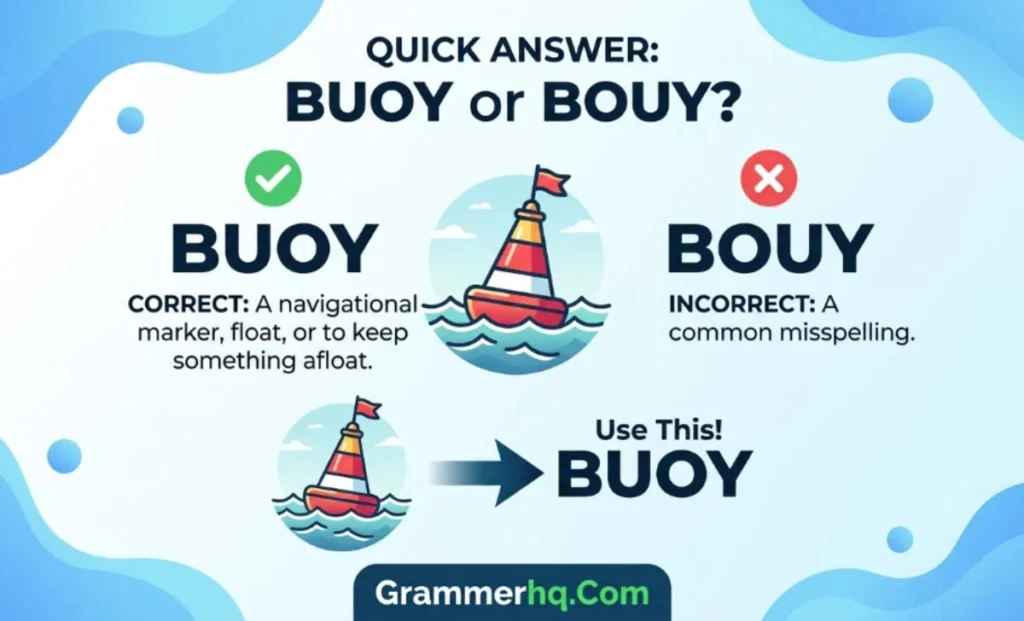
Buoy is correct.
Bouy is incorrect.
| Word | Status | Meaning |
|---|---|---|
| Buoy | ✅ Correct | A floating object used in water; also a verb |
| Bouy | ❌ Incorrect | A misspelling of buoy |
Correct: The boat passed the red buoy.
Incorrect: The boat passed the red bouy.
The spelling to remember is:
B-U-O-Y
The U comes before the O.
What Does Buoy Mean?
Buoy has two important uses in English: it can be a noun or a verb.
Buoy as a Noun
As a noun, a buoy is a floating object placed in water to mark locations, guide boats, or warn about possible danger. Oxford describes it as an object floating on the sea or a river that can mark places where it is dangerous or safe for boats to travel.
You may see a buoy used to:
- mark a navigation channel
- warn boats about hazards
- identify a safe area
- mark a swimming area
- indicate a location on the water
- assist with marine navigation
For example:
The captain slowed the boat as it approached the buoy.
Here, buoy refers to a physical floating marker.
Buoy as a Verb
Buoy can also function as a verb.
It can mean to:
- keep someone or something from sinking
- make someone feel happier or more confident
- support something and help it become more successful
For example:
The life jacket helped buoy the swimmer.
Her team’s victory buoyed her confidence.
Strong demand buoyed the local business.
The last two examples have nothing to do with a floating object. That figurative use is an important part of understanding the word.
Why Is “Bouy” Wrong?
The most common mistake is simply putting the vowels in the wrong order.
The correct spelling is:
B-U-O-Y
The common misspelling is:
B-O-U-Y
Because bouy looks plausible, it is an easy typing or spelling error. Pronunciation can make the problem worse, since the spoken word does not give every reader an obvious clue about the unusual U-O sequence.
But bouy is not an alternative spelling of buoy.
When you mean the standard English word, write buoy.
How Do You Spell Buoy?
Spell it:
B-U-O-Y
A simple memory aid is:
BU + OY = BUOY
Another useful connection is the related word buoyancy.
Think:
buoy → buoyant → buoyancy
The same buoy spelling appears at the beginning of these related words.
You do not need to memorize a complicated rule. Just remember:
BUOY has U before O.
How Do You Pronounce Buoy?
This is one reason the spelling can feel strange.
Cambridge lists /bɔɪ/ for UK English and US English, and also lists /ˈbuː.i/ as a US pronunciation.
So you may hear buoy pronounced roughly like:
- “boy”
- “BOO-ee”
The pronunciation can vary, but the spelling does not change.
That is an important distinction: different pronunciation does not create a different spelling such as “bouy.”
Is Buoy Spelled Differently in American and British English?
No.
The standard spelling is:
American English: buoy
British English: buoy
There is no standard American spelling bouy and no standard British spelling bouy.
What can vary is pronunciation. Cambridge records more than one pronunciation for the word.
So whether you are writing for a US audience, UK readers, students, or an international audience, buoy is the spelling to use.
What Is the Plural of Buoy?
The plural of buoy is:
buoys
For example:
Several buoys marked the edge of the swimming area.
Do not write bouys.
The spelling remains based on the original word:
buoy → buoys
This is another place where remembering the original U-O order helps.
What Is the Past Tense of Buoy?
The past tense and past participle are:
buoyed
For example:
The encouraging news buoyed her spirits.
Cambridge identifies buoyed as the past simple and past participle of buoy.
The incorrect form is:
❌ bouyed
The correct form is:
✅ buoyed
What Is the -ing Form of Buoy?
The present participle is:
buoying
For example:
The strong sales are buoying the company’s outlook.
Cambridge lists buoying as the present participle of buoy.
So the main forms are:
| Form | Correct |
|---|---|
| Base form | buoy |
| Plural | buoys |
| Past tense | buoyed |
| Present participle | buoying |
Common incorrect forms include bouy, bouys, bouyed, and bouying.
Buoy vs. Float: Are They the Same?
Not quite.
Float is a broad term describing something remaining on or near the surface of water.
A buoy is a specific floating object that serves a purpose, such as marking a location, guiding vessels, or warning about danger. Oxford specifically describes a buoy as a floating object used to identify dangerous and safe areas for boats.
For example:
A piece of wood can float on the water.
But:
A buoy can mark the entrance to a channel.
So a buoy may float, but not everything that floats is a buoy.
Buoy in Real-Life Sentences
Seeing the word in different contexts makes its meaning easier to understand.
Marine and Navigation Examples
The sailor spotted a red buoy near the harbor.
The buoy marked the edge of the channel.
The boat passed between two buoys.
A warning buoy indicated a dangerous area.
Figurative Examples
The team’s victory buoyed everyone’s confidence.
The positive feedback buoyed her spirits.
Strong consumer demand buoyed the company’s sales.
These examples show the two sides of buoy: the physical object used on water and the verb used for support, encouragement, or improvement. Cambridge documents these different verb meanings.
Common Buoy Spelling Mistakes
Because the spelling is unusual, several related mistakes can appear.
| Incorrect | Correct |
|---|---|
| ❌ bouy | ✅ buoy |
| ❌ bouys | ✅ buoys |
| ❌ bouyed | ✅ buoyed |
| ❌ bouying | ✅ buoying |
The easiest way to avoid all four is to learn the base spelling first:
BUOY
Once buoy is correct, the other forms are much easier to build.
Buoy or Bouy: Quick Comparison
| Feature | Buoy | Bouy |
|---|---|---|
| Standard spelling | ✅ Yes | ❌ No |
| Floating water marker | ✅ Yes | ❌ No |
| Can be a verb | ✅ Yes | ❌ No |
| Plural | buoys | bouys ❌ |
| Past tense | buoyed | bouyed ❌ |
| -ing form | buoying | bouying ❌ |
| US/UK spelling | Same | Not standard |
FAQs
Is buoy or bouy correct?
Buoy is correct. Bouy is a misspelling.
Is bouy a word?
Bouy is not the standard spelling of the English word. Use buoy instead.
How do you spell buoy?
The correct spelling is B-U-O-Y.
How do you pronounce buoy?
Cambridge lists /bɔɪ/ in UK and US English and /ˈbuː.i/ as another US pronunciation.
What does buoy mean?
As a noun, a buoy is a floating object used in water, especially for marking locations, guiding boats, or warning of danger. As a verb, it can mean to keep something afloat, encourage someone, or support something.
What is the plural of buoy?
The plural is buoys.
What is the past tense of buoy?
The past tense is buoyed.
What is the -ing form of buoy?
The -ing form is buoying.
Is buoy the same in American and British English?
Yes. Buoy is the standard spelling in both. Pronunciation can vary between varieties of English.
Why do people spell buoy as bouy?
The unusual U-O letter order and the word’s pronunciation make the spelling easy to mix up. The correct form is buoy.
Final Answer
If you are choosing between buoy and bouy, use:
Buoy ✅
Not:
Bouy ❌
Buoy is the standard English spelling. It can refer to a floating object used for navigation or safety, and it can also be a verb meaning to keep something afloat, encourage someone, or support something.
The spelling to remember is simple:
B-U-O-Y
U before O — buoy, not bouy.
Read More Blogs
- Catalog or Catalogue: Which Spelling Is Correct?
- Paid or Payed: Which Is Correct? Meaning, Rules & Examples
- Sightseeing vs Siteseeing: The Correct Spelling Explained
- Thursdays vs Thursdays: What Is the Correct Form?