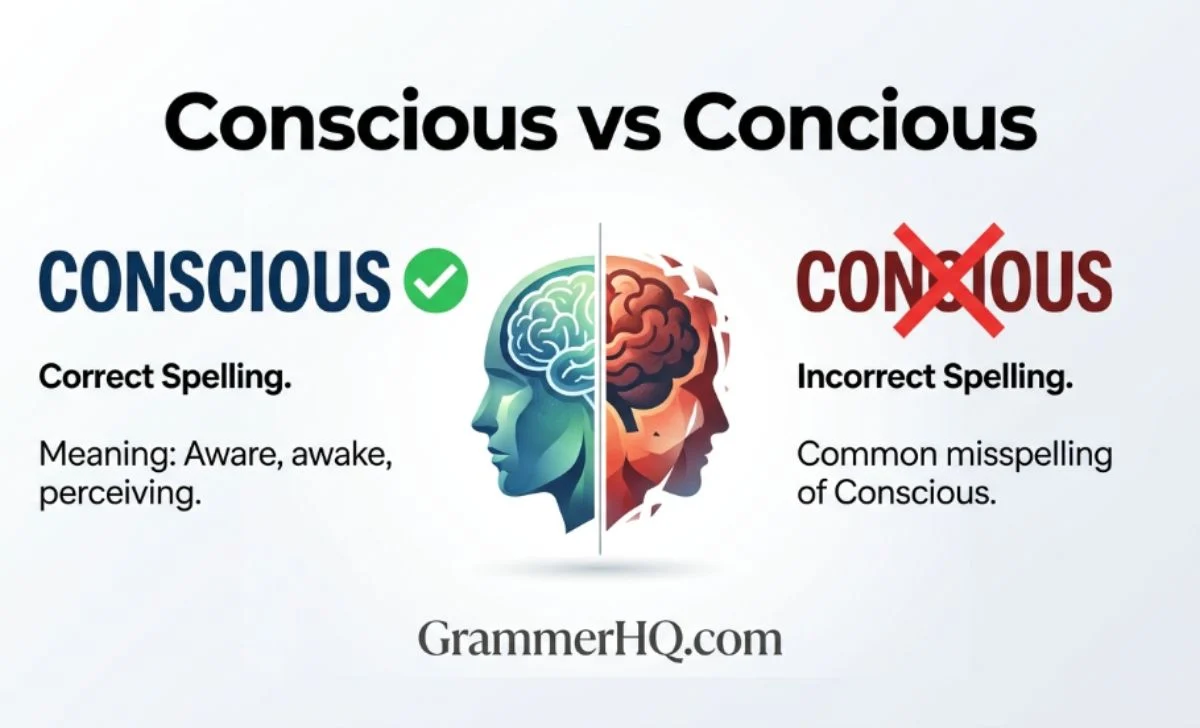
Conscious vs Concious is a common spelling question, but the answer is simple: conscious is correct, and concious is incorrect.
If you have ever wondered which spelling to use in an email, essay, report, or professional document, knowing this small difference can save you from an embarrassing spelling mistake.
The confusion comes from the unusual “sci” sequence in conscious, which is easy to overlook when writing quickly. Conscious means awake and aware, aware of something, or intentional in an action.
Concious has no standard use as the correct spelling of this word. In this guide, we will explain conscious vs concious, show their meanings and examples, and give you an easy way to remember the correct spelling every time.
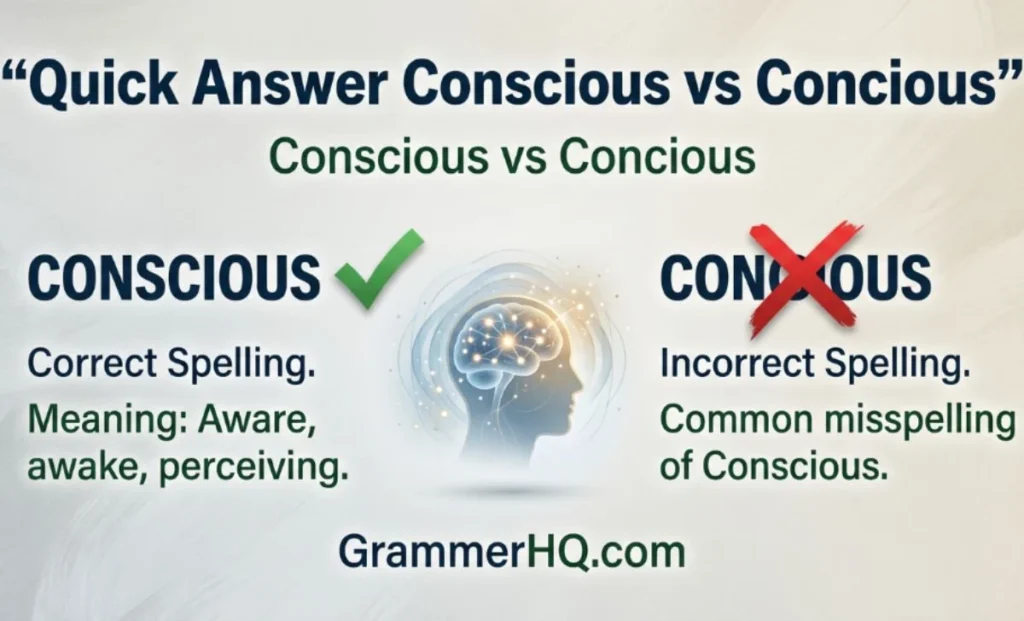
Quick Answer
| Spelling | Correct? | Meaning |
|---|---|---|
| Conscious | ✅ Correct | Awake, aware, or intentional |
| Concious | ❌ Incorrect | Common misspelling of conscious |
In short:
Conscious ✅
Concious ❌
There is no different meaning or regional spelling to choose between them. Instead, concious is simply the misspelled form of conscious.
What Does Conscious Mean?
Conscious is an adjective with several common uses. In everyday English, it can describe a person’s awareness, attention to something, or an intentional action. Cambridge and Oxford both recognize these major senses. (dictionary.cambridge.org)
1. Awake and aware
Someone who is conscious is awake, able to think, and aware of what is happening around them.
The driver was still conscious after the accident.
She was fully conscious when the doctor spoke to her.
This meaning is common when discussing an injury, illness, medical treatment, or loss of consciousness.
2. Aware of something
The word can also describe noticing or being aware of something.
I was conscious of the noise coming from upstairs.
She became conscious of everyone looking at her.
In particular, the pattern conscious of is common in both everyday and formal English. (dictionary.cambridge.org)
3. Intentional or deliberate
When something is a conscious decision, conscious choice, or conscious effort, it is done deliberately.
He made a conscious decision to spend less money.
She made a conscious effort to arrive early.
Therefore, conscious does not always mean “awake.” In this context, it means deliberate or intentional. (dictionary.cambridge.org)
How Do You Spell Conscious?
The correct spelling is:
C-O-N-S-C-I-O-U-S
The part that causes the most trouble is the middle:
con-SC-ious ✅
Not:
con-C-ious ❌
The missing s is what turns the correct spelling conscious into the common misspelling concious.
A useful way to remember it is to focus on the letter sequence “sci”:
con + sci + ous = conscious
Rather than relying only on pronunciation, remember that the s comes before the c.
Why Is “Concious” a Common Misspelling?
The pronunciation of conscious does not make every letter obvious. As a result, someone spelling the word from memory may leave out the s in the middle.
Fast typing can make the same mistake even easier to make.
Still, concious is not an alternative spelling. The standard English form is conscious.
Historically, the spelling also reflects the word’s Latin origin. Oxford traces conscious to Latin conscius, which helps explain the sc sequence found in the modern English word. (oxfordlearnersdictionaries.com)
Conscious in Real-Life Sentences
The word appears naturally in many everyday situations.
After the operation, the patient was conscious and able to answer questions.
For awareness, you might say:
I became conscious of the fact that everyone was waiting.
When describing deliberate action, this works well:
She made a conscious choice to stop checking her phone during work.
The word can also describe someone’s particular concern or interest:
He is very health-conscious and reads food labels carefully.
Similarly, it can describe a deliberate effort:
The company made a conscious effort to reduce waste.
These examples show the range of conscious in natural English, from physical awareness to deliberate decisions and compound adjectives. (dictionary.cambridge.org)
Conscious vs Conscience
Conscious is an adjective that means aware, awake, or knowing what is happening around you. It can also describe something done deliberately or intentionally.
Conscience is a noun that means your inner sense of right and wrong. It is the part of your mind that makes you feel guilty about doing something wrong or good about doing the right thing.
In simple terms:
- Conscious = aware or awake
- Conscience = your inner sense of right and wrong
Examples:
She was conscious of the noise outside.
(She was aware of it.)
His conscience would not let him lie.
(His sense of right and wrong stopped him.)
Easy Way to Remember
Think of conscious as awareness and conscience as morality.
Conscious → What you know or notice
Conscience → What you feel is right or wrong
Conscious, Consciously, and Consciousness
Several related words use the same spelling pattern.
Conscious
This is the adjective form.
She was conscious of the problem.
Consciously
This is the adverb form. It describes something done with awareness or intention.
He consciously avoided the subject.
Cambridge recognizes consciously as the adverb related to conscious. (dictionary.cambridge.org)
Consciousness
This is the noun form.
The patient regained consciousness after the accident.
The word can refer to being awake and aware, as well as awareness or understanding of something. (dictionary.cambridge.org)
Most importantly, the s remains in all three:
conscious
consciously
consciousness
Common Expressions With Conscious
You will often find conscious in phrases such as:
- conscious of something
- conscious decision
- conscious choice
- conscious effort
- health-conscious
- self-conscious
- environmentally conscious
- socially conscious
- fashion-conscious
For example:
She is environmentally conscious and tries to avoid unnecessary waste.
Another natural example is:
He made a conscious effort to listen carefully.
These compounds are established uses of conscious in modern English. Oxford lists forms such as health-conscious, environmentally conscious, socially conscious, and self-conscious. (oxfordlearnersdictionaries.com)
Common Mistakes With Conscious
The main spelling mistake is straightforward:
❌ concious
✅ conscious
The same missing s can appear in related words as well:
❌ conciously
✅ consciously
❌ conciousness
✅ consciousness
So, when checking any of these words, look for the sc sequence in the correct spelling.
Is “Concious” a Word?
No. Concious is not the standard spelling of an English word. It is a common misspelling of conscious.
For example:
❌ I was concious of the problem.
✅ I was conscious of the problem.
Therefore, if a spell checker flags concious, replace it with conscious.
Is Conscious American or British English?
Conscious is used in both American and British English.
Unlike spelling pairs such as organize/organise, this is not a regional spelling difference. Concious is not the British version of conscious, nor is it an American alternative.
The standard spelling in both varieties is:
conscious ✅
FAQs
1: Is conscious or concious correct?
Conscious is correct. Concious is a misspelling.
2: How do you spell conscious?
It is spelled C-O-N-S-C-I-O-U-S. Remember the s in the middle: conscious.
3: Is concious a word?
No. Concious is a common misspelling of conscious.
4: What does conscious mean?
It can mean awake and aware, aware of something, or deliberate and intentional.
5: What is the difference between conscious and conscience?
Conscious relates to awareness or intentional action, whereas conscience refers to a person’s moral sense of right and wrong.
6: What is the noun form of conscious?
The noun form is consciousness.
7: What is the adverb form of conscious?
The adverb form is consciously.
Final Answer
Conscious is the correct spelling. Concious is incorrect.
If you remember only one part of the word, remember the middle:
Whether you mean being awake, noticing something, or making a deliberate decision, the correct spelling is conscious.
Read More Blogs