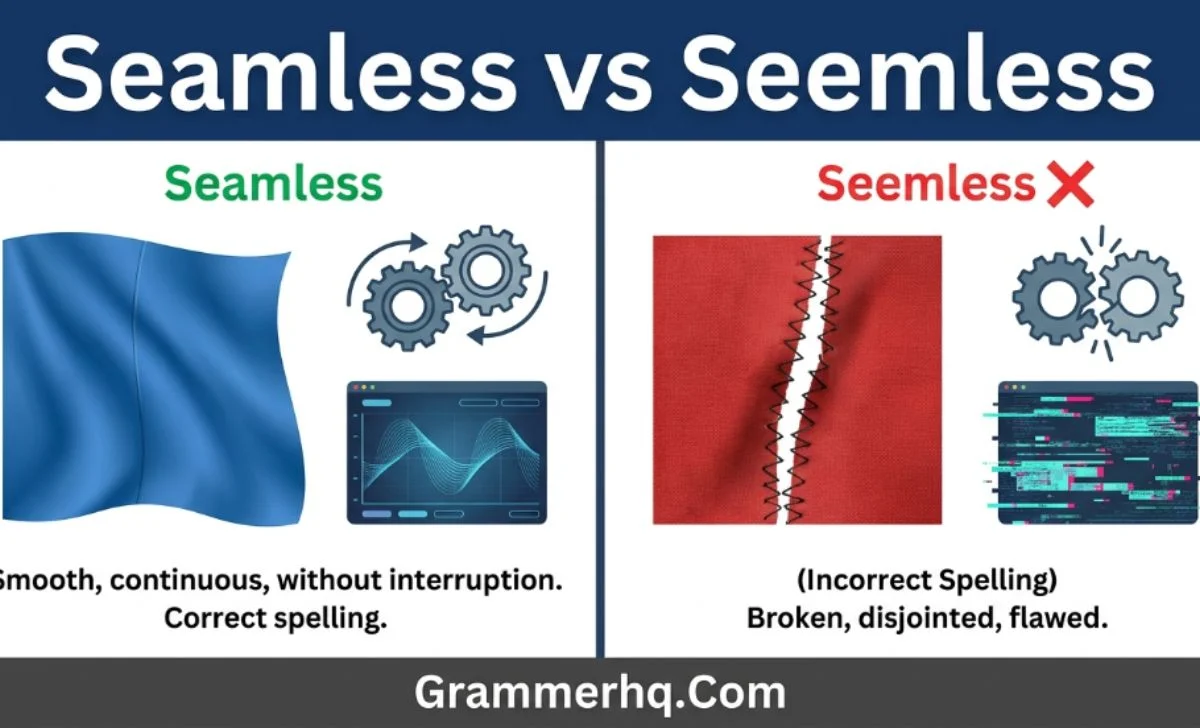
Seamless vs seemless? They sound almost exactly the same, but one spelling belongs in modern English when you mean smooth, uninterrupted, or perfectly connected.
The correct spelling is seamless. It describes something that has no visible seam or, more commonly today, something that happens without an obvious break, interruption, or awkward transition.
You might talk about a seamless transition, seamless integration, or seamless experience.But there is an interesting detail that makes this spelling question less straightforward than it first appears: seemless is an actual historical word.
It is recorded as an archaic adjective meaning “unseemly.” That is not the meaning people usually intend when they write seemless today.
So if you’re writing a modern email, essay, report, website, or business document, remember:
seam + less = seamless
Quick Answer
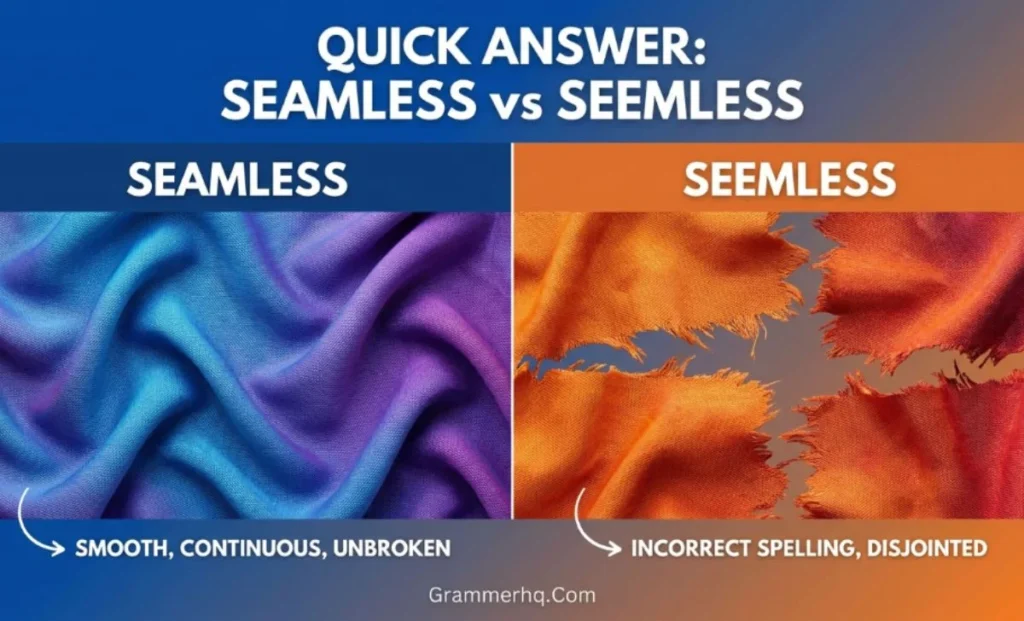
Seamless is the correct modern spelling when you mean smooth, continuous, uninterrupted, or without noticeable breaks.
Seemless is normally incorrect when used with that meaning. It survives in dictionaries as an archaic or obsolete word with a different meaning: unseemly.
| Word | Meaning | Modern use |
| seamless | Smooth, continuous, without a seam or noticeable break | ✅ Standard |
| seemless | Archaic: unseemly | ⚠️ Rare/historical |
For example:
The transition was seamless. ✅
Not:
The transition was seemless. ❌
The rule worth remembering
No seam = seamless.
That one connection can save you from making the same spelling mistake again.
What Does “Seamless” Mean?
Seamless is an adjective with two closely related meanings: a literal meaning and a figurative one.
Literal Meaning
Literally, seamless means having no seam.
A seam is the line where two pieces of fabric or material are joined. Something made without such a visible join can therefore be described as seamless.
For example:
She chose seamless clothing for the workout.
Here, seamless refers to the physical construction of the clothing.
Figurative Meaning
The figurative meaning is much more common in modern writing.
When something is seamless, separate parts connect or progress without a noticeable interruption, awkward change, or gap.
For example:
The company created a seamless transition to its new software.
The software does not have a literal seam. The word means that the change happened smoothly, without causing an obvious disruption.
This is why you see seamless so often in technology, business, customer service, design, education, and everyday communication.
What Does “Seemless” Mean?
Here’s the part many spelling articles overlook.
If you want to say that something is smooth or uninterrupted, seemless is not the modern spelling.
However, it would be inaccurate to say that seemless has never been a word.
Merriam-Webster records seemless as an archaic adjective meaning “unseemly.” Collins also identifies the word as obsolete. Its formation is different:
seem + -less
That historical meaning has little connection to the modern sense of seamless.
So:
- seamless → without a seam; smooth or uninterrupted
- seemless → archaic/obsolete; unseemly
If you’re writing modern English, seamless is the word you almost certainly need.
Why Do People Spell “Seamless” as “Seemless”?
The mistake makes sense once you hear the word aloud.
Seam and Seem Sound the Same
Seam and seem are homophones: they have the same pronunciation but different meanings and spellings.
Compare:
The dress has a visible seam.
with:
You seem tired.
A seam is a join.
To seem means to appear or give an impression.
When you hear seamless, the first syllable sounds like seem, which makes seemless look logical.
But pronunciation does not tell you which root produced the word.
The Correct Root Is “Seam”
The modern word is built from:
seam + -less
not:
seem + -less
That’s the key to the spelling.
Seam + Less: The Easiest Way to Remember It
You don’t need a complicated spelling rule.
Think about what a seam is.
A seam is a visible join between pieces of material. Add -less, meaning “without,” and you get:
seam + less = seamless
The same pattern appears in words such as:
- care + less = careless
- hope + less = hopeless
- power + less = powerless
- harm + less = harmless
- seam + less = seamless
So whenever you’re unsure, ask:
Does the word mean “without a seam” or, figuratively, “without a noticeable break”?
If yes, write seamless.
Seamless vs Seemless: Key Difference
The distinction becomes simple when you look at their roots and modern usage.
| Feature | Seamless | Seemless |
| Root | seam + -less | seem + -less |
| Standard modern word? | Yes | No, not for the usual meaning |
| Main meaning | Without seams; smooth or uninterrupted | Archaic: unseemly |
| Common today? | Very common | Extremely rare |
| Example | seamless transition | historical usage |
The important point is that these aren’t two modern spellings of the same word.
Seamless belongs to ordinary modern English.
Seemless belongs mainly to historical or dictionary contexts.
Seamless, Seamlessly, and Seamlessness
Knowing the related forms makes the spelling easier to retain.
Seamless
Seamless is an adjective.
The company delivered a seamless customer experience.
It describes a person, thing, process, transition, or experience.
Seamlessly
Seamlessly is the adverb.
The new system works seamlessly with the existing software.
It tells us how something happens.
Seamlessness
Seamlessness is the noun.
Customers appreciated the seamlessness of the checkout process.
It describes the quality or state of being seamless.
The word family is:
seam → seamless → seamlessly → seamlessness
Once you remember the root seam, these related forms become much easier to spell correctly.
Common Uses of “Seamless”
Modern English uses seamless far beyond clothing and fabrics.
Seamless Transition
The new manager made the leadership transition seamless.
The change happened without noticeable disruption.
Seamless Integration
The platform offers seamless integration with other business tools.
Different systems work together naturally.
Seamless Experience
The website gives customers a seamless shopping experience.
The customer can move through the process without unnecessary friction.
Seamless Workflow
Automation created a more seamless workflow for the team.
The different stages connect smoothly.
Seamless Communication
The new platform enables seamless communication between remote teams.
People can exchange information without unnecessary barriers.
Seamless Connection
The update provides a seamless connection between the phone and the vehicle.
The connection works without an obvious interruption.
Seamless Design
The designer created a seamless blend of modern and traditional elements.
The elements fit together naturally.
These collocations show how widely the figurative meaning has spread in contemporary English.
Seamless vs Smooth: What’s the Difference?
Smooth is the broader word.
You can describe a physical surface as smooth:
The table has a smooth finish.
You can also describe an event:
The meeting went smoothly.
Seamless, however, often emphasizes the connection between separate parts.
Compare:
The meeting went smoothly.
This means there were few problems.
The transition between the two teams was seamless.
This emphasizes that the change from one team to the other was barely noticeable.
The words can overlap, but they are not perfect substitutes.
Seamless vs Effortless: Are They the Same?
Not quite.
Effortless describes something that appears to require little effort.
She gave an effortless performance.
Seamless describes something that happens without noticeable breaks or awkward transitions.
The software provides a seamless user experience.
A process can look seamless even though a lot of work happened behind the scenes.
That distinction matters in professional writing because replacing one word with the other can subtly change the meaning.
Seamless vs Continuous
Continuous focuses on something continuing without stopping.
The machine produces a continuous stream of data.
Seamless focuses more on how naturally separate parts connect.
The application provides a seamless transition between devices.
A process may contain several separate stages and still be seamless if those stages connect without noticeable disruption.
Is “Seamless” American or British English?
Seamless is standard in both American and British English.
There is no US-versus-UK spelling change here.
So these are both correct:
- American English: seamless ✅
- British English: seamless ✅
You should not change seamless to seemless when writing for a British audience.
The pronunciation may be represented slightly differently in dictionary notation for US and UK speakers, but the spelling remains the same.
Common Spelling Mistakes With Seamless
Because seamless sounds like it begins with seem, several errors are easy to make.
1: Seemless Transition
❌ The company promised a seemless transition.
✅ The company promised a seamless transition.
2: Seemless Experience
❌ The app provides a seemless experience.
✅ The app provides a seamless experience.
3: Seemlessly
❌ The two systems work seemlessly together.
✅ The two systems work seamlessly together.
4: Seamlessy
❌ The process runs seamlessy.
✅ The process runs seamlessly.
The safest approach is not to memorize every possible mistake separately. Remember the root:
seam → seamless → seamlessly → seamlessness
Real-Life Examples of Seamless
Seeing the word in realistic situations makes its meaning much clearer.
Business
The handover between the two managers was seamless.
The new manager took over without creating noticeable disruption.
Technology
The app allows users to move seamlessly between their phone and laptop.
The experience remains connected across devices.
Education
The school created a seamless transition from online learning to classroom teaching.
The change between learning environments was smooth.
E-Commerce
Customers expect a seamless experience from browsing to checkout.
The stages of shopping should feel connected.
Travel
The new transport system makes connections between terminals more seamless.
The journey involves fewer awkward breaks.
Film
The editor created a seamless transition between the two scenes.
The change is difficult to notice.
Everyday Conversation
The conversation moved seamlessly from work to travel.
The subject changed naturally rather than abruptly.
These examples demonstrate why seamless is especially useful when several parts need to feel like one connected experience.
Is “Seemless” Ever Correct?
Yes but only in a very limited historical sense.
If you’re writing modern English and mean smooth, uninterrupted, or well connected, use seamless.
The word seemless is recorded in dictionaries as an archaic or obsolete adjective meaning unseemly. That means you may encounter it in historical writing or older language, but it is not the modern alternative spelling of seamless.
For example:
❌ We created a seemless checkout process.
✅ We created a seamless checkout process.
This is why the simplest explanation—“seemless is not a word”—is slightly incomplete. The more accurate explanation is:
Seemless exists historically, but seamless is the standard modern word for smooth or uninterrupted.
Where Does “Seamless” Come From?
The spelling makes more sense when you look at the word’s history.
Seamless = seam + -less
The suffix -less means “without” or “lacking.”
For example:
- careless = without care
- hopeless = without hope
- powerless = without power
- seamless = without a seam
Etymological sources trace seamless back to the late 14th or early 15th century, when it referred to something made or woven without a seam. The figurative idea of something being whole or integrated developed later.
That original physical idea still helps explain today’s figurative meaning.
If two things connect without an obvious “join,” the connection can feel seamless.
How Do You Pronounce “Seamless”?
Seamless is pronounced approximately:
SEEM-ləs
This is another reason the spelling causes trouble: the beginning sounds exactly like the familiar word seem.
So remember:
Pronunciation: seem-less
Spelling: seamless
Hearing the word cannot reliably tell you whether it starts with seam or seem. Knowing its root can.
A Quick Test: Which Word Should You Use?
When you’re unsure, ask what you actually mean.
If you mean “without a physical seam”
Use seamless.
The garment has a seamless design.
If you mean “without a noticeable interruption”
Use seamless.
The transition was seamless.
If you mean “appear to be”
Use seem.
You seem confident.
That last distinction is particularly useful:
seam = a joining line
seem = appear
seamless = without a seam or noticeable break
Once those three ideas are separated, the spelling becomes much easier.
FAQs
1: Is seamless or seemless correct?
Seamless is the correct modern spelling when you mean smooth, continuous, connected, or uninterrupted.
2: Is seemless a real word?
Yes, but it is a rare historical word. Merriam-Webster records seemless as an archaic adjective meaning “unseemly.” It is not the modern spelling of seamless.
3: Why is seamless spelled with “sea”?
Because it comes from seam + -less. A seam is a joining line, and -less means without.
4: What does seamless mean?
It can mean without a physical seam or, figuratively, without noticeable interruption, awkward transitions, or breaks.
5: Is seamless an adjective?
Yes.
The transition was seamless.
6: What is the adverb form of seamless?
The adverb is seamlessly.
The systems work seamlessly together.
7: What is the noun form of seamless?
The noun is seamlessness.
The seamlessness of the process impressed customers.
8: Is seamless American or British?
Both American and British English use seamless.
9: What is the opposite of seamless?
Depending on context, possible opposites include disjointed, interrupted, disconnected, awkward, and discontinuous.
10: How can I remember the spelling of seamless?
Remember:
No seam = seamless.
The word is built from seam + -less.
Final Answer:
If you’re choosing between seamless vs seemless, the answer is straightforward for modern English:
Use seamless.
It is the standard spelling when you mean smooth, continuous, connected, or without noticeable interruption. The word comes from seam + -less, which originally referred to something made without a physical seam.
Seemless is different. It survives as an archaic or obsolete word meaning unseemly, so you may find it in historical sources, but it is not the modern spelling of seamless.
When in doubt, remember the simplest rule:
No seam = seamless.
Read More Blogs:
- Habit vs Habbit: Which Is Correct? Spelling, Meaning & Examples
- Humorous vs. Humerous: Which Spelling Is Correct?