Choosing between and and or might seem easy, but these two small words can completely change the meaning of a sentence. For example, “Bring your passport and your ID” means you need both documents, while “Bring your passport or your ID” means either one is acceptable.
A single conjunction can turn a requirement into a choice.Because and and or appear in almost every conversation, email, report, and exam, using the wrong one can confuse your reader or even change your message.
The good news is that the rule is much simpler than many learners think.In this guide, you’ll learn the exact difference between and vs or, when to use each one, common grammar rules, practical examples, typical mistakes, and an easy memory trick that helps you choose the right word every time.
Quick Answer
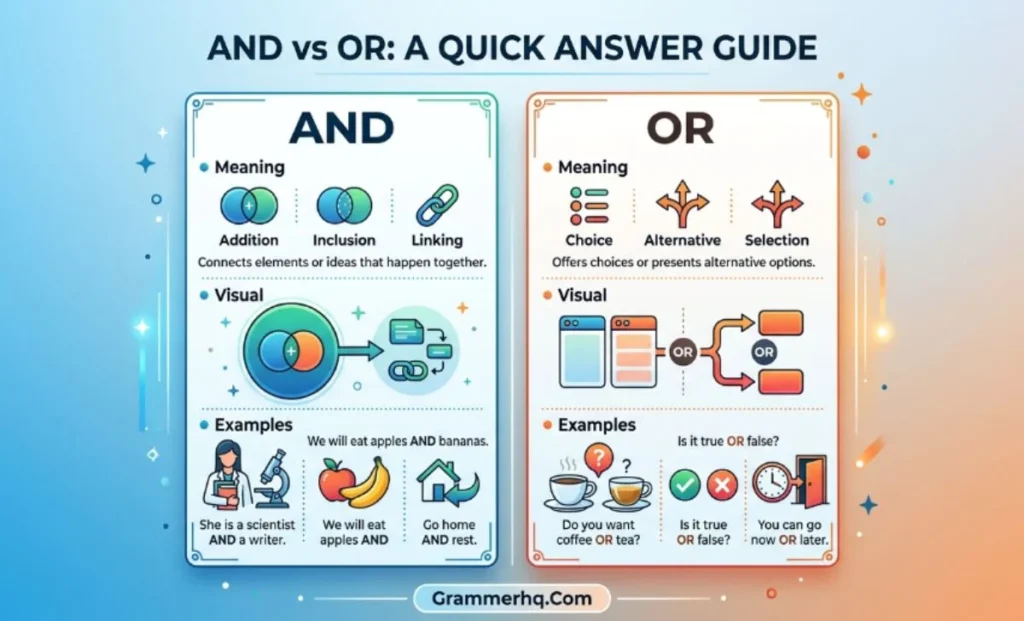
The difference between and and or comes down to addition versus choice.
- And joins words, phrases, or ideas that all belong together.
- Or introduces alternatives, options, or possibilities.
Examples
✅ I bought bread and milk.
(I bought both.)
✅ Would you like tea or coffee?
(Choose one.)
Easy rule to remember:
- And = Together
- Or = Choice
And vs Or at a Glance
| Feature | And | Or |
|---|---|---|
| Main Purpose | Connects ideas | Presents choices |
| Meaning | Includes everything mentioned | Offers one or more alternatives |
| Part of Speech | Coordinating conjunction | Coordinating conjunction |
| Shows | Addition | Choice or possibility |
| Common Use | Lists, combined actions, related ideas | Decisions, options, uncertainty |
| Example | Jack studies English and history. | Would you like pizza or pasta? |
What Does And Mean?
Definition
And is a coordinating conjunction used to connect words, phrases, or clauses that share equal importance. It tells the reader that every connected item is included.
In simple terms, and means “plus,” “along with,” or “together with.”
When to Use And
Use and when you want to:
- Add one idea to another.
- Connect two or more items in a list.
- Show that multiple actions happen together.
- Join two related facts.
- Link independent clauses with equal importance.
Examples
- Emma bought apples and oranges.
- We cleaned the house and washed the car.
- My brother studies engineering and works part-time.
- Sarah speaks English and Arabic.
- The meeting started on time and finished early.
Each example shows that both ideas are true.
Real-Life Example
Imagine your teacher says:
Bring your notebook and your calculator.
This instruction requires both items. Bringing only one means you haven’t completed the task.
Where You’ll Commonly See And
Everyday Conversation
- We ordered burgers and fries.
- She smiled and waved.
Emails
- Please review the document and share your feedback.
Business Writing
- The team completed the project and met the deadline.
Academic Writing
- Researchers collected the data and analyzed the results before publishing their findings.
What Does Or Mean?
Definition
Or is a coordinating conjunction used to introduce a choice, alternative, or possibility. Instead of combining ideas, it separates different options.
Think of or as meaning “either this” or “that.”
When to Use Or
Choose or when you want to:
- Offer a choice.
- Present different possibilities.
- Give someone options.
- Express uncertainty.
- Ask decision-based questions.
Examples
- Would you like coffee or tea?
- You can pay by cash or card.
- Should we travel by train or bus?
- Call me today or tomorrow.
- Wear a jacket or you’ll feel cold later.
Each sentence introduces an alternative instead of combining ideas.
Real-Life Example
At a café, the server asks:
Would you like soup or salad?
Normally, you’re expected to choose one option, not both.
Where You’ll Commonly See Or
Everyday Conversation
- Do you want to watch a movie or stay home?
Emails
- Let me know whether Monday or Tuesday works for you.
Business Writing
- Contact our support team by phone or email.
Academic Writing
- Students may submit the assignment online or hand in a printed copy.
And vs Or: Key Differences
Although and and or are both coordinating conjunctions, they serve opposite purposes. One combines ideas, while the other separates them into choices.
| And | Or |
|---|---|
| Adds information | Gives alternatives |
| Includes every connected item | Presents one or more options |
| Indicates all ideas apply | Indicates a choice or possibility |
| Creates a sense of combination | Creates a sense of selection |
Compare these examples:
- I need a laptop and a charger. (Both are necessary.)
- I need a laptop or a tablet. (Either option will work.)
Another example:
- She studies English and mathematics. (She studies both subjects.)
- She will study English or mathematics next semester. (She’ll choose one subject.)
The difference may seem small, but it has a big impact on the meaning of your sentence. Choosing the correct conjunction makes your writing clearer, more accurate, and easier to understand.
When Should You Use And?
The easiest way to choose and is to ask yourself one question:
If the answer is yes, and is usually the right choice. It connects words, phrases, or complete ideas that all belong together.
Use And to Add Information
Whenever you want to show that two or more things are true at the same time, use and.
Examples
- Lisa speaks English and French.
- The hotel was clean and affordable.
- He is honest and hardworking.
In each sentence, both pieces of information are equally important.
Use And for Lists
In English, and normally appears before the final item in a list.
Examples
- I bought apples, bananas, grapes, and oranges.
- The course covers grammar, vocabulary, pronunciation, and writing skills.
This tells the reader that every item belongs to the same group.
Use And for Actions That Happen Together
When one action follows another naturally, and links them smoothly.
Examples
- She unlocked the door and walked inside.
- We finished dinner and watched a movie.
- He checked the report and emailed the client.
Use And to Join Two Complete Ideas
A comma is often used before and when it joins two independent clauses.
Examples
- The presentation ended on time, and everyone applauded.
- The weather improved, and we continued our trip.
Both parts could stand alone as complete sentences, which is why the comma is appropriate.
When Should You Use Or?
Use or whenever you’re presenting a choice instead of combining ideas.
Ask yourself:
Can someone choose between these options?
If the answer is yes, or is usually the correct conjunction.
Use Or to Offer Choices
This is the most common use of or.
Examples
- Would you like coffee or tea?
- Should we travel by train or bus?
- Do you want chocolate or vanilla ice cream?
Only one option is normally expected.
Use Or for Alternatives
Sometimes more than one solution is acceptable.
Examples
- You can contact us by phone or email.
- Pay using cash or a debit card.
- Download the report as a PDF or Word document.
Here, the speaker gives different ways to complete the same task.
Use Or to Express Possibility
Or can also introduce uncertainty or another possible outcome.
Examples
- We may leave today or tomorrow.
- The package should arrive this afternoon or early tomorrow morning.
Use Or in Questions
Many everyday questions naturally use or because they ask someone to decide.
Examples
- Are you staying home or going out?
- Would you prefer a window seat or an aisle seat?
- Should I call you now or later?
Common Mistakes
Even advanced English learners occasionally confuse and and or. Most mistakes happen because they mix up addition with choice.
1: Using And Instead of Or
❌ Bring your passport and driver’s license if either document is accepted.
✅ Bring your passport or driver’s license if either document is accepted.
Why? Only one document is required.
2: Using Or Instead of And
❌ She speaks English or Spanish fluently.
✅ She speaks English and Spanish fluently.
Why? She speaks both languages.
3: Giving Confusing Instructions
❌ Complete Exercise 1 and Exercise 2. (when students only need one)
✅ Complete Exercise 1 or Exercise 2.
Always make sure your conjunction matches your intended meaning.
A Simple Memory Trick You’ll Actually Remember:
Instead of memorizing grammar rules, remember these two keywords:
AND = ADD
Both words begin with A.
If you’re adding people, things, ideas, or actions together, use and.
Examples
- Bread and butter
- Read and write
- Salt and pepper
OR = OPTION
The letter O can remind you of Option.
Whenever someone can choose, or is the right word.
Examples
- Tea or coffee
- Monday or Tuesday
- Online or offline
Whenever you’re unsure, ask yourself:
Am I adding information or offering a choice?
That single question will help you choose the correct conjunction almost every time.
What Does And/Or Mean?
You may come across and/or in contracts, application forms, business documents, or technical instructions. It combines the meanings of and and or, indicating that either option, or both options, are acceptable.
Examples
- Please submit your passport and/or driver’s license.
- Employees may attend the meeting in person and/or online.
- Applicants can provide a phone number and/or an email address.
Although and/or is grammatically correct, many professional style guides recommend avoiding it in everyday writing because it can sound vague.
Whenever possible, rewrite the sentence so your meaning is clear without using and/or.
Understanding Inclusive and Exclusive Or
The word or doesn’t always mean the same thing. Its meaning depends on the context.
Inclusive Or
An inclusive or means one option, the other option, or both.
Examples
- You can contact us by phone or email.
- We accept cash or digital payments.
Using both methods is also acceptable unless the sentence says otherwise.
Exclusive Or
An exclusive or means only one option can be chosen.
Examples
- Choose chicken or fish for your meal.
- Select either Standard or Premium membership.
In these cases, choosing both isn’t expected.
And vs Or in Real-Life Situations
Understanding grammar is useful, but applying it in everyday situations makes it easier to remember.
School
And
- Read Chapter 5 and answer the questions.
Or
- Submit your assignment online or hand it in to your teacher.
Workplace
And
- Review the proposal and send your feedback before Friday.
Or
- Contact the IT team by phone or email if you need assistance.
Travel
And
- Pack your passport and travel insurance documents.
Or
- You can travel by train or bus.
Shopping
And
- I bought bread and butter.
Or
- Would you like a paper bag or a reusable bag?
Daily Conversations
And
- We cooked dinner and watched a movie afterward.
Or
- Should we meet today or tomorrow?
These examples show how naturally both conjunctions appear in everyday English.
FAQ,s
1: What is the difference between and and or?
And joins words or ideas that all apply, while or introduces a choice, an alternative, or another possibility.
2: When should I use and?
Use and when you want to connect ideas that belong together.
Example
- Sarah packed her laptop and charger before leaving.
3: When should I use or?
Use or when someone must choose between options or when multiple possibilities exist.
Example
- Would you like coffee or tea?
4: Are and and or both conjunctions?
Yes. Both are coordinating conjunctions because they connect words, phrases, and independent clauses of equal grammatical importance.
5: Can a sentence start with and?
Yes. Beginning a sentence with and is grammatically acceptable when it improves the flow or emphasizes the next point.
Example
- And that’s exactly why clear grammar matters.
6: Can a sentence start with or?
Yes. Writers often begin a sentence with or to introduce another possibility or continue a line of thought.
Example
- Or perhaps there’s another solution we haven’t considered.
7: Can and and or appear in the same sentence?
Yes. They often appear together in longer sentences when each serves a different purpose.
Example
- Bring your notebook and calculator, or borrow them from the library.
8: Is and/or grammatically correct?
Yes. It’s common in legal and technical writing, but in general writing, a clearer sentence is usually a better choice.
9: Which is used more often in English?
Both are among the most frequently used words in English because they perform different grammatical functions. You’ll use and to connect ideas and or to present choices in everyday speaking and writing.
Conclusion
Although and and or are only two- and three-letter words, they play a major role in making your writing clear and accurate. And brings words, ideas, or actions together, while or introduces a choice or another possible option.
Choosing the right conjunction helps readers understand your message exactly as you intended.A simple way to remember the difference is this: if everything belongs together, use and; if a decision or alternative is involved, use or.
Once you understand this rule, you’ll write with greater confidence in emails, school assignments, professional documents, and everyday conversations.
The next time you pause before writing and or or, don’t memorize complicated grammar rules. Just ask yourself one question.The answer will almost always point you to the correct word.
Key Takeaways
- And connects related words, phrases, and ideas.
- Or introduces choices, alternatives, or possibilities.
- Both are coordinating conjunctions.
- And expresses addition, while or expresses selection.
- Context determines whether or means one option only or one-or-more options.
- Mastering these two conjunctions improves both spoken and written English.
Read More Blogs:
- Consistent or Consistant? The Only Spelling Guide You’ll Ever Need
- Meating vs Meeting: Meaning, Differences, and Correct Usage

Hi, I’m Amelia Parker, a grammar enthusiast and writer at GrammarHQ.com. I specialize in explaining spelling differences, confusing words, and common English mistakes through simple, practical, and easy-to-understand guides.