Tear vs tare can be confusing because the two words can sound exactly alike in one of their common uses. However, they have completely different meanings.
Tear can mean to rip or pull something apart, a rip or hole in something, or a drop of liquid from the eye.
Tare, on the other hand, is mainly used in weighing and refers to the weight of an empty container, package, or vehicle. It can also be used as a verb when you adjust a scale to exclude the container’s weight.
The tricky part is pronunciation: tear meaning “rip” sounds like tare, while tear meaning a drop from the eye has a different pronunciation.
Quick Answer
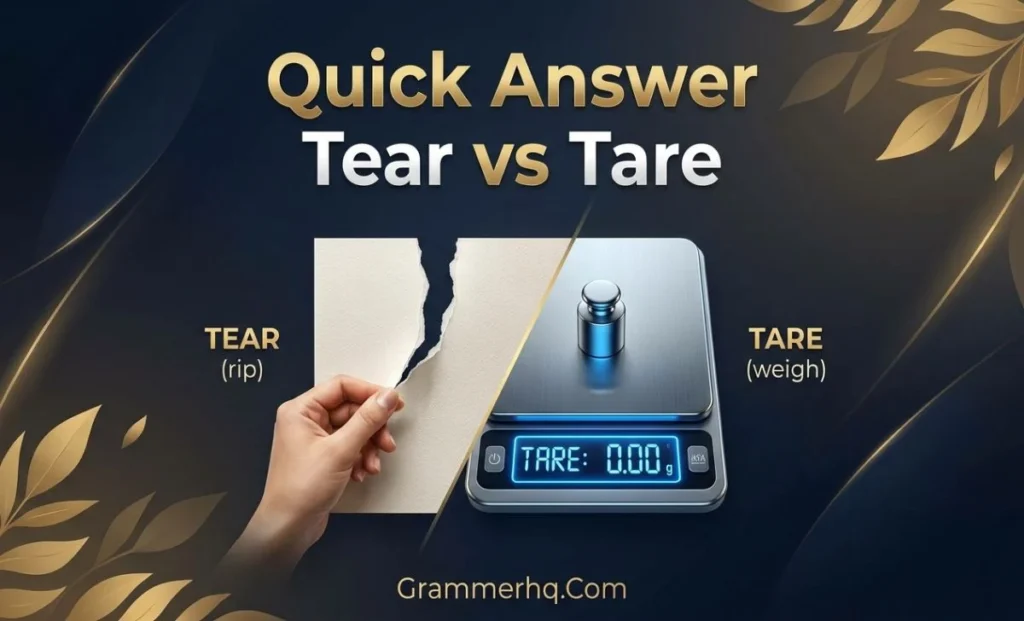
Tear is used for ripping, a rip or hole, or a drop from the eye.
Tare is used for container weight or for adjusting a scale before weighing something.
| Word | Main meaning | Example |
|---|---|---|
| tear | To rip or pull apart | Please tear the paper in half. |
| tear | A rip or hole | There is a tear in my jacket. |
| tear | A drop from the eye | A tear rolled down her cheek. |
| tare | Empty-container weight | The tare weight is 2 kg. |
| tare | Adjust a scale | Tare the scale before adding the flour. |
The easiest rule is:
Tear = rip or eye fluid.
Tare = weighing or scale adjustment.
What Does “Tear” Mean?
Tear has several meanings, and its pronunciation changes depending on the meaning.
Tear as a Verb: To Rip or Pull Apart
When tear means to rip, it describes pulling something apart or separating material by force.
- Please tear the paper in half.
- Be careful not to tear the envelope.
- The child tore the page from the notebook.
- I accidentally tore my shirt on the fence.
In this sense, tear is pronounced like “tair,” similar to tare.
Tear as a Noun: A Rip or Hole
Tear can also be a noun meaning a damaged or ripped area in something.
- There is a tear in my jacket.
- The curtain has a small tear.
- She noticed a tear in the corner of the page.
Here, the noun tear has the same pronunciation as the verb meaning “rip.”
Tear as a Noun: A Drop From the Eye
A different tear is the liquid that comes from your eye, usually because of emotion, irritation, or another physical response.
- A tear rolled down her cheek.
- He wiped a tear from his eye.
- The ending of the movie brought tears to her eyes.
This tear is pronounced like “teer,” not “tair.” That makes tear an especially tricky English word because the spelling stays the same while the pronunciation and meaning change.
What Does “Tare” Mean?
Tare is a separate English word. Its most common use is connected with weight, measurement, containers, and scales.
Tare as a Noun
As a noun, tare refers to the weight of an empty container, package, vehicle, or other object that needs to be excluded when calculating the weight of its contents.
For example:
- The tare weight of the container is 2 kg.
- The label shows the gross weight and tare weight.
- The shipping document lists the container’s tare.
This is why tare weight, not tear weight, is the correct expression in weighing and shipping contexts.
Tare as a Verb
Tare can also be a verb. On a kitchen, laboratory, or commercial scale, to tare the scale means to set it so the weight of the container is excluded from the measurement.
For example:
- Tare the scale before adding the ingredients.
- She tared the container before weighing the sample.
- The laboratory technician tared the scale before measuring the material.
So tare is not only a noun. Its verb forms include tared and taring.
Tear vs Tare Pronunciation
Pronunciation is one of the main reasons these words cause confusion.
| Word | Meaning | Approximate pronunciation |
|---|---|---|
| tear | to rip | “tair” |
| tear | a rip or hole | “tair” |
| tear | liquid from the eye | “teer” |
| tare | weight or scale adjustment | “tair” |
So:
tear = rip → “tair”
tare = weighing → “tair”
tear = eye fluid → “teer”
This means you cannot always identify tear and tare by sound alone. When tear means “rip,” it sounds like tare, so the surrounding meaning and context tell you which spelling is correct.
Tear, Tore, Torn, or Tare?
This is where another common mistake appears.
The verb tear, meaning “rip,” is irregular:
tear → tore → torn
It does not become tare in the past tense.
Compare:
- I tear the paper when I need to divide it.
- I tore the paper yesterday.
- I have torn the paper already.
Now compare that with tare, which belongs to weighing:
- I tare the scale before weighing the ingredients.
- I tared the container before taking the measurement.
- The technician is taring the scale.
So these are two separate verb families:
tear → tore → torn = rip
tare → tared → tared = adjust or account for weight
A Common Mistake
❌ I tared the paper in half.
✅ I tore the paper in half.
The first sentence uses a real word, tared, but it has the wrong meaning. The correct past tense of tear is tore.
Tear vs Tare in Real-Life Examples
The easiest way to understand the difference is to see how each word works in everyday situations.
Paper and Books
When you pull paper apart, use tear.
Please tear this page along the dotted line.
Past tense:
She tore the page in half.
Clothes and Fabric
A damaged or ripped area is a tear.
There is a tear in my jacket.
As a verb:
The branch tore his sleeve.
Crying and Emotion
When referring to liquid from the eye, use tear.
A tear rolled down her cheek.
Here, the pronunciation is “teer,” which is different from the ripping sense of tear.
Kitchen Scales
When you place an empty bowl on a scale and want the scale to ignore its weight, use tare.
Tare the scale before adding the flour.
This is one of the most common real-world uses of the verb tare.
Shipping and Packaging
When discussing the weight of an empty container or package, use tare.
The tare weight of the box is 1.5 kg.
The weight of the contents can then be determined without counting the packaging.
Gross Weight, Tare Weight, and Net Weight
The word tare is especially important in measurement because it is part of the relationship between gross weight, tare weight, and net weight.
A simple formula is:
Net weight = Gross weight − Tare weight
For example, suppose a package and its contents weigh 25 kg, while the empty packaging weighs 5 kg.
25 kg − 5 kg = 20 kg
So the net weight of the contents is 20 kg.
This is why you may see tare weight on shipping labels, weighing equipment, packaging information, and other measurement-related documents.
Common Tear vs Tare Mistakes
Because the words sound similar, spelling errors are easy to make.
1: Tear Weight
❌ The tear weight of the container is 3 kg.
✅ The tare weight of the container is 3 kg.
Use tare when talking about the weight of an empty container or packaging.
2: Tare the Paper
❌ Tare the paper in half.
✅ Tear the paper in half.
Use tear when you mean “rip.”
3: Tared the Paper
❌ I tared the paper yesterday.
✅ I tore the paper yesterday.
The past tense of tear is tore.
4: Tear the Scale
❌ Tear the scale before adding the ingredients.
✅ Tare the scale before adding the ingredients.
When you are adjusting a scale to exclude the container’s weight, use tare.
How to Remember Tear vs Tare
You only need two simple associations:
TEAR = RIP
TARE = SCALE
If you can replace the word with rip, choose tear:
Tear the paper.
Rip the paper.
If the sentence is about weighing a container or resetting a scale, choose tare:
Tare the scale.
Another useful memory connection is:
TARE → TARE button → SCALE
That makes tare easier to remember when you see it in cooking, laboratory, retail, or shipping contexts.
Tear vs Tare at a Glance
| Word | Part of speech | Meaning | Example |
|---|---|---|---|
| tear | Verb | To rip or pull apart | Tear the paper. |
| tear | Noun | A rip or hole | There is a tear in the shirt. |
| tear | Noun | Liquid from the eye | A tear fell from her eye. |
| tore | Verb | Past tense of tear | She tore the letter. |
| torn | Verb/adjective | Past participle of tear | The page was torn. |
| tare | Noun | Empty-container weight | Check the tare weight. |
| tare | Verb | Adjust a scale / account for container weight | Tare the scale. |
| tared | Verb | Past tense of tare | She tared the container. |
The key distinction is simple: tear belongs mainly to ripping, damage, or eye fluid, while tare belongs mainly to weighing and measurement.
FAQs
Is tare the past tense of tear?
No. The past tense of tear is tore, and its past participle is torn.
tear → tore → torn
Tare is a separate word associated mainly with weight and weighing.
Is tear pronounced the same as tare?
Sometimes. When tear means “rip,” it is pronounced like tare. However, tear meaning liquid from the eye has a different pronunciation.
Do you tear or tare paper?
You tear paper when you mean “rip” it.
I tore the paper in half.
Do you tear or tare a scale?
You tare a scale when you adjust it to exclude the weight of a container.
Tare the scale before adding the ingredients.
What is tare weight?
Tare weight is the weight of an empty container, package, vehicle, or similar object that is accounted for when determining the net weight of its contents.
What are the three forms of tear?
For the verb meaning “rip,” the main forms are:
tear → tore → torn
For example:
I tear the paper.
I tore the paper.
I have torn the paper.
What are the forms of tare?
As a verb, tare has forms such as tare, tared, and taring.
Tare the scale.
She tared the container.
He is taring the scale.
Conclusion
Tear and tare are both correct English words, but they belong in very different contexts. Use tear when you mean to rip something, a rip or hole, or a drop from the eye.
Use tare when you are talking about container weight or adjusting a scale. Remember the simplest rule: tear = rip; tare = scale. And when tear means “rip,” its past tense is tore, not tare.
Read More Blogs
- Camouflage Vs Camoflage: Which Spelling Is Correct?
- Parents vs Parent’s vs Parents’: What’s the Difference?

Hi, I’m Amelia Parker, a grammar enthusiast and writer at GrammarHQ.com. I specialize in explaining spelling differences, confusing words, and common English mistakes through simple, practical, and easy-to-understand guides.










