Choosing between saviour and savior can be confusing because both words have the same meaning and pronunciation. The only real difference is the variety of English you are using.
Savior is the preferred spelling in American English, while saviour is the standard spelling in British English and most Commonwealth countries.
In this guide, you’ll learn the correct spelling, pronunciation, history, usage differences, examples, common mistakes, and practical tips to help you use the right word with confidence.
Quick Answer
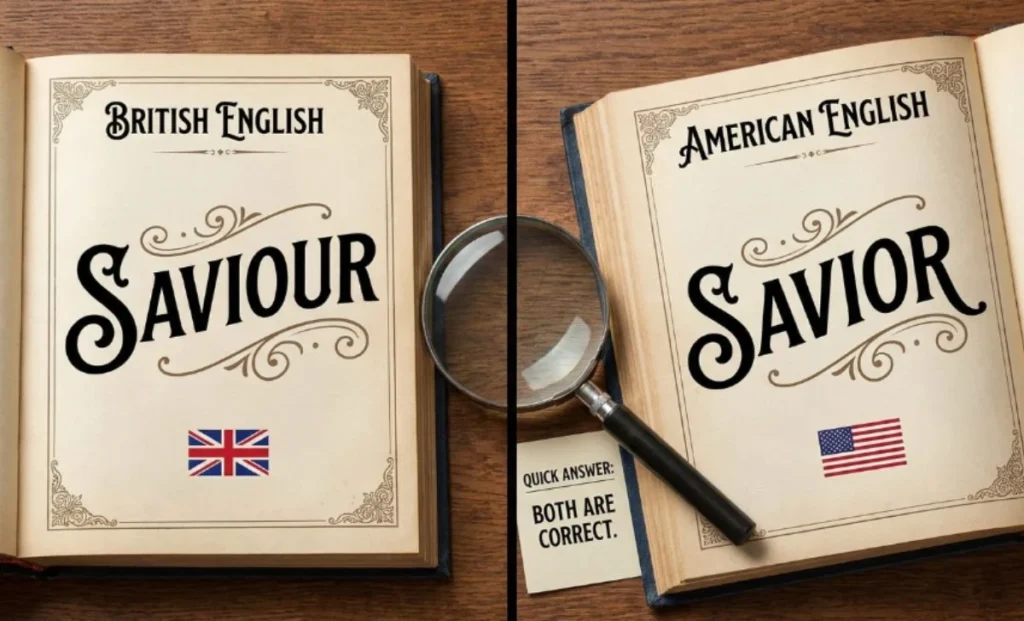
Both saviour and savior are correct.
- Savior is the standard spelling in American English.
- Saviour is the standard spelling in British English, Canadian English, Australian English, and New Zealand English.
- Both words mean a person who saves or rescues someone, or someone regarded as a deliverer or protector.
Examples
- The firefighter was hailed as a savior by the local community. (US English)
- Many people saw the doctor as their saviour during the crisis. (UK English)
Pronunciation of Saviour or Savior
Both spellings have the same pronunciation.
Pronunciation: /ˈseɪ.vjər/ (SAY-vyer)
The spelling changes, but the spoken word remains the same. This is why many English learners assume one spelling is incorrect. In reality, only the regional spelling differs.
Pronunciation Examples
- She called him her savior after he rescued her.
- They thanked their saviour for the timely help.
Why People Confuse Saviour or Savior
People often confuse these spellings because:
- They sound exactly alike.
- Both appear in books, websites, and media.
- American English drops the “u”, while British English keeps it.
- Many online platforms contain content written for different audiences.
- Spell checkers change the spelling based on language settings.
The confusion is similar to color vs colour, honor vs honour, and favor vs favour.
Saviour or savior synonym
- Saviour or Savior Synonyms are words with similar meanings, such as rescuer, hero, protector, guardian, deliverer, defender, champion, benefactor, liberator, and redeemer. The best synonym depends on the context.
- For example, rescuer fits someone who saves another from danger, while protector describes someone who keeps others safe.
- Remember that saviour (British English) and savior (American English) have the same meaning—the spelling changes only by region.
Examples:
- The firefighter became the town’s rescuer after saving several families.
- She saw her grandfather as her lifelong protector.
- The brave doctor was praised as a hero during the emergency.
Easy Trick to Remember Saviour or Savior
A simple memory trick is:
- Savior = USA = No “u”.
- Saviour = United Kingdom = Includes “u”.
If you’re writing for an American audience, choose savior.
If you’re writing for readers in the UK or Commonwealth countries, choose saviour.
Saviour or Savior KJV
In the King James Version (KJV) of the Bible, the correct spelling is Saviour with a “u” because the KJV follows British English spelling traditions. Modern American Bible translations often use Savior instead. The meaning is exactly the same in both spellings—they refer to Jesus Christ as the one who saves humanity. If you’re quoting directly from the KJV, always use Saviour to match the original text.
Examples:
- The KJV refers to Jesus Christ as our Saviour.
- Many modern American Bibles spell it Savior instead of Saviour.
- When quoting the KJV, keep the original spelling: Saviour.
Saviour or saver
- Saviour or Saver can be confusing because both words relate to helping or saving, but they have different meanings.
- Saviour refers to a person who rescues, protects, or delivers others from danger, while saver means someone or something that saves money, time, effort, or resources. Although both come from the verb save, they are not interchangeable.
- Choosing the correct word depends entirely on the context of your sentence. Understanding this difference helps you avoid common writing mistakes and communicate more accurately.
Examples:
- The firefighter became the town’s saviour after rescuing the family from the fire.
- Buying in bulk is a great money saver.
- Her quick advice was a real time saver during the project.
The Origin of Saviour or Savior
The word comes from the Latin salvator, meaning one who saves. It later entered Old French before becoming part of Middle English.
Originally, English commonly used spellings with -our. During the spelling reforms popularized in America by Noah Webster, many words lost the silent “u” to simplify spelling. As a result:
- British English kept saviour.
- American English adopted savior.
Both spellings have existed for centuries and remain correct today.
British English vs American English Spelling
The only difference is spelling—not meaning or pronunciation.
| British English | American English | Meaning |
|---|---|---|
| Saviour | Savior | A person who saves someone |
| Honour | Honor | Respect |
| Colour | Color | Hue |
| Favourite | Favorite | Preferred choice |
| Labour | Labor | Work |
Examples
British English
- She became the nation’s saviour.
American English
- He was considered the team’s savior.
Which Spelling Should You Use?
Choose the spelling based on your audience.
- Use savior if you write for readers in the United States.
- Use saviour for readers in the United Kingdom, Canada, Australia, New Zealand, and many other Commonwealth countries.
- If writing for an international audience, follow your company’s or publication’s style guide and remain consistent throughout your content.
Consistency is more important than choosing one spelling over the other.
Common Mistakes with Saviour or Savior
Here are mistakes people often make.
| Incorrect | Correct |
|---|---|
| Using both spellings in one article | Choose one style and stay consistent |
| Thinking one spelling is wrong | Both are correct depending on region |
| Changing spelling without changing language style | Match your audience’s English |
| Believing pronunciation changes | Pronunciation is the same |
Correct Examples
- The soldier became a national savior. (US)
- The volunteer was praised as a saviour. (UK)
Saviour or Savior in Everyday Examples
In Emails
- Thank you for being my savior during yesterday’s meeting.
- You were a true saviour when the project nearly failed.
In News
- Local residents called the rescue worker a savior.
- The nurse became a saviour for hundreds of patients.
On Social Media
- You’re my savior!
- Our dog is a real saviour.
In Formal Writing
- The charity described the volunteer as a savior for vulnerable families.
- Historians referred to him as the nation’s saviour.
Saviour vs Savior Comparison Table
| Feature | Saviour | Savior |
|---|---|---|
| Meaning | Person who saves | Person who saves |
| Pronunciation | Same | Same |
| British English | ✅ Yes | ❌ No |
| American English | ❌ No | ✅ Yes |
| Canadian English | ✅ Usually | Sometimes |
| Australian English | ✅ Yes | Rare |
| Correct Spelling | ✅ Yes | ✅ Yes |
Saviour or savior in a sentence
- Saviour or Savior in a Sentence depends on the type of English you’re writing. Savior is the correct spelling in American English, while saviour is used in British English and most Commonwealth countries.
- Both words have the same meaning and pronunciation, so only the regional spelling changes.
- Use the version that matches your audience and stay consistent throughout your writing. The examples below show how each spelling is used naturally in real sentences.
Examples:
- US English: The firefighter was hailed as a savior after rescuing the family from the burning house.
- UK English: The local doctor became the village’s saviour during the difficult winter.
- General: Many people consider education a savior/saviour that opens the door to a better future.
FAQ,s
Is saviour or savior correct?
Both are correct. Savior is American English, while saviour is British English.
Is there a difference in meaning?
No. Both words have exactly the same meaning.
Which spelling is used in the United States?
American English uses savior.
Which spelling is common in the UK?
British English uses saviour.
Do both words have the same pronunciation?
Yes. Both are pronounced /ˈseɪ.vjər/.
Can I use either spelling in academic writing?
Yes, as long as you follow the required language style and stay consistent.
Why does British English use “u”?
British English keeps the traditional -our spelling, while American English simplified many words by removing the silent “u”.
Conclusion
- Choosing between saviour and savior is simple once you know your audience. Both spellings are correct, have the same pronunciation, and carry the same meaning.
- The only difference is regional spelling. Use savior for American English and saviour for British English and most Commonwealth countries.
- Whichever form you choose, remain consistent throughout your writing. Understanding this distinction helps you write more professionally and avoid unnecessary spelling mistakes.
- Whether you’re creating academic papers, business emails, news articles, or social media posts, selecting the correct regional spelling makes your writing clearer and more appropriate for your readers.
Read More Blogs:
- Insite or Insight? Correct Spelling, Meaning & Usage Explained
- Honor or Honour: Which Spelling Is Correct In 2026

Hi, I’m Amelia Parker, a grammar enthusiast and writer at GrammarHQ.com. I specialize in explaining spelling differences, confusing words, and common English mistakes through simple, practical, and easy-to-understand guides.