If you are unsure about Stich vs Stitch, you are not alone. These two spellings look almost identical, but they are not used in the same way.
Stitch is the standard spelling when you are talking about sewing, knitting, wounds, or a sharp pain while running. Stich, however, is not completely made up or always incorrect.
It is a rare English word used mainly in literary or specialized contexts, including a line or verse.So, if you are writing ordinary English, stitch is almost certainly the word you need.
This guide explains the difference between stich and stitch, shows when each word is appropriate, and gives simple examples to help you remember the correct spelling.
Quick Answer
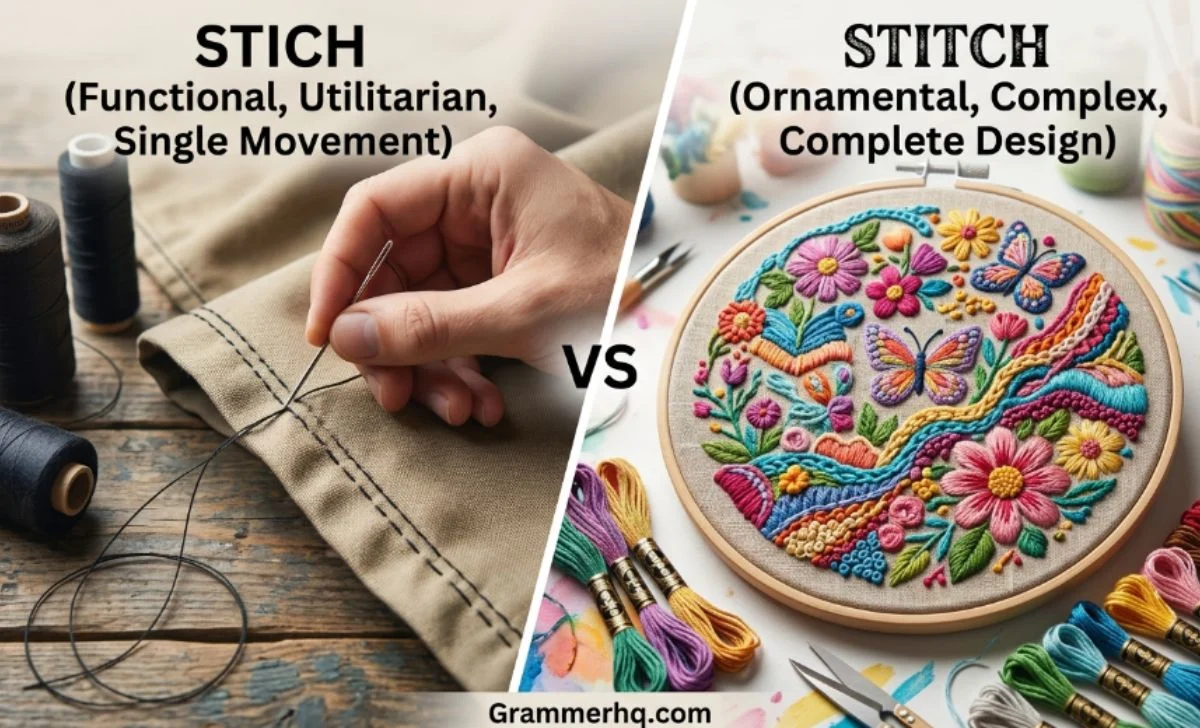
Stitch is the correct and common spelling for most everyday situations involving sewing, thread, knitting, wounds, or a sharp pain in your side.
Stich is a real but uncommon English word. In literary usage, it can refer to a line or verse, especially a line of poetry.
| Word | Meaning | Everyday Use |
|---|---|---|
| Stitch | A loop or series of loops made with thread; also a medical suture or side pain | Very common |
| Stich | A line or verse, with some specialized meanings | Rare |
The simple rule
If you mean sewing, knitting, a wound, or a side pain, use stitch.
If you mean a rare literary or specialized term, stich may be correct.
What Does “Stitch” Mean?
Stitch is a common English noun and verb. Its meaning changes slightly depending on the context.
Stitch as a Noun
A stitch can be a single loop or movement made with thread when sewing fabric.
For example:
- She added a small stitch to the torn shirt.
- This dress has a neat stitch along the edge.
- The tailor used several different stitches.
In knitting and embroidery, a stitch can also describe a particular loop or technique used to create a pattern.
Stitch for a Wound
In medical contexts, stitches are used to close a cut or wound so that the damaged skin can heal.
For example:
The doctor put three stitches in the cut.
This is one of the most familiar meanings of stitch.
Stitch as a Side Pain
A stitch can also mean a sudden sharp pain in your side, particularly while running or exercising.
For example:
I had to slow down because I got a stitch while running.
This meaning is common in British English and is widely understood in international English.
What Does “Stitch” Mean as a Verb?
As a verb, stitch means to join or repair something using thread, or to join parts together with stitches.
For example:
- She stitched the hole in her jeans.
- My grandmother taught me how to stitch by hand.
- The tailor stitched the pieces of fabric together.
- The nurse stitched the wound.
The related forms are:
- stitch
- stitches
- stitched
- stitching
Notice that the spelling keeps the second t:
stitch → stitching
Not:
stich → stiching
Is “Stich” a Real Word?
Yes. Stich is a real but uncommon English word.
This is an important distinction because it is often described simply as a misspelling of stitch. In ordinary writing, stich will usually be a spelling mistake. But dictionaries also recognize stich as a legitimate word with specialized meanings.
One literary meaning is a line or verse of poetry. The word is associated with the Greek stichos, meaning a line or row.
So, stich can appear in literary or specialized writing even though most English speakers rarely use it.
Example of the Literary Meaning
A sentence such as this could use stich in its specialized sense:
The scholar examined each stich of the ancient poem.
This is very different from:
She needs to stitch the torn fabric.
The first sentence uses the rare literary word. The second uses the normal everyday word.
When Should You Use “Stich”?
For most everyday English, you probably should not use stich.
In Literary Contexts
Stich can refer to a line or verse, especially in discussions of poetry or older literature.
In Specialized Writing
You may encounter the word in academic, historical, literary, or specialized texts.
As a Common Spelling Mistake
If you are talking about sewing, clothing, thread, wounds, or embroidery, stich is normally an error.
For example:
❌ She will stich the dress tonight.
✅ She will stitch the dress tonight.
Common Spelling Mistakes
These spellings are common mistakes:
- ❌ stiching → ✅ stitching
- ❌ stiches → ✅ stitches
- ❌ stiched → ✅ stitched
The correct forms all keep the second t in stitch. However, remember that stich itself can be correct in rare literary or specialized contexts.
Why Do People Confuse Stich and Stitch?
The confusion is easy to understand. The words differ by only one letter, and stich can look like a natural spelling when someone writes quickly.
They Look Almost Identical
Compare:
stich
stitch
The only difference is the extra t in stitch.
The Pronunciation Can Add to the Confusion
Stitch is pronounced approximately /stɪtʃ/. The final sound is easy to recognize, but the spelling does not always feel intuitive to English learners.
Fast Typing Causes Mistakes
People often leave out a letter when typing familiar words. Since stich looks plausible, spell-checking may be the only thing that catches the mistake.
Stich vs Stitch Examples;
The easiest way to understand the difference is to see the words in context.
Everyday Uses of “Stitch”
- I need to stitch this button back onto my shirt.
- The tailor stitched the damaged seam.
- She learned a new stitch for her knitting project.
- The doctor gave him five stitches.
- I got a stitch in my side during the race.
- We were in stitches after hearing the joke.
Rare Use of “Stich”
- The researcher analyzed each stich of the poem.
- The literary study discusses the structure of the stich.
The second group is much less likely to appear in everyday conversation.
Stitch vs Sew: What’s the Difference?
Stitch and sew are closely related, but they are not always interchangeable.
Sew is the broader verb for joining or repairing fabric with a needle and thread.
Stitch often focuses on the individual stitches or the act of joining something with stitches.
Compare these examples:
My mother taught me to sew.
I need to stitch this tear.
She sewed a dress for her daughter.
She stitched the decorative pattern by hand.
Both words can describe needle-and-thread work, but sew is the broader everyday term.
Common Expressions With “Stitch”
Because stitch is a common English word, it appears in several familiar expressions.
“In Stitches”
In stitches means laughing very hard.
Example:
That comedy had everyone in stitches.
Here, stitches has nothing to do with sewing. It is an idiomatic expression.
“A Stitch in Time Saves Nine”
This traditional proverb means that dealing with a small problem early can prevent a much bigger problem later.
For example, fixing a small leak today may prevent expensive water damage later.
“Stitch Up”
Stitch up can refer to sewing something together, including closing a wound, depending on the context. It can also have figurative meanings in informal English.
Stich vs Stitch: Which One Should You Use?
For everyday English, choose stitch.
Use stitch when you are talking about:
- sewing
- thread
- fabric
- embroidery
- knitting
- repairing clothes
- medical stitches
- a sharp side pain
- expressions such as “in stitches”
Use stich only when you specifically mean the rare literary or specialized word.
Quick test
Ask yourself:
“Am I talking about sewing, a wound, running pain, or a common English expression?”
If the answer is yes, write stitch.
Easy Trick to Remember “Stitch”
A simple way to remember the spelling is:
Stitch has two Ts.
Think of the two t’s as two small points holding the word together—just like stitches hold pieces of fabric together.
So remember:
STITCH = two Ts
That can help prevent common mistakes such as stich, stiches, and stiching.
Common Spelling Mistakes:
Here are some frequent mistakes and their correct forms:
| Incorrect | Correct |
|---|---|
| stich | stitch |
| stiching | stitching |
| stiches | stitches |
| stiched | stitched |
| stich a shirt | stitch a shirt |
| stich the wound | stitch the wound |
Remember that stich itself is not always an error. It can be correct when used in its rare literary or specialized sense.
Stich vs Stitch in Everyday Sentences
Here are a few natural examples to make the difference clear:
- I need to stitch the hole in my jacket.
- She knows several embroidery stitches.
- The doctor used three stitches to close the cut.
- I got a stitch in my side after running.
- My grandmother taught me how to stitch by hand.
- Everyone was in stitches during the comedy show.
- The tailor stitched the fabric carefully.
- The poem was analyzed stich by stich in the specialist’s study.
The first seven examples use the common word stitch. The last uses the rare literary sense of stich.
FAQ,s
Is it “stich” or “stitch”?
For almost all everyday uses, the correct spelling is stitch. Stich is a rare but legitimate word with specialized meanings.
Is “stich” a real English word?
Yes. Stich is a real English word, although it is uncommon. One of its meanings is a line or verse, particularly in literary contexts.
Is “stich” a misspelling of “stitch”?
It can be. If you mean sewing, knitting, a wound, or a side pain, stich is normally a misspelling of stitch. However, stich can be correct when used in its rare specialized sense.
What does “stich” mean?
In literary usage, stich can mean a line or verse of poetry. It also has some specialized historical meanings.
What does “stitch” mean?
Stitch can mean a loop made with thread, the act of sewing, a medical suture, or a sharp side pain. It can also appear in expressions such as in stitches.
Is it “stiching” or “stitching”?
The correct spelling is stitching.
❌ stiching
✅ stitching
Is it “stiches” or “stitches”?
The correct spelling is stitches.
❌ stiches
✅ stitches
Is it “stiched” or “stitched”?
The correct spelling is stitched.
❌ stiched
✅ stitched
What is the difference between stitch and sew?
Sew is the broader word for joining fabric with a needle and thread. Stitch can refer to a particular stitch, the act of stitching, or the resulting sewn connection.
Conclusion
The difference between stich and stitch becomes simple once you consider the context. Stitch is the standard word used in everyday English for sewing, knitting, medical stitches, side pain, and several common expressions.
Stich, on the other hand, is a rare but legitimate English word, especially in literary or specialized contexts.So, if you are writing about clothes, thread, embroidery, wounds, or running, choose stitch.
If you encounter stich in a literary or academic text, it may be intentional rather than a spelling mistake.In short: Use “stitch” for everyday English; reserve “stich” for its specific rare meanings.
Read More Blogs:
- Shakey or Shaky: Which Spelling Is Correct?
- Consistent or Consistant? The Only Spelling Guide You’ll Ever Need