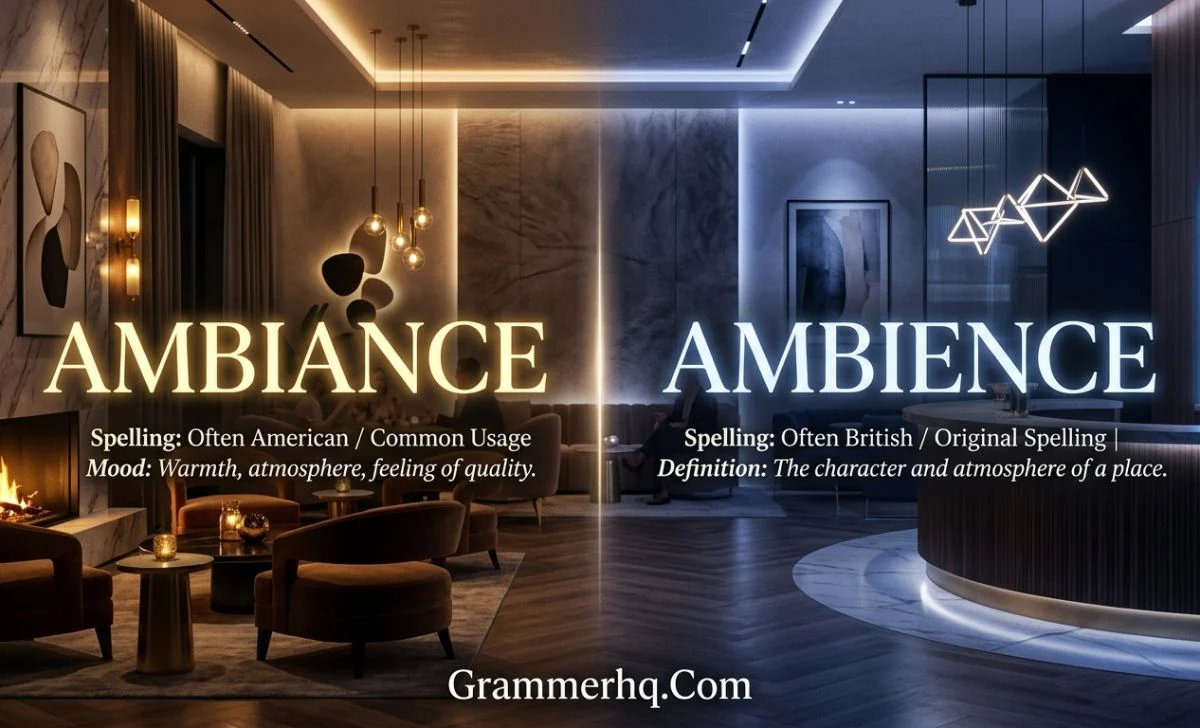
Ambiance and ambience are both correct spellings. They are nouns that describe the character, atmosphere, mood, or overall feeling of a place or situation.
The difference is mainly spelling and usage preference, not meaning. Major dictionaries, including Cambridge, Oxford, and Collins, recognize both forms.
If you are writing for a US audience, ambiance is a familiar choice. In British English, ambience is especially well established.
However, this is a preference rather than a strict rule: both spellings are used in both varieties of English.
Quick Answer
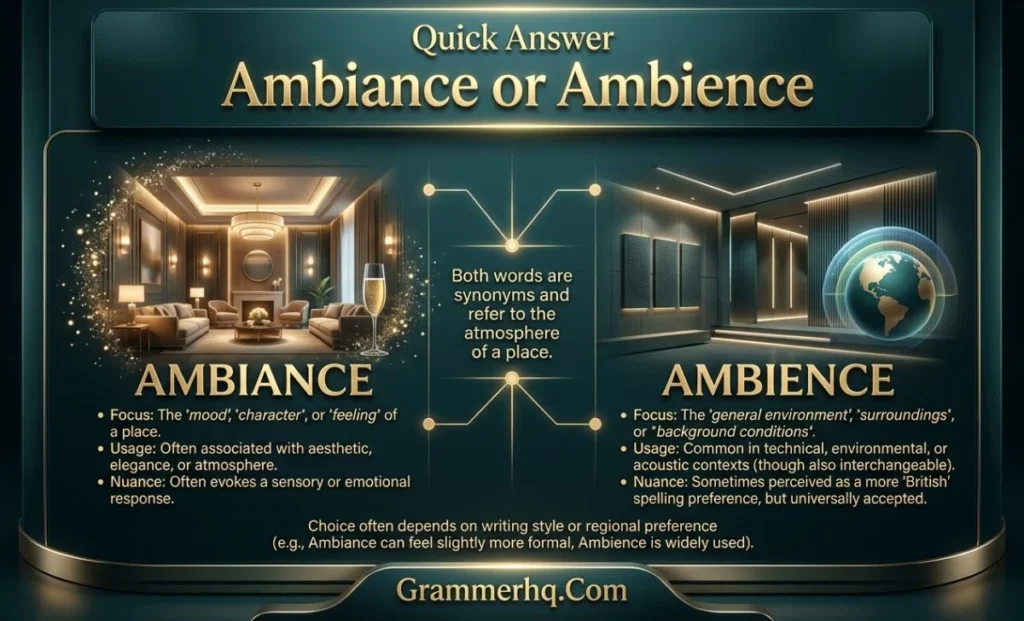
Ambiance and ambience are both correct.
| Word | Correct? | Meaning | Part of Speech |
|---|---|---|---|
| Ambiance | Yes | Atmosphere or character of a place | Noun |
| Ambience | Yes | Atmosphere or character of a place | Noun |
So you can write:
The restaurant has a relaxing ambiance.
Or:
The restaurant has a relaxing ambience.
Both sentences mean the same thing.
The safest way to remember the difference is simple:
Ambiance = correct
Ambience = correct
The spelling changes, but the basic meaning does not. Cambridge lists ambiance as an alternative form of ambience, while Oxford also gives ambiance as an alternative spelling.
What Does Ambience Mean?
Ambience means the character or atmosphere of a place and the feeling it creates.
For example, a restaurant’s ambience may come from its:
- Lighting
- Music
- Interior design
- Furniture
- Colors
- Noise level
- Service
- Overall setting
Consider this sentence:
The soft lighting gives the restaurant a warm ambience.
The word does not refer to the lighting alone. It describes the overall character or feeling created by the environment.
Oxford defines ambience as the character and atmosphere of a place and gives examples involving lighting, cities, and other settings.
Ambience in a Sentence
Here are some natural examples:
The café has a cozy ambience.
The hotel is known for its peaceful ambience.
Low lighting created a romantic ambience.
The old neighborhood has a distinctive ambience.
In each example, ambience is a noun describing the feel or character of the setting.
What Does Ambiance Mean?
Ambiance has the same basic meaning as ambience.
It describes the mood, character, atmosphere, or overall quality of an environment.
For example:
The restaurant has an elegant ambiance.
You can replace ambiance with ambience without changing the meaning:
The restaurant has an elegant ambience.
Collins specifically defines ambiance in American English as the mood, character, quality, tone, or atmosphere of an environment and also lists ambience as an alternative.
Ambiance in a Sentence
The candles created a romantic ambiance.
We chose the hotel for its relaxed ambiance.
The music added to the lively ambiance.
The room has a modern ambiance.
These examples show why ambiance is often used when describing restaurants, hotels, rooms, events, and other places.
Ambiance vs Ambience: What’s the Difference?
There is no important difference in basic meaning between ambiance and ambience.
The two forms describe the same general idea: the character or atmosphere of a place.
| Feature | Ambiance | Ambience |
|---|---|---|
| Meaning | Atmosphere or character | Atmosphere or character |
| Grammar | Noun | Noun |
| Correct spelling | Yes | Yes |
| Meaning changes? | No | No |
| Regional preference | Commonly associated with US usage | Strongly established in UK usage |
| Can both appear in US English? | Yes | Yes |
For example:
The wedding had a beautiful ambiance.
The wedding had a beautiful ambience.
There is no change in meaning.
Collins likewise treats ambience and ambiance as alternative forms and gives the same core sense of atmosphere or character.
Ambiance or Ambience in American English
Both spellings are accepted in American English.
Ambiance is a familiar choice for US writers, but ambience is not wrong in American English.
Cambridge’s American English entry lists ambience with ambiance as an alternative form. Collins also gives ambiance as an American English spelling.
For example, an American writer might say:
The restaurant has a sophisticated ambiance.
But this is also correct:
The restaurant has a sophisticated ambience.
So avoid treating this as an absolute rule:
❌ Ambiance is American, so ambience is wrong in American English.
A better rule is:
Ambiance is a familiar American choice, but both spellings are accepted.
For a US-focused website such as an American English grammar resource, choosing ambiance can be a sensible style decision. What matters most is using the chosen form consistently.
Ambience or Ambiance in British English
Ambience is especially well established in British English.
For example:
The restaurant has a pleasant ambience.
However, ambiance is also an accepted English spelling. It should not automatically be marked as a spelling error simply because the writing follows British English.
Cambridge’s UK entry lists ambiance as an alternative spelling, while Oxford does the same.
So the practical distinction is:
- British English: ambience is a very natural choice.
- American English: ambiance is a very natural choice.
- Both varieties: both forms are recognized.
That is more accurate than presenting the two spellings as a strict US-versus-UK divide.
Which Spelling Should You Use?
The best choice depends on your audience and your existing style.
Writing for a US Audience
Ambiance is a natural choice.
The hotel has a luxurious ambiance.
Writing for a UK Audience
Ambience may feel more natural.
The hotel has a luxurious ambience.
Writing for an International Audience
Either spelling works.
The important thing is to avoid switching unnecessarily between the two.
For example, if your article starts with:
The café has a relaxed ambiance.
there is usually no reason to change later to:
The restaurant’s elegant ambience…
unless you have a specific reason for the change.
Consistency makes your writing look more polished.
Ambiance and Ambience in Sentences
The easiest way to see that the words are interchangeable is to compare them in real situations.
Restaurant
The restaurant’s warm ambiance made us want to stay longer.
The restaurant’s warm ambience made us want to stay longer.
Hotel
The hotel has a quiet ambiance that suits couples.
The hotel has a quiet ambience that suits couples.
Home
Soft lamps can create a comfortable ambiance.
Soft lamps can create a comfortable ambience.
Wedding
The flowers and music created a romantic ambiance.
The flowers and music created a romantic ambience.
Office
Natural light gives the office a more welcoming ambiance.
Natural light gives the office a more welcoming ambience.
In every pair, changing the spelling does not change the meaning.
Ambience vs Atmosphere: Are They the Same?
Ambience and atmosphere are closely related and can often be used interchangeably when describing a place.
For example:
The café has a relaxed ambience.
You could also say:
The café has a relaxed atmosphere.
However, ambience is often used when talking specifically about the character or feel created by an environment.
Lighting, music, decoration, architecture, furniture, sounds, and even the way people behave can contribute to a place’s ambience.
Cambridge lists atmosphere, vibe, tone, and feel among related words and examples for ambience.
How Do You Pronounce Ambiance and Ambience?
Pronunciation can vary somewhat by English variety.
Cambridge gives these pronunciations:
- Ambience: /ˈæm.bi.əns/ in UK English
- Ambiance: /ˌɑːm.biˈɑːns/ in its US entry
Cambridge also records pronunciation information for both forms in its American English dictionary.
A simple learner-friendly approximation is:
ambience: AM-bee-uhns
ambiance: AM-bee-ahns
Because accents differ, a dictionary audio recording is the best reference when exact pronunciation matters.
Is Ambiance a Misspelling of Ambience?
No.
This is one of the most important points about these words.
Ambiance is not a misspelling of ambience. It is an accepted alternative form.
Likewise, you should not automatically mark ambience as incorrect when someone writes ambiance.
Major dictionaries support this distinction. Cambridge lists ambiance as an alternative spelling, and Oxford identifies it as an alternative form of ambience.
So:
❌ Ambiance is wrong.
is incorrect.
Instead:
✅ Ambiance is correct.
✅ Ambience is correct.
Common Mistakes With Ambiance and Ambience
1: Treating one spelling as wrong
Both forms are accepted.
2: Making the US/UK distinction too strict
It is useful to talk about regional preference, but ambiance is not exclusively American and ambience is not exclusively British. Dictionary evidence supports both forms across English varieties.
3: Switching spellings without a reason
Choose the form that matches your audience or style guide, then use it consistently.
4: Using the noun as an adjective
You would not normally say:
❌ The restaurant is very ambiance.
Instead, use the noun correctly:
✅ The restaurant has a relaxing ambiance.
Or use an adjective such as:
✅ The restaurant has a relaxing atmosphere.
FAQs
Is ambiance or ambience correct?
Both are correct. They are alternative spellings of the same noun and have the same basic meaning.
Is ambiance American or British English?
Ambiance is used in both varieties, but it is particularly familiar in American English. Ambience is especially well established in British English. Neither form is exclusive to one variety.
Is ambience American English?
Yes. Ambience is also used in American English. Cambridge’s American English entry lists ambiance as an alternative form rather than treating ambience as incorrect.
Is ambiance a misspelling?
No. Ambiance is a correct alternative spelling of ambience.
Do ambiance and ambience mean the same thing?
Yes. Both refer to the character, atmosphere, mood, or overall feeling of a place or situation.
Which spelling should I use in American English?
Ambiance is a natural choice for American-focused writing, but ambience is also correct. Follow your publication’s preferred style and remain consistent.
Which spelling should I use in British English?
Ambience is a natural and well-established British English choice. Ambiance is also recognized as an alternative spelling.
Conclusion
Ambiance and ambience are both correct spellings. They are nouns with the same basic meaning: the character, atmosphere, mood, or overall feeling of a place or situation.
The difference is mainly spelling and regional preference, not meaning. Ambiance is especially familiar in American English, while ambience is particularly well established in British English, but neither spelling belongs exclusively to one variety.
So if you are wondering “ambiance or ambience?”, the simple answer is:
Use either one. Choose the form that fits your audience or style guide, and use it consistently.
Read More Blogs
- Skiis or Skis: Which Spelling Is Correct?
- Fryed or Fried: Which Spelling Is Correct?
- At Least or Atleast: Which Is Correct?
- Axle vs Axel: What’s the Difference?