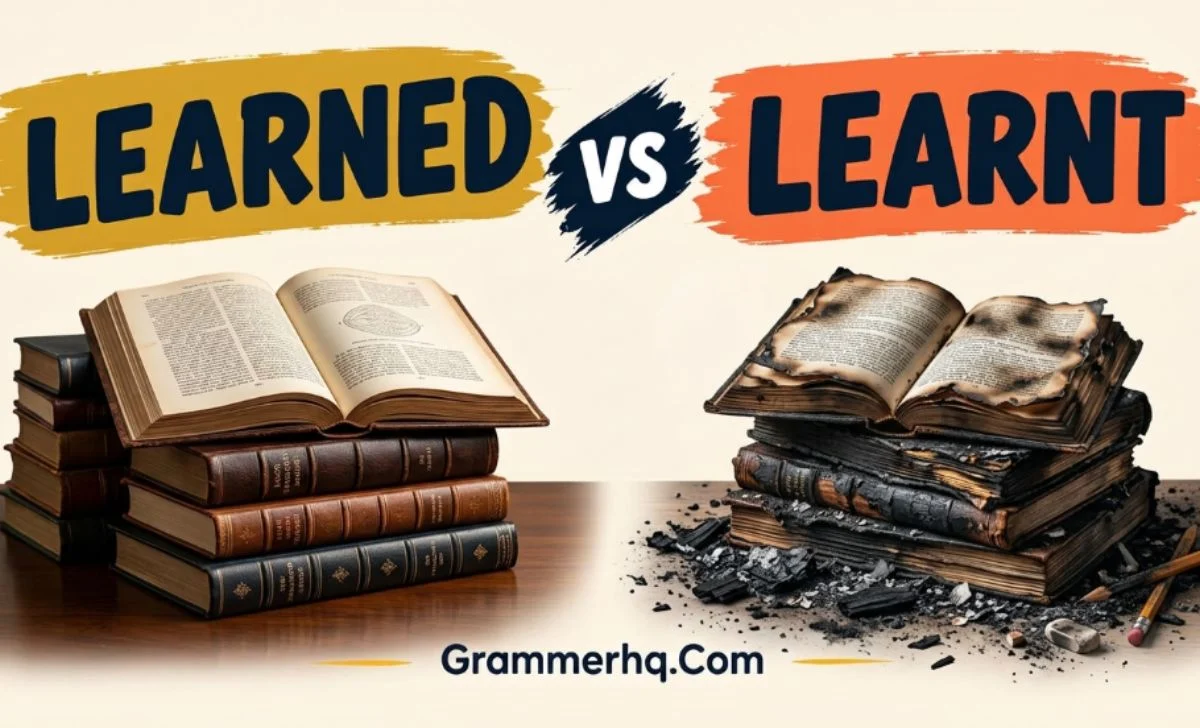
Have you ever written “I learned” and then wondered whether “I learnt” would be better? You are not alone. Both forms appear in books, websites, conversations, and professional writing, which can make this small difference surprisingly confusing.
The good news is simple: learned and learnt are both correct when they are used as the past tense or past participle of learn. The main difference is regional preference.
Learned is the usual form in American English, while learnt is especially common in British English. However, British English also uses learned, so the distinction is not an absolute rule.
There is another important detail: learned can also be an adjective meaning knowledgeable or scholarly. In that meaning, learnt cannot replace it.Let’s break down the difference so you can confidently choose the right form every time.
Quick Answer

Both “learned” and “learnt” are correct.
They are two accepted past forms of the verb learn.
| Word | Correct? | Typical usage |
|---|---|---|
| Learned | ✅ Yes | Standard in American English; also used in British English |
| Learnt | ✅ Yes | Especially common in British English |
For example:
- I learned something new today.
- I learnt something new today.
Both sentences mean the same thing.
The main difference is which form is preferred in a particular variety of English, rather than a difference in meaning.
The easiest rule
American English → learned is preferred.
British English → learnt is common, but learned is also correct.
And remember one special case:
Learned = knowledgeable or scholarly when used as an adjective.
What Does Learned Mean?
Learned is the -ed form of the verb learn.
It can work as both the simple past and past participle.
Learned as the simple past
I learned a new word yesterday.
The action happened in the past.
Learned as a past participle
I have learned a lot from this experience.
Here, learned is used with have.
More examples
She learned how to drive last year.
We learned an important lesson.
He learned the truth later.
They learned to work together.
In all of these examples, learned is a verb.
What Does Learnt Mean?
Learnt is another accepted past form of learn.
It has the same basic meaning as learned when used as a verb.
For example:
I learnt a valuable lesson.
She learnt how to swim.
We have learnt a great deal.
He learnt from his mistake.
There is no meaningful difference in the learning itself. The difference is primarily regional usage and style.
Learnt is particularly common in British English.
Learned vs Learnt: What Is the Difference?
The biggest difference is preference, not meaning.
Learned
Learned is the dominant form in American English.
I learned English at school.
She learned a new skill.
We learned about the problem yesterday.
Learnt
Learnt is especially common in British English.
I learnt English at school.
She learnt a new skill.
We learnt about the problem yesterday.
Both sets of sentences are grammatically correct.
However, there is an important nuance that is sometimes missed in simple grammar articles:
British English does not prohibit “learned.”
A British writer can use learned, while an American writer will normally prefer learned over learnt.
So this is better understood as a usage preference rather than a strict grammar rule.
Is Learned or Learnt More Correct?
Neither one is inherently “more correct.”
Both are standard forms of the verb learn.
What changes is the English variety being used.
If you are following American English conventions, learned is the natural choice.
If you are following British English conventions, learnt is very common, although learned is also accepted.
This is similar to other English variations where different forms survive in different regions.
The important thing is to avoid treating learnt as a misspelling. It is not.
Learned or Learnt in American and British English
Here is the practical difference:
| Situation | Better choice |
|---|---|
| American English | learned |
| British English | learnt is especially common |
| British English alternative | learned is also correct |
| Formal American writing | learned |
| Formal British writing | learnt or learned, depending on style |
| Adjective meaning “knowledgeable” | learned |
If you are writing for a specific publication, school, company, or audience, follow its established style.
Consistency matters more than trying to force one form everywhere.
When to Use Learned
Use learned when it fits the variety of English and style you are following.
It is especially appropriate when writing in American English.
Examples
I learned something interesting today.
She learned how to cook.
We learned the rules quickly.
He learned from his mistakes.
They learned about climate change in class.
Common expressions
You will also frequently see:
- lesson learned
- well learned
- learned behavior
- learned skill
- learned response
However, not every occurrence of learned has the same grammatical function. That becomes particularly important with the adjective learned.
When to Use Learnt
Use learnt when you are following a style in which this form is preferred, particularly British English.
Examples
I learnt something interesting today.
She learnt how to cook.
We learnt the rules quickly.
He learnt from his mistakes.
They learnt about climate change in class.
The meaning remains the same as the corresponding sentences with learned.
The Important Exception: Learned as an Adjective
This is the part you should not overlook.
Learned can be an adjective meaning knowledgeable, highly educated, or scholarly.
For example:
She is a learned scholar.
He is a learned professor.
The book was written by a learned historian.
Here, learned does not mean “learned something in the past.”
It describes someone who has extensive knowledge or education.
In this meaning, learnt cannot replace learned.
So:
✅ He is a learned scholar.
❌ He is a learnt scholar.
This gives us an important distinction:
learned = past form of learn
learned = knowledgeable or scholarly
The second use is specifically an adjective.
How Is Learned Pronounced?
There is an interesting pronunciation difference depending on how the word is being used.
When learned is the past tense or past participle of learn, it is normally pronounced as one syllable.
learned → similar to “lernd”
For example:
I learned the answer.
But when learned is an adjective meaning knowledgeable or scholarly, it is pronounced with two syllables.
learned → “LER-nid”
For example:
She is a learned professor.
This is an excellent clue for identifying the adjective.
Easy pronunciation rule
Verb: learned → one syllable
Adjective: learned → two syllables
Are Learned and Learnt Interchangeable?
In many sentences, yes.
When both words are being used as past forms of learn, they normally communicate the same meaning.
Compare:
I learned the lesson.
I learnt the lesson.
Or:
She has learned a lot.
She has learnt a lot.
The meaning is essentially unchanged.
But they are not interchangeable when learned is being used as the adjective meaning knowledgeable.
That is why context matters.
Learned or Learnt in the Past Tense
Both can be used as the simple past of learn.
Learned
I learned the answer yesterday.
Learnt
I learnt the answer yesterday.
Both describe an action that happened in the past.
The choice is mainly based on regional preference.
Learned or Learnt as a Past Participle
Both forms can also function as past participles.
For example:
I have learned a lot.
I have learnt a lot.
And:
She had learned the rules.
She had learnt the rules.
Again, the meaning is the same.
Lesson Learned or Lesson Learnt?
You may have seen both expressions:
lesson learned
and
lesson learnt
Both are correct.
Lesson learned
This is particularly natural in American English.
It was a difficult lesson learned.
Lesson learnt
This is particularly common in British English.
It was a difficult lesson learnt.
If you are following a British style guide, lesson learnt may feel more natural. In American writing, lesson learned is generally preferred.
Learned From or Learnt From?
Both constructions are correct.
I learned from my mistakes.
I learnt from my mistakes.
The word from does not change the choice.
The difference remains the same: learned is the more typical American form, while learnt is especially common in British usage.
Learned to or Learnt to?
Again, both are correct.
She learned to drive.
She learnt to drive.
He learned to play the piano.
He learnt to play the piano.
There is no grammatical rule that makes one version universally correct.
Learned About or Learnt About?
Both are possible.
We learned about history.
We learnt about history.
The same regional preference applies.
If you are writing in American English, learned about is the natural choice.
In British English, learnt about is common.
Common Mistakes With Learned and Learnt
1: Thinking Learnt Is a Spelling Error
It is not.
Learnt is a legitimate English word and a standard past form of learn, particularly common in British English.
2: Saying Learned Is Wrong in British English
That is also incorrect.
British English uses learned as well as learnt.
The difference is preference and frequency, not a strict right-versus-wrong rule.
3: Using Learnt as the Adjective
When you mean knowledgeable or scholarly, use learned.
✅ a learned professor
❌ a learnt professor
4: Mixing Regional Styles Randomly
Using both forms is not automatically grammatically wrong.
However, if your article, essay, or website follows a particular English variety, consistent usage creates a more polished result.
5: Assuming Every Learned Has the Same Pronunciation
It does not.
The verb form and adjective form of learned can have different pronunciations.
A Simple Trick to Remember Learned vs Learnt
Use this three-step rule:
1. Talking about the action of learning?
Both are possible.
I learned something.
I learnt something.
2. Writing mainly in American English?
Choose:
learned
3. Writing in British English?
learnt is very common, but learned is also acceptable.
And if learned means “knowledgeable”?
Choose:
learned, not learnt.
Learned or Learnt Examples
Here are some quick comparisons:
| Meaning | Example with Learned | Example with Learnt |
|---|---|---|
| Past learning | I learned the answer. | I learnt the answer. |
| New skill | She learned to swim. | She learnt to swim. |
| Experience | He learned from his mistake. | He learnt from his mistake. |
| Education | We learned about history. | We learnt about history. |
| New information | They learned the truth. | They learnt the truth. |
| Present perfect | I have learned a lot. | I have learnt a lot. |
| Past perfect | She had learned the lesson. | She had learnt the lesson. |
In each row, the two verb forms have essentially the same meaning.
Which One Should You Use?
If you are unsure, use the following guide.
Choose Learned if:
- You are writing in American English.
- Your audience expects American spelling conventions.
- Your organization uses learned consistently.
- You want the standard American form of the past tense.
Choose Learnt if:
- You are following British English conventions.
- Your publication or organization prefers learnt.
- You want to maintain consistency with surrounding British usage.
Always Choose Learned if:
You are using the adjective meaning knowledgeable or scholarly.
a learned professor
a learned writer
a learned scholar
Is Learned More Common Than Learnt?
The answer depends on where the English is being used.
In American English, learned is overwhelmingly the normal choice.
In British English, both forms occur, with learnt being especially common.
Therefore, saying that one form is universally more common would miss the regional nature of the distinction.
The safest approach is to identify your target variety first and then maintain consistency.
Why Do English Speakers Use Both Forms?
The two forms reflect the way English has historically developed different past-tense patterns.
English has retained several verbs with competing -ed and -t forms. Examples include:
- learned / learnt
- burned / burnt
- dreamed / dreamt
- spelled / spelt
- smelled / smelt
Some varieties favor one form, while others retain both.
That is why learnt is not an incorrect or incomplete version of learned. It is an established form that remains particularly strong in British English.
FAQs
1: Is learned or learnt correct?
Both are correct as past forms of learn. Learned is standard in American English, while learnt is especially common in British English.
2: Is learnt a real word?
Yes. Learnt is a standard past-tense and past-participle form of learn.
3: Is learned correct in British English?
Yes. British English uses both learned and learnt, although learnt is especially common.
4: Which is better, learned or learnt?
Neither is universally better. Use learned for American English and learnt when following a British style that prefers it.
5: Is “lesson learned” correct?
Yes. Lesson learned is correct and particularly common in American English.
6: Is “lesson learnt” correct?
Yes. Lesson learnt is also correct and especially common in British English.
7: Can I use learned and learnt in the same sentence?
It is grammatically possible, but there is usually no reason to switch between them. Consistent style is preferable.
8: Is learned an adjective?
Yes. Learned can mean knowledgeable, educated, or scholarly.
9: Can learnt mean knowledgeable?
No. When you mean knowledgeable or scholarly, use learned.
10: Do learned and learnt mean the same thing?
As past forms of the verb learn, they have essentially the same meaning. Their main difference is regional preference.
11: How do you pronounce learned?
As the past form of learn, learned is normally one syllable. As the adjective meaning knowledgeable, it is pronounced with two syllables.
12: Should I use learned or learnt in formal writing?
Both can be appropriate. The best choice depends on the English variety and style guide you are following.
Final Verdict
Learned and learnt are both correct.
When they function as the past tense or past participle of learn, they have the same basic meaning. The main difference is regional usage:
Learned is the standard and strongly preferred form in American English.Learnt is especially common in British English, although learned is also correct in British English.
There is one important exception: when learned is an adjective meaning knowledgeable, educated, or scholarly, learnt cannot replace it.
So if you are writing: I learned something new.
or
I learnt something new.
both are correct.
But if you write:
She is a learned scholar.
only learned works in that meaning.
The easiest takeaway
Past form of learn → learned or learnt
American English → learned
British English → learnt is common; learned is also correct
Knowledgeable/scholarly → learned
Once you remember those four points, the learned vs learnt confusion becomes much easier to handle.
Read More Blogs
- Habit vs Habbit: Which Is Correct? Spelling, Meaning & Examples
- Swiftie vs Swifty: Which Spelling Is Correct?

Hi, I’m Amelia Parker, a grammar enthusiast and writer at GrammarHQ.com. I specialize in explaining spelling differences, confusing words, and common English mistakes through simple, practical, and easy-to-understand guides.