Mold or mould—which spelling is correct? If you have seen both versions in books, websites, or everyday writing, the difference can look like a simple spelling mistake. It is not.
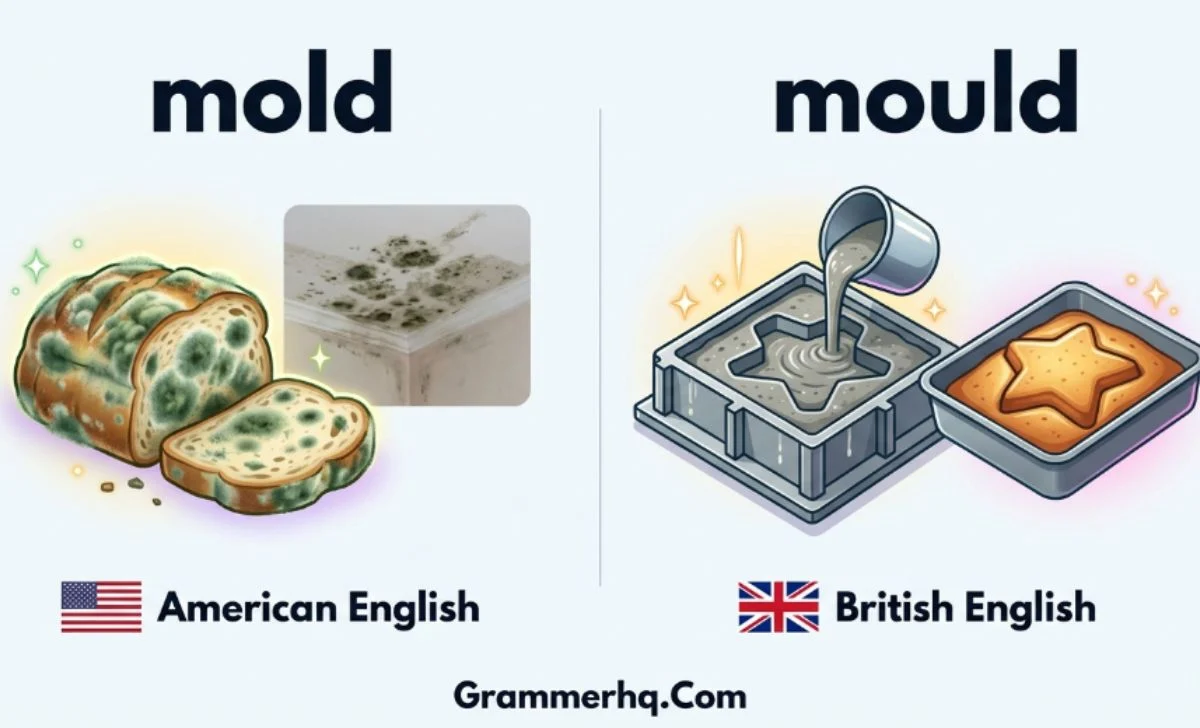
Mold and mould are both correct. The main difference is regional: mold is the standard American English spelling, while mould is the standard British English spelling.
The words can describe fungal growth, a container used to shape something, or the process of shaping and influencing something.
So, which one should you use? The answer depends on the English variety and audience you are writing for. Once you choose one, keep the same spelling throughout your writing.
Quick Answer
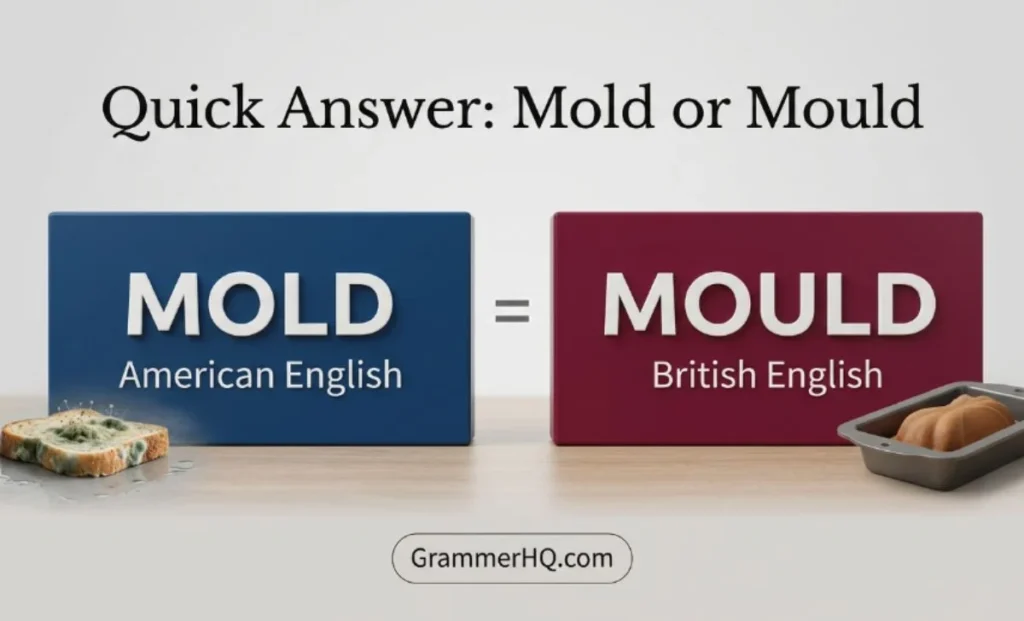
Mold is the preferred American English spelling, while mould is the preferred British English spelling.
| Question | Answer |
|---|---|
| American English | mold |
| British English | mould |
| Do they mean the same thing? | Yes, generally |
| Do they sound different because of spelling? | No |
| Is either spelling wrong? | No |
| Molded or moulded? | molded US / moulded UK |
| Molding or moulding? | molding US / moulding UK |
Cambridge lists mold as the US spelling of mould and mould as the UK spelling of mold. Merriam-Webster likewise describes mould as a chiefly British spelling of mold.
Simple rule:
🇺🇸 American English → mold
🇬🇧 British English → mould
What Is the Difference Between Mold and Mould?
The difference is primarily regional spelling, not a difference in meaning.
For example:
American English:
There is mold on the bread.
British English:
There is mould on the bread.
Both sentences describe the same thing.
The same distinction appears when the word is used as a verb:
American English:
The artist molded the clay into a bowl.
British English:
The artist moulded the clay into a bowl.
The important point is that mold and mould belong to different spelling conventions of English. Neither should automatically be labeled a misspelling.
What Does Mold or Mould Mean?
The word has several related meanings. Knowing the context makes its use much easier.
1. Mold or Mould as Fungal Growth
In the most common everyday sense, mold/mould refers to a fungus that can grow on food, damp walls, and other materials, particularly in warm or moist conditions.
Examples:
The bread developed mold after several days.
We discovered mould behind the cupboard.
Moisture can encourage mold growth.
The bathroom needs better ventilation to prevent mould.
Oxford defines this sense as a fine green, grey, or black fungal growth that can develop on old food or objects left in warm, wet air.
Related terms include:
- mold growth / mould growth
- mold spores / mould spores
- moldy / mouldy
- mold removal / mould removal
- mold problem / mould problem
2. Mold or Mould as a Container or Form
Mold/mould can also mean a hollow container used to give a soft or liquid material a particular shape.
This meaning is common in:
- baking
- cooking
- pottery
- sculpture
- manufacturing
- metal casting
- plastics
For example:
Pour the chocolate into the mold.
Pour the chocolate into the mould.
The statue was cast in a stone mold.
The workers poured the material into a mould.
Cambridge and Oxford both list this as a separate noun meaning involving a container or form used to shape a substance.
3. Mold or Mould as a Verb
As a verb, mold/mould means to shape something into a particular form.
For example:
She molded the clay into a small bowl.
British English:
She moulded the clay into a small bowl.
The word can also mean to influence or shape someone’s character, ideas, or development.
Her experiences molded her approach to teaching.
His childhood moulded the way he viewed the world.
Cambridge includes both the physical meaning of shaping a material and the figurative meaning of trying to change or influence someone.
4. Mold or Mould as a Type, Pattern, or Character
The word can also describe a particular type, style, or pattern.
For example:
She does not fit the traditional mold of a politician.
British English:
She does not fit the traditional mould of a politician.
This meaning appears in expressions such as:
- in the mold of
- in the mould of
- cast in the same mold
- cast in the same mould
- break the mold
- break the mould
Oxford lists this figurative sense as a particular style or set of characteristics typical of someone or something.
Mold vs Mould in American and British English
The easiest way to remember the spelling is to connect it with the broader English variety you are using.
American English: Mold
American English normally uses:
- mold
- molds
- molded
- molding
- moldy
- molder
Examples:
The cake was baked in a silicone mold.
The experience molded his personality.
The wall has a serious mold problem.
British English: Mould
British English normally uses:
- mould
- moulds
- moulded
- moulding
- mouldy
- moulder
Examples:
The cake was baked in a silicone mould.
The experience moulded his personality.
The wall has a serious mould problem.
Merriam-Webster lists mold with forms such as molded and molding, while noting British mould as the corresponding variant.
Do Mold and Mould Have Different Pronunciations?
No. The spelling difference does not create a different word pronunciation.
Cambridge gives:
- UK: /məʊld/
- US: /moʊld/
The slight difference in the vowel reflects the normal pronunciation differences between British and American English—not the addition or removal of the letter u.
A simple pronunciation guide is:
mold / mould → “mohld”
So you do not need to pronounce mould as a completely different word.
Mold or Mould in Different English-Speaking Countries
It is tempting to divide English into “American” and “British” and assume every country follows one side perfectly. Real-world usage can be more complicated.
For practical writing, the safest approach is to consider your target audience, publication, institution, and style guide.
If You Are Writing for the United States
Use:
mold, molded, molding, moldy
If You Are Writing for the United Kingdom
Use:
mould, moulded, moulding, mouldy
If You Are Writing for Another English-Speaking Audience
Check the spelling convention used by the organization, publisher, school, or style guide you are following.
This is especially important in:
- academic writing
- journalism
- professional documents
- government publications
- international websites
- edited publications
The goal is consistent regional English, not simply choosing the spelling that looks more familiar.
Mold vs Mould: Related Word Forms
Once you understand the basic difference, the related forms become much easier.
| American English | British English |
|---|---|
| mold | mould |
| molds | moulds |
| molded | moulded |
| molding | moulding |
| moldy | mouldy |
| molder | moulder |
For example:
US:
The machine molded the plastic parts.
UK:
The machine moulded the plastic parts.
US:
The molding process requires careful temperature control.
UK:
The moulding process requires careful temperature control.
Cambridge and Merriam-Webster both support the US/UK distinction in these related forms.
Mold or Mould Examples in Real Life
The word appears in several everyday situations.
Food
American:
I threw away the bread because it had mold on it.
British:
I threw away the bread because it had mould on it.
Home
American:
We found mold around the bathroom window.
British:
We found mould around the bathroom window.
Cooking
American:
Grease the cake mold before adding the batter.
British:
Grease the cake mould before adding the batter.
Manufacturing
American:
The plastic is heated before it is placed in the mold.
British:
The plastic is heated before it is placed in the mould.
Personal Development
American:
Early experiences can mold a child’s personality.
British:
Early experiences can mould a child’s personality.
Figurative Use
American:
She is a scientist in the mold of her famous mentor.
British:
She is a scientist in the mould of her famous mentor.
These examples demonstrate an important point: the spelling changes with the English variety, while the underlying meaning remains the same.
Common Mistakes With Mold and Mould
1: Calling “Mould” a Misspelling.
Mould is not a misspelling.
It is the standard British spelling.
Correct:
There is mould on the wall.
2: Calling “Mold” Incorrect.
Mold is not incorrect.
It is the standard American spelling.
Correct:
There is mold on the wall.
3: Mixing Regional Forms.
A writer should avoid switching between US and UK spelling without a reason.
For example:
The plastic was moulded into a mold.
If the document is intended to follow American English, use:
The plastic was molded into a mold.
If it follows British English, use:
The plastic was moulded into a mould.
The problem is not that either individual word is wrong. The problem is inconsistent spelling conventions.
4: Assuming the Meaning Changes.
Adding or removing the u does not normally change the meaning.
Mold and mould can both refer to fungus, a shaping container, the act of shaping, or a figurative type or pattern.
Mold or Mould: Which Spelling Should You Use?
Use this simple decision rule.
Choose “Mold” If:
- You are writing American English.
- Your main audience is in the United States.
- Your publication follows US spelling.
- Your style guide uses American English.
Examples:
mold growth
mold removal
molded plastic
molding process
Choose “Mould” If:
- You are writing British English.
- Your main audience is in the United Kingdom.
- Your publication follows British spelling.
- Your style guide uses British English.
Examples:
mould growth
mould removal
moulded plastic
moulding process
Writing for an International Audience?
Choose one English variety based on your publication or primary audience, then use it consistently.
You do not need to write both forms every time.
For example, if your website uses American English throughout, simply use mold naturally and mention mould once when explaining the regional difference.
Is Mold or Mould More Common?
Neither spelling is universally “more correct.”
The apparent frequency depends heavily on where the English is being used.
In American English, mold is the normal form. In British English, mould is the normal form. Cambridge explicitly labels the forms by regional usage.
That means a searcher in the United States may naturally type mold, while someone accustomed to British English may search for mould.
For writers, the useful question is therefore not:
“Which spelling is more common worldwide?”
It is:
“Which spelling matches my audience?”
That is the spelling you should normally use.
Why Do Mold and Mould Have Different Spellings?
The two spellings reflect the broader historical development of English on different sides of the Atlantic.
English has accumulated spelling variations over centuries, and American English developed some forms that differ from British conventions. Mold/mould fits the same general pattern seen in other US/UK spelling pairs.
Compare:
- color / colour
- favor / favour
- honor / honour
- labor / labour
Merriam-Webster traces mold through Middle English and earlier forms, including a sense related to form or shape, while modern dictionaries preserve mould as the British spelling.
So the extra u in mould is not a random addition. It is part of a broader regional spelling tradition.
Mold vs Mould vs Molded vs Moulded: Quick Comparison
| Form | American English | British English |
|---|---|---|
| Base word | mold | mould |
| Plural | molds | moulds |
| Past tense | molded | moulded |
| Past participle | molded | moulded |
| -ing form | molding | moulding |
| Adjective | moldy | mouldy |
| Related noun | molder | moulder |
Easy Memory Trick
Think of the British spelling as keeping the u:
mould → moulded → moulding → mouldy
American English drops it:
mold → molded → molding → moldy
This is not a rule for every English spelling difference, but it works neatly for this word family.
FAQs
1: Is mold or mould correct?
Both are correct. Mold is the standard American English spelling, while mould is the standard British English spelling.
2: Is mould British or American?
Mould is the British English spelling. American English normally uses mold.
3: Is mold American English?
Yes. Mold is the standard American English form of British mould.
4: Do mold and mould mean the same thing?
Yes. They can refer to fungal growth, a container used to shape something, the act of shaping something, or a particular type or pattern.
5: Do mold and mould sound the same?
Yes, essentially. Cambridge lists UK /məʊld/ and US /moʊld/. The vowel reflects the accent rather than the spelling difference itself.
6: Is “mold” correct in British English?
British English normally uses mould. If you are following British spelling, mould is the appropriate choice.
7: Is “mould” correct in American English?
American English normally uses mold. Mould is recognized as the British spelling.
8: Is it molded or moulded?
Use molded in American English and moulded in British English.
9: Is it molding or moulding?
Use molding in American English and moulding in British English.
10: What is the plural of mold or mould?
The American plural is molds. The British plural is moulds.
11: Is mold a noun or a verb?
It can be both. As a noun, it can mean fungal growth or a form used for shaping something. As a verb, it can mean to shape or influence something.
12: Which spelling should I use in academic writing?
Follow the spelling convention required by your university, journal, publisher, or style guide. If no specific rule is given, choose the English variety appropriate for your intended audience and remain consistent.
Conclusion
Mold and mould are both correct. The difference is mainly regional: mold is the standard American English spelling, while mould is the standard British English spelling.
Both can describe fungal growth, a shaping container, the act of shaping something, or a figurative type or pattern. Their related forms follow the same pattern: molded/moulded, molding/moulding, and moldy/mouldy.
If you are unsure which version to choose, identify your audience first. Then use the spelling that matches your English variety and keep it consistent.
Quick rule: American English → mold. British English → mould.
Editorial Note
Definitions, regional labels, pronunciation, and related forms in this guide were checked against current entries from Cambridge Dictionary, Oxford Learner’s Dictionaries, and Merriam-Webster.
Read More Blogs:

Hi, I’m Amelia Parker, a grammar enthusiast and writer at GrammarHQ.com. I specialize in explaining spelling differences, confusing words, and common English mistakes through simple, practical, and easy-to-understand guides.