Many English learners stop when they reach the past tense of sneak. Should you write sneaked or snuck?
Both words appear in books, newspapers, and daily conversations, which makes the choice confusing. Some teachers say only sneaked is correct, while others accept snuck without question.
People search for “Sneaked or Snuck” because they want to avoid grammar mistakes in school, business emails, academic writing, and everyday communication.
They also want to know which form is preferred in American English and British English.
This guide clears up the confusion. You will learn the difference, pronunciation, history, usage rules, examples, and the best choice for different audiences.
Sneaked or Snuck – Quick Answer
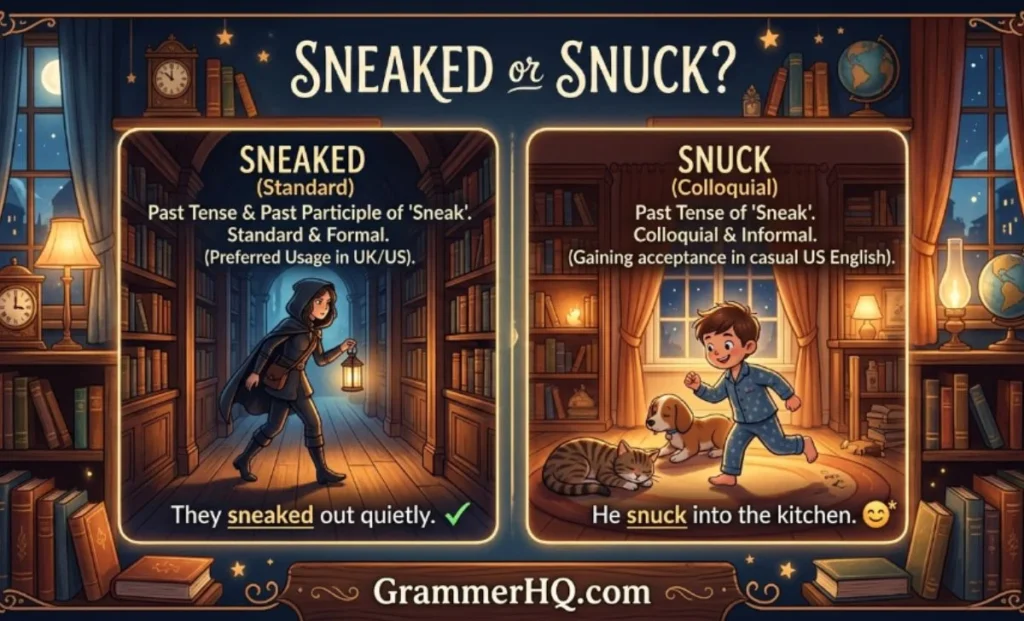
Both sneaked and snuck are correct past tense forms of the verb sneak.
- Sneaked is the traditional and more formal form.
- Snuck is widely accepted, especially in American English.
Examples:
- She sneaked into the kitchen for a midnight snack.
- He snuck out of the house after dinner.
In formal or academic writing, many editors still prefer sneaked. In everyday American conversation, snuck is very common.
Quick Comparison Table
| Feature | Sneaked | Snuck |
|---|---|---|
| Grammar status | Correct | Correct |
| Formality | More formal | More informal |
| Traditional usage | Yes | No |
| Common in American English | Yes | Very common |
| Common in British English | Very common | Less common |
| Academic preference | Preferred | Sometimes avoided |
Pronunciation of Sneaked or Snuck
Correct pronunciation helps avoid confusion when speaking.
Sneaked
Pronunciation: /sneekt/
It sounds like:
“sneekt”
The ending sounds similar to:
- leaked
- peaked
- freaked
Snuck
Pronunciation: /snʌk/
It sounds like:
“snuk”
The vowel sound is the same as in:
- luck
- truck
- duck
Spoken Confusion
People often confuse these words because they refer to the same action. Native speakers may use one form more often depending on where they live.
For example:
- Americans frequently say, “He snuck in.”
- British speakers often say, “He sneaked in.”
Both pronunciations are accepted by major dictionaries.
Why People Confuse Sneaked or Snuck

Many English users struggle with these words for several reasons.
1. Both Forms Are Correct
Most grammar choices have one right answer and one wrong answer. Here, both forms are accepted.
This creates uncertainty.
2. Regional Differences
American and British English use different preferences.
Americans hear snuck often.
British speakers hear sneaked more frequently.
3. Similar Verb Patterns
English contains irregular verbs like:
- stick → stuck
- strike → struck
- dig → dug
Because of these patterns, many people naturally expect:
sneak → snuck
4. School Grammar Rules
Older grammar books taught only sneaked.
Modern dictionaries accept both forms, which can confuse learners.
5. Formal vs Informal Writing
Writers are unsure which version sounds professional.
As a result, they search online before publishing content.
Easy Trick to Remember Sneaked or Snuck
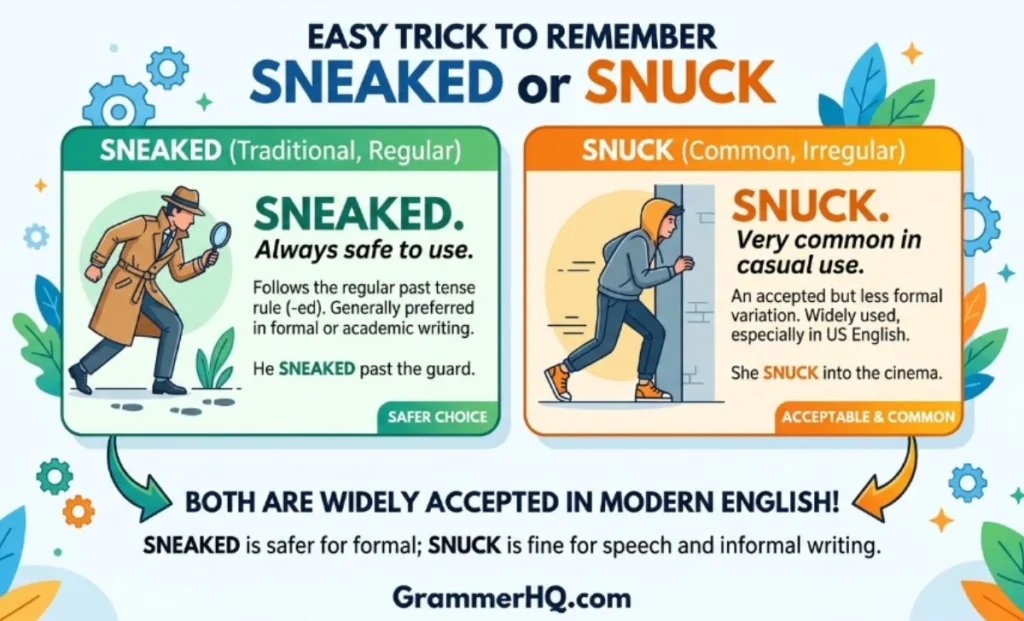
A simple memory trick can help.
Use This Rule:
Formal = Sneaked
Casual American speech = Snuck
Memory Trick
Think:
“Sneaked for school, Snuck for stories.”
If you are writing:
- essays
- reports
- business emails
- academic papers
Choose sneaked.
If you are writing:
- dialogue
- fiction
- social media posts
- casual messages
You can safely use snuck, especially for American readers.
Another easy trick:
If you are unsure, use sneaked because it works everywhere.
The Origin of Sneaked or Snuck
Understanding the history explains why two forms exist.
The verb sneak first appeared in English during the late sixteenth century.
Originally, the past tense was only:
sneaked
English speakers used this form for hundreds of years.
Later, around the nineteenth century, many Americans began using snuck.
Why?
English speakers often create new irregular forms by analogy.
Examples include:
- strike → struck
- stick → stuck
- sling → slung
People naturally formed:
sneak → snuck
At first, many grammar experts criticized this new form.
However, usage grew steadily.
Today, leading dictionaries such as:
- Merriam-Webster
- Oxford English Dictionary
- Cambridge Dictionary
recognize both forms as standard English.
This evolution shows how language changes over time.
British English vs American English Spelling
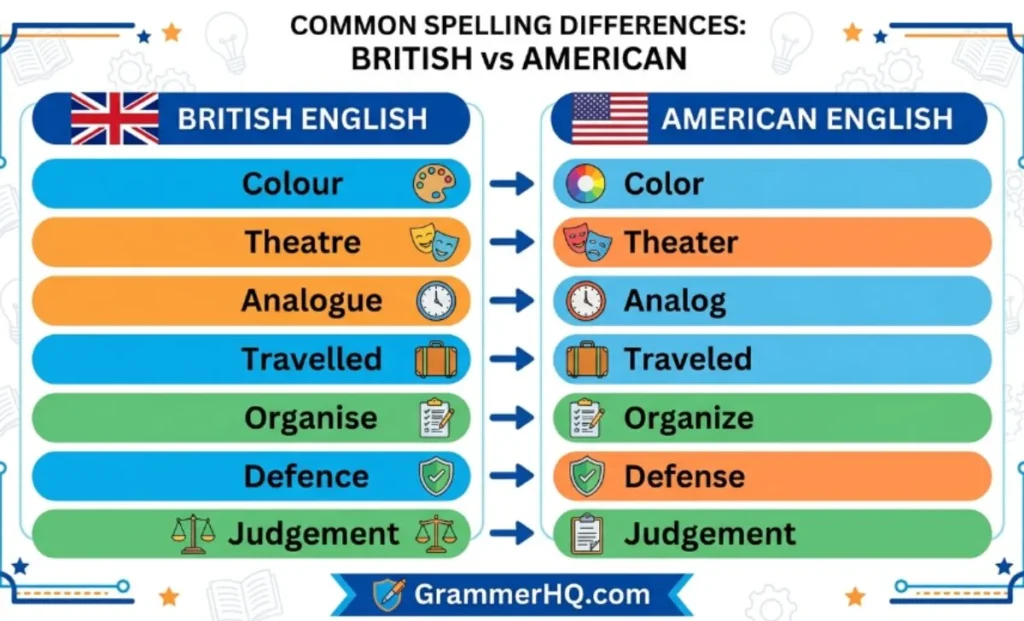
Regional preferences play a major role.
American English
American speakers commonly use both forms.
However, snuck appears very frequently in speech and informal writing.
Examples:
- The child snuck downstairs.
- Someone snuck into the stadium.
British English
British English traditionally prefers sneaked.
Examples:
- The cat sneaked through the garden.
- He sneaked away quietly.
British writers may still use snuck, but it appears less often.
Comparison Table
| Situation | American English | British English |
|---|---|---|
| Daily conversation | Snuck common | Sneaked preferred |
| Newspapers | Both | Mostly sneaked |
| Academic writing | Sneaked preferred | Sneaked preferred |
| Business communication | Sneaked | Sneaked |
| Fiction dialogue | Both | Both |
Example Sentences
US Example:
“He snuck into the movie theater.”
UK Example:
“He sneaked into the cinema.”
Both sentences are grammatically correct.
Which Spelling Should You Use?
The best choice depends on your audience.
Use Sneaked When:
- Writing essays.
- Writing academic papers.
- Creating business documents.
- Publishing global content.
- Unsure about audience location.
Use Snuck When:
- Writing for American readers.
- Creating fiction dialogue.
- Writing casual blog posts.
- Posting on social media.
- Mimicking everyday speech.
Audience-Based Advice
| Audience | Recommended Form |
|---|---|
| United States | Sneaked or Snuck |
| United Kingdom | Sneaked |
| Canada | Mostly Sneaked |
| Australia | Sneaked |
| International audience | Sneaked |
| Academic readers | Sneaked |
Professional writers often choose sneaked because it sounds more formal and universally accepted.
Common Mistakes with Sneaked or Snuck
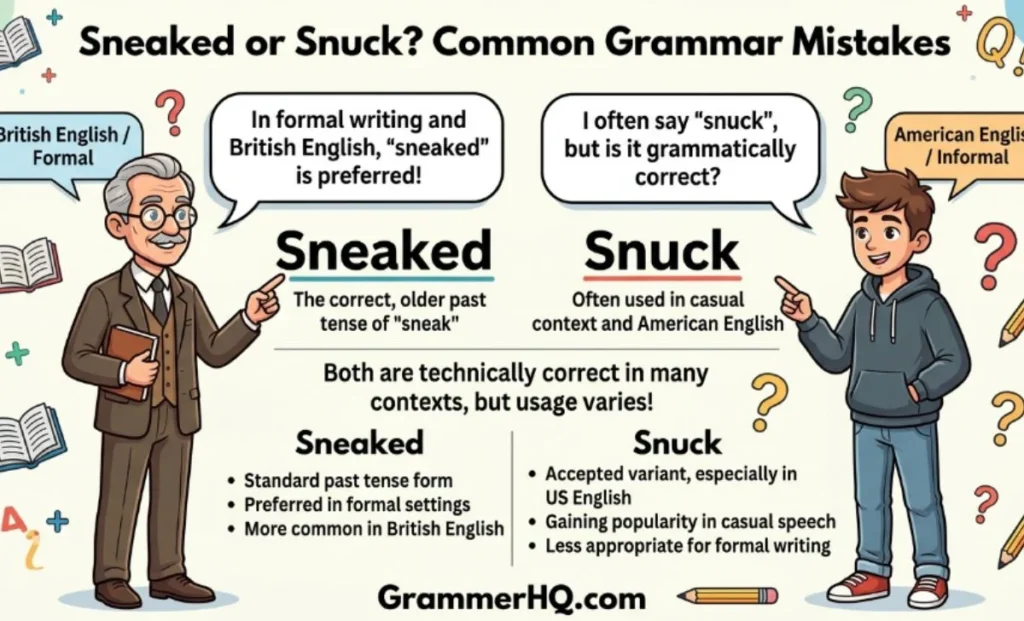
Many writers make avoidable errors.
Mistake 1: Thinking Snuck Is Wrong
❌ Incorrect belief:
“Snuck is not a real word.”
✅ Correct:
“Snuck is a recognized English word.”
Mistake 2: Using Both in One Sentence
❌ Wrong:
“He sneaked and snuck into the room.”
✅ Better:
“He sneaked into the room.”
or
“He snuck into the room.”
Mistake 3: Using Snuck in Highly Formal Writing
Although accepted, some academic editors still dislike snuck.
Safer choice:
✅ Use sneaked.
Mistake 4: Confusing Tense Forms
Correct verb forms:
| Verb Form | Word |
|---|---|
| Base verb | Sneak |
| Present participle | Sneaking |
| Past tense | Sneaked / Snuck |
| Past participle | Sneaked / Snuck |
Examples:
- She is sneaking out.
- She has sneaked out.
- She has snuck out.
Sneaked or Snuck in Everyday Examples
Understanding real-life usage makes the difference clear.
In Emails
Formal email:
“I noticed someone had sneaked changes into the report.”
In News Writing
“Officials said protesters had sneaked into the restricted area.”
Many news organizations prefer sneaked because of its formal tone.
In Social Media
“Who snuck the snacks into the cinema?”
Social media users commonly choose snuck.
In Fiction
“The spy snuck past the guards.”
Writers often use snuck because it sounds natural in dialogue.
In Academic Writing
“The researcher sneaked additional observations into the appendix.”
Academic style guides generally favor sneaked.
Everyday Conversation Examples
- My dog snuck onto the sofa.
- The children sneaked cookies before dinner.
- He snuck out quietly.
- She sneaked into the room unnoticed.
- We snuck backstage after the concert.
- They sneaked through the crowd.
Sneaked or Snuck – Google Trends & Usage Data
Usage patterns differ around the world.
United States
Search and usage data show that snuck is extremely popular in the United States.
American speakers use it regularly in speech, television, films, and online conversations.
United Kingdom
British users overwhelmingly prefer sneaked.
Schools and publishers also favor this traditional form.
Australia and New Zealand
Writers generally choose sneaked, although snuck occasionally appears.
Canada
Canadian English accepts both forms, but sneaked remains more common in formal contexts.
General Trend
Language experts have observed that:
- Sneaked remains dominant in formal writing.
- Snuck continues to grow in informal American English.
As language evolves, acceptance of snuck has increased significantly.
Sneaked vs Snuck Comparison Table
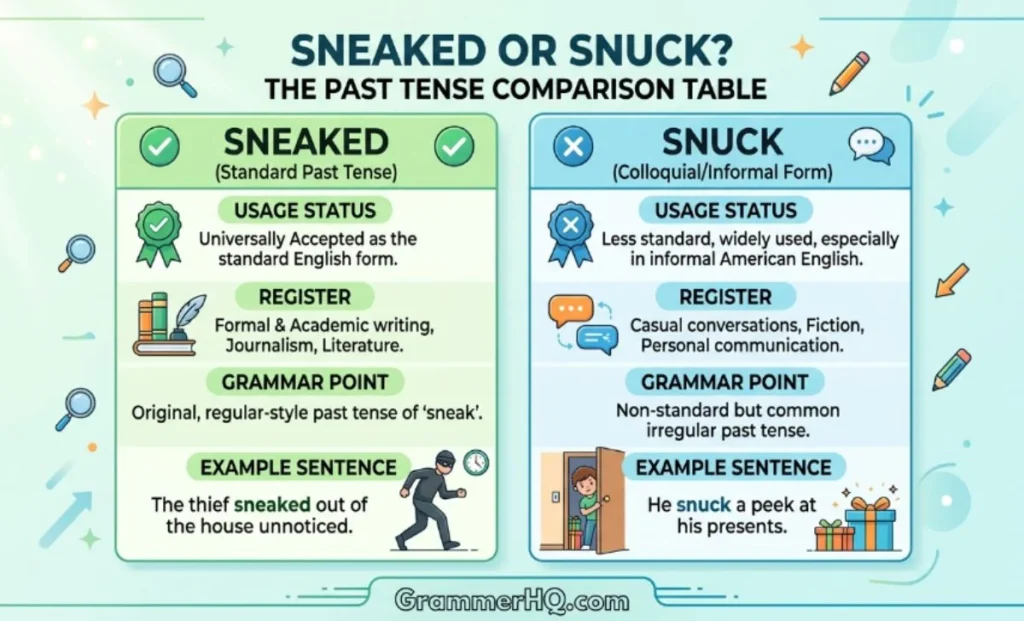
| Category | Sneaked | Snuck |
|---|---|---|
| Meaning | Past tense of sneak | Past tense of sneak |
| Correctness | Correct | Correct |
| Formality | Formal | Informal |
| Origin | Traditional | Later development |
| US Usage | Common | Very common |
| UK Usage | Preferred | Less common |
| Business Writing | Recommended | Less preferred |
| Academic Writing | Recommended | Sometimes avoided |
| Conversation | Natural | Very natural |
| Global Audience | Best choice | Less universal |
FAQs
Is it sneaked or snuck?
Both are correct. Sneaked is more formal, while snuck is common in American English.
Is snuck grammatically correct?
Yes. Major dictionaries recognize snuck as a standard English word.
Which is more formal: sneaked or snuck?
Sneaked is generally considered more formal.
Do British people say snuck?
Some do, but British English strongly prefers sneaked.
What is the past participle of sneak?
Both sneaked and snuck can function as past participles.
Should I use snuck in academic writing?
Most academic editors recommend using sneaked.
Why do Americans say snuck?
American speakers developed snuck by analogy with irregular verbs such as stick–stuck and strike–struck.
Conclusion:
The debate over Sneaked or Snuck has a simple answer: both forms are correct. The main difference lies in style, audience, and region.
Sneaked is the older and more traditional form. It remains the safest choice for formal writing, academic work, and international audiences.
Snuck, on the other hand, is widely accepted and extremely common in American English, especially in everyday speech and informal writing.
When choosing between the two, think about who will read your work. If you want a universally accepted option, choose sneaked.
If you are writing casually for American readers, snuck sounds natural and conversational. Understanding these differences will help you write with confidence and avoid unnecessary grammar confusion.
Read More Blogs:
- Is It Fulfill or Fulfil? The Correct Spelling You Need to Know
- Sung or Sang: What’s the Difference and Which One Is Correct?