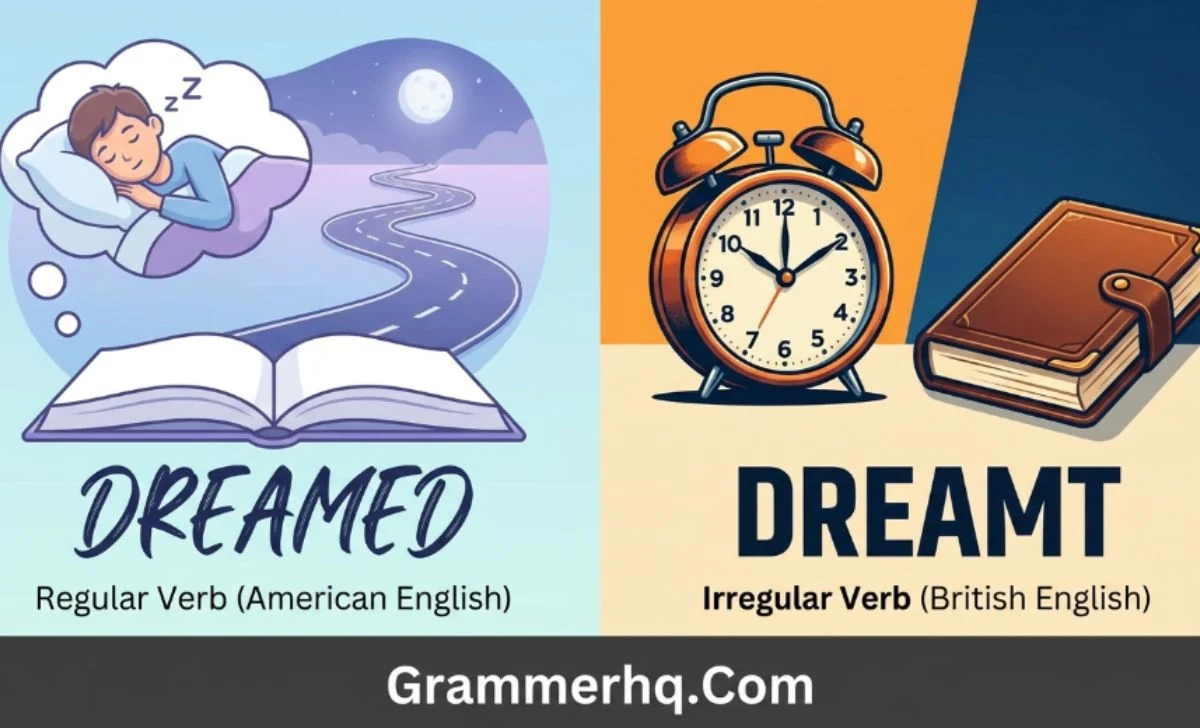
Dreamed vs dreamt is a common English usage question, but the answer is simple: both forms are correct. They are two accepted past forms of the verb dream, so neither one is a spelling mistake.
Dreamed is especially common in American English, while dreamt is particularly common in British English. But the boundary is not absolute: British writers can use dreamed, and American writers can use dreamt.
So if you have ever stopped while writing “I about it last night”, wondering which form belongs in the blank, you do not need to worry about choosing a “correct” form and a “wrong” one.
Both work.The better question is: Which form sounds right for your audience and the kind of English you are using?
Quick Answer
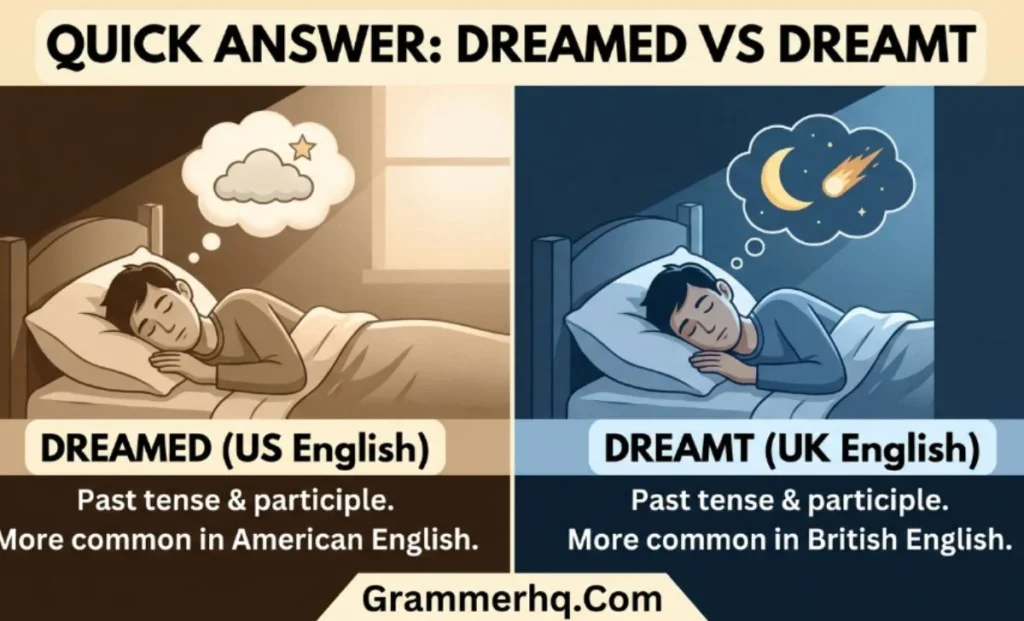
Both dreamed and dreamt are correct past forms of dream.
| Form | Correct? | Common preference |
|---|---|---|
| dreamed | Yes | Especially common in American English |
| dreamt | Yes | Especially common in British English |
For example:
I dreamed about my old school last night.
I dreamt about my old school last night.
Both sentences are grammatically correct and have the same basic meaning.
If you are writing in American English, dreamed is usually the safer natural choice. If you are writing in British English, dreamt is a very natural choice, although dreamed is also correct.
What Is the Difference Between Dreamed and Dreamt?
The two words are different forms of the same verb.
Dreamed is the regular -ed form:
dream → dreamed
Dreamt is the shorter irregular form:
dream → dreamt
In ordinary use, changing one for the other does not normally change the meaning.
Compare:
She dreamed of becoming a writer.
She dreamt of becoming a writer.
Both mean that she had the ambition or hope of becoming a writer.
The real distinction is therefore not meaning but usage and preference.
Is Dreamed or Dreamt the Past Tense of Dream?
Both are past-tense forms of dream.
You can say:
I dreamed about flying.
or:
I dreamt about flying.
You can also use either form when describing a past ambition:
He dreamed of playing professional football.
He dreamt of playing professional football.
There is no grammatical rule saying that only one of these forms can be used.
Dreamed and Dreamt as Past Participles
Both forms can also work as the past participle of dream.
This becomes important with have, has, and had.
With have or has
I have dreamed about that place many times.
I have dreamt about that place many times.
With had
She had dreamed of opening a bakery since childhood.
She had dreamt of opening a bakery since childhood.
So the basic forms are:
| Verb form | Correct form |
|---|---|
| Base form | dream |
| Simple past | dreamed / dreamt |
| Past participle | dreamed / dreamt |
| Present participle | dreaming |
| Third-person singular | dreams |
This is why dictionaries may list both dreamed and dreamt under the same verb.
Dreamed vs Dreamt in American and British English
This is where most of the confusion comes from.
American English: Dreamed
In American English, dreamed is generally the more common form.
For example:
I dreamed about my childhood home.
She dreamed of becoming a doctor.
If you are writing an American-style article, essay, email, or report, dreamed will usually sound natural.
British English: Dreamt
In British English, dreamt is particularly common.
For example:
I dreamt about my childhood home.
She dreamt of becoming a doctor.
But British English does not ban dreamed. You can still write:
She dreamed of becoming a doctor.
That sentence is correct.
The important distinction
It is better not to memorize this as:
dreamed = American
dreamt = British
That rule is too rigid.
A more accurate way to remember it is:
Dreamed is especially common in American English, while dreamt is especially common in British English. Both are standard forms.
Can You Use Dreamt in American English?
Yes.
Dreamt is not incorrect in American English. It is simply less common than dreamed in many contexts.
For example:
I dreamt about my grandfather last night.
There is nothing grammatically wrong with this sentence.
However, if you are writing specifically for an American audience and want your wording to match common American usage, dreamed is usually the more natural choice.
Can You Use Dreamed in British English?
Yes.
British English speakers and writers can use dreamed.
For example:
They dreamed of buying a house near the coast.
That sentence is perfectly acceptable.
If the surrounding text uses other British preferences, you may choose dreamt for consistency, but there is no grammar rule requiring it.
Dream About vs Dream Of
The expression that follows dream can affect the meaning.
Dream about
Dream about commonly refers to the subject or events experienced while sleeping.
I dreamed about my old teacher last night.
I dreamt about my old teacher last night.
Here, the speaker is talking about an actual dream during sleep.
Dream of
Dream of often refers to a hope, ambition, or something someone strongly wants.
She dreamed of becoming a pilot.
She dreamt of becoming a pilot.
Both forms are correct.
There can be overlap, though. Context determines the intended meaning.
For example:
I dreamed of my childhood home.
This can refer to seeing the home in a dream, while:
I dreamed of owning a beach house.
clearly expresses an ambition or desire.
Dreamed Up or Dreamt Up?
You may also see dreamed up and dreamt up.
Both are correct.
Here, dream up is a phrasal verb meaning to invent, imagine, or think of an idea.
For example:
The engineers dreamed up a simple solution.
The engineers dreamt up a simple solution.
The phrase does not necessarily involve sleeping. It describes creating an idea through imagination or thought.
Common Mistakes With Dreamed and Dreamt
Knowing that both forms are correct does not mean every sentence containing them will be correct.
1: “Dreamt is the only British form”
This is too absolute.
Dreamt is strongly associated with British English, but dreamed is also used in British English.
2: “Dreamed is only American”
Again, this is incorrect.
Dreamed is especially common in American English, but it is not restricted to the United States.
3: Using dreamed after “did”
This is a grammar problem rather than a choice between the two forms.
❌ Did you dreamed about me?
❌ Did you dreamt about me?
✅ Did you dream about me?
After did, use the base form of the verb.
The same principle applies to negatives:
I didn’t dream about anything.
Not:
I didn’t dreamed about anything.
4: Assuming the two forms have different meanings
Usually, they do not.
I dreamed about the ocean.
I dreamt about the ocean.
The meaning is essentially the same.
The difference lies mainly in form, regional usage, and style.
Dreamed vs Dreamt: Real-Life Examples
Here are some natural examples from everyday English.
Talking about a dream during sleep
I dreamed that I was flying over the city.
I dreamt that I was flying over the city.
Talking about a childhood ambition
As a child, she dreamed of becoming an astronaut.
As a child, she dreamt of becoming an astronaut.
Talking about a long-held goal
They had dreamed of starting their own company.
They had dreamt of starting their own company.
Talking about an imagined solution
She dreamed up a clever way to save time.
She dreamt up a clever way to save time.
Asking about a dream
Did you dream about the trip?
Notice that dream, not dreamed or dreamt, follows did.
Why Does English Have Two Past Forms of Dream?
English contains many verbs with more than one accepted past form. Dreamed developed as the regular -ed form, while dreamt belongs to the group of shorter irregular forms ending in -t.
This kind of variation is not unique to dream.
Compare:
- learned / learnt
- burned / burnt
- smelled / smelt
- spelled / spelt
Regional English has helped preserve different preferences for these forms.
That is why English can have two standard forms without one being an error.
Which One Should You Use?
If you need a simple practical rule, use this:
Choose “dreamed” if:
- You normally write in American English.
- You prefer the regular -ed form.
- You want a straightforward choice for a broad audience.
- Your writing already uses similar -ed forms.
Choose “dreamt” if:
- You normally write in British English.
- You prefer the shorter traditional form.
- It matches the style of the surrounding text.
- You want your writing to follow a British preference.
Most importantly, do not switch between the two just because you think one is grammatically superior. Both are legitimate.
A Simple Way to Remember the Difference
Think of the pair like this:
Dreamed → regular -ed form
Dreamt → shorter irregular form
Then remember the regional preference:
American English → dreamed is more common
British English → dreamt is especially common
But the final rule is even simpler:
Both are correct.
FAQs
1: Is “dreamed” correct?
Yes. Dreamed is a standard past-tense and past-participle form of dream.
2: Is “dreamt” correct?
Yes. Dreamt is also a standard form of dream and is especially common in British English.
3: Is dreamt British English?
It is strongly associated with British English, but it is not exclusively British.
4: Is dreamed American English?
It is especially common in American English, but it is also used in British English and other varieties.
5: Which is more common: dreamed or dreamt?
The answer depends on the variety of English. Dreamed is generally more common in American English, while dreamt is particularly common in British English.
6: Can I use dreamt in American English?
Yes. It is grammatically correct, although dreamed is generally the more common choice in American usage.
7: Can I use dreamed in British English?
Yes. British English also uses dreamed, so it is not an error.
8: What is the past tense of dream?
The past tense can be dreamed or dreamt.
9: What is the past participle of dream?
The past participle can also be dreamed or dreamt.
10: Is “dreamed up” correct?
Yes. Dreamed up is correct, and dreamt up is also correct. Both can mean “invented” or “imagined.”
11: Are dreamed and dreamt interchangeable?
In most ordinary grammatical contexts, yes. Both can express the past or completed form of dream, although one may sound more natural depending on regional English and style.
Final Verdict
Dreamed vs dreamt is not a case of right versus wrong. Both forms are correct.
Use dreamed if it fits your preferred variety of English, especially American English. Use dreamt if you prefer British English or the shorter traditional form. Neither choice changes the basic meaning of the verb.
So whether you write:
I dreamed about it last night.
or:
I dreamt about it last night.
your grammar is correct.
The best choice is the one that fits your audience, your variety of English, and your writing style.
Read More Blogs:
- Tearing or Taring: What Is the Difference?
- Which or Wich? Correct Spelling, Meaning, Origin & Examples