The difference between adapt and adopt is simple, but using the wrong one can completely change the meaning of a sentence.
Adapt refers to changing or adjusting to fit new circumstances, while adopt means accepting, introducing, or legally taking someone into a family.
Because these verbs have similar spelling and pronunciation, they are often confused in everyday writing. Understanding how each word is used will help you write more accurately in academic, business, and professional English.
Quick Answer
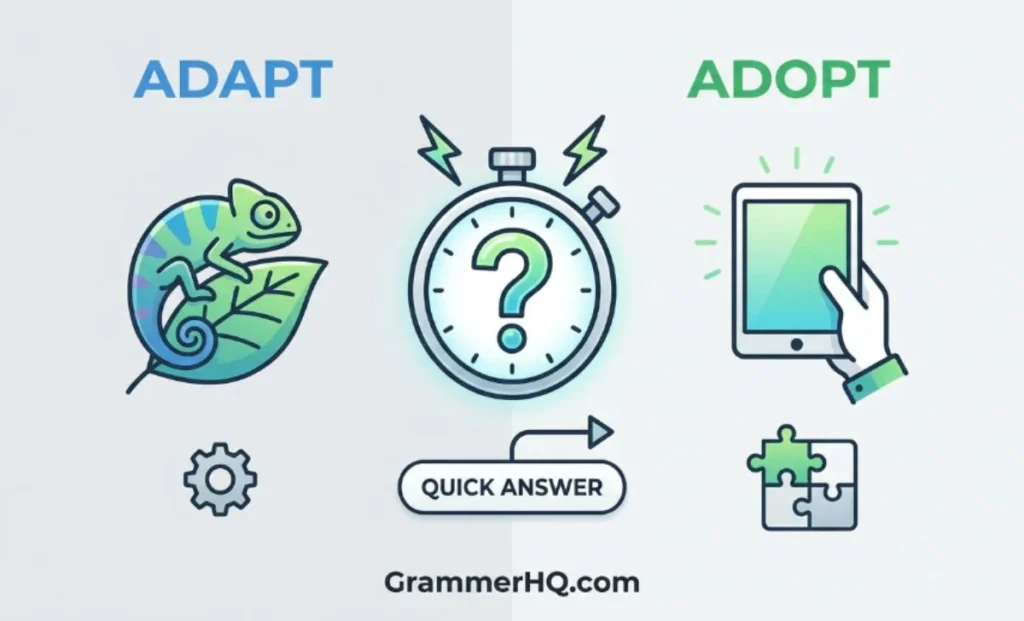
Although these two words look and sound alike, they have different meanings. One refers to changing or adjusting to fit a new situation, while the other means accepting, introducing, or legally taking responsibility for someone or something.
The correct choice depends on whether the action involves making a change or accepting something new.
| Word | Use it when… | Example |
|---|---|---|
| Adapt | Something changes to fit new circumstances | She adapted quickly to her new job. |
| Adopt | Something is accepted, introduced, or legally taken into a family | The company adopted a new strategy. |
Remember: Change = Adapt. Accept = Adopt.
Pronunciation of Adapt or Adopt
How to Pronounce Adapt
- IPA: /əˈdæpt/
- Pronunciation: uh-DAPT
- The stress falls on the second syllable (DAPT).
Example:
Employees must adapt to new workplace policies.
How to Pronounce Adopt
- British English IPA: /əˈdɒpt/
- American English IPA: /əˈdɑːpt/
- British Pronunciation: uh-DOPT
- American Pronunciation: uh-DAHPT
- The stress also falls on the second syllable.
Example:
The company adopted a new marketing strategy.
Why They Sound Similar
Many English learners confuse these words because they:
- Begin with ad-
- Have two syllables
- Place the stress on the second syllable
- Differ by only one vowel sound
As a result, they can sound similar in fast speech, even though they have different meanings.
Pronunciation Comparison
| Word | IPA | Sounds Like |
|---|---|---|
| Adapt | /əˈdæpt/ | uh-DAPT |
| Adopt | /əˈdɒpt/ (BrE), /əˈdɑːpt/ (AmE) | uh-DOPT / uh-DAHPT |
Quick Tip: Focus on the vowel in the second syllable. Adapt uses the short “a” sound (DAPT), while Adopt uses the “o” sound (DOPT or DAHPT), making them easy to distinguish when speaking and listening.
Why People Confuse Adapt or Adopt
Similar Spelling
The words differ by only one letter:
- Adapt
- Adopt
This small spelling difference makes them easy to mix up, especially during fast typing or proofreading.
Similar Pronunciation
Both words start with the same prefix and have the same stress pattern, so they sound alike in everyday conversation.
Both Are Verbs
Since both words describe actions, learners sometimes assume they can be used interchangeably. In reality, they describe completely different actions.
Related Contexts
The confusion increases because both words often appear in discussions about change, education, business, technology, and personal growth.
For example:
- A company adopts new software.
- Employees adapt to the new software.
The actions happen together, but they are not the same.
Common Mistake
❌ She adapted a new policy.
✅ She adopted a new policy.
❌ We adopted to the new environment.
✅ We adapted to the new environment.
Understanding the action behind each word is the easiest way to avoid these mistakes.
Easy Trick to Remember Adapt or Adopt
Adapt = Adjust
Think of Adjust whenever someone or something changes to suit a new situation. Since both words begin with A, this simple connection helps you remember that adapt is the correct choice when the focus is on change.
Example:
Plants adapt to different climates over time.
Adopt = Accept
Think of Accept whenever an idea, habit, policy, or responsibility is chosen or taken on. This reminds you that adopt means to begin using or formally take something into your life.
Example:
The school adopted a new grading system.
One-Line Memory Rule
Adapt = Adjust to change.
Adopt = Accept something new.
Quick Memory Table
| If you want to… | Choose |
|---|---|
| Change to fit a new situation | Adapt |
| Fit into a new environment | Adapt |
| Adjust your behavior | Adapt |
| Accept a new idea or policy | Adopt |
| Start using a new method | Adopt |
| Choose a new strategy | Adopt |
| Legally take a child or pet into your family | Adopt |
Final Tip: If the action involves changing, choose adapt. If it involves accepting or beginning something new, choose adopt.
Adapt and Adopt Synonyms
Adapt synonyms include adjust, modify, change, alter, and accommodate.
Adopt synonyms include accept, choose, embrace, use, and implement.
Adapt means changing or adjusting to fit a new situation or condition.
Adopt means accepting, choosing, or beginning to use something new.
Understanding these related words makes it easier to choose the correct term in writing.
Examples:
- Employees must adapt to new workplace conditions.
- The company modified its software for mobile devices.
- The organization adopted a new business strategy.
- Many schools implemented modern learning methods.
The Origin of Adapt or Adopt
Origin of Adapt
Adapt comes from the Latin adaptare, meaning “to fit,” “to adjust,” or “to make suitable.” It entered English in the early 17th century and has consistently referred to changing a person, object, or idea to suit new conditions or a different purpose.
Examples:
- Engineers adapted the design to improve safety.
- The school adapted its teaching methods for online classes.
- The screenplay was adapted from a bestselling novel.
Origin of Adopt
Adopt comes from the Latin adoptare, meaning “to choose,” “to take as one’s own,” or “to accept.” It entered English before adapt and was first used for the legal adoption of a child. Over time, its meaning expanded to include accepting ideas, methods, technologies, habits, and policies.
Examples:
- The city adopted stricter environmental regulations.
- Many organizations adopted remote work policies.
- They adopted a child from another country.
Origin Comparison
| Word | Latin Root | Original Meaning | Modern Meaning |
|---|---|---|---|
| Adapt | adaptare | To fit or make suitable | To change or adjust to new conditions |
| Adopt | adoptare | To choose or take as one’s own | To accept, begin using, or legally take into a family |
Although both words share the Latin prefix ad- (“to” or “toward”), they developed from different root verbs, which is why their meanings remain distinct today.
British English vs American English
Both British English and American English use the same spellings for adapt and adopt. Unlike word pairs such as colour/color or centre/center, these words do not have regional spelling variants.
Spelling Comparison
| Word | British English | American English |
|---|---|---|
| Adapt | Adapt | Adapt |
| Adopt | Adopt | Adopt |
Pronunciation Difference
The spelling stays the same, but adopt is pronounced slightly differently in each variety of English. Adapt is pronounced almost identically in both.
| Word | British English | American English |
|---|---|---|
| Adapt | uh-DAPT | uh-DAPT |
| Adopt | uh-DOPT | uh-DAHPT |
Key Takeaway: You never need to change the spelling of either word for British or American audiences. The only regional variation is the pronunciation of adopt.
Which Word Should You Use?
Choose Adapt for Change
Use adapt when a person, object, process, or idea must change to fit new circumstances.
Examples:
- Businesses adapt to changing market conditions.
- Teachers adapt lessons for different learning styles.
- Software is often adapted for mobile devices.
- Athletes adapt their training throughout the season.
Choose Adopt for Acceptance
Use adopt when someone accepts, introduces, or begins using something new, or legally takes a child or pet into a family.
Examples:
- The company adopted a flexible work policy.
- Many schools adopted digital learning tools.
- She adopted healthier daily habits.
- They adopted a rescue dog.
Quick Choice
| Situation | Correct Word |
|---|---|
| A change is needed to suit new conditions | Adapt |
| An idea, method, policy, habit, child, or pet is accepted | Adopt |
Easy Rule: Change = Adapt. Acceptance = Adopt.
Adapt vs Adopt Comparison Table
| Feature | Adapt | Adopt |
|---|---|---|
| Meaning | Change to fit new conditions | Accept or begin using something |
| Focus | Adjustment | Acceptance |
| Commonly Used With | Environment, behavior, design, software, strategies | Ideas, policies, methods, habits, children, pets |
| Typical Pattern | Adapt to something | Adopt something |
| Best Used When | A change is required | A choice or decision is made |
Adapt or Adopt in Everyday Examples
Workplace
- The company adopted a flexible work policy to improve employee satisfaction.
- Staff members adapted quickly to the revised workflow.
Education
- Teachers adapted classroom activities to meet different learning needs.
- The university adopted a new assessment framework.
Technology
- Developers adapted the software for multiple devices.
- Many businesses adopted AI-powered productivity tools.
Healthcare
- Medical teams adapted treatment plans to reflect the latest clinical guidance.
- Hospitals adopted stricter patient safety standards.
Daily Life
- After moving abroad, she adapted to a different culture and lifestyle.
- He adopted healthier eating habits to improve his overall well-being.
Media and Communication
- The novel was adapted into an award-winning television series.
- Several organizations adopted new communication guidelines to improve transparency.
Common Mistakes with Adapt or Adopt
Mistake 1: Referring to an Accepted Policy
❌ Incorrect: The company adapted a new hiring policy.
✅ Correct: The company adopted a new hiring policy.
Policies, rules, and strategies are adopted because they are introduced or accepted.
Mistake 2: Describing a New Environment
❌ Incorrect: It took me a week to adopt to my new office.
✅ Correct: It took me a week to adapt to my new office.
A new place or situation requires adaptation, so adapt to is the correct choice.
Mistake 3: Mixing Up Change and Acceptance
❌ Incorrect: The school adapted new classroom rules.
✅ Correct: The school adopted new classroom rules.
❌ Incorrect: Students adopted to the new timetable.
✅ Correct: Students adapted to the new timetable.
The first sentence involves accepting new rules, while the second describes adjusting to a change.
Mistake 4: Omitting the Correct Preposition
❌ Incorrect: She adapted a different culture.
✅ Correct: She adapted to a different culture.
The verb adapt is normally followed by to, while adopt takes a direct object.
Quick Corrections
| Incorrect | Correct |
|---|---|
| Adapt a policy | Adopt a policy |
| Adopt to a new environment | Adapt to a new environment |
| Adapt new technology | Adopt new technology |
| Adapt a child | Adopt a child |
| Adopt to changing conditions | Adapt to changing conditions |
FAQs
What is the difference between adapt and adopt?
Adapt means to change or adjust to fit a new situation, condition, or purpose. Adopt means to accept, choose, or begin using something new.
Is “adopt to” correct English?
No. “Adopt to” is incorrect. The correct phrase is “adapt to” when talking about adjusting to a situation.
Example:
She adapted to her new workplace quickly.
Are Adapt and Adopt Contradictory?
No, adapt and adopt are not contradictory words. They describe different actions. Adapt means changing or adjusting to fit a new situation, while adopt means accepting, choosing, or beginning to use something new.
Can you adapt an idea or adopt an idea?
You adopt an idea when you accept or start using it. You adapt an idea when you modify it to make it suitable for a different purpose.
Examples:
- The company adopted a new strategy.
- The writer adapted the idea for a younger audience.
What is the difference between adopt and adapt in research?
In research, adopt means accepting or using an existing theory, method, or framework, while adapt means modifying an existing approach to fit a specific study or purpose.
Example:
- Researchers adopted an existing framework for the study.
- The method was adapted to suit local conditions.
Is a movie adapted or adopted from a book?
The correct word is adapted.
A movie, play, or television series is adapted from a book because the original content is changed into a new format.
Example:
The film was adapted from a bestselling novel.
Is adopt only used for children?
No. Although adopt is commonly used for legally taking a child into a family, it also applies to accepting ideas, methods, habits, policies, and technologies.
Example:
Many businesses adopted new digital tools.
What is the difference between adapt and adept?
Adapt is a verb that means to change or adjust to a new situation. Adept is an adjective that means highly skilled or proficient at something.
Example:
- She adapted to the new environment quickly.
- He is adept at solving complex problems.
What is the easiest way to remember adapt and adopt?
Remember:
Adapt = Adjust
Adopt = Accept
If something changes to fit a situation, use adapt. If something is accepted or introduced, use adopt.
Conclusion
Choosing the right word becomes easier when you understand the difference between adjusting to change and accepting something new.
These two commonly confused terms may look similar, but they describe different actions and cannot replace each other in most situations.
A simple way to remember the distinction is: one focuses on adaptation, while the other focuses on acceptance. Using the correct expression helps your writing become clearer, more precise, and more professional in everyday, academic, and workplace communication.
Read More Blogs:
- Successful or Succesful: Why One Spelling Is Wrong
- Donut or Doughnut: One Word, Two Spellings Here’s Why