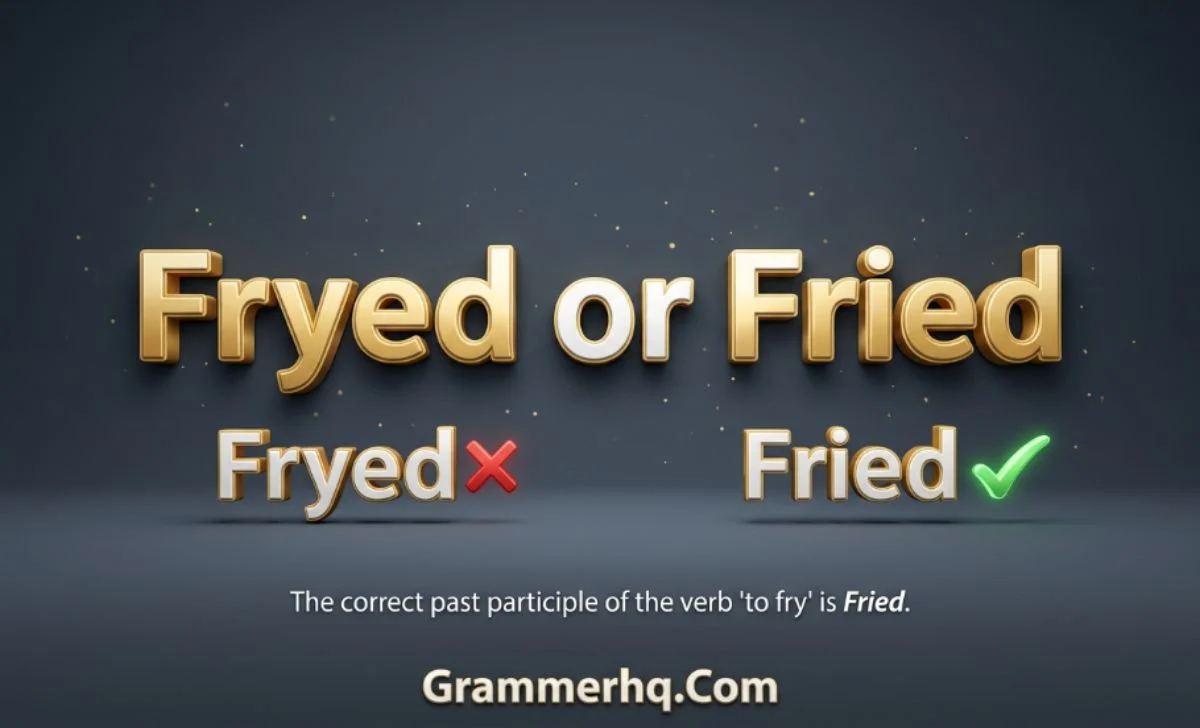
Fryed or fried? The correct spelling is fried. If you are writing the past tense or past participle of fry, use fried, not fryed.
For example:
I fried two eggs for breakfast.
The reason is the spelling change that happens when a verb ending in a consonant + y takes -ed: the y changes to i. So fry becomes fried. Oxford and Collins both list fried as the standard past form of fry. (oxfordlearnersdictionaries.com)
Quick Answer
Fried is the correct spelling.
Fryed is a common misspelling of the past tense of fry.
| Word | Standard spelling? | Example |
|---|---|---|
| fried | ✅ Yes | She fried the eggs. |
| fryed | ❌ No | She fryed the eggs. |
The simple rule to remember is:
fry → fried
Why Is It Fried, Not Fryed?
The spelling fryed looks logical because it seems to follow the simple pattern of adding -ed:
fry + ed = fryed
English spelling changes the final y, however. When a verb ends in a consonant + y, the y changes to i before -ed.
So:
fry → fried
The same pattern appears in:
- try → tried
- cry → cried
- dry → dried
- reply → replied
- study → studied
This is why fried is not an irregular spelling to memorize on its own. It follows a familiar English spelling pattern.
What About Words Ending in a Vowel + Y?
This is where the rule becomes more useful.
When a word ends in a vowel + y, the y normally stays in place:
- play → played
- enjoy → enjoyed
- stay → stayed
Compare:
consonant + y: fry → fried
vowel + y: play → played
This small distinction explains why fryed looks tempting but is not the standard spelling.
What Are the Forms of Fry?
The verb fry has several common forms, and each one has a different role.
| Verb form | Correct word | Example |
|---|---|---|
| Base form | fry | I fry eggs. |
| Third-person singular | fries | She fries eggs. |
| Present participle | frying | She is frying eggs. |
| Simple past | fried | She fried eggs. |
| Past participle | fried | She has fried eggs. |
Oxford identifies fried as both the past simple and past participle of fry, while Collins lists the related forms fries, frying, and fried. (oxfordlearnersdictionaries.com)
The easiest way to remember the full pattern is:
fry → fries → frying → fried
Fried in Real-Life Examples
Here are some natural examples you might see in everyday English:
- I fried an egg before leaving for work.
- She fried the chicken for dinner.
- We fried the onions in a little oil.
- He fried the fish in a large pan.
- They fried some potatoes for the guests.
- My father fried the vegetables before serving them.
- I have already fried the eggs.
Notice that fried is used when the action has already happened.
Compare:
I fry eggs every morning.
This describes a regular habit.
I fried eggs this morning.
This describes an action that happened in the past.
Fry, Fries, Frying, or Fried?
These forms are easy to confuse because they all come from the same verb.
Fry
Use fry as the base form:
I usually fry vegetables for dinner.
Fries
Use fries with he, she, or it in the simple present:
She fries the onions before adding the sauce.
Frying
Use frying when the action is happening:
She is frying the chicken now.
Fried
Use fried for the past tense or past participle:
She fried the chicken yesterday.
She has fried the chicken already.
This gives you a useful four-form pattern:
fry → fries → frying → fried
Is Fried a Verb or an Adjective?
Fried can be a verb form or an adjective, depending on how it is used.
Fried as a verb
She fried the eggs.
Here, fried is the past tense of fry.
Fried as an adjective
We ordered fried chicken.
Here, fried describes the chicken.
This adjective use is common in food-related expressions such as fried eggs, fried rice, fried fish, and fried potatoes. Collins also recognizes fried as an adjective describing food cooked in hot fat or oil. (collinsdictionary.com)
Why Do People Write Fryed?
The most likely reason is straightforward: fryed looks like the result of simply adding -ed to fry.
Compare:
walk + ed → walked
So it is easy to assume:
fry + ed → fryed
But the spelling rule changes the final y:
fry + ed → fried
The same pattern helps with other common verbs:
- try → tried
- cry → cried
- carry → carried
- worry → worried
- reply → replied
Learning the pattern is more useful than memorizing fried as a one-off spelling.
Fryed or Fried in American and British English?
The correct spelling is fried in both American and British English.
| English variety | Correct form |
|---|---|
| American English | fried |
| British English | fried |
There is no American-versus-British spelling difference between fried and fryed. Collins lists fried as the past form of fry in its dictionary entries. (collinsdictionary.com)
So whether you are writing for readers in the United States, the United Kingdom, or elsewhere, fried is the standard choice.
Common Mistakes With Fryed and Fried
The spelling fryed can look correct at first because it seems natural to add -ed directly to fry. However, standard English changes the final y to i, giving us fried.
Here are a few common mistakes:
| Incorrect | Correct |
|---|---|
| ❌ I fryed an egg this morning. | ✅ I fried an egg this morning. |
| ❌ She fryed the chicken yesterday. | ✅ She fried the chicken yesterday. |
| ❌ He has fryed the fish already. | ✅ He has fried the fish already. |
| ❌ The onions were fryed in oil. | ✅ The onions were fried in oil. |
Notice the same spelling pattern in every example: fry becomes fried when the verb takes the past-tense or past-participle form.
For example, the sentence “She fried the chicken yesterday” is correct because the action happened in the past. Likewise, “He has fried the fish already” uses fried as the past participle.
The easiest rule to remember is:
fry → fried
Once you remember that change, the common fryed spelling mistake becomes much easier to avoid.
Is Fryed a Word?
You may encounter fryed in informal writing, user-generated content, older material, or as a spelling error. However, it is not the standard modern spelling used for the past tense or past participle of fry.
For school assignments, professional writing, websites, emails, recipes, and everyday communication, use fried.
If you are unsure, dictionary entries provide a reliable check: Oxford and Collins list fried as the standard past form of fry. (oxfordlearnersdictionaries.com)
A Simple Trick to Remember Fried
Remember these four words together:
try → tried
cry → cried
dry → dried
fry → fried
They follow the same basic spelling pattern.
You can also remember:
Fry loses the Y before -ed.
So:
❌ fryed
✅ fried
That one small spelling change is all you need to remember.
FAQs
Is it fryed or fried?
Fried is correct. Fryed is not the standard spelling of the past tense of fry.
What is the past tense of fry?
The past tense of fry is fried.
She fried the eggs for breakfast.
What is the past participle of fry?
The past participle is also fried.
She has fried the eggs.
Why does fry become fried?
Because fry ends in a consonant + y. Before -ed, the y changes to i:
fry → fried
Is fryed ever correct?
For standard modern English, use fried when you mean the past tense or past participle of fry. Fryed may appear in nonstandard or historical material, but it is not the normal modern form.
Is fried the same in American and British English?
Yes. Fried is the standard spelling in both American and British English.
What is the difference between fried and frying?
Fried refers to the past form:
She fried the eggs.
Frying describes the ongoing action:
She is frying the eggs.
Conclusion
If you are deciding between fryed or fried, choose fried.
The standard forms are:
fry → fries → frying → fried
The important spelling rule is that a verb ending in a consonant + y generally changes the y to i before -ed:
try → tried
cry → cried
fry → fried
So when you write about food that was cooked in the past, write “I fried the eggs,” not “I fryed the eggs.”
Fry → fried. That is the spelling to remember.
Read More Blogs