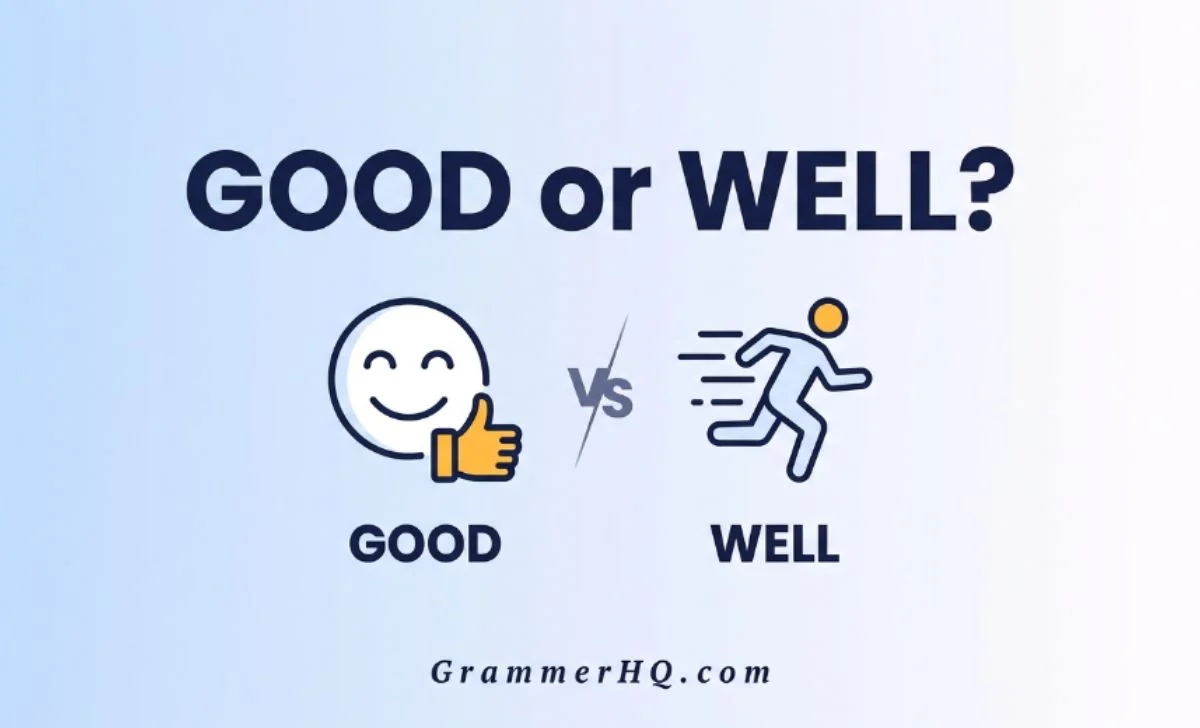
Many English learners wonder whether they should use good or well because both words describe positive qualities but serve different grammatical purposes.
The short answer is simple: good is usually an adjective that describes a noun or follows a linking verb, while well is usually an adverb that describes how an action is performed.
However, well can also be an adjective when talking about someone’s health. In this guide, you’ll learn the grammar rules, common expressions, real-life examples, memory tricks, and practical tips to use good and well correctly in every situation.
Quick Answer
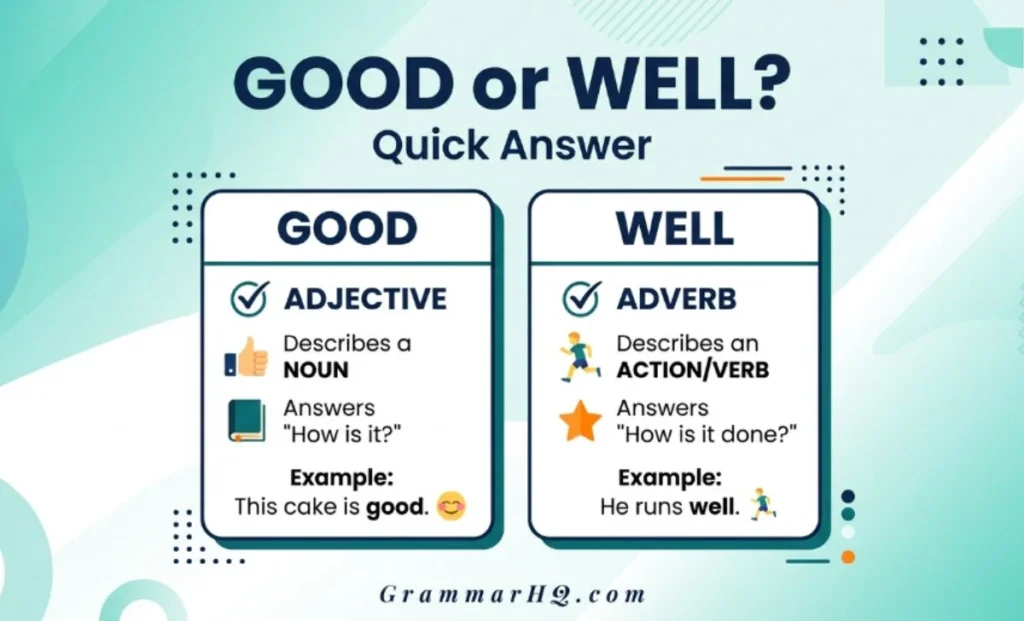
The difference between good and well depends on what you are describing.
- Good is an adjective. It describes a person, place, thing, or condition.
- Well is usually an adverb. It describes how an action is performed.
- Well can also be an adjective when it means healthy.
Quick Examples
| Correct Sentence | Why It’s Correct |
|---|---|
| She is good at math. | Good describes the person. |
| She writes well. | Well describes the verb writes. |
| I feel good today. | Feel is a linking verb, so use good. |
| I am well now. | Well means healthy. |
Quick Rule
- Use good after linking verbs such as be, seem, look, feel, smell, taste, sound, become, remain, and appear because these verbs describe a condition rather than an action.
- Use well after action verbs when explaining how something happens.
Examples
✅ The soup tastes good.
✅ He speaks English well.
Featured Snippet Answer
Good is an adjective used to describe nouns or a person’s condition after linking verbs, while well is usually an adverb that describes how an action is done. The exception is that well also works as an adjective when talking about health.
What Is the Difference Between Good and Well?
Although good and well both express something positive, they have different grammatical roles. Understanding this difference is the easiest way to avoid common mistakes.
| Feature | Good | Well |
|---|---|---|
| Part of speech | Adjective | Usually an adverb |
| Main purpose | Describes a noun or condition | Describes a verb or action |
| Answers | What is someone or something like? | How was the action done? |
| Can describe health? | No | Yes |
| Common use | She is a good teacher. | She teaches well. |
Use Good When You Describe:
- A person
- A place
- An object
- A quality
- A condition after a linking verb
Examples
- This book is good.
- He is a good friend.
- The weather looks good.
- The food smells good.
- Your idea sounds good.
Use Well When You Describe an Action
Use well when answering the question “How?”
Examples
- She sings well.
- They worked well together.
- He drives well.
- The team performed well.
- You explained the lesson well.
The Important Exception
Many learners think well is always an adverb, but that is not true.
When talking about health, well becomes an adjective.
Examples
✅ I am well now.
✅ After the surgery, he is finally well again.
Here, well means healthy, not “in a good way.”
Side-by-Side Comparison
| Correct | Incorrect | Explanation |
|---|---|---|
| She plays tennis well. | She plays tennis good. | The verb plays needs an adverb. |
| The movie was good. | The movie was well. | The movie is a noun, so use an adjective. |
| I feel good today. | I feel well today.* | Good is preferred after the linking verb feel when describing your overall state. |
| I’m well again. | I’m good again.* | Well specifically means healthy after illness. |
Note: In everyday conversation, I’m good is also commonly used to mean “I’m fine” or “No, thank you.” The intended meaning depends on the context.
Why This Difference Matters
Using good instead of well, or the other way around, can make a sentence sound unnatural or grammatically incorrect. Learning which word matches the verb or noun helps you write more clearly in emails, school assignments, business communication, and everyday conversations.
In the next section, we’ll look at when to use “good” and the grammar rules that make it the correct choice.
When to Use Good
Use good when you want to describe a noun, pronoun, or the condition of someone or something after a linking verb. Because good is an adjective, it tells us what someone or something is like, not how an action is done.
Use Good Before a Noun
When good comes before a noun, it describes its quality.
Examples
- She is a good teacher.
- We had a good meal.
- It was a good decision.
- They bought a good laptop.
- He is a good leader.
Use Good After Linking Verbs
Linking verbs connect the subject to a description instead of showing an action. Common linking verbs include:
- be
- seem
- become
- feel
- look
- sound
- smell
- taste
- appear
- remain
Because these verbs describe a state or condition, they are followed by good, not well.
Examples
- The cake tastes good.
- You look good today.
- Everything sounds good.
- The flowers smell good.
- The plan seems good.
Why “I Feel Good” Is Usually Correct
Many learners think I feel well is always the correct sentence. In fact, I feel good is the standard choice when you are talking about your overall mood, emotions, or general condition.
Examples
- I feel good after my vacation.
- She feels good about the results.
- We all feel good today.
Here, feel is a linking verb, so good describes the subject rather than the action.
When to Use Well
Use well when describing how an action is performed. In this role, well is an adverb that modifies a verb.
Use Well After Action Verbs
Action verbs show what someone does. Well explains how the action happens.
Examples
- She writes well.
- He speaks English well.
- They worked well together.
- The children behaved well.
- You explained the lesson well.
A simple way to check is to ask “How?”
- How does she write? → Well
- How did they perform? → Well
When Well Means Healthy
Although well is usually an adverb, it also works as an adjective when talking about health.
Examples
- I’m well now.
- She isn’t well today.
- He became well after a few weeks.
- We hope you get well soon.
In these examples, well means healthy, not “in a good way.”
Good vs Well Grammar Rules
Remember these simple grammar rules whenever you are unsure which word to choose.
| Rule | Use Good | Use Well |
|---|---|---|
| Describes a noun | ✅ Yes | ❌ No |
| Describes a verb | ❌ No | ✅ Yes |
| After a linking verb | ✅ Usually | ⚠️ Only when talking about health |
| Describes health | ❌ No | ✅ Yes |
| Answers “How?” | ❌ No | ✅ Yes |
Rule 1: Use Good with Linking Verbs
Correct:
- The food tastes good.
- Your idea sounds good.
- She looks good.
- The movie was good.
Incorrect:
- The food tastes well.
- Your idea sounds well.
Rule 2: Use Well with Action Verbs
Correct:
- She sings well.
- He drives well.
- They completed the project well.
Incorrect:
- She sings good.
- He drives good.
Rule 3: Use Well for Health
Correct:
- Are you well now?
- She isn’t feeling well.
Correct in a different meaning:
- I feel good today. (I’m happy or comfortable.)
Notice the difference:
- I feel good. → My mood or overall condition is positive.
- I feel well. → My physical health is good.
Both can be correct, but they express different meanings.
Common Expressions with Good and Well
Some expressions appear so often in everyday English that they deserve special attention.
I Am Good or I Am Well?
Both are correct, but they mean different things.
I am good
Means:
- I’m fine.
- I’m satisfied.
- I’m okay.
- No, thank you.
Examples
- “How are you?” — I’m good.
- “Would you like more coffee?” — I’m good, thanks.
I am well
Means:
- I am healthy.
Example
- After being sick for a week, I’m well again.
Quick Tip
In everyday American English, I’m good is much more common than I’m well when someone asks, “How are you?”
I’m Doing Good or I’m Doing Well?
The standard grammatical choice is:
✅ I’m doing well.
Here, well describes how you are doing.
Examples
- I’m doing well at my new job.
- She’s doing well in school.
- Our business is doing well this year.
However, I’m doing good can also be correct when good means helping others or benefiting society.
Example
- The charity is doing good around the world.
Compare the meanings:
- I’m doing well. → I am successful or things are going well.
- I’m doing good. → I am helping people or making a positive difference.
Feel Good or Feel Well?
Both are correct, but the meaning changes.
| Expression | Meaning |
|---|---|
| Feel good | Happy, comfortable, or emotionally positive |
| Feel well | Physically healthy |
Examples
- I feel good after exercising.
- She doesn’t feel well today because she has a fever.
Look Good or Look Well?
Use look good to describe appearance.
- You look good today.
- The new office looks good.
Use look well mainly when talking about health.
- You look well after your vacation.
Sound Good or Sound Well?
Use sound good in almost every situation.
Examples
- That sounds good.
- Your idea sounds good.
Sound well is very rare and usually refers to someone’s ability to produce sound, not whether an idea is acceptable.
These common expressions are among the most frequently searched questions about good and well, and understanding their meanings will help you use both words naturally in everyday English.
Easy Trick to Remember Good vs Well
If you forget the grammar rule, use this simple memory trick:
Good describes things. Well describes actions.
Ask yourself one question:
Are you describing a person, place, thing, or condition?
→ Use good.
Are you describing how someone does something?
→ Use well.
Memory Formula
- Good = Adjective = Describes a noun or condition
- Well = Adverb = Describes a verb or action
Quick Examples
| If You Mean… | Correct Word | Example |
|---|---|---|
| A person’s quality | Good | She is a good teacher. |
| How someone performs | Well | She teaches well. |
| A thing’s quality | Good | The food is good. |
| How something is done | Well | He cooked well. |
| Someone is healthy | Well | She is well now. |
A Simple Way to Check
If you can replace the word with “healthy,” use well.
- She is well. ✔
- He isn’t well today. ✔
If you are describing quality, use good.
- The movie was good.
- Your answer is good.
This one rule will help you avoid most grammar mistakes.
Common Mistakes with Good and Well
Even advanced English learners sometimes confuse good and well. Most mistakes happen when people use an adjective where an adverb is needed, or vice versa.
Mistake 1: Using Good After an Action Verb
❌ She sings good.
✅ She sings well.
Why?
Sings is an action verb, so it needs the adverb well.
Mistake 2: Using Well After a Linking Verb
❌ The soup tastes well.
✅ The soup tastes good.
Why?
Tastes is a linking verb here, so it describes the soup rather than an action.
Mistake 3: Confusing Health with General Condition
❌ I’m good again after the flu.
✅ I’m well again after the flu.
Why?
When talking specifically about recovering from illness, well means healthy.
Mistake 4: Saying “Doing Good” Instead of “Doing Well”
❌ She’s doing good in school.
✅ She’s doing well in school.
Exception
If you mean helping others, then doing good is correct.
Example:
- The volunteers are doing good in their community.
Common Error Summary
| Incorrect | Correct | Reason |
|---|---|---|
| He drives good. | He drives well. | Action verb needs an adverb. |
| The cake tastes well. | The cake tastes good. | Linking verb takes an adjective. |
| She writes good. | She writes well. | Describes how she writes. |
| I’m good again after surgery. | I’m well again after surgery. | Talking about health. |
Good vs Well in Everyday Examples
Seeing both words in real-life situations makes the grammar much easier to remember.
Everyday Conversation
- “How are you?” — I’m good, thanks.
- “Are you feeling better?” — Yes, I’m well now.
- You look good today.
- She speaks French well.
Emails
Correct
Thank you for your presentation. You explained the project well.
The proposal looks good. We can move forward.
Workplace
- She performed well during the interview.
- He has a good relationship with clients.
- The meeting went well.
- We made good progress this week.
Academic Writing
- The student answered the questions well.
- She wrote a good research paper.
- The experiment produced good results.
Social Media
- Your photos look good.
- You handled that situation well.
- The event was good.
- The team played well tonight.
News Style
- The company performed well despite market challenges.
- Doctors say the patient is well enough to return home.
- Experts described the new policy as a good decision.
Good vs Well – Google Trends & Usage Data
Search interest in good vs well remains consistent because it is a common grammar topic studied by English learners, students, teachers, and professionals.
Users usually search this topic when they want to improve their grammar, prepare for English exams, or write more accurately.
Countries Where the Topic Is Popular
- United States
- United Kingdom
- Canada
- Australia
- India
- Pakistan
- Philippines
These countries have large English-speaking communities or many English learners, making grammar-related searches consistently popular.
Common Search Queries
People frequently search for:
- good or well
- good vs well
- difference between good and well
- when to use good and well
- I am good or I am well
- doing good or doing well
- feel good or feel well
- good vs well examples
- good or well grammar
- is good an adjective
These searches show that users want practical grammar rules, clear explanations, and real-world examples rather than long theoretical discussions.
Good vs Well Comparison Table
| Feature | Good | Well |
|---|---|---|
| Part of speech | Usually an adjective | Usually an adverb |
| Main purpose | Describes a noun or condition | Describes how an action is performed |
| Used after linking verbs | ✔ Yes | ✔ Only when talking about health |
| Used after action verbs | ✘ No | ✔ Yes |
| Refers to health | ✘ No | ✔ Yes |
| Example | The food is good. | She cooks well. |
FAQs
Is good an adjective or an adverb?
Good is an adjective. It describes nouns and follows linking verbs such as be, feel, seem, look, taste, and sound.
Is well an adjective or an adverb?
Usually, well is an adverb that describes a verb. However, it can also be an adjective when it means healthy.
Which is correct: good or well?
Both are correct. Use good to describe people, places, things, or conditions, and use well to describe actions. Use well as an adjective only when referring to health.
Why do people confuse good and well?
Both words have positive meanings, but they belong to different parts of speech. Many learners mistakenly use good where an adverb is required or well where an adjective is needed.
Is it correct to say “I am good”?
Yes. In everyday English, I’m good commonly means “I’m fine” or “No, thank you.” It is a natural and widely accepted expression.
Is “doing good” ever correct?
Yes. Doing good is correct when it means helping people or making a positive difference. If you mean performing successfully, use doing well.
How can I remember the difference between good and well?
Remember this rule:
- Good describes people, things, or conditions.
- Well describes actions and also means healthy.
Conclusion
Choosing between good and well becomes easy once you understand their grammatical roles. Good is an adjective that describes a person, place, thing, or condition, especially after linking verbs.
Well is usually an adverb that explains how an action is performed, but it also functions as an adjective when talking about health.
By learning the basic rules, practicing common expressions, and paying attention to context, you can avoid one of the most common English grammar mistakes.
Whenever you’re unsure, remember the simple rule: good describes things, while well describes actions. With regular practice, using the correct word will become natural in both speaking and writing.
Read More Bloogs:
- Capital or Capitol: Which Word Is Correct and Why Does It Matter?
- Already or All Ready: What’s the Difference and Which Is Correct?