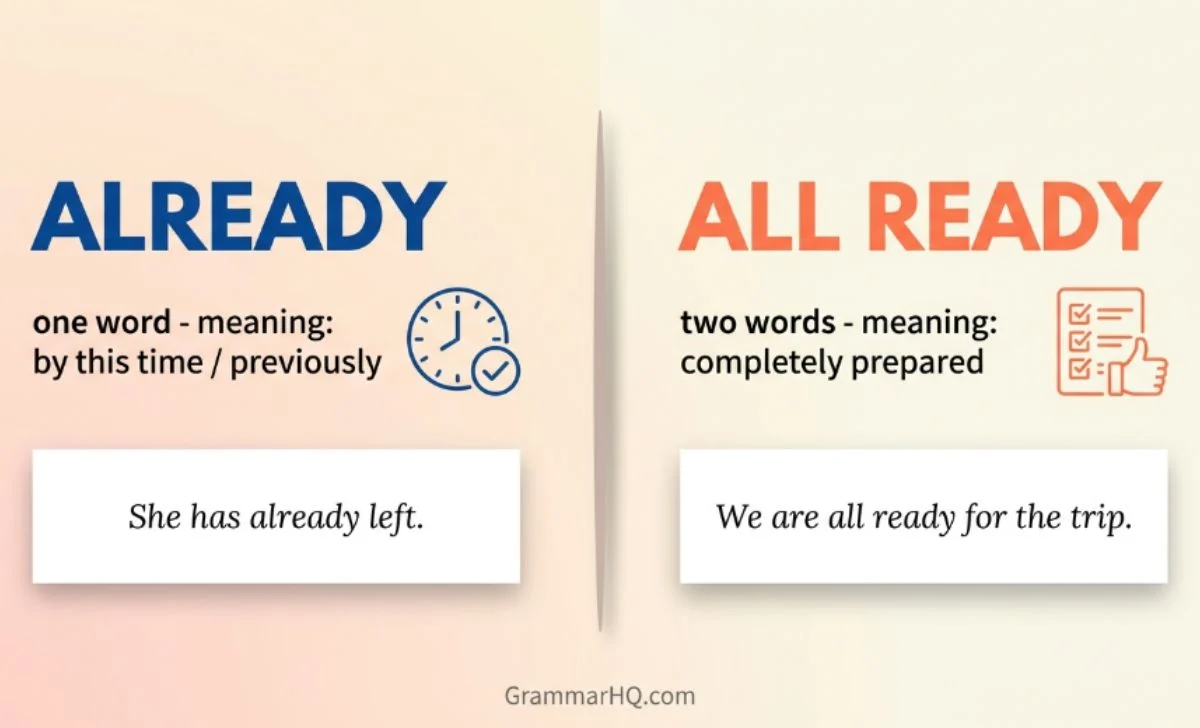
Many English learners wonder whether they should write already or all ready because the two expressions sound almost identical but have different meanings. The confusion often leads to grammar mistakes in emails, school assignments, and everyday writing.
The short answer is simple: already is an adverb meaning before now or by this time, while all ready is a two-word phrase meaning completely prepared.
In this guide, you’ll learn the difference, correct pronunciation, grammar rules, memory tricks, comparison tables, and real-life examples so you can confidently choose the right form every time.
Quick Answer
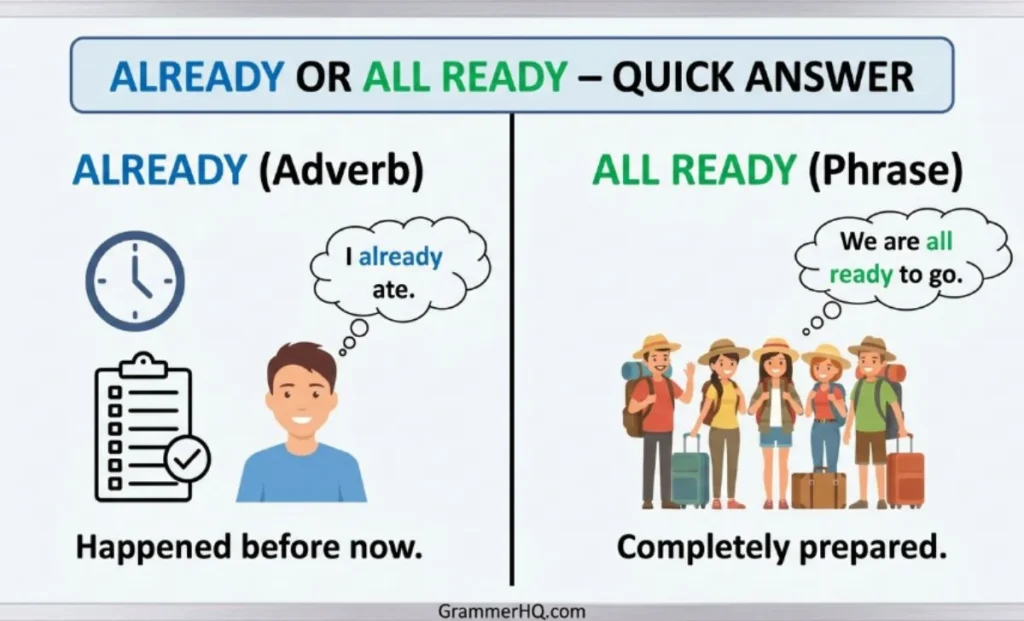
Although they sound alike, already and all ready are not interchangeable.
| Word | Meaning | Part of Speech | Example |
|---|---|---|---|
| Already | Before now or by this time | Adverb | I have already finished my homework. |
| All Ready | Completely prepared | Phrase | We are all ready to leave. |
Use already when something has happened before now.
Examples
- She has already submitted the report.
- Have you already eaten lunch?
- The movie has already started.
Use all ready when people or things are fully prepared.
Examples
- The students are all ready for the exam.
- We are all ready to begin the meeting.
- The team is all ready for the final match.
Quick Tip
If you can replace the phrase with completely prepared, use all ready.
If you can replace it with before now or by this time, use already.
Pronunciation of Already or All Ready
Both expressions are pronounced almost the same, which is one of the main reasons people confuse them.
| Word | Pronunciation | Sounds Like |
|---|---|---|
| Already | awl-RED-ee | One word spoken smoothly |
| All Ready | awl RED-ee | Two separate words spoken together |
In everyday conversation, native English speakers often pronounce them so similarly that the difference is almost impossible to hear. Because of this, the sentence context is usually the easiest way to understand which one is intended.
Listen to the meaning, not just the sound.
Compare these examples:
- I have already packed my bags. (The packing happened before now.)
- We are all ready to board the plane. (Everyone is fully prepared.)
Already vs All Ready – Key Differences
The easiest way to avoid mistakes is to focus on meaning, not pronunciation.
| Feature | Already | All Ready |
|---|---|---|
| Number of words | One | Two |
| Part of speech | Adverb | Phrase |
| Main meaning | Before now | Completely prepared |
| Refers to | Time | Readiness |
| Common with | Present perfect verbs | Forms of be (is, are, was, were) |
| Example | She has already left. | They are all ready to go. |
Why People Confuse Already or All Ready
When speaking, the difference is difficult to hear, so people often rely on sound instead of meaning. The mistake becomes even more common when typing quickly or writing from memory.
Another reason is that both expressions can appear in similar sentence structures. However, they serve different grammatical purposes.
The main reasons for the confusion
- They have nearly identical pronunciation.
- Both are commonly used in everyday English.
- One is a single word, while the other is a two-word phrase.
- Their meanings change based on the sentence context.
- Many learners assume they are simply different spellings of the same word.
Compare these sentences
| Incorrect Understanding | Correct Meaning |
|---|---|
| We are already to leave. | ❌ Incorrect because already cannot mean “prepared.” |
| We are all ready to leave. | ✅ Everyone is prepared to leave. |
| She is all ready finished. | ❌ Incorrect because all ready cannot mean “before now.” |
| She has already finished. | ✅ The action happened before now. |
- Time or a completed action → already
- Preparation or readiness → all ready
Easy Trick to Remember Already or All Ready
A simple memory trick can help you choose the correct form every time.
Remember this rule:
- Already = Already happened
- All Ready = All prepared
Think about the first word.
If you can insert completely before ready, then all ready is the correct choice.
Example
- We are all ready for the presentation.
- We are completely ready for the presentation. ✅
Now compare it with already.
- We have already submitted the application.
- We have before now submitted the application. ✅
Memory Table
| If the sentence means… | Use |
|---|---|
| Before now | Already |
| By this time | Already |
| Fully prepared | All Ready |
| Everyone is ready | All Ready |
This simple test works in nearly every situation and helps prevent one of the most common grammar mistakes in English writing.
Already or All Ready in British and American English
Neither already nor all ready changes spelling between British English and American English. Both varieties use already as an adverb meaning “by this time” and all ready as a phrase meaning “completely prepared.”
Whether you are writing for a British or American audience, the same grammar rules apply. The correct choice depends on the meaning of the sentence rather than the variety of English you use.
Common Mistakes with Already or All Ready:
Even experienced writers occasionally use these expressions incorrectly because they focus on pronunciation instead of grammar.
Here are the mistakes people make most often.
| Incorrect | Correct | Why |
|---|---|---|
| We are already to leave. | We are all ready to leave. | The sentence describes readiness. |
| I am all ready finished. | I have already finished. | The sentence describes a completed action. |
| They were already for the race. | They were all ready for the race. | It refers to preparation. |
| She has all ready called me. | She has already called me. | It refers to time, not readiness. |
| Is everyone already? | Is everyone all ready? | Asking whether everyone is prepared. |
Tips to avoid these mistakes
- Focus on the meaning, not the pronunciation.
- Check whether the sentence refers to time or preparation.
- Remember that already is always one word.
- Remember that all ready is always two separate words.
- Proofread emails, assignments, and professional documents before sending them.
Using the correct form makes your writing clearer and more professional.
Already or All Ready in Everyday Examples
Understanding the rule is helpful, but seeing each expression in real situations makes it much easier to remember.
In Everyday Conversation
| Situation | Correct Usage |
|---|---|
| Asking about a completed task | Have you already finished your homework? |
| Getting ready to leave | We’re all ready to go. |
| Arriving earlier than expected | They already arrived. |
| Preparing for an event | The guests are all ready. |
In Emails
✅ Already
I have already attached the requested documents.
We have already reviewed your application.
✅ All Ready
The presentation is all ready for tomorrow’s meeting.
Our team is all ready to begin the project.
These examples show that already usually refers to time, while all ready describes readiness.
Common Search Queries About Already or All Ready:
People search for already or all ready because the two expressions sound alike but have different meanings.
Most learners want quick answers about correct usage, pronunciation, grammar, and sentence examples so they can avoid common writing mistakes.
The searches below reflect the questions people ask most often before choosing the correct form.
Exmple:
already meaning
all ready meaning
already in a sentence
all ready in a sentence
already pronunciation
all ready pronunciation
FAQ,s
1. Is It Already or All Ready?
Both already and all ready are correct, but they have different meanings. Already is one word and means something happened before now or sooner than expected. All ready is two words and means everyone or everything is completely prepared.
Examples:
- I have already finished my homework.
- We are all ready to leave.
2. What Is the Difference Between Already and All Ready?
The main difference is their meaning and grammatical function. Already is an adverb that refers to something that has happened before a particular time. All ready is a phrase meaning completely prepared.
Example:
- She has already eaten dinner.
- The students are all ready for the exam.
3. When Should I Use Already in a Sentence?
Use already when you want to say that something happened before now or earlier than expected. It often appears with the present perfect or past perfect tense.
Examples:
- I have already seen that movie.
- He had already left when I arrived.
4. When Should I Use All Ready in a Sentence?
Use all ready when you mean that everyone or everything is fully prepared. Because it contains the adjective ready, it usually describes a state of preparation.
Examples:
- We are all ready for the trip.
- The children are all ready for school.
5. Is “All Ready” Two Words or One Word?
All ready is always written as two words when it means completely prepared. All modifies ready, so the words work together as a phrase.
Example:
- Are you all ready to go?
Do not write allready when you mean completely prepared.
6. Is Already One Word or Two Words?
Already is always written as one word. It is an adverb meaning before now, by this time, or sooner than expected.
Example:
- She has already completed the assignment.
The spelling allready is incorrect.
7. Can Already and All Ready Be Used Interchangeably?
No. Already and all ready are not interchangeable because they express different ideas.
Already refers to time or something that has happened, while all ready refers to being completely prepared.
Compare:
- They have already arrived.
- They are all ready to begin.
8. What Does Already Mean in English?
Already means that something has happened before now or before a particular time. It can also suggest that something happened sooner than expected.
Examples:
- I have already finished my work.
- Is it already midnight?
9. What Does All Ready Mean in English?
All ready means completely prepared. It can describe a group of people who are prepared or everything that is needed for something.
Examples:
- We are all ready for the meeting.
- The equipment is all ready for use.
10. How Can I Easily Remember the Difference Between Already and All Ready?
Use this simple trick: already = time, while all ready = prepared.
If you can replace the phrase with “by now” or “before now,” use already. If you can replace it with “completely prepared,” use all ready.
Example:
- I have already eaten. → I have eaten by now.
- We are all ready. → We are completely prepared.
11. Which Is Correct: “Are You Already Ready?” or “Are You All Ready?”
Both can be correct, but they mean different things.
Are you already ready? asks whether someone became ready sooner than expected.
Are you all ready? asks whether everyone or everything is completely prepared.
Examples:
- You just arrived. Are you already ready?
- Everyone has their bags. Are you all ready?
12. What Is the Difference Between “Already Ready” and “All Ready”?
Already ready means someone or something became ready before now or sooner than expected. All ready means completely prepared.
Examples:
- She is already ready for the interview.
- We are all ready for the interview.
In short, already focuses on when something happened, while all ready focuses on being prepared.
Conclusion
Already and all ready may sound almost identical, but they have different meanings and grammatical functions. Already is an adverb that refers to something happening before now, while all ready is a phrase that describes someone or something as fully prepared.
The easiest way to choose the correct form is to focus on the sentence’s meaning rather than its pronunciation. If the sentence is about time, use already. If it is about readiness, use all ready.
With the comparison tables, memory tricks, and real-life examples in this guide, you can confidently use both expressions correctly in conversations, emails, academic writing, and professional communication.
Read More Bloogs:
- What Is the Difference Between Email and Gmail?
- Crier or Cryer : Meaning Explained Simply and Clearly

Hi, I’m Amelia Parker, a grammar enthusiast and writer at GrammarHQ.com. I specialize in explaining spelling differences, confusing words, and common English mistakes through simple, practical, and easy-to-understand guides.