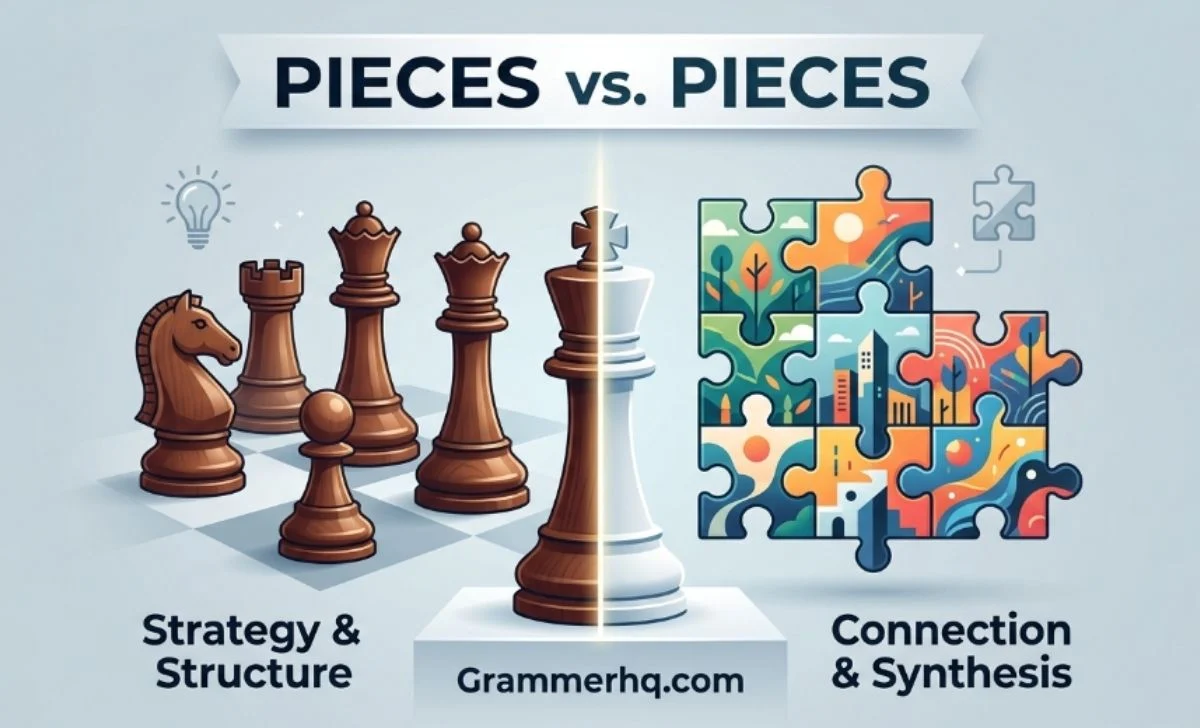
If you’re wondering about pieces vs peices, the correct spelling is pieces. The word peices is a common misspelling caused by reversing the i and e.
Although the two forms look similar, only pieces is accepted in standard English. It is the plural form of piece and can refer to parts, portions, separate objects, fragments, or individual works of art and music.
In this guide, you’ll learn the difference between pieces vs peices, how to pronounce and use the correct form, and an easy way to remember its spelling.
Quick Answer
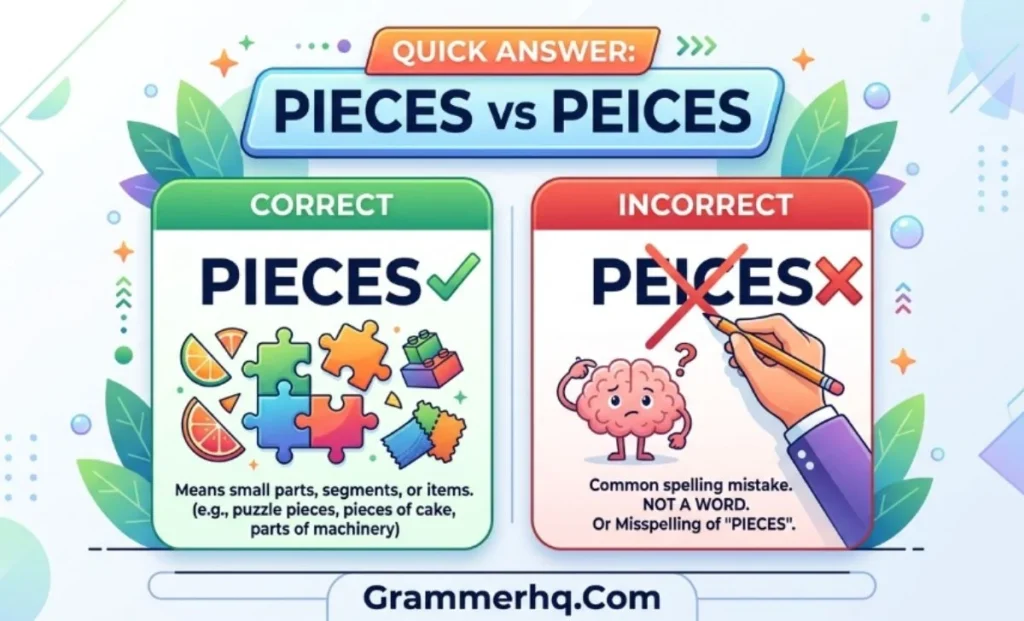
Pieces is the correct spelling. Peices is a misspelling.
| Spelling | Status | Meaning |
|---|---|---|
| pieces | ✅ Correct | Plural of piece |
| peices | ❌ Incorrect | Misspelling of pieces |
For example:
The puzzle is missing three pieces.
The spelling follows a simple pattern:
piece → pieces
There is no standard English form peices.
Why Is “Pieces” Correct?
The correct spelling starts with the singular noun piece.
When you need the plural, simply add -s:
piece + s = pieces
Nothing changes inside the base word. The letters remain in this order:
p-i-e-c-e
Adding s gives:
p-i-e-c-e-s
The incorrect version peices switches the position of i and e. That small change turns the correct spelling into a common typo.
For this reason, learning piece first is the easiest way to get pieces right.
What Does “Pieces” Mean?
Pieces generally refers to more than one part, item, portion, or unit. The exact meaning depends on the situation.
For instance, a broken object may fall into several pieces:
The vase shattered into small pieces.
Food can also be divided into pieces:
She cut the apple into four pieces.
In another context, the word can describe separate items:
The store sells handmade furniture pieces.
The same noun can even describe creative works:
The pianist performed three beautiful pieces.
Therefore, pieces has a wider range of meanings than simply “broken parts.”
Piece vs. Pieces: Singular and Plural
The distinction between piece and pieces is simple.
Piece is singular, while pieces is plural.
Compare these examples:
I found one piece of the puzzle.
I found four pieces of the puzzle.
The same rule applies to other nouns and expressions:
- one piece of paper
- two pieces of paper
- a piece of cake
- several pieces of cake
- one piece of furniture
- several pieces of furniture
In short:
one → piece
more than one → pieces
Why Do People Spell “Pieces” as “Peices”?
The mistake usually comes from reversing the i and e in the middle of the word.
The correct spelling is:
piece
A common misspelling is:
peice
Adding -s to the incorrect form produces peices, but that does not make it a valid plural.
Another reason for the confusion is pronunciation. When you hear piece, the sound does not clearly tell you whether the written word contains ie or ei.
As a result, someone may spell it from memory and accidentally reverse the letters.
Fast typing can cause the same problem. A quick keystroke may put e before i without the writer noticing.
The safest approach is to remember the whole base word:
PIECE → PIECES
How to Remember the Spelling of Pieces
A simple memory trick can help you avoid the peices mistake.
Remember “PIE”
Look at the beginning of the word:
PIE + CE = PIECE
Then add S:
PIECE + S = PIECES
So the pattern becomes:
PIE → PIECE → PIECES
Another useful habit is to memorize the singular form rather than treating the plural as a completely new word.
Once piece is familiar, the plural requires only one extra letter:
piece → pieces
Pieces Pronunciation
The singular piece sounds like “pees.”
The plural pieces is pronounced approximately “PEE-siz.”
A common IPA representation for pieces is:
/ˈpiːsɪz/
The plural therefore has two syllables.
Pronunciation can help you recognize the word when speaking, but it is not a reliable way to remember the spelling. The written pattern piece → pieces is much easier to rely on.
Common Uses of “Pieces” in Everyday English
The word appears in many ordinary expressions. Its meaning changes according to the noun or situation around it.
Pieces of Food
When food is divided into portions, pieces is a natural choice:
- We ordered several pieces of chicken.
- Cut the fruit into small pieces.
Pieces of Paper
The noun can describe separate sheets or parts of paper:
- There were pieces of paper all over the floor.
- She tore the letter into several pieces.
Pieces of Furniture
Here, pieces refers to individual furniture items:
- The room contains several old pieces of furniture.
- We bought two new pieces of furniture.
Pieces of Information
The expression pieces of information refers to individual facts or details:
- The report contains several useful pieces of information.
- We gathered a few important pieces of information during the interview.
Pieces of Advice
English commonly uses pieces of advice when referring to individual suggestions:
- My father gave me two valuable pieces of advice.
- She offered several helpful pieces of advice.
Pieces of Evidence
In legal, investigative, or formal contexts, you may encounter pieces of evidence:
- The investigators discovered several important pieces of evidence.
- Each piece of evidence helped clarify the case.
Puzzle Pieces
A puzzle consists of individual pieces that fit together:
- We couldn’t find the last two pieces of the puzzle.
- The children carefully arranged the puzzle pieces.
Chess Pieces
The individual objects used in chess are called pieces:
- He carefully moved his chess pieces across the board.
- All the chess pieces were back in the box.
“Pieces” in Art, Music, and Writing
The word has another important use in creative contexts.
A piece can refer to an individual work of art, music, or writing. Therefore, pieces does not always mean physical fragments.
For example:
The gallery displayed several impressive pieces of art.
She performed two classical pieces of music.
The magazine published several short pieces by young writers.
In these sentences, each piece is a complete creative work rather than a broken part of something.
Pieces vs. Peices: Common Mistakes
Several errors are worth watching for when writing this word.
Peices ❌
This is the most common spelling mistake.
Incorrect:
The box contains five peices.
Correct:
The box contains five pieces.
Peice ❌
The singular form is sometimes misspelled in the same way.
Incorrect:
I need one peice.
Correct:
I need one piece.
Piece’s vs. Pieces
These forms have different grammatical jobs.
Pieces is the plural:
The pieces are on the table.
Piece’s is a possessive form:
The piece’s color is unusual.
The apostrophe does not make piece plural. It shows possession.
Pieces vs. Piece vs. Peace
One related spelling distinction is worth knowing because piece and peace sound alike.
| Word | Meaning | Example |
|---|---|---|
| piece | One part or item | I need one piece. |
| pieces | More than one part or item | I need several pieces. |
| peace | A state without conflict | Everyone hopes for peace. |
For example:
She gave me a piece of chocolate.
In contrast:
The agreement helped bring peace to the region.
Although piece and peace sound alike, their meanings and spellings are completely different.
15 Natural Examples of “Pieces”
Seeing the word in different situations makes its usage easier to remember.
- The children picked up the pieces of the broken toy.
- Please cut the bread into smaller pieces.
- I need two pieces of paper for the project.
- The puzzle is still missing three pieces.
- She gave me several useful pieces of advice.
- The article contains interesting pieces of information.
- Investigators found several pieces of evidence.
- We bought two new pieces of furniture.
- The glass shattered into tiny pieces.
- All the chess pieces were placed on the board.
- The museum owns several valuable pieces of art.
- He wrote several short pieces for the newspaper.
- The musician performed three different pieces.
- Put the pieces together and see what you can make.
- The children divided the cake into equal pieces.
Is “Peices” Ever Correct?
No. Peices is not the standard spelling of this English word.
If you see peices in an email, article, assignment, report, or other English text, it should normally be corrected to pieces.
The correct forms are:
piece — singular
pieces — plural
This spelling is the same in both British and American English.
British English vs. American English
Unlike words such as colour/color or organise/organize, this word does not have separate British and American spellings.
| English variety | Correct spelling |
|---|---|
| British English | pieces |
| American English | pieces |
So, regardless of which variety of English you are writing, pieces is the correct choice.
FAQs
1: Is “pieces” the correct spelling?
Yes. Pieces is the correct spelling and is the plural form of piece.
2: Is “peices” a word?
Peices is not the standard spelling of the word. It is a common misspelling of pieces.
3: What is the plural of “piece”?
The plural form is pieces.
piece → pieces
4: How do you spell pieces?
The correct spelling is P-I-E-C-E-S.
5: Why is “peices” wrong?
The letters i and e are reversed in peices. The correct base word is piece.
6: Is “pieces” singular or plural?
Pieces is plural. Its singular form is piece.
7: What does “pieces” mean?
Depending on the context, pieces can mean parts, portions, separate objects, fragments, or individual creative works.
8: Is “pieces” the same in British and American English?
Yes. Both varieties use the spelling pieces.
9: What is the difference between “piece” and “pieces”?
Piece refers to one item or part. Pieces refers to two or more.
10: How can I remember the spelling of pieces?
Remember the base word piece, then add -s:
piece → pieces
You can also use the simple pattern:
PIE → PIECE → PIECES
Final Answer:
When you’re deciding between pieces and peices, choose pieces every time.
Pieces ✅ — correct
Peices ❌ — incorrect
The word pieces is the plural form of piece. It can describe parts, portions, separate objects, fragments, information, advice, evidence, artwork, music, and more.
The easiest spelling pattern to remember is:
piece → pieces
If the i and e often get mixed up, use the PIE trick:
PIE → PIECE → PIECES
That simple pattern will help you avoid the common peices spelling mistake.
Read More Blogs:
- Photo vs. Picture: Meaning, Difference, and Examples
- Storey vs Story: What’s the Difference? UK vs US English