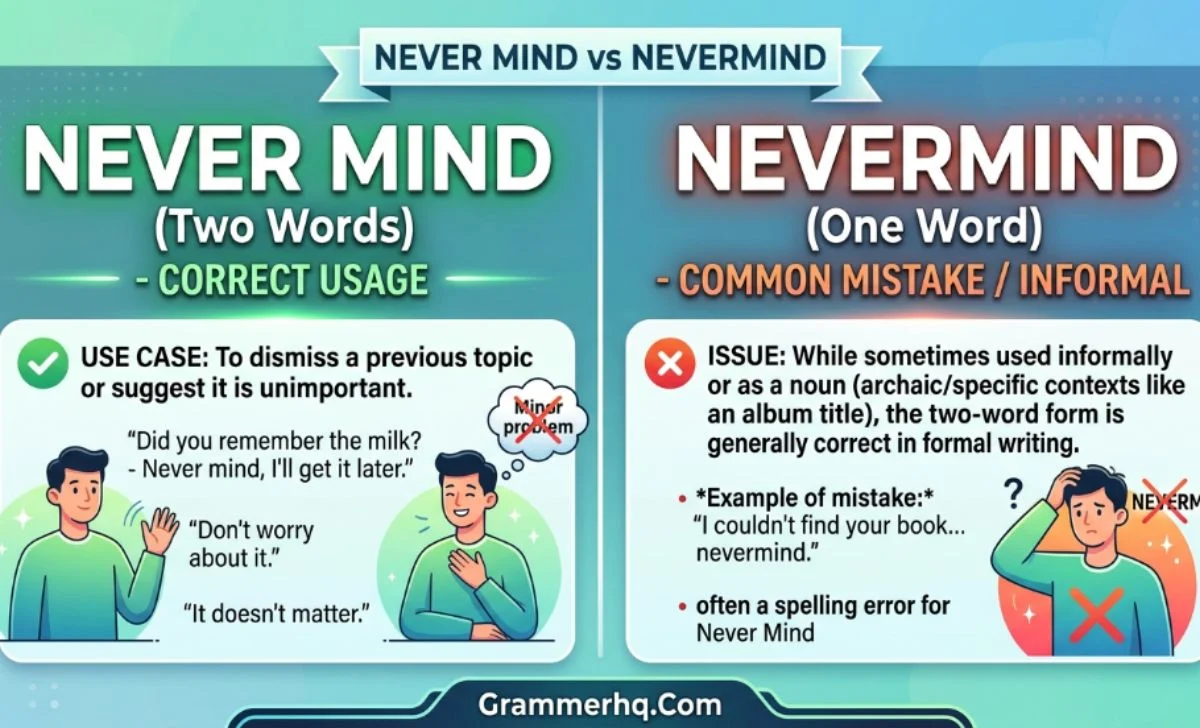
Never Mind vs Nevermind is a common spelling question because the two forms look almost identical but are not always used in the same way.
If you have ever wondered whether to write never mind as two words or nevermind as one, you are not alone. The confusion often comes from seeing both forms in everyday English, online conversations, and informal writing.
In this guide, we will explain which form is considered standard, what each version means, and when you should use it. You will also see clear examples that make the difference easy to remember.
Quick Answer
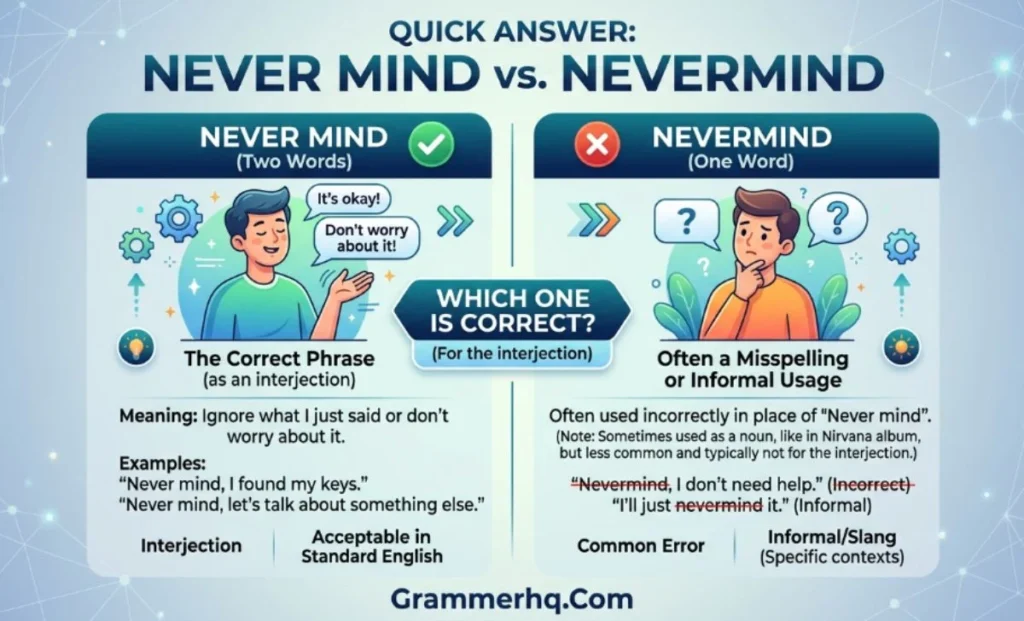
Never mind is the standard spelling for the common English expression.
Use it when you mean:
- forget it
- don’t worry
- disregard that
- don’t concern yourself with it
- let alone
- much less
Nevermind is also an established word, but its use is much more limited. It functions as a noun in expressions involving attention, concern, heed, or business, and is generally described as regional, dialectal, informal, or old-fashioned.
| Form | Main function | Typical meaning | Example |
| never mind | Standard expression | Forget it; don’t worry; let alone | Never mind, I found my keys. |
| nevermind | Rare noun | Attention; concern; heed | He paid it no nevermind. |
The easiest rule
If you can replace the phrase with “forget it,” “don’t worry,” “disregard that,” or “let alone,” use never mind.
Never mind. I’ll take care of it.
What Does “Never Mind” Mean?
The meaning of never mind depends on the context, but its common uses all involve dismissing, disregarding, or moving past something.
Merriam-Webster records uses that include telling someone not to be concerned, disregarding something previously mentioned, and referring to something even less likely or possible.
1. “Forget It” or “Don’t Worry”
This is the most familiar use.
“I’m sorry I broke the glass.”
“Never mind. It was an accident.”
Here, never mind reassures the other person that the problem is not important enough to worry about.
You can also use it to tell someone not to concern themselves with something:
Never mind the mess. I’ll clean it up.
2. To Disregard Something
Sometimes you begin a question or statement and then realize that you no longer need an answer.
“Do you know where my phone is?”
“Never mind. I found it.”
In this situation, never mind essentially means:
You can disregard what I just asked.
This is especially common in everyday conversation and messages.
3. “Let Alone” or “Much Less”
This use is easy to overlook but is an important part of the expression.
I can barely afford a used car, never mind a new one.
The speaker is saying that a new car is even less affordable than a used car.
Another example:
She can barely walk a mile, never mind run a marathon.
Here, never mind has the sense of “let alone” or “much less.” Merriam-Webster specifically identifies this conjunction-like use.
What Does “Nevermind” Mean?
Nevermind is not simply a nonexistent word.
In its less common noun use, it can mean attention, heed, concern, consideration, business, or affair. Dictionary sources describe this usage as dialectal, informal, regional, or old-fashioned, and it commonly appears in negative constructions.
For example:
Don’t pay him no nevermind.
Here, nevermind means roughly attention or heed.
Another example is:
It’s no nevermind of yours.
In this expression, the noun refers to someone’s business or concern.
These examples are quite different from:
Never mind. I found the answer.
In the first group, nevermind is a noun. In the second, never mind is the familiar expression.
Why the distinction matters
A grammar guide that says “nevermind is always wrong” oversimplifies the issue.
A more accurate rule is:
Never mind is the standard form of the everyday expression; nevermind is a rare noun with a different function.
Never Mind vs Nevermind: The Main Difference
The difference becomes much easier to remember when you focus on function rather than spelling.
Never Mind Is the Everyday Expression
Use never mind when you are telling someone to disregard something, reassuring them, withdrawing a question, or introducing a “let alone” comparison.
Examples:
Never mind. We can try again tomorrow.
Never mind what he said.
I can’t afford lunch, never mind dinner.
Nevermind Is a Rare Noun
Use nevermind only when it is functioning as the uncommon noun described above.
Examples:
He paid the warning no nevermind.
That’s no nevermind of yours.
These noun constructions are unusual in contemporary standard writing, which is why most readers are far more likely to encounter never mind.
Why Do People Confuse Never Mind and Nevermind?
The confusion is understandable, especially for people who learn English primarily through speech.
They Sound the Same
When spoken naturally, there is no clear pause between never and mind.
So:
never mind
can sound almost exactly like:
nevermind
A listener may therefore assume that the phrase should be written as one word.
Informal Writing Favors Shorter Forms
Text messages, social media posts, chats, and comments often use relaxed spelling.
You may see:
Nevermind, I found it.
This is common enough to look normal, but frequency in casual online writing does not necessarily make it the preferred form in edited English.
Pop Culture Reinforces the One-Word Form
Many readers know Nevermind from the title of Nirvana’s famous album.
That makes the closed spelling especially familiar, even though the ordinary English expression is generally written never mind.
English Does Sometimes Create Compound Words
English frequently turns established phrases into single words over time. That makes nevermind look like a natural development.
However, spelling is determined by actual usage and grammatical function—not simply by whether joining two words looks logical.
When Should You Use “Never Mind”?
For normal modern writing, never mind is the form to choose.
In Everyday Conversation
Never mind. I’ll do it myself.
When Someone Apologizes
“Sorry I’m late.”
“Never mind. We just got here.”
When You Change Your Mind
“Could you send me the address?”
“Never mind. I have it now.”
When Telling Someone Not to Worry
Never mind the delay. We still have plenty of time.
When Meaning “Let Alone”
I can’t afford a bicycle, never mind a car.
In a Workplace Message
Never mind my previous message; I found the correct document.
All of these uses call for never mind, not the rare noun nevermind.
Is “Nevermind” Correct in Formal Writing?
If you mean “forget it,” “don’t worry,” or “disregard that,” use never mind.
That applies to:
- academic writing
- business communication
- reports
- applications
- professional articles
- edited website content
For example:
Never mind my previous message; I found the correct file.
This is grammatically fine.
However, formal writing sometimes benefits from a more precise alternative:
Please disregard my previous message.
The second version sounds more professional, but that is a question of register, not spelling.
So don’t confuse these two ideas:
Never mind = standard English expression.
Please disregard = more formal alternative in certain contexts.
Can You Use “Nevermind” in Texting?
You will certainly see nevermind in texts and online conversations.
For example:
Nevermind, I got it.
Readers will normally understand what the writer means.
However, if your goal is standard spelling, especially in writing that will be published or professionally edited, never mind is the safer choice.
There is also an informal digital shortcut:
NVM
It commonly means “never mind” or “disregard my previous message.” Merriam-Webster notes NVM and NM as texting and internet abbreviations of the expression.
For example:
NVM, I found it.
That belongs to casual digital communication, not formal writing.
How to Punctuate “Never Mind”
The punctuation depends on how the expression is used.
As a Standalone Reply
“Do you still need help?”
“Never mind.”
No comma is needed.
At the Beginning of a Sentence
Never mind, I already called her.
The comma separates the opening expression from the following statement.
Before a Noun
Never mind the noise.
Do not add a comma simply because never mind appears before a noun.
In a “Let Alone” Construction
I can barely afford dinner, never mind a vacation.
The comma separates the two related ideas.
With a Dash
A dash can also work when the writer wants a stronger break:
Never mind—I’ve already solved it.
This is particularly natural in dialogue and informal prose.
Is “Never-Mind” Correct?
For the ordinary modern expression, never-mind is not the standard spelling.
Use:
Never mind.
rather than:
Never-mind.
The hyphenated form has appeared historically and can occur in older or specialized usage, but there is no reason to hyphenate the normal expression in contemporary standard English.
This gives you three forms with three different levels of usefulness:
| Form | Modern everyday use |
| never mind | Standard and preferred |
| nevermind | Rare noun; also seen informally as a closed spelling |
| never-mind | Not the normal modern form |
Never Mind vs “Never You Mind”
Never you mind is a related expression, but it has a different tone.
Compare:
Never mind. I’ll handle it.
with:
Never you mind what we’re planning.
The second can mean “don’t concern yourself with that” or “stop asking about it.”
Depending on the context, it may sound:
- playful
- teasing
- secretive
- dismissive
- slightly rude
For example:
“What are you buying?”
“Never you mind. It’s a surprise.”
The phrase is therefore useful in dialogue, but it is not simply another spelling of never mind.
Why Is Nirvana’s Album Called “Nevermind”?
One of the most famous examples of the one-word spelling is Nevermind, the 1991 studio album by Nirvana.
The title is a proper name, so its official spelling is simply part of the title.
Compare:
Never mind, I’ll call you later.
with:
Nevermind is a Nirvana album.
The first is an ordinary English expression. The second is a title.
This is an important distinction because seeing Nevermind in a famous album title does not mean that the standard everyday phrase has changed its spelling.
Common Mistakes and Corrections
1: Writing “Nevermind” for “Forget It”
❌ Nevermind, I’ll handle it.
✅ Never mind, I’ll handle it.
2: Using One Word Before “Let Alone”
❌ I can barely walk, nevermind run.
✅ I can barely walk, never mind run.
3: Saying “Nevermind Is Not a Word”
❌ Nevermind isn’t a word.
This is too absolute.
A better explanation is:
Nevermind exists as a rare noun, but it is not the standard form of the everyday expression.
4: Adding a Hyphen
❌ Never-mind the cost.
✅ Never mind the cost.
5: Assuming Online Frequency Equals Standard Usage
Seeing nevermind frequently on social media does not necessarily mean that it is the preferred spelling in formal or edited English.
Never Mind: Real-Life Examples
The following examples show how the standard expression works in different situations.
At Home
Never mind the dishes. I’ll wash them later.
At School
“Can you explain question four?”
“Never mind. I understand it now.”
At Work
Never mind my earlier message; I attached the wrong file.
During a Phone Call
“Should I call you back later?”
“Never mind. I’m free now.”
While Shopping
I can’t afford the basic model, never mind the premium version.
In a Text Message
Never mind—I found my charger.
When Reassuring Someone
Never mind the mistake. We can correct it.
When Disregarding a Comment
Never mind what they think.
Rare Noun Use
He paid the warning no nevermind.
The last sentence is intentionally different: nevermind is being used as a noun rather than as the common expression.
An Easy Trick to Remember the Correct Form
Instead of memorizing a complicated spelling rule, test the meaning.
If you could replace the expression with:
“Forget it”
→ never mind
“Don’t worry”
→ never mind
“Disregard that”
→ never mind
“Let alone”
→ never mind
If it means attention, concern, heed, or business in the rare noun constructions discussed above, nevermind may be appropriate.
One rule covers almost every situation
If you mean the everyday expression, write “never mind” as two words.
That is the safest rule for standard English.
Never Mind in American and British English
There is no major American-versus-British spelling choice here.
The ordinary expression is never mind in both varieties of standard English.
The closed noun nevermind is associated with more limited regional, dialectal, informal, or older usage. Collins, for example, labels its American noun uses as dialectal or old-fashioned and its British entry as US informal.
So you do not need to choose never mind or nevermind based on whether your audience is American or British.
For standard everyday writing, use:
never mind
FAQs
1: Is “never mind” one word or two?
It is normally two words when used as the standard expression meaning “forget it,” “don’t worry,” “disregard that,” or “let alone.”
2: Is “nevermind” a real word?
Yes. Nevermind exists as a noun meaning things such as attention, heed, concern, or business in limited usage. Dictionaries describe these uses as regional, dialectal, informal, or old-fashioned.
3: Which is correct: “never mind” or “nevermind”?
For the ordinary expression, never mind is the standard and preferred form.
4: Is “nevermind” a spelling mistake?
It depends on the context. As a replacement for the everyday phrase never mind, it is nonstandard in careful writing. But nevermind is also a legitimate noun in certain uncommon expressions.
5: Can I write “nevermind” in a text?
You may see and use it in informal digital communication, and readers will generally understand it. However, never mind is the standard spelling if you want conventional edited English.
6: Is “never mind” formal?
It is standard English, but it can have a conversational tone. In a formal email, please disregard may sometimes be a more polished alternative.
7: Does “never mind” mean “forget it”?
Yes. It commonly tells someone to forget or disregard something, or indicates that a previous question or statement no longer matters.
8: Can “never mind” mean “let alone”?
Yes. For example:
I can’t afford a bicycle, never mind a car.
Here, it means “let alone” or “much less.”
9: Is “never-mind” correct?
It is not the standard modern spelling of the ordinary expression. In normal writing, use never mind.
10: Why is Nirvana’s album spelled “Nevermind”?
Nevermind is the official title of Nirvana’s 1991 album. A proper title can have its own spelling, so the album title does not change the standard spelling of the everyday expression.
Conclusion
The choice between never mind vs nevermind becomes simple once you look at the meaning. Never mind is the standard form for the everyday expression meaning “forget it,” “don’t worry,” “disregard that,” or “let alone.”
Nevermind is not simply a nonexistent word. It has a legitimate but uncommon noun use involving attention, heed, concern, or business, particularly in regional or older expressions.
So, for emails, schoolwork, articles, professional writing, and ordinary conversation, remember the safest rule:
If you mean “forget it” or “don’t worry,” write never mindas two words.
Read More Blogs:

Hi, I’m Amelia Parker, a grammar enthusiast and writer at GrammarHQ.com. I specialize in explaining spelling differences, confusing words, and common English mistakes through simple, practical, and easy-to-understand guides.